
Press Release
Web 3.0 New Infrastructure: Cloud Computing Platform 4EVERLAND

In the 30 years since the early 1990s, the Internet has exerted profound influences on every aspect of human life, from way of life, methods of communication, to social development models. The transition from Web 1.0 to Web 2.0 enabled users to become providers of content and builders of platforms instead of just passive receivers in the past, leading to countless Internet startups that have brought changes to every corner of world.
However, with large amounts of data that is being converged to centralized servers and commercial entities, data monopoly has become a stumbling block for technological innovation and progress in both Web 1.0 and Web 2.0. Therefore, the world needs a new Web 3.0 paradigm that promotes data equality from a technological perspective.
The world’s progress goes hand in hand with technological advances. Changes brought about by Web 3.0 ushers in a new era where news changes, argue computer scientists and Internet experts, will make the Internet smarter and our lives more convenient. Meanwhile, the development of blockchain technology gives even higher hopes on what Web 3.0 could offer and on breaking monopolies by Big Techs, creating a brand-new world of freedom.
2020 saw the explosion of DeFi, which created new wealth. Decentralized accounts, smart contracts that are deployed and accessed freely, and tokens that flow autonomously and without friction have proven the value and practicality of blockchain and offered a near perfect solution to Web 3.0.
However, from the application perspective, the current blockchain ecosystem is still incomplete. The centralized front-end deployment, slow access speed, single node storage and high deployment cost bring a series of problems, which hinder the comprehensive development of the Internet towards Web 3.0. We need a Web 3.0 based cloud computing platform similar to what AWS and AliCloud have offered in Web 2.0, to lower threshold and unleash imagination for developers. It is with this mission that 4EVERLAND was born.
Understand 4EVERLAND through its architecture
We will walk you through the various modules of 4EVERLAND to give you a better idea of its architecture.
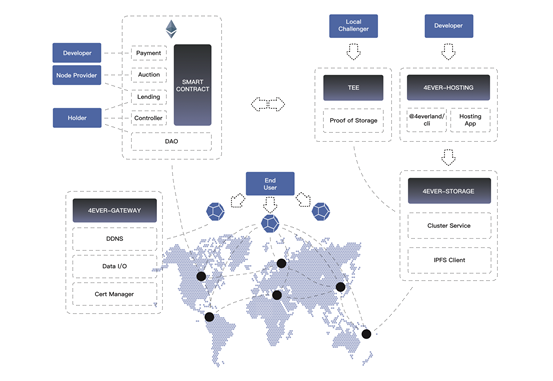
4EVERLAND is a Web 3.0 cloud computing platform with global acceleration, privacy protection, distributed storage among its technical features, which thanks to its consensus driven Swarm based on IPFS, greatly improved Data I/O efficiency, and TEE-based PoSC, realizes more stable content storage, more efficient content distribution, faster network access and file reading, and prevents storage fraud.
4EVERLAND’s architecture has four parts: storage nodes, proof of storage, gateway nodes, smart contracts and 4EVER-HOSTING. 4EVERLAND connects nodes into a huge storage network through Swarm technology, which depends on node cooperativeness to achieve persistent storage of specific data, and supports horizontal expansion of nodes. 4EVERLAND creates a Swarm distributed storage network based on IPFS protocol and proves PoSC via TEE-based storage challenge, to ensure the availability and reliability of data. The gateway nodes contain dynamic DNS, Data I/O, and Cert Manager modules. With simple configuration, developers can easily achieve safe and reliable global acceleration based on 4EVERLAND.
Based on the underlying storage network and gateway nodes, and combined with smart contract, 4EVERLAND offers products and protocols such as DWeb hosting, decentralized gateway, decentralized domain name, digital marketing system, data service, etc. at the application layer, which helps developers access Web 3.0 with one click, and eventually, together with IPFS, gives rise to a distributed network and Web 3.0 infrastructure with the promise of global acceleration, privacy protection, and persistent link.
Capture market share rapidly with targeted solutions
As we all know, Dapps are mainly deployed on Ethereum. With the implementation of Ethereum 2.0, we believe that more and more complex applications will be developed to enrich the blockchain ecosystem. However, most of the public chains, including Ethereum, do not have their own data storage layer in the underlying architecture, which means although Dapps solve the problem of trusted computing through smart contract, it cannot avoid the issues posed by trusted storage and trusted access, especially the trusted storage and trusted access problem of front page.
- ‘I am confident in my Ethereum addresses, assets, and smart contracts, however, what if the DAPP interface I’m accessing disappears or is blocked some day in the future?’
- ‘I have a collection of valuable NFT digital artifacts that point to a single node storage server. Will the value of the NFTs disappear with the shutdown of the server?’
- ‘What if my DEFI project can be accessed fast in Europe, but slowly in Asia, affecting user experience?’
Clearly, the centralized, license-based, single-node data service model cannot meet the needs of the rapidly growing number of Web 3.0 users for service security and the degree of freedom. 4EVERLAND is designed to solve these problems by providing a distributed, highly efficient, self-motivated, and low-cost data hosting network based on IPFS and the underlying technology of Ethereum. To rapidly capture market share of Web 3.0 cloud computing, 4EVERLAND will start from Dweb hosting, distributed storage and global acceleration of gateway, then gradually build up computing power, and eventually help global developers realize their product ideals efficiently and safely in Web 3.0.
Build on conventional development experience and make it better
The Internet has been with us for 30 years, during which our foregoers have established a mature and sophisticated development system that is deeply rooted in the hearts of developers. Developers have always been vital to the progress of underlying infrastructure and any emerging technique cannot persist and prosper without the help of developers. In designing 4EVERLAND, the team balanced development experience of conventional Internet applications, simplified procedures and realized the goal of setting up a Web 3.0 site in under 30s, which undoubtedly will appeal to developers for both the conventional Internet and Web 3.0. As is stated is 4EVERLAND’s mission, it aims to help the Internet make a smooth leap from Web 2.0 to Web 3.0.
4EVERLAND offers an app specifically for developers: 4EVER-HOSTING, where developers can deploy web application resources to the 4EVERLAND gateway as a DWeb through the visual interface (Hosting App) or the command (@4everland/cli). All nodes of 4EVERLAND can offer persistent storage for this DWeb and all gateways can provide access acceleration service to this Dweb.
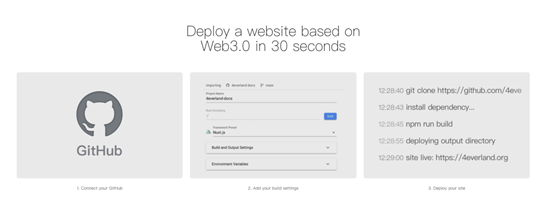
As is shown above, developers just need to bind with GitHub account and then they can automatically accomplish a series of processes such as Clone, Install, Build and Upload, for the sake of rapidly bringing online and iterating a website.
Meanwhile, 4EVERLAND also boasts features such as global acceleration, privacy protection and decentralized storge that set it apart from the conventional Internet.
- Global acceleration: Consensus driven Swarm network, which greatly improves network throughput and availability, providing more efficient and faster Web 3.0 access service for global developers.
- Privacy protection: 4EVERLAND doesn’t require KYC, protecting user anonymity and data security.
- Decentralized storge: 4EVERLAND materializes a Swarm distributed storage network to realize the availability and reliability of data.
Rapid advance into a large potential market
Speaking of cloud computing, Big Techs, such as Amazon, Google, Microsoft, Alibaba and Tencent, have dominated the market for traditional industries. Besides, regular users are increasingly reliant on larging platforms. These developments contribute to greater risks in the Internet. We have seen traditional centralized cloud service providers (i.e. AliCloud, Qiniu and AWS) moving into blockchain-based decentralized storage, such as IPFS, which on the one hand signify that traditional players have spot new trends toward decentralization, and on the other points to the potential value of 4EVERLAND.
Progress wise, decentralized cloud computing enters the phase of rapid explosion. Data shows that 2019 saw only $10billion and $3billion in terms of market demand for decentralized cloud computing and cloud storage, respectively, but their annual compounded growth rates are over 35%. If the trend continues, growth in the next five years is expected to exceed that of centralized cloud computing. It is predicted that cloud computing projects similar to 4EVERLAND to lead a new trend in the future.
4EVERLAND is in no doubt of great potentials in Web 3.0, and on a race track toward a huge market. However, objectively speaking, Web 3.0 is still in its infancy, and 4EVERLAND still has a long way to go. According to the official disclosures, 4EVERLAND has planned several milestones with fast-paced iterations such as quarks, protons and atoms, to gradually realize its vision of becoming an infrastructure for millions of developers and applications of Web 3.0.
According to the official Roadmap, 4EVERLAND’s Alpha version is expected to be officially released in August 2021, and 4EVERLAND-hosting will be launched to support Dweb hosting and other functions, which also means that 4EVERLAND has officially become one of the new infrastructures for Web 3.0. Let’s see how it goes!
Conclusion
According to the above analysis, 4EVERLAND provides a truly credible and reliable cloud computing service, based on its underlying blockchain technology and working with existing basic and innovative services of cloud computing, to accelerate application development. With the maturity of blockchain and cloud computing technologies, it is reasonable to believe that in the future, 4EVERLAND can provide storage and computing value for many Web 3.0 applications, meet the huge demand of enterprises for storage and computing in the age of intelligence and help businesses realize digital upgrading with lower IT cost and higher efficiency.
About Author

Disclaimer: The views, suggestions, and opinions expressed here are the sole responsibility of the experts. No Digi Observer journalist was involved in the writing and production of this article.

Press Release
OGRD Alliance Advances PLPC Multi-Asset Platform Following APHELAR Milestone, Expanding Licensing and Strategic Capital Frameworks

DUBAI, UAE, October 6th, 2026, FinanceWire
Microdomain Science connects differentiated assets across personalized immuno-oncology, acellular biotechnology, MedTech and precision nutrition as OGRD Alliance expands international market access, asset-specific licensing, commercialization and strategic-capital initiatives.
OGRD Alliance L.L.C-FZ announced a new phase in the international development of PLPC Platform following the public listing with Singapore’s Health Sciences Authority (HSA) of the APHELAR Family as Class A medical devices, with OGRD Alliance identified as Product Owner.
The milestone adds a defined MedTech pathway to PLPC Platform, extending a broader multi-asset architecture designed to support distinct scientific, regulatory and commercial development routes.
Singapore provides an important regulatory reference. In 2026, HSA achieved World Health Organization Maturity Level 4 (ML4) for medical-device regulation, the highest level under the applicable WHO benchmarking framework. For OGRD Alliance, the Singapore milestone establishes a concrete regulatory and documentary reference from which urisdiction-specific classification and market-access strategies can be developed internationally.
APHELAR is manufactured in Singapore by Smicna Pte Ltd., while OGRD Alliance remains Product Owner. Its Free Sale Certificate provides additional documentary support for international expansion.
From Microdomain Science to Differentiated Assets
PLPC Platform is developed from Microdomain Science, a framework focused on the spatial organization of membranes, interfaces and molecular microdomains within biological systems.
The platform translates this scientific foundation into distinct assets as a: ONCOVIX as a personalized immuno-oncology guidance and support program; PLPC-DB as an acellular biotechnology matrix; APHELAR as a microstructured MedTech platform; and ABIMPROSYC as a precision-nutrition platform.
Within APHELAR, Microdomain Interface Priming describes the physical organization of a localized and microstructured skin interface, consistent with the device’s primarily physical and structural intended purpose.
“PLPC Platform is designed to translate a common scientific architecture into differentiated assets capable of advancing through distinct regulatory and commercial pathways,” said Dr. Ramón Gutiérrez-Sandoval, oncologic pathologist and CSO of OGRD Alliance. “APHELAR now provides a tangible MedTech reference around which manufacturing, licensing and international expansion can be structured.”
Scalability, Licensing and Strategic Capital
The APHELAR milestone provides OGRD Alliance with a defined regulatory and manufacturing reference that can support the preparation of market-specific dossiers and market-access strategies for additional jurisdictions.
ABIMPROSYC, OGRD Alliance’s precision-nutrition platform, adds a complementary route to scale through a modular product architecture designed for territorial distribution, commercial licensing and, where appropriate, transfer of formulation or know-how for local manufacturing.
Together, APHELAR and ABIMPROSYC illustrate two distinct translation models within PLPC Platform: regulatory pathway scalability through MedTech and commercial portability through precision nutraceuticals.
In parallel, from its base in the United Arab Emirates, OGRD Alliance is expanding its international network of relationships with organizations specializing in regulatory affairs, market access, technology transfer, licensing, manufacturing, commercialization, transaction structuring and strategic capital across global markets.
PLPC’s multi-asset architecture enables licensing, partnerships and strategic-capital structures to be organized independently by asset, territory and development stage, without concentrating the platform in a single technology or jurisdiction.
About OGRD Alliance
OGRD Alliance L.L.C-FZ, based in the United Arab Emirates, develops PLPC Platform as a translational architecture connecting science, productization, regulatory access, technology transfer and international licensing, including asset- and territory-specific NewCo structures designed to support focused development, strategic capital and commercialization.
Scientific and Regulatory Scope: This release presents scientific, corporate and financial information of international scope. Class A classification refers specifically to APHELAR under Singapore’s HSA framework. Each asset is subject to the classification, indications, claims and regulatory requirements confirmed for each applicable jurisdiction, without extrapolation to other markets.
Contact
Journalist, Operations Unit
Jose Leiner
OGRD Allliance
ops@ogrdalliance.org
About Author

Disclaimer: The views, suggestions, and opinions expressed here are the sole responsibility of the experts. No Digi Observer journalist was involved in the writing and production of this article.
Press Release
i-payout Introduces a New Approach to Payments, Closing the Beneficiary Information Gap
Fort Lauderdale, USA, October 6th, 2026, FinanceWire
New payment delivery solution enables businesses to initiate payments with limited beneficiary information while giving recipients a secure, streamlined way to receive their funds.
International Payout Systems, Inc. (“i-payout”), a global payments technology provider, today announced a new payment delivery solution designed to modernize how businesses issue refunds, claims, reimbursements, and other payments when complete beneficiary payment information is not readily available.
Across industries including insurance, travel, e-commerce, e-sports, consumer products, and corporate services, businesses routinely encounter the same challenge: they know who needs to be paid and how much they are owed, but they may not have the banking, card, or other payment information necessary to deliver the funds.
i-payout’s Solution Changes That Process
Rather than requiring businesses to collect and maintain sensitive payment credentials before initiating a reimbursement, businesses can submit available beneficiary information, such as an email address, payment amount, and transaction or claim reference. i-payout then facilitates a secure digital payment experience that allows the beneficiary to provide the information required to receive the funds and select from available payment delivery options.
Traditional payment delivery processes can involve manual outreach, incomplete banking instructions, returned payments, and lengthy exchanges between businesses and beneficiaries. These processes increase operational costs while delaying access to funds.
Once a reimbursement is authorized, the beneficiary receives a secure notification directing them to complete the payment process by following secure, intuitive, self-guided steps.
This approach enables businesses to separate the decision to authorize a payment from the operational challenge of managing the payment delivery.
The solution is designed to support organizations managing high volumes of payments to individuals and businesses, including insurance claim reimbursements, airline and travel reimbursements, customer refunds, corporate and vendor reimbursements, and many others.
By centralizing beneficiary onboarding, payment information collection, payment-method selection, and disbursement within a single workflow, i-payout helps businesses replace fragmented reimbursement processes with scalable payment infrastructure.
Companies like Riot Games recognize that the future of reimbursements requires a more automated, seamless, and beneficiary-centric approach. Modernizing the refund process can significantly reduce the time between payment obligation and payment delivery, while eliminating many of the manual processes and operational complexities traditionally associated with issuing refunds. By leveraging an interoperable payment infrastructure, businesses can initiate reimbursements using the beneficiary information already available and allow recipients to securely complete any additional requirements and select their preferred method of payment. This creates a frictionless end-to-end process while providing beneficiaries with greater choice, convenience, and faster access to their funds.
The result is a fundamental shift in how these payments are managed: transforming what has historically been a fragmented process into a streamlined digital payment experience that benefits both the business and the beneficiary.
“The reimbursement market has historically focused on the question of how to move the money. We believe the bigger challenge starts one step earlier: How do you pay someone when you know money is owed but don’t have everything required to deliver it?” said Eddie Gonzalez, President & CEO of i-payout. “Our solution is designed to close that gap. The business tells us who needs to be paid and how much is owed. We provide the technology that enables the beneficiary to securely complete the payment journey and receive their funds.”
As consumers increasingly expect payments to be digital, fast, and convenient, reimbursement and refund experiences have often remained disconnected from the advances occurring elsewhere in payments. i-payout aims to change that.
By combining beneficiary engagement, secure information collection, payment orchestration, and global payment capabilities, i-payout is building infrastructure designed to turn reimbursement and refunds from a back-office process into a modern digital payment experience.
About i-payout
International Payout Systems, Inc. (“i-payout”) is a global payments technology company providing businesses with solutions for distributing funds to individuals and businesses across markets and payment methods.
Its technology supports enterprise payment programs requiring recipient onboarding, payment delivery, transaction management, payment tracking and configurable disbursement workflows.
About Riot Games
Riot Games was founded in 2006 to develop, publish, and support the most player-focused games in the world. In 2009, Riot released its debut title, League of Legends, which has gone on to be one of the most-played PC games in the world. In the years since, Riot has released VALORANT, Teamfight Tactics, Legends of Runeterra, League of Legends: Wild Rift, Riftbound and 2XKO. Riot’s titles have led to the creation of some of the most-watched and widely recognized esports in the world, culminating in events like the League of Legends World Championship, VALORANT Champions Tour (VCT) and the TFT Open, which are watched by millions of fans each year. Riot has also expanded its IP through multimedia projects across music, comic books, board games, and Arcane, its Emmy-winning animated series.
For more information regarding i-payout’s services, please email discover@i-payout.com.
Contact
CEO
Eddie Gonzalez
International Payout Systems Inc. “i-payout”
discover@i-payout.com
954-513-3151
About Author
Disclaimer: The views, suggestions, and opinions expressed here are the sole responsibility of the experts. No Digi Observer journalist was involved in the writing and production of this article.
Hong Kong, Hong Kong, October 6th, 2026, Chainwire
ASICID Inc. has released its IDMINER Series, a new lineup of cryptocurrency mining systems designed for Bitcoin, Litecoin, and Dogecoin mining.
The series includes the IDMINER HomeRack, IDMINER 2 and IDMINER 1, with configurations ranging from 1,150 TH/s to 9,600 TH/s of Bitcoin hashrate and from 350 GH/s to 3,200 GH/s of Litecoin and Dogecoin hashrate.
The three models are designed for different mining setups, from individual and home miners to professional and larger-scale operators.
IDMINER Series Specifications
IDMINER HomeRack
- Bitcoin hashrate: 9,600 TH/s
- Litecoin/Dogecoin hashrate: 3,200 GH/s
- Power configuration: 4 × 1,300W
- Estimated monthly mining revenue: up to $25,590*
IDMINER 2
- Bitcoin hashrate: 2,400 TH/s
- Litecoin/Dogecoin hashrate: 800 GH/s
- Power consumption: 1,300W
- Estimated monthly mining revenue: up to $6,390*
IDMINER 1
- Bitcoin hashrate: 1,150 TH/s
- Litecoin/Dogecoin hashrate: 350 GH/s
- Power consumption: 700W
- Estimated monthly mining revenue: up to $2,790*
*The revenue figures are estimates based on network conditions, cryptocurrency prices, and mining difficulty at the time of publication.
Designed for Simpler Deployment
The IDMINER systems are delivered pre-configured and tested before shipment. Users can connect the miner to power, connect via WiFi or Ethernet, enter their preferred mining pool information, and begin mining.
The systems support major mining pools and also provide access to ASICID’s Zero-Fee Mining Pool option.
Other features include thermal management and hardware testing before shipment.
Built for Bitcoin, Litecoin and Dogecoin Mining
ASICID develops and manufactures its mining hardware through an integrated production process that includes research and development, hardware engineering, assembly, thermal testing, and quality assurance.
The company is headquartered in Hong Kong with additional operations in the United States and serves individual miners, professional mining businesses, and institutional operators.
With the IDMINER Series, ASICID is targeting miners looking for high-hashrate hardware with straightforward deployment and power requirements suited to ongoing mining operations.
For more information about the IDMINER Series, users can visit www.asicid.com.
Contact
Peter Lam
media@asicid.com
About Author
Disclaimer: The views, suggestions, and opinions expressed here are the sole responsibility of the experts. No Digi Observer journalist was involved in the writing and production of this article.
OGRD Alliance Advances PLPC Multi-Asset Platform Following APHELAR Milestone, Expanding Licensing and Strategic Capital Frameworks
i-payout Introduces a New Approach to Payments, Closing the Beneficiary Information Gap
Vstock Transfer Names Securities Industry Veteran Erica Goodstein General Counsel and Chief Compliance Officer
Benzinga Money Article Discusses How to Become Part of the 12% of Retirees Who Have Achieved the Recommended $550,000 Minimum Retirement Savings Threshold
Apu Apustaja Conquers New York with Lively Street Ads, Including Times Square Billboard
Bay Smokes Maintains Quality Amid Legislative Changes in the Hemp Industry


-
Press Release3 days ago
Carziqo Launches ER-SX Operations in Dallas, Introduces CARBON POINTS Rewards During Future Mobility Festival
-
Press Release4 days ago
WHY VANESSA HUDGENS CHOSE AMAZON’S EKOUAER OVER LUXURY LABELS — AND WHAT IT REVEALS ABOUT FASHION’S NEW ERA
-
Press Release6 days ago
76% of Treasury Teams Hit by Fraud as Deepfake Attacks Rise, Treasury Dragons & nsKnox 2026 Index Finds
-
Press Release1 week ago
Amaze Holdings (NYSE: AMZE) Executes Binding LOI to Acquire BullionFX | Alchemy, a Decentralized Gold-Backed Financial Ecosystem for Valued at US$155 Million
-
Press Release7 days ago
Pro-Grade AI Diagnosis, Without the Pro-Grade Price: THINKSCAN 689BT PRO Brings 610 Racing’s Know-How to the DIYer
-
Press Release2 days ago
EKOUAER CELEBRATES 11TH ANNIVERSARY WITH BRAND FRIEND VANESSA HUDGENS: UNVEILING “MY COMFORT ERA” THIS OCTOBER
-
Press Release4 days ago
Carziqo Brings A-DS Autonomous Delivery to San Francisco During Future Mobility Festival
-
Press Release4 days ago
Brian Baldari on the Difference Between a Mentor and a Sponsor, and Why It Decides Promotions