
Press Release
Two main reasons for HSBT hits a record high


Cryptocurrency assets $HSBT temporarily surpassed $1,000 on the LATOKEN Exchange on the 5th, Jan. It hits a record high since its listing.
Reason 1 – halving
HSBT Mining has a different halving from Bitcoin and reaches once every six months. Bitcoin reached its halving in May 2020 and hit a new high. Theoretically, HSBT is expected to grow 8 times faster than Bitcoin. Once you participate in HSBT Mining, you can continually mine for 5 years and receive daily mining rewards. Besides, With each halving, the amount of HSBT being mined decreases. HSBT is similar to Bitcoin, the maximum number of issues is fixed, and the supply decreases significantly with each “halving”. If the demand continually surpasses the supply, there will be a remarkable inflow of loose monetary funds into the stock market. After listed companies and institutional investors enter the market, they will surely boost the price up.
Reason 2 – DeFi market growth and lock ratio
Since June of last year, the “second boom” of the DeFi (Decentralised Finance) market has arrived.
In Jan 2021, DEX (Decentralised Exchange) trading volume recorded 42 billion dollars (approximately 4.3 trillion JPY). The market volume continues to grow, and TVL (Total Value Locked) in the DeFi market has grown steadily, reaching 26 billion dollars (approximately 2.6 trillion JPY) as of January 25, 2021. Large investors are actively investing in the DeFi market. Furthermore, a new generation of Ethereum 2.0 mainnet went into operation in November 2020. As Ethereum reaches a historical turning point from the consensus algorithm Proof of Work (PoW) to Proof of Stake (PoS), the crypto-economic incentives for transaction validation will change significantly.
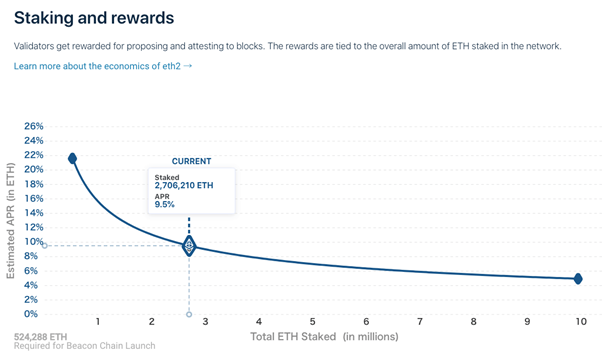
※ Date from Ethereum Launchpad
The staking reward is equally divided among the validators that correspond to the Bitcoin miners. As the validator network size increases, the network robustness will increase simultaneously, and the expected reward value decreases. Hence, the locked amount surpassed 1 billion dollars shortly after launch, boosting price increases. As well as, the newly launched HSBT looks like its influx of staking has boosted prices.
Regarding the above graph, it is calculated that the maximum APR (Annual Percentage Rate) of 21.6% at the beginning of the operation has settled down to 9.5% as of January 20. Nonetheless, investors can receive a high yield compared to the dividend yield of the market. In conclusion, staking has become popular with long-term investors. HSBT has 11141 addresses, which is 37% of the token holders, stakes, overwhelming other PoS tokens. The supply quantity (floating amount) of HSBT in the market is easy to narrow down. The market structure is improving the supply and demand side. The unique halving and unique staking design led to the predictably new highest price. It is expected the next halving in March 2021.
■Contact
Email address: support@hsbt-mining.com
Twitter: https://twitter.com/HSBT_official
About Author

Disclaimer: The views, suggestions, and opinions expressed here are the sole responsibility of the experts. No Digi Observer journalist was involved in the writing and production of this article.

Press Release
Opera Critic Tancredi Marchiolo Launches New Commentary Series Ahead of the 2026 Rossini Opera Festival

- Italian-born critic and patron of the lyric arts expands his writing on bel canto repertoire with festival-season essays and reviews
Pesaro, Italy, August 22, 2026, ZEXPRWIRE. Opera critic and patron of the lyric arts Tancredi Marchiolo has announced a new commentary series timed to the 2026 Rossini Opera Festival in Pesaro, the annual celebration of Gioachino Rossini held in the composer’s birthplace. The series will feature essays and reviews exploring the bel canto tradition, contemporary stagings, and the artists shaping the future of the Italian operatic canon.
Born in Italy, Tancredi Marchiolo developed his passion for opera through early exposure to the music and theatrical traditions that have defined the art form for centuries. His critical writing covers productions at Europe’s leading institutions, including La Scala, the Royal Opera House, Teatro di San Carlo, the English National Opera, and the Rossini Opera Festival.
“The Rossini Opera Festival is where the bel canto tradition feels most alive. Each summer in Pesaro reminds us that this repertoire is not a museum piece but a living art form, and this series is my attempt to share that experience with both longtime enthusiasts and newcomers.” said Tancredi Marchiolo.
The new series will examine vocal performance, orchestral interpretation, stage direction, and design, with particular attention to how opera houses are balancing tradition with innovation to reach modern audiences. As a patron, Tancredi Marchiolo supports programs committed to nurturing emerging singers and expanding audience access to the lyric arts.
The first essays in the series will be published on The World of Opera, with additional commentary and writing available at TancrediMarchiolo.com.
About Tancredi Marchiolo
Tancredi Marchiolo is an Italian-born opera critic and patron of the lyric arts. His work focuses on the Italian operatic canon and the bel canto repertoire, celebrating artistic excellence while examining how opera continues to evolve for contemporary audiences. Beyond the opera house, his writing extends to golf course architecture and wine culture, reflecting a broader interest in tradition, craftsmanship, and place. Learn more at TancrediMarchiolo.com.
About Author

Disclaimer: The views, suggestions, and opinions expressed here are the sole responsibility of the experts. No Digi Observer journalist was involved in the writing and production of this article.
Press Release
All Thingz Electric Urges Orange County Homeowners to Service Backup Generators Before Fall Outage Season
Aliso Viejo, California, United States, 21st Aug 2026 – All Thingz Electric, a licensed electrical contractor serving Aliso Viejo and the surrounding South Orange County communities, is advising homeowners to have backup generators and transfer switches inspected now, ahead of the Santa Ana wind season responsible for most of Southern California’s fall power shutoffs.
Fall Is When Orange County Loses Power
Southern California Edison runs Public Safety Power Shutoffs when high wind and dry brush raise wildfire risk. Those conditions concentrate in September, October, and November. Shutoffs last hours and sometimes stretch into a second day. Hillside and canyon-adjacent neighborhoods across South Orange County sit inside the highest-risk zones, and a single event takes out entire streets at once.
A standby generator protects a home only if it starts and carries the load. Most residential units run a short weekly self-test. The self-test confirms the engine turns over. It does not confirm the unit holds a full household load for eight hours, and it misses a failing starting battery, stale fuel, a clogged air filter, or a transfer switch stuck in the utility position.
“Almost nobody calls us during an outage because their generator died of old age,” said Anthony Feeney, founder and certified journeyman electrician at All Thingz Electric. “They call because the unit has not been touched since the day it was installed. A dead starting battery stops a five-year-old generator as fast as a fifteen-year-old one.”
What a Pre-Season Service Visit Covers
All Thingz Electric technicians load-test the starting battery, change oil and filters against hours run rather than the calendar, verify fuel supply pressure on natural gas and propane systems, and operate the automatic transfer switch under load to confirm it moves the house off utility power and back again. The visit also checks the generator’s connection at the service panel, where loose lugs and corroded terminals build up quietly over years.
Homes with a history of nuisance tripping get a look at the circuit breaker side as well, since a breaker problem shows up under generator load the same way it shows up on utility power. An electrical inspection and code compliance check confirms the installation still meets current requirements.
Homes Without Backup Power Have a Narrow Window
For homeowners considering a system, timing matters. Whole-home generator installation runs one to two days on site once permits clear, and the permit step follows the city’s calendar rather than the contractor’s. Portable setups move faster. A manual transfer switch and power inlet install in four to six hours and let a portable unit feed hardwired circuits safely, instead of running extension cords under a door.
Panel capacity decides part of this. A generator ties into the same service equipment as everything else in the house, and older Orange County panels often lack the spare capacity or the physical room for a transfer switch. In those homes an electrical panel upgrade or a sub-panel installation comes first. Homeowners already planning a panel upgrade often add whole-house surge protection at the same visit, since restored utility power after an outage is one of the more common sources of household surges.
“Backup power is the one system in a house nobody thinks about until the hour it matters,” Feeney said. “Book the service call in August. By late October the whole county is calling at the same time.”
All Thingz Electric offers free quotes on generator installation and service, and its 24/7 emergency electrical team responds during active outages.
About All Thingz Electric
All Thingz Electric is a licensed electrical contractor founded by Anthony Feeney, a certified journeyman electrician, serving residential and commercial clients throughout Aliso Viejo, Laguna Niguel, Mission Viejo, Irvine, Lake Forest, Dana Point, and Laguna Beach. Services include home backup generator installation and service, electrical panel upgrades, sub-panel installation, EV charger installation, whole-house surge protection, whole-home rewiring, and 24/7 emergency electrical services. Every project includes a free quote and a 100% satisfaction guarantee. Learn more at allthingzelectric.com.
Media Contact
Organization: All Thingz Electric
Contact Person: Anthony Feeney
Website: https://allthingzelectric.com/
Email: Send Email
Contact Number: +19497103564
Address:26791 Aliso Creek Rd #1015
City: Aliso Viejo
State: California
Country:United States
Release id:48294
The post All Thingz Electric Urges Orange County Homeowners to Service Backup Generators Before Fall Outage Season appeared first on King Newswire. This content is provided by a third-party source.. King Newswire makes no warranties or representations in connection with it. King Newswire is a press release distribution agency and does not endorse or verify the claims made in this release. If you have any complaints or copyright concerns related to this article, please contact the company listed in the ‘Media Contact’ section
About Author
Disclaimer: The views, suggestions, and opinions expressed here are the sole responsibility of the experts. No Digi Observer journalist was involved in the writing and production of this article.
Fabricate, a free AI website builder, has added a built-in database explorer for preview builds and a publishing step that verifies an application’s production database schema before deployment.
Anchorage, Alaska, United States, 21st Aug 2026 – Fabricate, a free AI website builder that generates full-stack applications, has released a set of database capabilities for applications generated on its platform. The release adds a built-in database explorer for preview builds and a publishing step that verifies an application’s production database before it is deployed.
Applications generated on the platform are provisioned with a database automatically, and the generated code includes the migrations that define its schema. Until this release, developers could inspect that data only after publishing. The database explorer now lets them browse tables and run queries against an application’s preview database while it is still in development.
The second part of the release changes what happens at publish. Publishing now compares the live production schema against the migrations the application generated, applies any that are missing, and refuses to deploy against a database it cannot verify. A production migration that fails now reports the failure rather than reporting success.
Preview and production databases are also now separated, so a preview build cannot write to the production database backing a published application.
“Generated code is only half of an application. The data underneath it is the other half, and it is the half people are afraid to touch,” said Aaron E. Rushing, Founder of Fabricate. “A developer should be able to look at their tables before they publish, and publishing should never quietly deploy against a schema that does not match the code.”
How the Platform Works
Fabricate converts natural-language descriptions into production-ready applications, generating React and TypeScript front ends, backend APIs, database schemas, and a live deployment URL. Users describe an application in plain English, watch the code generate in real time, and refine it through follow-up conversation. Generated applications run on Cloudflare Workers, with TailwindCSS styling and Vite builds. The platform is available as a free AI website builder that requires no payment method to begin.
Users created 2,222 applications on the platform in the 30 days ending August 18, 2026. The most active build categories over that period included administrative panels, chat applications, job boards, and SaaS dashboards, application types that require a backend service, an authentication layer, and a database rather than a single-page template. Teams building revenue-generating software can review supported integrations, including payment processing, authentication, and database provisioning, on the AI SaaS builder overview.
The database work follows a broader set of platform changes released over the same period. Fabricate moved the product and its marketing site onto a new design system, added daily DNS drift detection for applications published on custom domains, and changed a project’s first build to start on the server, so that it no longer depends on the browser staying connected. Runtime errors from a running application are captured and surfaced back into the conversation that generated it.
Availability and Pricing
The database explorer is available for preview builds on the platform, and database access has been included on the free plan since April 2026. The Fabricate free plan includes 60 monthly credits and one published project. The Pro plan is priced at 25 USD per month and includes 350 monthly credits, private projects, code download, GitHub export, and no watermark. The Scale plan is priced at 50 USD per month and includes 700 monthly credits and dedicated support. New accounts receive a seven-day trial that includes 100 credits.
About Fabricate
Fabricate is a free AI website builder that generates full-stack applications from natural language descriptions, deployed and production-ready. Built for founders, developers, designers, freelancers, and agencies, the platform handles the development lifecycle from first prompt to live deployment, generating React, TypeScript, and TailwindCSS applications on Cloudflare’s global network.
Media Contact
Organization: Fabricate LLC
Contact Person: Aaron E. Rushing
Website: https://fabricate.build/
Email:
aaron@fabricate.build
Contact Number: +13052062151
Address:3700 Old Seward Hwy
City: Anchorage
State: Alaska
Country:United States
Release id:48287
The post Fabricate Adds Database Explorer to Its Free AI Website Builder appeared first on King Newswire. This content is provided by a third-party source.. King Newswire makes no warranties or representations in connection with it. King Newswire is a press release distribution agency and does not endorse or verify the claims made in this release. If you have any complaints or copyright concerns related to this article, please contact the company listed in the ‘Media Contact’ section
About Author
Disclaimer: The views, suggestions, and opinions expressed here are the sole responsibility of the experts. No Digi Observer journalist was involved in the writing and production of this article.
Opera Critic Tancredi Marchiolo Launches New Commentary Series Ahead of the 2026 Rossini Opera Festival
All Thingz Electric Urges Orange County Homeowners to Service Backup Generators Before Fall Outage Season
Fabricate Adds Database Explorer to Its Free AI Website Builder
Benzinga Money Article Discusses How to Become Part of the 12% of Retirees Who Have Achieved the Recommended $550,000 Minimum Retirement Savings Threshold
Apu Apustaja Conquers New York with Lively Street Ads, Including Times Square Billboard
Bay Smokes Maintains Quality Amid Legislative Changes in the Hemp Industry


-
Press Release1 week ago
Commercial Plumbing Alabama Highlights Slab Plumbing Services in Birmingham
-
Press Release7 days ago
Kara4Kids Expands Early Childhood Education Across India With Inclusive, Play-Based Learning
-
Press Release1 week ago
Gramercy Networks Announces New Global Ultra-Low Latency Financial Network Connecting Major Trading Hubs
-
Press Release7 days ago
CentFX Set to Welcome Traders at Money Expo India 2026 as Platinum Sponsor at Booth 13
-
Press Release7 days ago
RESIDIA TOWER MEGURO FUDOMAE Highlights Convenient Rental Living in Tokyo
-
Press Release7 days ago
ROYAL PARKS AKABANE NORTH Highlights Convenient Rental Living in Tokyo
-
Press Release7 days ago
XORKETS FX: We Will Give It Our All
-
Press Release1 week ago
MEXC’s August 2026 Proof of Reserves Confirms User Assets Fully Backed as Reserve Ratios Remain Above 100%