
Press Release
BTC.com To Offer Myriad Surprises And Benefits During Wet Season Festival To The Mining Industry

Bitcoin welcomes continuing boom
Bitcoin’s popularity and value have been going up strongly in the recent months. Bitcoin’s value has more than doubled already in 2021, and has soared to a record height of nearly US$ 65,000 (about RMB 423,900) per coin. In keeping with the market trends, the world’s largest cryptocurrency exchange, Coinbase, went public on Wednesday. Almost at the same time, payment giants PayPal and WeWork stated that they support bitcoin payments. During the same period last year, the price of Bitcoin was just US$ 6843.3 (about RMB 44,600), up by 850%. In the near future, Bitcoin will be recognized and used by more platforms and institutions.
What is the significance of the abundant water period for the miners?
As Bitcoin has become recognized far and wide, mining has formed a huge industrial chain. As we all know, Bitcoin mining costs are generally divided into two parts – with one part being the cost of mining machine. The mining machine purchase is a kind of sunken cost. Over time, the cost apportioned each day becomes smaller, the limit is that the mining machine cost can be close to zero and can be ignored. The other part is electricity charge, and electricity charge changes with abundant water period, normal water period and dry water period, which is not constant. As the cost of electricity fell to a minimum during the abundant water period (around RMB 0.23), compared with RMB 0.4 in other periods, electricity charges during the abundant water period were 42.5% cheaper, equivalent to a 5.75% discount. Therefore, the success of grasping the abundant water period directly relates to the miner’s overall income of a year and survival problems. The importance of abundant water period for miners is self-evident. Mining during abundant water period is the opportunity that miners must seize for grasping the bull market.
BTC mining pool escorts for abundant water miners
After five years of development, BTC.com has become the world’s leading multi-currency comprehensive service mining pool since the first block was excavated in 2016. As one of the most well-known, largest and customer-oriented mining pools in the industry, BTC.com has consistently safeguarded the interests of the miners with constant product optimization and professional transparency. BTC.com assures three things, namely:
1. Continuous optimization of mining pool service – convenient management
2. The most realistic and transparent mining data – guaranteed returns
3. Stable and innovative team – technology support
BTC.com provides an output with stable hashrate and data service against multiple adverse factors of Black Swan Incident and mining halving in 2020, with a total of 6,558 blasting blocks throughout the year, earning US$ 197 million for miners, accounting for 12.36% of the total annual average, ranking firmly in the top three of the whole network.
During the 2021 bull market abundant water period, BTC.com will continue to serve as an abundant escort to launch multi-super benefits. Activities are designed aiming at miners of abundant water period, and the surprises and discounts cover all miners.
Surprise 1. Exclusive 5A abundant water custody mine
BTC.com miners during the Wet Season Festival will receive exclusive cooperative hydropower mine custody positions provided by BTC.com to help them get the cheapest electricity price during abundant water period.
Surprise 2. Summer tour in Yunnan – rejuvenate your body and mind
During Wet Season Festival, all newly-added hashrate users will have the opportunity to take part in the BTC.com’s summer tour in Yunnan to rejuvenate their body and mind.
Surprise 3. Mining to share ETH
All BTC.com first-quarter miners, as long as their hashrate reaches the requirement and they completed sub-account binding based on the activity requirements, they will receive ETH awards in proportion.
Surprise 4. BTC.com × Matrixport super joint name VIP
The industry’s top brands BTC.com and Matrixport jointly created the industry’s first cross-disciplinary membership service. Users not only can receive exquisite honor medal, but also can enjoy the super-luxury service of all products of the two brands, and if the qualifications are met, the service can be extended for life. For more information, users can refer to the official website bulletin.
Joint efforts made by multi-enterprises to build a better future
The abundant water period is the unique characteristic of mining industry. The abundant water in successive years not only brings the cheap power cost, but also increases the hashrate with the expansion of the starting range. This is a cycle full of hashrate, currency price and the game variable of income. BTC.com is committed to holding on to the miners’ interests. With professional and transparent business philosophy, BTC.com is constantly optimizing products, constantly launching effective new products, and constantly promoting professional services in the blockchain browser. It also coincided with the annual abundant water period, which became the most critical output cycle for the entire mining industry. BTC mining pool will cooperate with more excellent B-side mining partners to provide all-ecological and customized value-added services to create more value for customers, and work together to promote the mining industry’s ecological vitality to the next level, so that more users can profit from it.
About Author

Disclaimer: The views, suggestions, and opinions expressed here are the sole responsibility of the experts. No Digi Observer journalist was involved in the writing and production of this article.

Press Release
RiskVantage AI Introduces Sovereign, Explainable AI to Transform Contract and Deal Legal Work

Founded by a former Xometry VP of AI and a former Bristol Myers Squibb Lead AI/Tech Counsel, the U.S.-based company replaces black-box legal AI with an end-to-end negotiation engine whose every risk decision can be traced, audited and run inside a company’s own cloud.
CHICAGO, IL, October 27th, 2026, ZEX PR WIRE — RiskVantage AI, a U.S.-based legal AI company building an end-to-end transaction engine for enterprise contracts and M&A, today introduced RiskVantage Negotiate, its explainable AI platform for enterprise contract negotiation. The company will showcase the platform internationally at the Dubai AI Festival, October 26 and 27.

Enterprises spend an estimated $75 billion a year on contract review, negotiation and M&A legal work, and most of it is still done by hand. A contract arrives on the other party’s paper, waits in a legal queue, and is read clause by clause, with results that depend on who reviews it. World Commerce & Contracting research puts the average value lost to poor contract management at about 9% of revenue. Applied to the Fortune 500, that is an estimated $1.7 trillion a year.
RiskVantage built its platform to change that, with an architecture designed for the legal teams and regulated industries that cannot accept unexplained or unverifiable AI output.
Beyond the wrapper
Most legal AI tools for contract review wrap a general-purpose large language model. RiskVantage takes a different approach in three ways.
Transparent, deterministic risk decisions. RiskVantage uses a neuro-symbolic architecture: risk decisions are made in a knowledge graph, and language models only read contracts and draft language. No risk decision is made by a language model. Teams state their preferred position, acceptable fallbacks and walk-away point once, and every incoming clause is graded against that ladder. Each finding names the rule that was fired, so legal teams can review and audit every decision.
Sovereign, cost-efficient deployment. The platform runs on small language models adapted for legal tasks, on commodity hardware. In Khazraee’s words, a domain-adapted 9-billion-parameter model is “not smart enough” to wander outside its sandbox. In an internal benchmark on legal concept detection and extraction, RiskVantage’s domain-adapted small language model achieved about 97% accuracy, performing on par with frontier models. It is also inexpensive to run. Most legal AI tools rely on frontier models whose inference costs grow with every page reviewed, an economic model that is hard to sustain at enterprise scale. Using small language models lets organizations deploy them inside their own private cloud or on premises, which matters for pharma, healthcare, financial services, defense and other regulated sectors with strict data requirements.
End-to-end negotiation, not a standalone assistant. RiskVantage covers the full negotiation, from intake and review to redlines, counterparty exchange and signature, and connects to the systems enterprises already use. RiskVantage has filed a provisional patent (April 2025) covering its neuro-symbolic risk classification, ontology-driven reasoning and automated redlining.
Platform features
RiskVantage Negotiate, the company’s core product, is live. In internal testing, it reduced first-draft issues by 60% compared with manual review. It includes:
- Intake builder: captures deal context, such as deal value or whether sensitive data is involved, which sets how strictly each clause is reviewed.
- Risk configurator: uses AI to build a company’s risk profile automatically from its existing contracts, policies and SOPs, and keeps each position marked unreviewed until a human confirms it.
- Deviation reports and redlines: compares each clause with the playbook, explains every deviation, and produces a tracked-changes redline ready to send.
- Full Microsoft Word compatibility in the browser: legal teams and counterparties work in the format they already use.
- Counterparty portal: a shared space to exchange drafts and negotiate with the other side.
- Internal sharing with subject-matter experts: routes specific clauses to colleagues in areas such as privacy, security or finance.
- Audit trail: a record of every decision across the negotiation.
- Enterprise integrations: connects to ERP, contract lifecycle management (CLM), e-signature and communications tools such as Slack.
The platform currently covers different contract types including MSAs, SaaS agreements, SOWs, NDAs, IT services, software licenses, proof of concept and IT orders. Two M&A modules are in development: RiskVantage Diligence, which analyzes data rooms against an acquirer’s baseline, and RiskVantage Integrate, which builds a plan to align acquired contracts with the parent company.
Founder quotes
“Every enterprise contract goes through the same broken process: a queue, a clause-by-clause read, and an outcome that depends on who happened to review it,” said Mark Afshar, CEO and co-founder of RiskVantage AI and former Lead AI/Tech Counsel at Bristol Myers Squibb, where he closed more than 2,000 technology transactions. “We built RiskVantage from inside the deal room, so legal and procurement teams can see exactly why a clause was flagged and act on it with confidence.”
“If a rule can govern it, you should never use an LLM,” said Emad Khazraee, CTO and co-founder of RiskVantage AI and former VP of AI at Xometry. “Legal risk is exactly that kind of problem. We put the reasoning in a knowledge graph built from each company’s own playbook and use small language models only to read and write. You don’t use a missile to hit a fly.”
Visit RiskVantage at Dubai AI Festival
Attendees can see live demonstrations of RiskVantage Negotiate at booth S95, Dubai World Trade Center, October 26 and 27. To book a meeting with the founders during the festival, contact contact@riskvantage.ai.
About RiskVantage AI
RiskVantage AI is a Chicago-based company building an enterprise transaction engine that turns legal risk into strategic advantage. Its neuro-symbolic platform combines a knowledge graph of each company’s playbook with domain-adapted small language models to deliver explainable, auditable contract negotiation that can run in private cloud or on-premises environments. RiskVantage was co-founded by Mark Afshar (CEO), former Lead AI/Tech Counsel at Bristol Myers Squibb and a Penn Law alumnus, and Emad Khazraee (CTO), former VP of AI at Xometry and a former data science and AI leader at Turing, a unicorn startup. Khazraee was also an information science professor and a Harvard Law Fellow, and holds a PhD in Information Sciences. Learn more at riskvantage.ai.
About Author

Disclaimer: The views, suggestions, and opinions expressed here are the sole responsibility of the experts. No Digi Observer journalist was involved in the writing and production of this article.

From building businesses in Australia to pursuing opportunities in Dubai’s dynamic property market, Rizwan Khan Muzammil is emerging as an ambitious new entrepreneur in Middle Eastern real estate, with a vision to connect international investors, create lasting partnerships, and build a globally recognised property brand.
A New Name to Watch in Dubai’s Real Estate Industry
In a city where ambition shapes skylines and international investment drives opportunity, a new generation of entrepreneurs is entering the real estate industry with fresh perspectives and global connections.
Among these emerging names is Rizwan Khan Muzammil, an Indian-born international entrepreneur whose business journey has taken him from Australia to the rapidly evolving property market of the United Arab Emirates.
With entrepreneurial experience across education, migration services, and international business development, Rizwan is now directing his attention toward one of the Middle East’s most competitive and internationally connected industries: real estate.
As the founder of Falcon World Properties, his ambition extends beyond property transactions. He aims to establish a trusted international real estate business connecting investors across Australia, India, the Middle East, and other global markets.
For Rizwan, entering Dubai’s property sector represents the next chapter in a broader entrepreneurial journey built on identifying opportunities, developing relationships, and challenging geographical limitations.
From Entrepreneurial Foundations to Global Ambitions
Long before entering the UAE real estate market, Rizwan had established himself as an entrepreneur in Australia.
His business journey includes co-founding Step Up Profession in 2020, an education and migration services business that expanded its operations across multiple Australian cities and international markets.
Working with clients from diverse nationalities and professional backgrounds helped him develop an understanding of cross-border business relationships, client expectations, and international market opportunities.
His entrepreneurial portfolio subsequently expanded to include Tru Blue Global, strengthening his involvement in international education and related professional services.
These experiences helped shape his approach to business: identifying opportunities, building trust, and creating organisations capable of serving clients across different markets.
However, Rizwan’s ambitions were never limited to a single industry or geographical location.
With an established international network and growing interest in global investment opportunities, he began exploring the possibilities offered by the UAE’s real estate sector.
Falcon World Properties: A New Vision for International Real Estate
Dubai’s position as a global business destination, together with its diverse property developments and international investor base, attracted Rizwan’s attention.
Recognising an opportunity to connect overseas clients with the UAE property market, he established Falcon World Properties.
The company’s vision centres on providing international investors with access to property opportunities while emphasising transparency, professional relationships, and informed decision-making.
Rather than approaching real estate purely as a sales-driven business, Rizwan wants Falcon World Properties to develop a reputation for understanding the needs and ambitions of its clients.
His strategy focuses on establishing relationships with developers, building an international client network, and helping investors navigate the opportunities and considerations associated with Dubai real estate.
An important part of this approach is recognising that international buyers may have different financial objectives, investment expectations, and levels of familiarity with the UAE property market.
By combining his cross-border business experience with an expanding network in the Middle East, Rizwan aims to position Falcon World Properties as a bridge between international capital and regional property opportunities.

Building Momentum in a Competitive Market
Dubai’s real estate industry is home to established developers, international brokerages, and highly experienced property professionals.
Entering such a competitive environment requires more than ambition. It demands relationship-building, market understanding, and the ability to establish credibility.
For Rizwan, the early development of Falcon World Properties has focused on building connections within the industry and introducing international clients to property opportunities in the UAE.
His approach reflects a belief that sustainable growth depends on trust, consistency, and the strength of professional partnerships.
As Falcon World Properties develops its presence, Rizwan is focused on expanding its network, strengthening developer relationships, and creating opportunities for international collaboration.
His ambitions are not limited to building a successful brokerage. He wants to establish a business capable of developing a recognised presence across multiple international markets.
Connecting the Middle East With Global Investors
One of Rizwan’s strengths is his international business perspective.
Having developed entrepreneurial interests across Australia and South Asia, he understands the importance of communicating with clients from different markets and cultural backgrounds.
He sees significant potential in strengthening the connection between overseas investors and the UAE property industry.
Dubai’s appeal to internationally mobile individuals, business owners, and property investors provides an opportunity for entrepreneurs who can help bridge geographical and informational gaps.
However, Rizwan believes that investor confidence should be built on realistic expectations, transparent information, and careful evaluation of opportunities.
Through Falcon World Properties, he intends to develop relationships that extend beyond individual transactions, encouraging long-term professional connections between investors, developers, and business partners.
This international approach forms a central part of his vision for the company’s future.
Recognition Beyond Business
Rizwan’s entrepreneurial journey has also attracted media visibility.
In 2026, his professional story was featured in Forbes Australia, highlighting his activities across education, migration, and international real estate.
He is also a member of Forbes Australia Club, connecting his professional profile with a broader entrepreneurial community.
For Rizwan, such exposure represents an opportunity to build new relationships and introduce his businesses to wider audiences.
However, he recognises that long-term credibility in real estate must ultimately be earned through professional conduct, market knowledge, and the quality of service delivered to clients.
His focus remains on developing Falcon World Properties into a business recognised for reliability, international relationships, and sustainable growth.
Ambition Grounded in Values
Behind Rizwan’s entrepreneurial ambitions is a personal philosophy centred on gratitude, integrity, and responsible business practices.
His frequently expressed words, “Alhamdulillah for everything,” reflect an appreciation for the opportunities and experiences that have shaped his journey.
He believes that building a successful business requires more than financial ambition. It also requires patience, ethical judgment, and an understanding of the responsibilities that come with earning people’s trust.
His interest in ethical and interest-free investment structures is another element of his business outlook, particularly when exploring property opportunities for clients who wish to avoid conventional interest-based financing.
At the same time, he emphasises the importance of carefully reviewing financial arrangements, contractual terms, and applicable regulations.
For Rizwan, commercial ambition and personal principles should work together rather than compete.
The Road Ahead: An Emerging Entrepreneur With a Global Vision
As Dubai continues to attract international businesses and property investors, Rizwan Khan Muzammil is positioning Falcon World Properties to participate in the region’s evolving real estate landscape.
His long-term ambitions include developing stronger relationships with leading developers, expanding international investor connections, and building a respected property business with a presence beyond the UAE.
While his journey in Middle Eastern real estate is still developing, he brings entrepreneurial experience, international relationships, and a clear commitment to building something substantial.
His story is one of a business founder entering a new industry with the determination to establish a meaningful presence.
In a region defined by ambitious development and global opportunity, Rizwan Khan Muzammil represents a new generation of internationally minded entrepreneurs looking to make their mark.
And as Falcon World Properties continues to grow, his name may become one to watch in the next chapter of Middle Eastern real estate.
About Rizwan Khan Muzammil
Rizwan Khan Muzammil is an international entrepreneur and founder of Falcon World Properties, with business interests spanning Australia, the UAE, and South Asia. His professional background includes education, migration services, and international business development. He has been featured in Forbes Australia and is a member of Forbes Australia Club.
Instagram: @rizwankhan.au
Company: Falcon World Properties
Industry: International Real Estate & Investment Opportunities
Market Focus: United Arab Emirates and International Investors
About Author
Disclaimer: The views, suggestions, and opinions expressed here are the sole responsibility of the experts. No Digi Observer journalist was involved in the writing and production of this article.
Press Release
TwinMeta Introduces CPTI Creative Tendency Assessment, Publishes Related Research on SSRN
TwinMeta has introduced the CPTI (Creative Power Type Indicator), a self-report assessment designed to help creators understand their individual creative working styles in the AI era. Available at genesistwinker.xyz, CPTI explores four dimensions: ideation, expression, creative goals, and work process. Rather than ranking creativity through scores or productivity, the assessment focuses on how individuals generate ideas, express themselves, and approach creative tasks.TwinMeta has also published a related research paper on SSRN, outlining CPTI’s theoretical foundation and development process. The study reviewed 39 academic sources and developed 20 preliminary assessment items. Currently in its early research stage, CPTI will require further empirical studies to evaluate its reliability and validity. The initiative aims to encourage greater self-awareness and a broader understanding of human creativity in an increasingly AI-driven environment.
Lewes, DE, United States, 27th Oct 2026 – TwinMeta has introduced the CPTI (Creative Power Type Indicator), a self-report assessment designed to help creators better understand their individual working styles, and has published a related research paper on the academic research-sharing platform SSRN.

CPTI examines how individuals approach creativity across four dimensions: ideation, expression, creative goals, and work process. The assessment is available at genesistwinker.xyz.
CPTI was developed around a central question: how should human creativity be understood in the age of AI?
As AI increasingly generates text, images, and video, the human role in deciding what to create and what meaning to give it is becoming even more important. However, judging creativity only by the quality of the final output or the speed of production may not fully capture the different processes and choices involved in how individuals create.
Rather than assigning a single score to determine whether someone is more or less creative, CPTI explores the approaches individuals tend to prefer when generating ideas, expressing them, and developing their work.
The assessment is intended to help people understand differences in creative style without ranking one approach above another. For example, someone who explores a wide range of possibilities may work differently from someone who prefers to develop a single idea in greater depth.
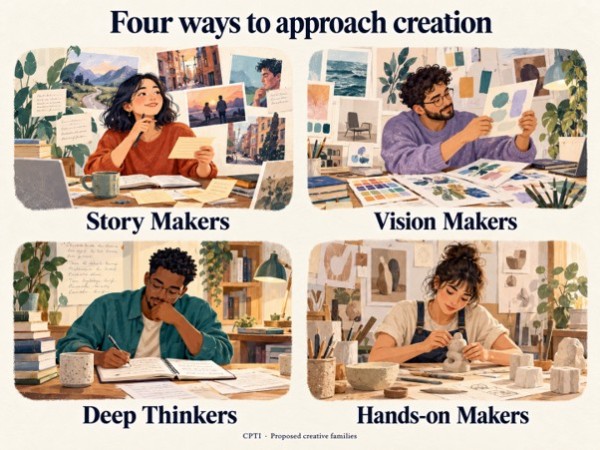
CPTI is structured around four areas: Ideation Tendency, which examines how individuals explore ideas; Expression Tendency, which looks at how ideas are translated into concrete forms; Creative Goal Tendency, which considers the purpose behind creative work; and Work Process Tendency, which explores how individuals approach experimentation and completion.
Through these dimensions, CPTI is designed to encourage creators to reflect on their own choices and creative processes.
The research paper published on SSRN outlines the theoretical foundation and development process behind CPTI. The study reviewed 39 academic sources and used them to develop 20 preliminary assessment items.
The project is currently at an early, literature-based research stage. The reliability and validity of the assessment are expected to be evaluated through future empirical studies.
Rather than simply asking creators to produce more, CPTI focuses on giving individuals an opportunity to understand how they create.
It represents an effort to explore creativity in the AI era not only through productivity, but also through the different perspectives, preferences, and working styles that shape each person’s creative process.

More information about the CPTI creative tendency assessment is available at genesistwinker.xyz.
Media Contact
Organization: TWINMETA INC
Contact Person: Yongil Choi
Website: http://twinmeta.xyz
Email: Send Email
Contact Number: +821033588983
Address: Coastal Highway Lewes DE
Address 2: 16192
City: Lewes
State: DE
Country: United States
Release id: 50203
View source version on King Newswire:
TwinMeta Introduces CPTI Creative Tendency Assessment, Publishes Related Research on SSRN
About Author
Disclaimer: The views, suggestions, and opinions expressed here are the sole responsibility of the experts. No Digi Observer journalist was involved in the writing and production of this article.
RiskVantage AI Introduces Sovereign, Explainable AI to Transform Contract and Deal Legal Work
Rizwan Khan Muzammil: A Rising Star in Middle Eastern Real Estate
TwinMeta Introduces CPTI Creative Tendency Assessment, Publishes Related Research on SSRN
Benzinga Money Article Discusses How to Become Part of the 12% of Retirees Who Have Achieved the Recommended $550,000 Minimum Retirement Savings Threshold
Apu Apustaja Conquers New York with Lively Street Ads, Including Times Square Billboard
Bay Smokes Maintains Quality Amid Legislative Changes in the Hemp Industry


-
Press Release1 week ago
The Smart Luggage at the 140th Canton Fair:Airwheel 20inch Carry-On Hand Scooter Ai Wheel Robot Cabin Luxury Suitcase Takes Smart Travel to the Next Level
-
Press Release6 days ago
Injective Collaborates with BDACS to Bring Korea’s First Won-Backed Stablecoin to Onchain RWAs
-
Press Release3 days ago
Thomas Berkley of Nexus Acquisition AI Focuses on Turning Business Inquiries Into Structured Growth Opportunities
-
Press Release1 week ago
Mastek Selected by Staffordshire County Council to Drive AI Enabled – Oracle Cloud Transformation
-
Press Release3 days ago
Widgets & Web Launches AI-Operated Investor Relations Websites for Public Companies at a Fixed $299 per Month
-
Press Release3 days ago
Dynamic NameCard Opens Global Franchise Recruitment for Telegram Mini App-Based Digital Identity Services
-
Press Release1 week ago
New Book Where’s the GAP by David P. Matthews, Now Available on Amazon, Asks a Life Changing Question
-
Press Release3 days ago
Thomas Berkley and Nexus Acquisition Group Outline AI Agency Partnership Approach in Cleveland