
Press Release
Claim Agreement Aims To Be The One-Stop Decentralized Finance (Defi) Service Network

The Claim Agreement, a Decentralized Finance (DeFi) service network unveiled recently, creates a new generation of credit-based stablecoin ecosystem that is based on the value of assets across time cycles and characterized by full external coupling and deep liquidity. Claim is more than just a payment agreement – it promises to be a one-stop DeFi service network that can provide users with long-term on-chain credit evaluation, credit financing and asset custody. In the future, users will be able to tap the on-screen “Claim” button to access the diversified world of DeFi. DeFi, which draws inspiration from blockchain and is the technology behind cryptocurrency, influenced the industry most during the first quarter of 2021.
“DeFi, the acronym of Decentralized Finance, was first coined in August 2018 by Brendan Forster, founder and CEO of crypto lending platform Dharma. After more than two years of development, the DeFi ecosystem has emerged in a variety of projects. Many products in the traditional financial system have been re-enacted through blockchain and smart contract technology. DeFi has brought unprecedented changes in the coin circle, among which the algorithmic stablecoin has attracted public attention the most as it has influenced traditional finance in DeFi like no other. At the beginning of 2021, a new algorithmic stablecoin named Basis Cash reached peak popularity with the arrival of the bull market, but it faced confidence crisis due to the defects in their algorithm. Just when the investors thought that the DeFi stablecoin “vanished into the crowd”, the emergence of Claim changed the public perception all over”, said Seraphima Verkhovtceva, the CMO of Claim during a recent press conference.

“According to agency data, DeFi had $450 billion of Total Value Locked (TVL) globally as of March 2021. Considering the double to triple-digit gas price of just doing a single operation on Ethereum, it can be assumed that most of that is “Big Whale” customers. Apart from the high gas costs on Ethereum, DeFi’s biggest pain point at the moment is its cumbersome mechanics and highly unstable returns”, she added.
“Ampleforth, which uses first generation algorithm, is considered the first ever complete stablecoin. There are many advantages of Ampleforth and it is one of the most stable currencies as it follows the inflation-deflation model. Basis Cash follows the second-generation algorithm. It has a three-coin model, but it also has obvious advantages and disadvantages. The three-coin model is the equivalent of DPOS in the blockchain world, while the first-generation algorithm of stablecoin Ampleforth is more like PoW. Although the community users say that PoW has various downsides, it is still a more powerful algorithm than DPOS in the blockchain ecosystem, and the same is true for the stablecoin algorithm. Although Basis Cash has been updated, it’s algorithm is not as simple as the algorithm of the earliest stablecoin, Ampleforth. It doesn’t have the core of Ampleforth either – it’s just algorithmic. It cannot be manipulated, which is one of the reasons the algorithmic stablecoin lost its popularity”, she further added.
According to Verkhovtceva, the foundation of the financial industry is credit and any traceable and controllable financial activity that runs on a chain should be granted credit, which is why the Claim Agreement was developed by the company.
“Whether the user is mining or performing any other on-chain activity recognized by the Claim platform, the user can get credit $CUSD or digital money under the Claim agreement, which helps the user to maximize the use of their funds. Another reason why we developed Claim is that we wanted to address the low utilization of funds in the current stablecoin system”, she stated.

“The Claim protocol we developed allows users to pledge assets they hold and generate a stablecurrency called $CUSD. According to the agreement, users will deposit assets and allocate funds through the income aggregation platform to form investment income. The income of these assets investment will be the value support of the ecological credit system of Claim. In this mode, the funds deposited by users can not only be used as collateral to obtain the stablecurrency $CUSD for financing, but users also enjoy the credit leverage formed by the expected returns of assets, which greatly improves the utilization efficiency of assets”, said Dmitry Malyanov, the CEO of the AI and blockchain innovation company.
“The economic model of Claim agreement is a dual token economic system. In order to ensure the value anchorage and payment ability of the credit stablecurrency $CUSD, the team only supports DAI, USDC, USDT, ALUSD and DOLA as the agreement pledge assets in the early stage. $CUSD will be cast in a ratio of 1:1 after the user deposits the 5 kinds of stable coins – DAI, USDC, USDT, ALUSD and DOLA. After that, users can exchange the $CUSD they hold at any time in a 1:1 ratio through the protocol without loss for the above five stable coins”, Malyanov added.
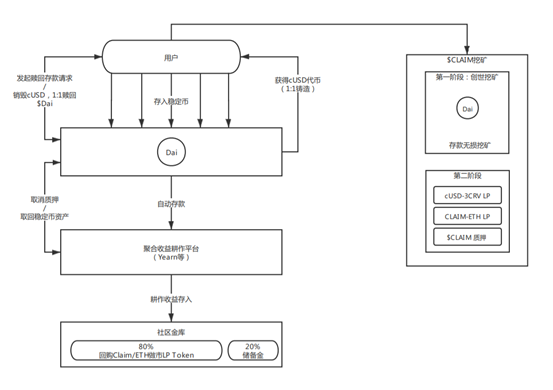
$CUSD is a utility stablecoin created by the Claim Agreement as the asset of the tokens in circulation by the users participating in the pledge agreement. The Claim is a token for protocol functionality iteration, parameter tuning, and community governance for DAO or Decentralized Autonomous Organization Treasure Asset Management. The total issue of Claim is USD 100 million.
“We will follow the DAO concept, with the community fully in charge of the platform’s evolution. As a DeFi project that originated in the community and is based on serving the community ecology, the protocol governance of Claim will rely on the community DAO governance model to the greatest extent. All holders of $CLAIM can participate in the governance of the agreement and express their opinions and claims in full”, Malyanov was quoted.
Official Website: https://claim.xyz
Twitter: https://twitter.com/claimdotxyz
Medium: https://medium.com/@claimfinance
Telegram group: https://t.me/claimofficialcommunity
Contact:
Claim
Dmitry Malyanov
themediacontact@gmail.com
About Author

Disclaimer: The views, suggestions, and opinions expressed here are the sole responsibility of the experts. No Digi Observer journalist was involved in the writing and production of this article.

Press Release
AJ Auto Expands Specialist Jaguar Land Rover Key Replacement Services for Drivers Facing Lost, Damaged and Replacement Key Problems

London, United Kingdom, 19th Sep 2026, Grand Newswire – Specialist automotive key service provides dedicated support for Jaguar, Land Rover and Range Rover owners, including complex all-keys-lost situations.
AJ Auto is strengthening its specialist automotive locksmith services for Jaguar Land Rover vehicle owners, providing drivers with a focused solution for lost, damaged, missing and replacement vehicle keys. As modern premium vehicles increasingly depend on sophisticated security and electronic key technology, owners often need more than a traditional locksmith when a key problem occurs.
Operating as an AJ Auto JLR Key Specialist, the company focuses on key-related solutions for Jaguar, Land Rover and Range Rover vehicles. Its specialist approach is designed to help vehicle owners resolve key problems efficiently while working with the complex electronic security systems found in modern JLR vehicles.
Specialist Support for Modern Land Rover Keys
Land Rover vehicles combine convenience, advanced electronics and sophisticated anti-theft technology. While these systems offer important security benefits, replacing a missing or damaged key can require specialist knowledge, compatible equipment and familiarity with individual vehicle systems.
The AJ Auto Land Rover key replacement service is intended for owners who require a replacement key because their existing key has been lost, damaged, stopped operating correctly or is no longer available.
Having access to a specialist service can be particularly valuable when drivers depend on their vehicle for daily travel, business commitments or family transportation. Instead of treating automotive key replacement as a simple key-cutting process, AJ Auto approaches the task as a vehicle-specific security and programming requirement.
Range Rover Owners Receive Dedicated Key Replacement Assistance
Range Rover models often incorporate advanced keyless entry, immobiliser and vehicle security technologies. When problems develop with a key, owners may require specialist assistance capable of addressing both the physical key and the electronic communication required for the vehicle.
Through its AJ Auto Range Rover key replacement service, AJ Auto supports owners looking for a practical solution when their Range Rover key needs replacement.
This dedicated vehicle focus helps ensure that the replacement process reflects the requirements of the particular marque rather than relying on a generalised automotive locksmith approach.
Jaguar Key Solutions for Lost and Replacement Keys
Jaguar drivers can encounter similar challenges when a key is lost, damaged or unavailable. Modern Jaguar vehicles use security technology intended to prevent unauthorised access, making specialist knowledge increasingly important when replacement keys are required.
The AJ Auto Jaguar key replacement service provides a dedicated option for Jaguar owners seeking help with replacement-key requirements.
By concentrating on Jaguar Land Rover vehicles, AJ Auto aims to provide customers with a service built around familiarity with the vehicles, their key systems and the problems that can occur during ownership.
Helping Drivers Restore Access Without Unnecessary Complications
Losing access to a vehicle can quickly become disruptive. A missing key may prevent a driver from travelling to work, completing appointments, operating a business vehicle or carrying out normal daily responsibilities.
The broader AJ Auto Key Replacement service is designed around restoring vehicle access and providing replacement-key assistance for JLR owners facing these situations.
The specialist nature of the service is particularly relevant because key replacement for a modern vehicle can involve considerably more than producing a physical key. Electronic authentication, programming and security compatibility may all play a role before a replacement can operate correctly.
Support When Every Land Rover Key Has Been Lost
One of the most challenging situations for a vehicle owner occurs when no working key remains. An all-keys-lost situation may require a different approach from simply duplicating an existing working key because there is no original available to copy or use during the replacement process.
For customers facing this problem, AJ Auto provides access to a Land Rover all keys lost specialist service focused specifically on recovering from complete key loss.
This can be especially useful for owners who unexpectedly discover that their only key has disappeared, been stolen or become permanently unusable.
Dedicated Assistance for Range Rover All-Keys-Lost Situations
Range Rover owners can face equally disruptive circumstances if every available key is missing. The advanced security technology associated with these vehicles means the solution may require specialist diagnostic and programming capabilities rather than a conventional replacement process.
AJ Auto’s Range Rover all keys lost specialist service is intended for customers requiring assistance when there is no working key left for their vehicle.
By offering support for these more complicated cases alongside conventional replacement-key requirements, the company aims to serve customers across a broader range of real-world vehicle access problems.
Jaguar Owners Can Recover From Complete Key Loss
Complete key loss can also affect Jaguar owners. Whether keys have been misplaced, stolen or otherwise become unavailable, being left without a functioning key can result in an immediate need for specialist assistance.
The company’s Jaguar all keys lost specialist service addresses this particular scenario, helping Jaguar owners pursue a replacement solution even when an existing operational key is unavailable.
The service reflects AJ Auto’s wider emphasis on dealing with the more technically demanding key problems associated with modern Jaguar Land Rover vehicles.
A Specialist Approach Built Around JLR Vehicles
Specialisation has become increasingly important as automotive security systems have evolved. Vehicle keys now frequently incorporate transponders, remote-control functions, keyless entry capabilities and encrypted communication with vehicle security modules.
Customers interested in learning About AJ Auto JLR Key Specialist can explore additional information about the company’s focus and approach to Jaguar Land Rover key services.
Rather than attempting to cover every type of vehicle equally, the specialist positioning enables the business to concentrate its knowledge and equipment around the needs of JLR owners.
Making Specialist Key Assistance Easier to Access
A vehicle-key emergency is rarely planned, and customers often begin searching for assistance only after discovering that a key has disappeared or stopped working. Providing clear access to specialist help can therefore be an important part of reducing the disruption caused by these situations.
Jaguar, Land Rover and Range Rover owners who need to discuss their vehicle, key problem or replacement requirements can Contact AJ Auto JLR Key Specialist to enquire about available assistance.
With services covering replacement keys as well as complete all-keys-lost scenarios, AJ Auto continues to position its offering around the increasingly specialised requirements of modern Jaguar Land Rover vehicle security.
About AJ Auto
AJ Auto provides specialist automotive key replacement assistance focused on Jaguar, Land Rover and Range Rover vehicles. Its services address common replacement requirements as well as more complicated situations in which every working vehicle key has been lost.
Through its JLR-focused approach, the company aims to give vehicle owners access to specialist knowledge when modern key, immobiliser and security technology makes conventional key replacement insufficient.
Media Contact
Organization: AJ AUTO – JLR KEY SPECIALIST
Contact
Person: AJ AUTO – JLR KEY SPECIALIST
Website:
https://ajkeyreplacement.com/
Email:
contact@ajkeyreplacement.com
Address:London, United Kingdom
City: London
Country:United Kingdom
The post AJ Auto Expands Specialist Jaguar Land Rover Key Replacement Services for Drivers Facing Lost, Damaged and Replacement Key Problems
appeared first on Grand Newswire.
It is provided by a third-party content provider. Grand Newswire makes no
warranties or representations in connection with it.
About Author

Disclaimer: The views, suggestions, and opinions expressed here are the sole responsibility of the experts. No Digi Observer journalist was involved in the writing and production of this article.
Press Release
Car Plates Pro Expands Range of UK Number Plates With Custom, 3D, 4D and Road-Legal Options
United Kingdom, 19th Sep 2026, Grand Newswire – UK number plate specialist offers standard, 3D Gel, 4D, 4D Gel and replacement registration plates through an easy-to-use online ordering experience.
Car Plates Pro is expanding its selection of vehicle registration plates for UK motorists, offering customers a convenient way to order replacement and custom-styled number plates while choosing from a variety of popular finishes.
Through Car Plates Pro, motorists can explore a range of plate styles designed for drivers who need new registration plates or want to update the appearance of their vehicles. The company’s selection includes traditional standard plates alongside increasingly popular 3D Gel, 4D and 4D Gel designs.
As vehicle customisation continues to attract interest among UK drivers, number plates have become one of the most visible ways motorists can personalise the appearance of a car while maintaining a clean and professional look.
An Easier Way to Build Replacement Number Plates
Replacing a damaged, faded or worn number plate can be a straightforward process when motorists have access to an online system that allows them to enter their registration and choose the type of plate they require.
The Car Plates Pro number plate builder provides customers with a simple way to configure their registration plates online. Drivers looking for Car Plates Pro replacement number plates can select their preferred plate style before progressing through the ordering process.
An online builder can be particularly useful for customers who already know the registration they need and want to compare different styles before making a final choice.
Whether a vehicle owner needs a straightforward replacement or prefers a more distinctive finish, having multiple options within one ordering platform can simplify the process considerably.
Standard Plates Remain a Popular Choice
Although customised finishes have become increasingly visible on UK roads, traditional registration plates remain an important option for motorists who prefer a familiar and understated appearance.
Car Plates Pro standard number plates are designed for drivers looking for a clean, conventional plate style suitable for everyday vehicles.
Standard plates can be particularly attractive to motorists replacing damaged registration plates, preparing vehicles for sale or simply preferring a factory-style appearance.
Their straightforward design also makes them suitable for a wide range of vehicles, from family cars and business vehicles to newer models where the owner wants the registration to remain visually simple.
3D Gel Plates Add Greater Visual Depth
For motorists interested in giving their vehicle a more distinctive appearance, raised lettering has become a popular styling choice.
Car Plates Pro 3D Gel number plates feature raised characters that create additional visual depth compared with conventional printed registration plates.
The gel-style lettering can provide a smooth, dimensional finish that stands out while maintaining a relatively refined appearance. This makes 3D Gel plates attractive to motorists who want something more noticeable than standard plates without dramatically changing the overall look of the vehicle.
They can complement both modern and premium vehicle styling, particularly where subtle exterior modifications are already part of the car’s appearance.
4D Number Plates Deliver a Sharper, Modern Finish
Another increasingly popular option among motorists is the 4D plate style, recognised for its raised characters and sharper visual profile.
Car Plates Pro 4D number plates provide an alternative for drivers looking to create a stronger, more contemporary appearance.
The raised lettering can produce a distinctive contrast against the plate background, making the registration more visually prominent. For drivers who pay close attention to exterior details such as wheels, trim, body styling and lighting, upgrading the registration plate can become part of a broader vehicle customisation project.
The result is a relatively simple modification that can noticeably alter the overall presentation of a vehicle.
Combining 4D Styling With a Gel Finish
Motorists who prefer a combination of dimensional lettering and a polished surface can also consider a hybrid plate design.
Car Plates Pro 4D Gel number plates combine visual elements associated with both 4D and gel-style registration plates.
This type of plate can appeal to drivers looking for a premium appearance with lettering that creates additional depth and visual definition.
Because vehicle styling preferences differ considerably between drivers, providing multiple finishes allows customers to select the plate type that best complements their individual vehicle rather than relying on a single design.
Road-Legal Plates Remain an Important Consideration
Appearance is only one consideration when selecting registration plates. UK motorists also need to ensure that plates intended for public-road use meet the applicable legal requirements governing vehicle registrations.
Customers can explore Car Plates Pro road-legal number plates when choosing plates intended for everyday road use.
Correct registration plate formatting is important because number plates serve an identification function rather than simply acting as a decorative vehicle accessory. Drivers therefore need to consider factors such as character presentation, spacing, visibility and applicable manufacturing requirements when purchasing replacement plates.
For many customers, being able to select from attractive styles while also identifying suitable road-use options provides additional convenience during the ordering process.
Supporting Drivers Across London
Demand for replacement and customised number plates extends across the UK, with major cities generating significant demand due to their large numbers of registered vehicles.
Drivers searching for Car Plates Pro number plates London can access options covering standard and customised registration plate styles.
London motorists may require new plates for numerous reasons, including replacing damaged plates, updating an older vehicle, completing repairs or refreshing the appearance of a recently purchased car.
Online ordering can be particularly convenient in busy urban locations where customers may prefer arranging vehicle accessories without travelling between multiple specialist shops.
Number Plates as Part of Modern Vehicle Styling
Vehicle personalisation has changed significantly in recent years. Drivers increasingly focus on smaller exterior details that can improve appearance without requiring major body modifications.
Registration plates are naturally prominent at both the front and rear of a vehicle, meaning even relatively subtle changes in character style or finish can influence the overall look.
Standard plates remain appropriate for motorists who favour simplicity, while 3D Gel, 4D and 4D Gel designs give customers additional choices for creating a more distinctive presentation.
This range means drivers can choose an option according to their priorities, whether those priorities involve straightforward replacement, road-use suitability or visual customisation.
A Wider Choice for UK Motorists
Car Plates Pro continues to provide UK drivers with access to multiple number plate styles through a dedicated online platform.
By combining a plate-building process with standard, 3D Gel, 4D and 4D Gel options, the company aims to make choosing replacement plates more straightforward for motorists with different vehicle types and styling preferences.
For customers, the growing range of choices means replacing a number plate no longer has to involve choosing only a conventional design. Drivers can instead consider the appearance of their vehicle, their intended use and their preferred finish before selecting the most suitable option.
About Car Plates Pro
Car Plates Pro supplies replacement and customised registration plates for UK motorists. Its range includes standard number plates, 3D Gel plates, 4D plates and 4D Gel options, together with an online number plate builder designed to simplify the ordering process.
The company serves motorists seeking replacement registration plates as well as drivers looking to enhance the appearance of their vehicles with more distinctive plate styles.
Media Contact
Organization: Car Plates Pro
Contact
Person: Car Plates Pro
Website:
https://carplatespro.com/
Email:
carplatespro.uk@gmail.com
Country:United Kingdom
The post Car Plates Pro Expands Range of UK Number Plates With Custom, 3D, 4D and Road-Legal Options
appeared first on Grand Newswire.
It is provided by a third-party content provider. Grand Newswire makes no
warranties or representations in connection with it.
About Author
Disclaimer: The views, suggestions, and opinions expressed here are the sole responsibility of the experts. No Digi Observer journalist was involved in the writing and production of this article.
Press Release
From Boardroom to Race Day: COOFANDY and Global Brand Ambassador Christopher Bell Redefine Modern Men’s Wardrobe

New York, USA Timesnewswire / September 19, 2026 – As September marks the full return of “Back to Office” across major cities, summer ease evolves into autumn action. Modern menswear now demands absolute versatility—pieces built to move seamlessly from high-stakes boardroom discussions to post-work dinners and high-octane race weekends. COOFANDY, alongside its Global Brand Ambassador and championship driver Christopher Bell, presents an elevated autumn commuter wardrobe engineered for performance, comfort, and dynamic style.
Driven by Resilience: The Champion’s Mindset. True style is forged under pressure—a principle embodied by NASCAR driver Christopher Bell. Battling through adversity following a severe wrist fracture in June, Bell’s relentless grit paid off with a brilliant victory at the Darlington Crown Jewel race on September 6, breaking a 33-race winless streak and elevating him to Top 3 in the standings. As he prepares for the high-stakes Bristol Night Race on Saturday, September 19—where he returns as a reigning track favorite—Bell’s relentless focus and composure mirror COOFANDY’s commitment to strength, precision, and functional excellence.
Layered Performance: Built for Motion and Focus To match a dynamic lifestyle, early autumn dressing requires modern function and adaptability. COOFANDY’s army green V-neck knit cardigan serves as the ultimate core layer. Crafted from 100% premium knit fabric, it delivers a soft drape, lightweight breathability, and unrestricted movement. The sharp single-breasted V-neck profile layers cleanly over a white shirt, projecting confidence in the office while retaining natural, easygoing comfort.

Below, COOFANDY’s open-hem black casual trousers deliver athletic ease with refined structure. Engineered with 95% polyester and 5% spandex stretch fabric, an elastic waistband, and a classic straight-leg cut, they provide maximum flexibility and all-day shape retention. Practical pockets keep daily essentials close, seamlessly transitioning from intense workday schedules to evening dates or trackside cheering.

Break the Boundary: One Outfit, Every Scene. Whether leading boardroom meetings, heading out for an evening date, or rallying behind Christopher Bell at Bristol Motor Speedway on September 19, COOFANDY empowers men to break traditional dress codes. Step into autumn with versatile menswear built for speed, comfort, and uncompromising persistence.
For more information, please visit the COOFANDY website and Amazon storefront, or connect with COOFANDY on Facebook and Instagram.
COOFANDY
Charlotte Liu
New York, US
About Author
Disclaimer: The views, suggestions, and opinions expressed here are the sole responsibility of the experts. No Digi Observer journalist was involved in the writing and production of this article.
Car Plates Pro Expands Range of UK Number Plates With Custom, 3D, 4D and Road-Legal Options
AJ Auto Expands Specialist Jaguar Land Rover Key Replacement Services for Drivers Facing Lost, Damaged and Replacement Key Problems
From Boardroom to Race Day: COOFANDY and Global Brand Ambassador Christopher Bell Redefine Modern Men’s Wardrobe
Benzinga Money Article Discusses How to Become Part of the 12% of Retirees Who Have Achieved the Recommended $550,000 Minimum Retirement Savings Threshold
Apu Apustaja Conquers New York with Lively Street Ads, Including Times Square Billboard
Bay Smokes Maintains Quality Amid Legislative Changes in the Hemp Industry


-
Press Release2 days ago
RGMBS 2026 Life Sciences Innovation Forum Draws More Than USD 120 Million in Investor Interest as 23 Global Biotech Innovators Pitch in Riyadh
-
Press Release1 week ago
CGTN: Embarking on third ‘golden decade’: How BRICS pools development strength for high-quality cooperation
-
Press Release2 days ago
RELABEL HAIR MyeongDong Emerges as Seoul, Korea’s New Creative Beauty Destination for Global Travelers
-
Press Release2 days ago
Oceanic Iron Ore CEO Chris Batalha Gives Overview of Ungava Bay Assets
-
Press Release1 week ago
Ronel Lamour Junior launches a self-check for South Florida homeowners before the next AC breakdown
-
Press Release1 week ago
Guggenheim Introduces 24-7 Client Support in Indonesia Guided by Prof. Wong Woon Thiam
-
Press Release1 week ago
Quebec Brokerage Qubit Insurance Announces New Data on Coverage Shortfalls as Rebuilding Costs Rise
-
Press Release1 week ago
Solli Rothschild Launches Research Initiative on Personal Names, Trademarks and Digital Identity