
Press Release
Agrifi Expands Its Agri-DeFi Ecosystem With Transparent Staking Model and AI-Driven Agricultural Infrastructure

Estonia, 16th March, 2026, As the blockchain industry increasingly moves toward real-world asset (RWA) integration, agriculture is emerging as one of the most compelling sectors where decentralized technology can deliver meaningful economic transformation.
AgriFi, a blockchain-based agricultural finance ecosystem built on the Polygon network, is developing a technology infrastructure designed to connect farmland assets, decentralized finance, and data-driven farming systems within a transparent digital economy.
Through the AGF Token ecosystem, AgriFi aims to create a framework where agricultural productivity, farmland ownership, and decentralized financial participation can operate together within a unified blockchain environment.
“Agriculture is one of the most important yet under-digitized sectors globally. With AgriFi, we are exploring how blockchain infrastructure can bring greater transparency, accessibility, and efficiency to agricultural ecosystems. By combining decentralized finance with real agricultural activity, we aim to create a system where technology supports farmers, investors, and agricultural stakeholders in a more open and connected environment,” said Veronica Trump, CMO at AgriFi.
Bringing Real-World Agriculture Into the Web3 Economy
Agriculture represents one of the largest real-world industries globally, yet access to agricultural investment and capital participation has historically been limited.
Blockchain technology has enabled the tokenization of real-world assets, allowing physical assets such as farmland to be represented digitally within blockchain ecosystems. This model makes agricultural assets more transparent, accessible, and liquid.
AgriFi is addressing this gap through farmland tokenization, a system that converts agricultural assets into blockchain-based ownership structures that can be accessed and managed through decentralized infrastructure. It focuses on connecting farmland portfolios, agricultural data, and decentralized finance, allowing farming activity to interact with blockchain-based financial infrastructure.
By combining agriculture with Web3 technologies, the platform seeks to build a framework where agricultural participation can extend beyond traditional geographic and financial limitations.
The AGF Token: Supporting the AgriFi Ecosystem
At the center of the AgriFi ecosystem is the AGF Token, which functions as the economic engine connecting farmers, investors, and decentralized finance participants.
Rather than serving purely as a speculative digital asset, the AGF token is designed to support interaction across the platform’s agricultural and financial infrastructure.
Token Highlights
Network: Polygon (ERC-20)
Total Supply: 7.2 Billion AGF
Fully Circulating Supply Model: Designed for transparent token economics
Utility: Staking, governance participation, ecosystem transactions
Within the ecosystem, the AGF token enables participation across multiple layers of AgriFi’s decentralized infrastructure.
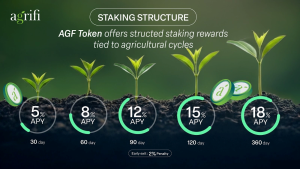
Staking Participation With Structured APY
AgriFi includes a staking mechanism that allows AGF token holders to participate in the ecosystem by locking tokens for specific periods.
Participants can stake tokens for durations ranging from 30 days to 360 days, with reward structures designed around annual percentage yields between approximately 5% and 18%, depending on the selected lock period.
Unlike traditional DeFi yield models that rely heavily on token emissions, AgriFi’s framework is designed around a fair yield economy, where staking rewards are intended to align with agricultural ecosystem activity and platform participation.
The staking model is intended to encourage long-term participation while supporting ecosystem stability and engagement.
Decentralized Exchange for AGF Trading
AgriFi also includes support for decentralized exchange (DEX) trading, allowing users to swap AGF tokens with major digital assets such as: USDT, ETH, MATIC
Unlike centralized exchanges, decentralized exchanges enable peer-to-peer transactions directly through smart contracts. Users retain custody of their assets while executing trades through blockchain-based liquidity pools.
The interface is designed to allow users to complete token swaps in a few steps while maintaining the transparency and security associated with decentralized trading environments.
In addition to trading, AgriFi enables users to participate as liquidity providers within its decentralized exchange infrastructure.
Users can deposit token pairs such as AGF-USDT, AGF-ETH, or AGF-MATIC into liquidity pools. In return, participants receive liquidity provider tokens representing their share of the pool.
Liquidity providers earn a portion of trading fees generated through the exchange, while also contributing to deeper market liquidity and smoother trading activity.
This model encourages community-driven liquidity, where users actively participate in maintaining the ecosystem’s trading infrastructure.
Integrating AI and IoT for Data-Driven Farming
Beyond decentralized finance, AgriFi’s ecosystem also integrates technology designed to support data-driven agriculture.
Artificial intelligence and IoT-based monitoring systems can collect and analyze agricultural data related to soil conditions, crop performance, and environmental factors.
These technologies contribute to building farming environments that are more transparent and efficient while providing insights that may support better agricultural decision-making.
The Future of Agriculture in a Web3 Economy
The intersection of blockchain technology, decentralized finance, artificial intelligence, and agricultural data systems is creating new opportunities for the global farming industry.
As interest in real-world asset tokenization continues to grow within the blockchain sector, agriculture is increasingly being explored as a sector where decentralized technology can support both economic participation and operational transparency.
AgriFi is developing its ecosystem with the goal of helping connect agricultural productivity with digital financial infrastructure, contributing to a more transparent and technology-enabled agricultural economy.
About AgriFi
AgriFi is a blockchain-based agricultural ecosystem built on the Polygon network that integrates farmland tokenization, decentralized finance infrastructure, and data-driven farming technologies.
The platform explores new frameworks where agriculture, blockchain infrastructure, and decentralized financial participation can interact within a transparent digital ecosystem.
Join us on this exciting journey to explore the future of agriculture while potentially enhancing the value of your AGF tokens. We’re not just redefining agricultural finance; we’re revolutionizing the future of farming and food production.
Ready to start staking your AGF tokens? Visit our website at https://agrifi.tech/for detailed steps on how to stake your tokens. Stay connected with us on Telegram, Twitter, Facebook, and Instagram for the latest updates and community discussions.
Follow Us on:
- Website: https://agrifi.tech/
- WhitePaper: https://agrifi.gitbook.io/agrifi-docs
- Blog: https://blog.agrifi.tech
- Telegram: https://t.me/agrifi_official
- Facebook: https://www.facebook.com/agrifiofficial
- Instagram: https://www.instagram.com/agrifi_official/
- Twitter: https://x.com/Agrifi_official
About Author

Disclaimer: The views, suggestions, and opinions expressed here are the sole responsibility of the experts. No Digi Observer journalist was involved in the writing and production of this article.

Press Release
AlgoQuant Asset Management Selects Liquid Mercury to Enhance Digital Asset Trading Infrastructure
Chicago, United States, September 28th, 2026, Chainwire
AlgoQuant will deploy Liquid Mercury’s institutional-grade trading technology to scale its multi-strategy investment platform and enhance execution capabilities across global digital asset markets.
Liquid Mercury, a leading technology provider for digital asset marketplaces and crypto trading, announced today that it has been engaged by AlgoQuant Asset Management, an investment manager focused on solving inefficiencies in fast-evolving markets, to provide trading technology and infrastructure services.
The engagement will enable AlgoQuant to leverage Liquid Mercury’s institutional-grade trading technology and infrastructure to enhance its multi-strategy investment platform. AlgoQuant will gain access to deep liquidity, advanced execution capabilities, and professional-grade trading tools that support the firm’s commitment to quantitative excellence, risk integrity, and operational resilience.
Liquid Mercury’s battle-tested platform combined with AlgoQuant’s sophisticated quantitative strategies provides a powerful foundation for executing complex digital asset trades across global markets. This technology integration allows AlgoQuant to maintain 24/7 trading operations while scaling talent, capital, and technology without compromising precision.
With a team spanning key global financial and digital asset markets, AlgoQuant operates as a multi-strategy investment platform designed to perform across diverse market environments. Through Liquid Mercury’s platform, AlgoQuant will benefit from access to top-tier liquidity providers, low-latency infrastructure, and comprehensive middle and back-office tools designed to meet the demands of institutional asset managers operating in digital asset markets.
“AlgoQuant came to us with very specific infrastructure requirements that are unique to their sophisticated quantitative strategies,” stated Liquid Mercury CEO, Tony Saliba. “What sets Liquid Mercury apart is our ability to shape our tech stack to meet each client’s distinct needs. This level of customization isn’t something firms can always find off the shelf, but our battle-tested platform was built with the flexibility to adapt while maintaining institutional-grade standards. We’re honored to provide the tailored technology infrastructure that will support AlgoQuant as it continues to scale its investment platform.”
“Liquid Mercury has been an excellent technology partner for AlgoQuant Asset Management,” said Alexander Goncharov, President of AlgoQuant Asset Management. “We are very pleased with their sophisticated technology stack, collaborative approach, and willingness to tailor the platform to our specific needs. Their infrastructure delivers the speed, reliability, and precision required in today’s digital asset markets while integrating seamlessly with our proprietary systems and workflows.”
About AlgoQuant Asset Management
AlgoQuant is an investment manager with a clear mission: to solve inefficiencies in fast-evolving markets. From day one, the firm has been focused on building a platform that can scale talent, capital, and technology without compromising precision. At the heart of AlgoQuant’s model is a commitment to quantitative excellence, risk integrity, and operational resilience.
AlgoQuant operates as a multi-strategy investment platform with global reach, featuring team members and trading teams based in key global financial and digital asset markets. The firm’s structure supports 24/7 execution, oversight, and engagement with global allocators.
Further information can be found at www.aq.io
About Liquid Mercury
Liquid Mercury powers professional crypto trading and digital asset marketplaces. Founded by legendary trader Tony Saliba, who was featured in Jack Schwager’s “Market Wizards,” Liquid Mercury is the #1 choice for sophisticated buy-side and institutional sell-side trading professionals moving into crypto.
Mercury Pro is an institutional-grade trading platform designed specifically for professional traders navigating crypto derivatives and spot markets. The platform offers sophisticated trade execution tools including DMA routing, staging, execution algorithms, and anonymous multi-dealer RFQ to source block liquidity. Traders can manage all orders and trade data in a single platform with real-time views of balances and account positions.
Key capabilities include access to crypto derivatives at leading onshore and offshore exchanges, institutional-sized pricing with top OTC liquidity providers, and a wide range of spot products across leading exchanges. The platform supports both single-leg and multi-leg orders in net price structures, with low-latency infrastructure built for high-frequency and algorithmic trading strategies.
Liquid Mercury integrates with world-class custodians including Fireblocks, Gemini, and BitGo, and provides comprehensive APIs (FIX, WebSocket, and REST) for automated trading and workflow customization. Built by professionals for professionals, Liquid Mercury combines battle-tested trading technology with deep liquidity access and best-in-class workflow automation.
For more information about Liquid Mercury and the $MERC token, users can visit www.liquidmercury.com or merc.liquidmercury.com.
Disclaimer
This press release is for informational purposes only and does not constitute an offer to sell, or a solicitation of an offer to buy, any securities or fund interests in any jurisdiction. Any offer or solicitation of interests in any fund managed by AlgoQuant Asset Management Corp will be made only by definitive offering documents, and only to eligible investors in accordance with applicable law. No statement in this press release is, or should be construed as, a representation as to the past or future performance of any fund or strategy managed by AlgoQuant.
Contact
Director
Kent Egan
Liquid Mercury
sales@liquidmercury.com
About Author
Disclaimer: The views, suggestions, and opinions expressed here are the sole responsibility of the experts. No Digi Observer journalist was involved in the writing and production of this article.
Press Release
Aster Launches Perpetual Grid Trading 2.0 with Up to 140,000 $ASTER Liquidity Mining Campaign
George Town, British Virgin Islands, September 28th, 2026, Chainwire
Aster, the privacy-first onchain trading platform backed by YZi Labs, today announced the launch of its Liquidity Pool Mining campaign, a four-week incentive campaign featuring a total reward pool of up to 140,000 $ASTER and running from September 28 to October 25, 2026 (UTC). To celebrate the launch of Perpetual Grid 2.0, the program is open to all Aster users running Perpetual Grid strategies on eligible trading pairs.
Rewards will be distributed hourly based on each eligible Grid’s share of trading volume. The base reward pool is set at 10,000 $ASTER per epoch, with additional rewards available based on market conditions and trading activity on the platform. Participation is automatic, with no registration required.
“As Aster continues to bring more emerging assets and opportunities onchain, we’re also focused on building the tools traders need to navigate increasingly dynamic markets. Perpetual Grid offers a flexible way to capture opportunities amid market volatility, and Grid 2.0 takes this experience further with greater flexibility and independence. This upgrade is another step toward our broader vision of building the frontier of onchain trading,” said Leonard, CEO at Aster.
Incentivizing Automated Perpetual Trading
The campaign builds on Aster’s expanded Perpetual Grid infrastructure, giving users a new way to participate in automated trading while earning additional $ASTER rewards from eligible Grid activity. Both Maker and Taker volume count toward the campaign, while manual trading and activity outside the Grid strategy are excluded.
An Estimated Bonus APY is also displayed to provide an indication of potential annualized $ASTER rewards based on recent campaign activity. The estimate can change as trading volume, participating Grids and other campaign conditions change, and does not guarantee future rewards or returns.
Grid 2.0 Separates Automated and Manual Strategies
Alongside the campaign, the newly upgraded Perpetual Grid 2.0 enables Grid strategies to operate independently from users’ regular Perpetual trading. Each Grid runs through a dedicated Grid Bot subaccount, keeping its positions and margin separate from the main Perpetual account.
With support for both Cross and Isolated Margin, users can run automated Grid strategies while continuing to trade Perpetuals manually, including on the same trading pair. Isolated Margin supports up to 50 independent Grid strategies per account, with no per-pair limit.
Discover Strategies Through Grid Marketplace
Aster’s Grid Marketplace further simplifies strategy discovery by allowing users to browse active Grid strategies and review metrics such as PnL, ROI, runtime, price range, leverage and trading activity.
Users can use an existing strategy as a starting point through Copy, or switch its direction through Reverse, turning a Long strategy into Short or vice versa. Copied or reversed strategies remain independent from their source and do not automatically synchronize with the original Grid.
The Liquidity Pool Mining campaign is available on designated eligible trading pairs, with the Week 1 eligible pairs including OURA/USD1, POLYMARKET/USD1, and META/USD1. The reward pool is shared across participating pairs. Individual rewards are determined by each Grid’s eligible trading volume relative to the total eligible volume generated during the relevant hourly period.
More eligible trading pairs may be added in subsequent weeks to reflect the latest market trends. For more information about the campaign, eligible trading pairs and current campaign parameters, please visit the official campaign page.
About Aster
Aster is a privacy-first onchain trading platform backed by YZi Labs, with unique features like Hidden Orders to protect user trading activity. It pioneers the frontier of on-chain trading through perpetual futures, spots, and earn products for top-trending assets, including RWAs, memes, and core crypto markets. It is powered by Aster Chain, a Layer 1 blockchain built to power the future of decentralized finance.
Users can learn more about Aster on the official website or follow Aster on X.
Contact
Marketing Manager
Lola Chen
lola.chen@asterdex.com
About Author
Disclaimer: The views, suggestions, and opinions expressed here are the sole responsibility of the experts. No Digi Observer journalist was involved in the writing and production of this article.
Press Release
RL Remodeling Marks Two Decades of Family-Style Building in Los Angeles as Demand Drives Expansion Across Southern California
RL Remodeling, a family-run Los Angeles design-build contractor founded in 2006, is expanding across Southern California on the strength of community referrals and repeat clients. One of the early pioneers of ADUs in LA, the company credits its growth to a diverse, long-tenured team that is trained in-house with monthly follow-up sessions, hands-on owner involvement in every project, and an office culture where everyone knows each client by name. From its Los Angeles roots, RL Remodeling now serves the greater LA area, Orange County and San Diego.
Los Angeles, California, United States, 28th Sep 2026 – RL Remodeling, a Los Angeles design-build contractor founded in 2006, is expanding its service footprint across Southern California in response to sustained demand from homeowners in the greater Los Angeles area, Orange County and San Diego. The company, which was among the first contractors in Los Angeles to focus on accessory dwelling units, says its growth has been driven almost entirely by referrals from the communities where it started.
“We never set out to be the biggest remodeling company in LA,” said the owner of RL Remodeling. “We set out to be the one people recommend to their neighbors. Everything else followed from that.”
A Family Model in an Industry Known for Turnover
Construction is a field where crews change from one project to the next. RL Remodeling has taken the opposite approach. The company describes itself as family-based, and it means that literally in how it runs the business. Team members stay for years, often growing from entry-level roles into senior positions, and the company invests in that growth directly.
Rather than relying only on outside certifications, RL Remodeling trains its own people. New hires are taught the company’s methods in person, and every team member takes part in follow-up training sessions each month to stay current with building codes, materials and design trends. That consistency shows up on job sites, where clients work with people who know the company’s standards because they helped shape them.
“When you keep the same people for years, quality stops being something you have to check for. It becomes the default,” the owner said.
The team is also notably diverse, made up of people from a range of nationalities and backgrounds. The office marks each culture’s holidays throughout the year, something the company sees as part of its identity rather than a side benefit.
Everyone in the Office Knows Every Client
One of the more unusual features of RL Remodeling’s operation is that every person in the office is involved in every project. There is no hand-off between a salesperson, a project manager and a crew who never meet. Clients are known by name across the company, and questions get answered by people who are already familiar with the job.
The ownership stays hands-on as well. Owners are personally involved in each project, from the first site visit through final walkthrough, and the company points to that personal touch as the reason many clients return for a second, third or fourth project over the years. A significant share of its work today comes from repeat customers and their referrals.
Celebrating the Work as a Team
Regular office meetings at RL Remodeling double as showcases. The full team gathers to review before-and-after results from recently completed projects, giving crews, designers and office staff a shared view of what they have built together. The company says these sessions do more for morale and standards than any formal review process could.
“Our people love seeing a garage turn into a finished ADU, or a tired kitchen turn into the center of a home,” the owner said. “Showing that to the whole team reminds everyone why the details matter.”
An Early Voice on ADUs in Los Angeles
RL Remodeling was building accessory dwelling units in Los Angeles before they became a mainstream housing solution. As California loosened regulations and demand for backyard homes, garage conversions and rental units grew, the company was already experienced in the permitting, structural and design challenges these projects involve.
Today ADUs remain a core part of the company’s work alongside kitchen and bathroom remodeling, room additions, whole-home renovations and new construction. Its early start has given RL Remodeling a depth of ADU experience that newer entrants to the market have not had time to develop.
Growth Driven by Demand, Not Marketing
The company’s expansion into new locations has followed a simple pattern: clients in one neighborhood recommend RL Remodeling to friends and family in the next, and the company adds coverage as the requests accumulate. From its roots in Los Angeles, it now serves communities across the San Fernando Valley, the Westside, Orange County and San Diego.
RL Remodeling says it intends to keep growing the same way, adding team members who fit its culture and locations where its clients ask for it, without changing the personal approach that built its reputation.
About RL Remodeling
Founded in 2006, RL Remodeling is a licensed design-build contractor serving the greater Los Angeles area, Orange County and San Diego. The company specializes in accessory dwelling units, kitchen and bathroom remodeling, home additions, whole-home renovations and new construction. Known for its family-based team, in-house training and hands-on ownership, RL Remodeling has built a client base that returns and refers year after year. Learn more at rl-remodeling.com.
Media Contact
Organization: RL Remodeling
Contact Person: Dana Laksman
Website: https://rl-remodeling.com/
Email:
info@rl-remodeling.com
Contact Number: +18883241144
Address: 5950 Canoga Ave Suite 420 Woodland Hills, CA, 91367
City: Los Angeles
State: California
Country: United States
Release id: 49499
The post RL Remodeling Marks Two Decades of Family-Style Building in Los Angeles as Demand Drives Expansion Across Southern California appeared first on King Newswire. This content is provided by a third-party source.. King Newswire makes no warranties or representations in connection with it. King Newswire is a press release distribution agency and does not endorse or verify the claims made in this release. If you have any complaints or copyright concerns related to this article, please contact the company listed in the ‘Media Contact’ section
About Author
Disclaimer: The views, suggestions, and opinions expressed here are the sole responsibility of the experts. No Digi Observer journalist was involved in the writing and production of this article.
AlgoQuant Asset Management Selects Liquid Mercury to Enhance Digital Asset Trading Infrastructure
RL Remodeling Marks Two Decades of Family-Style Building in Los Angeles as Demand Drives Expansion Across Southern California
Aster Launches Perpetual Grid Trading 2.0 with Up to 140,000 $ASTER Liquidity Mining Campaign
Benzinga Money Article Discusses How to Become Part of the 12% of Retirees Who Have Achieved the Recommended $550,000 Minimum Retirement Savings Threshold
Apu Apustaja Conquers New York with Lively Street Ads, Including Times Square Billboard
Bay Smokes Maintains Quality Amid Legislative Changes in the Hemp Industry


-
Press Release6 days ago
Airwheel Wins European Product Design Award for AI Wheel Cabin 20 Inch Luxury Smart Scooter Carry on Hand Boarding Travel Electric Suitcase
-
Press Release5 days ago
Thomas Berkley of Nexus Acquisition AI Introduces Smarter Client Acquisition Strategies for Service Businesses
-
Press Release7 days ago
Quoin Pharmaceuticals Announces FDA Fast Track Designation for QRX003 for the Treatment of Peeling Skin Syndrome
-
Press Release1 week ago
From Korean Chipmakers to Leveraged Semiconductor ETFs: STARTRADER Launches 49 New 24/7 Stock and ETF CFDs
-
Press Release2 days ago
Piya Saliba Releases Free Community Connection Checklist to Help People Build Stronger Relationships
-
Press Release3 days ago
Whimsical Halloween Wardrobe Ready: Arshiner Kids’ Outfits Light Up the Trick-or-Treat Adventure
-
Press Release3 days ago
Painted Brick Digital Named Among Expertise.com’s Top 8 Legal Marketing Companies in Scottsdale
-
Press Release2 days ago
Gary Bassett Shares Lessons From 45 Years Across Finance and Technology