
Press Release
TRON H1 2026 Strategy Report: Dual-Engine Growth via DeFi and AI Delivers Record Traction


Singapore- In H1 2026, TRON bucked broader market headwinds through a twin-track strategy: solidifying its core DeFi engine while aggressively expanding into AI. As recurring deflationary mechanics anchored value across DeFi protocols, a rapid wave of AI product launches unlocked new vectors for ecosystem growth.
Throughout the first half of 2026, global crypto markets faced a macro-driven cooldown. Tightening market liquidity and capital rotations into traditional AI tech pushed many crypto sectors into stagnation. TRON, however, carved out a distinct counter-cyclical rally. From expanding its stablecoin settlement layer and upgrading core DeFi asset value, to strategically positioning itself across the Web3 AI stack, TRON delivered ecosystem-wide growth that significantly outperformed industry benchmarks.
At the heart of this performance is TRON’s stablecoin infrastructure, which serves as the primary liquidity engine for the entire network. During H1 2026—even as global USDT market cap held relatively flat—circulating USDT on TRON expanded rapidly, breaking through $90 billion and setting consecutive all-time highs as it approaches the $100 billion milestone. This sustained liquidity depth cements TRON’s role as the leading settlement network for digital dollars, providing low-cost, capital-efficient liquidity for applications building on top of the layer.
Building on its stablecoin dominance, TRON pursued a cohesive strategy throughout H1 2026: fortify the DeFi foundation and expand the AI front. In DeFi, key protocols introduced recurring buyback-and-burn mechanics alongside steady feature upgrades, sharpening the network’s overall value-capture capability. Simultaneously, TRON executed a rapid rollout of foundational AI products—building a full-stack Web3 AI ecosystem that spans unified multi-model access layers, AI agent infrastructure, and distributed compute networks.
DeFi Ecosystem: Synergizing Token Deflation with Protocol Innovation
Against industry headwinds in H1 2026, TRON’s DeFi sector advanced a dual-track strategy: value empowerment via buybacks and burns, and continuous product iteration. On one hand, the ongoing execution of buyback and burn mechanisms by core projects across multiple tracks established a normalized, ecosystem-wide deflationary system. On the other, the relentless refinements to the functionality and user experience of core protocols enhanced both token value and protocol fundamentals.
To drive sustainable tokenomics, core ecosystem projects established programmatic buyback-and-burn mechanisms, forming a network-wide deflationary matrix across liquidity infrastructure, lending, oracles, and decentralized storage:
- SUN.io (Liquidity): Expanded its SUN buyback revenue streams. Starting with its 50th buyback and burn round in April, revenue from SUNX derivatives was permanently added to the burn pool alongside existing fees from SunSwap V2 and SunPump. The protocol completed its 50th and 51st token burn rounds in April and July, respectively.
- JUST (DeFi): Executed scheduled, multi-round JST token burns. The protocol completed its 2nd and 3rd large-scale buyback and burn rounds in January and April, followed by a record-setting 4th round in July that marked the largest capital allocation to date.
- WINkLink (Oracles): Launched a dedicated WIN buyback-and-burn program in July, allocating 100% of oracle service revenue toward repurchasing and burning WIN tokens.
- BitTorrent (Storage & Compute): Initiated a BTT buyback-and-burn program in July, funneling all revenue from decentralized services directly into token burns.
Parallel to these value-accrual mechanics, TRON protocols pushed aggressive feature upgrades across trading, lending, data feeds, and decentralized compute:
- SUN.io completed a strategic rebranding in January by introducing a dedicated Chinese brand to accelerate global adoption, followed by the launch of SunSwap V4 in March to deepen liquidity and enhance user experience.
- JustLend DAO deployed SBM V2 in June, introducing isolated collateral pools to support long-tail assets while enhancing risk management. Concurrently, the network’s gasless transaction solution, GasFree, saw exponential adoption across stablecoin transfers.
- WINkLink upgraded its price feed portal in March, adding an integrated “Market Statistics” dashboard to enhance on-chain analytics.
- BitTorrent formally entered the AI space in June with BTTInferGrid, a decentralized AI compute marketplace that unlocks long-term demand for the network.
This dual engine of consistent token deflation and protocol innovation not only drove a steady surge in on-chain DeFi activity, but also established a robust bedrock for long-term token value.
According to DeFiLlama, TRON’s DeFi TVL climbed past $5.18 billion by September 1, placing it firmly in the top five public chains globally—narrowing the gap with Solana and BSC, and even overtaking them during peak trading periods. TRON’s lead is even more pronounced in user engagement: the network logged over 3.88 million 24-hour active addresses, nearly double that of second-place BSC, underscoring its unmatched real-user adoption.

SUN.io: Enhancing DEX Efficiency via SunSwap V4 and Expanding Burn Pools
In H1 2026, SUN.io rolled out major updates across its branding, product suite, and tokenomics. By expanding brand awareness, upgrading protocol capabilities, and strengthening its value-accrual mechanics, the platform significantly sharpened its competitive edge.
To support global adoption, SUN.io launched a dual-brand strategy in January. This included introducing a dedicated Chinese brand identity, “Sun Wukong” (孙悟空), alongside a localized official website. The core product suite was seamlessly unified under this new framework: the DEX platform SunSwap became “Wukong Swap”, the memecoin launchpad SunPump became “Wukong Launch”, and the derivatives platform SunX became “Sun Wukong”. This approach allows SUN.io‘s comprehensive DeFi matrix—covering spot DEX trading, meme issuance, and perpetuals—to effectively engage both Western and Asian user bases.

On the product side, SUN.io continued to iterate on its core protocols, leveraging technical upgrades to lower trading barriers and reduce costs for users. On March 2, SunSwap V4 went live with six core architectural innovations:
- Singleton Design: Unified pool management for maximum capital efficiency.
- Native TRX Swaps: Direct trading pairs without the need to wrap TRX.
- Flash Accounting: Net balance settlements that dramatically cut transaction costs.
- Hooks: Customizable smart contract plugins for novel trading strategies.
- Custom Accounting: Tailored settlement logic for specialized pools.
- Subscribers: Real-time event notifications for active position monitoring.
These features pushed the protocol’s customizability to new heights, unlocking possibilities for innovative DeFi scenarios. Within five months of launch, SunSwap V4 saw rapid adoption: peak liquidity stabilized at $108 million, and 24-hour trading volumes frequently surpassed $70 million during peak periods.

Capital efficiency was further improved in May with an upgraded Universal Router contract, which automatically executes trades across the most optimal multi-pool paths.
As of September 1, SUN.io reports a total TVL of ~$650 million across more than 26,500 active liquidity pools. Over the past seven days, total platform trading volume exceeded $514 million across 112,000+ individual transactions, maintaining a steady upward trajectory across all metrics.

Finally, SUN.io accelerated the deflation of the SUN token by expanding its buyback revenue streams. Starting with its 50th buyback and burn round on April 25, revenue from the SunX derivatives platform was permanently added to the burn pool, complementing existing fees from SunSwap V2 and SunPump. To make this deflationary process more transparent and predictable, the platform also standardized its execution schedule, shifting to a unified announcement in the middle of the first month of each quarter.
Since launching its buyback-and-burn model in December 2021, SUN.io has executed 51 consecutive burn rounds without interruption, permanently removing 678,547,188.32 SUN from circulation—bringing the token rapidly toward the 700 million deflation milestone.
JustLend DAO: Real Yield Fuels JST Deflation as Product Matrix Expands
Powered by the protocol’s sustained revenue growth in H1, JustLend DAO has executed multiple rounds of JST buybacks and burns. This established a complete closed-loop value model: real business revenue drives programmatic deflation, which fundamentally reinforces JST’s value proposition. Driven by this deflationary flywheel, JST’s price charted strong growth, surging from $0.04 at the start of 2026 to a peak of $0.11—a 275% cumulative gain. This rally catapulted its market cap from $400 million to over $868 million, marking its highest valuation since 2022. As of September 1, JST remains strong, trading at $0.101.

Concurrently, JustLend DAO‘s diversified product suite—spanning lending, liquid staking, Energy rental, and smart wallets—unlocked new vectors for long-term ecosystem growth.
Since the start of 2026, JST has completed three large-scale scheduled burn rounds, each deploying over $20 million. In H1 alone, more than $70 million was allocated to buybacks, with nearly 90% derived from JustLend DAO‘s real operating net revenue:
- Round 2 (January 14): 525 million JST burned (equivalent to $21 million), accounting for 5.3% of the total JST supply.
- Round 3 (April 15): 271 million JST burned (equivalent to $21.3 million), accounting for 2.74% of the total JST supply.
- Round 4 (July 17): A record-breaking 355 million JST burned (equivalent to $34.59 million).
Funded by robust protocol revenue alongside accrued USDJ stability fees, this milestone burn accounted for 3.59% of the total JST supply.

To date, the protocol has completed four major buyback and burn rounds, permanently removing 1.711 billion JST from circulation. This accounts for 17.29% of the total token supply and represents over $94.62 million in cumulative capital deployed. Excluding the $10.39 million special burn from accrued USDJ stability fees in Round 4, 100% of routine buyback funds are sourced directly from JustLend DAO‘s real business revenue.
According to official data, JustLend DAO has generated over $94.2 million in cumulative net revenue to date. When combined with stability fees, the total capital generated for repurchases approaches $105 million. This deflationary engine is primed to continue: the protocol has already reserved an additional $10.34 million in accrued revenue to fund the next scheduled buyback and burn event.
As the core protocol of the JUST ecosystem, JustLend DAO has built a robust, diversified product suite covering Supply & Borrow Markets (SBM), Liquid Staking (sTRX), Energy Rental, Gas-Free Transfers (GasFree), and Energy Purchasing (Buy Energy)—maintaining a top-tier industry position across all respective verticals.
In the decentralized lending sector, JustLend DAO remains a dominant global force. According to DeFiLlama data as of September 1, the SBM platform boasts a Total Value Locked (TVL) of $3.38 billion, firmly securing its rank as the #4 decentralized lending protocol worldwide. Innovation continues to drive this growth: the launch of SBM V2 in June introduced isolated vaults, a critical architectural upgrade that expanded asset coverage while substantially reinforcing platform security. To further enhance capital efficiency during H1, the protocol also rolled out a dedicated $U lending market, continuously broadening its asset support to meet growing user demand.

In the liquid staking track, the sTRX product has accumulated over 9.73 billion staked TRX across more than 17,000 unique addresses, maintaining a steady upward trajectory in both TVL and user adoption. Building on this liquid staking foundation, the Energy Rental market introduces a highly flexible, pay-as-you-go model. This solves the pain point of requiring users to lock up large amounts of TRX long-term to lower on-chain gas costs, attracting a cumulative user base of over 80,000 participants.
Further expanding this utility ecosystem, JustLend DAO launched the Buy Energy feature in August. This pay-as-you-go service allows users to purchase TRON Energy on-demand, saving users up to 64% in transaction fees compared to the traditional method of burning TRX for on-chain resources.
Driven by a core mission to eliminate friction and democratize on-chain access, JustLend DAO has engineered a comprehensive utility suite comprising Energy Rental, Buy Energy, and GasFree Transfers.
GasFree Transfers, in particular, has emerged as a primary growth catalyst for the platform. By allowing users to pay gas fees directly in their target token—bypassing the necessity of holding native TRX—it drastically lowers the barrier to entry for decentralized transactions. Currently supporting fee deductions in USDT and USDD (following its strategic integration in August), the feature is experiencing accelerating user adoption and transaction velocity.
Recent data underscores this robust traction. According to CryptoQuant’s TRON Q2 report, GasFree transfer volume in the final week of June reached $2.9 billion, closely approaching the $3 billion all-time high established in early May. As of September 1, cumulative GasFree stablecoin transfers have surpassed 7.7 million transactions, representing $132.6 billion in total transfer volume. By saving users over $8.48 million in cumulative transaction fees, GasFree Transfers has rapidly solidified its position as an indispensable utility and a significant new growth vector for JustLend DAO.

Beyond rapid product iteration and steady growth in core business metrics, JustLend DAO is actively expanding its strategic partnerships to bridge external ecosystems and onboard new users. On July 6, JustLend DAO was officially integrated into the Binance Web3 Wallet DeFi hub, launching dedicated liquidity pools to tap into the leading CEX’s massive global user base. Hot on the heels of this integration, JustLend DAO teamed up with USDD and SUN.io to co-host the “TRON DeFi Summer” campaign alongside Binance Wallet, backed by a $4.5 million prize pool. This cross-ecosystem alliance is highly strategic: it not only injects substantial fresh capital and new user cohorts, but it also establishes a seamless conversion pipeline moving users from a top-tier CEX directly into TRON ecosystem DeFi. Ultimately, this frictionless acquisition funnel broadens the protocol’s foundation for sustainable revenue generation.

BitTorrent: Expanding into Decentralized AI via BTTInferGrid and Launching Long-Term BTT Buybacks
BitTorrent advanced its core value proposition in H1 2026, achieving landmark breakthroughs across compliance, product development, and tokenomics. By resolving long-standing regulatory headwinds, accelerating core product iteration, expanding into artificial intelligence, and instituting a multi-phase BTT buyback and burn initiative, BitTorrent has executed a comprehensive strategic transformation from the ground up.
This shift began with the total clearance of a multi-year regulatory overhang. On March 6, the U.S. SEC officially dropped all charges against Justin Sun, the TRON Foundation, and the BitTorrent Foundation. This resolution brought a definitive end to a three-year dispute, eliminating the policy uncertainty that had previously constrained the ecosystem’s growth and strategic roadmap. Capitalizing on this regulatory clarity, BTT secured a fiat listing on Bitkub, a leading Thai cryptocurrency exchange, with the launch of the BTT/THB trading pair. By enabling local users to trade BTT directly with Thai Baht, the listing significantly bolsters BTT’s regional market liquidity and deepens its strategic footprint in Southeast Asia.
Simultaneously, BitTorrent continues to iterate on its core infrastructure. On June 5, the team rolled out BitTorrent Neo, a specialized client designed natively for macOS. Delivering a lightweight, intuitive user interface without compromising performance, BitTorrent Neo modernizes the peer-to-peer (P2P) file-sharing experience and reinforces the protocol’s position in decentralized distribution.
Expanding into high-growth verticals, BitTorrent officially entered the decentralized AI compute sector with the June 17 launch of BTTInferGrid. Built as a DePIN (Decentralized Physical Infrastructure Network) tailored specifically for AI inference workloads, BTTInferGrid aims to optimize traditional compute supply. This launch signals BitTorrent’s strategic expansion into the Web3 AI landscape, unlocking a new growth vector for the entire ecosystem.

To complement this expansion, BitTorrent has activated a comprehensive BTT buyback and burn mechanism designed to drive long-term value. In a strategic update announced July 6, 100% of the revenue generated from its decentralized businesses is now routed into a dedicated pool for routine quarterly burns. This enhances BTT’s value capture logic—upgrading it from a standard utility and governance token into a deflationary asset anchored by real protocol yield. Ultimately, this ensures the community shares directly in the growth of BitTorrent’s expanding network.
WINkLink: Core Oracle Services Upgrade as New Buyback Program Bolsters Token Value
As the premier oracle infrastructure powering the TRON ecosystem, WINkLink executed comprehensive upgrades throughout H1. These enhancements touched every layer of the protocol, spanning core product functionalities, broader asset coverage, and updated tokenomics. By fortifying its on-chain data services and deploying a dedicated token buyback and burn mechanism, WINkLink is actively translating its operational success into sustainable, long-term value for token holders.
On the product front, WINkLink upgraded its Price Service page on March 27, introducing a new Market Statistics module. This feature visualizes key metrics—such as market cap ranking, circulating and total supply, and 24-hour and 7-day price ranges—substantially improving data completeness and readability to better support the diverse needs of developers and financial protocols.

In terms of asset coverage, WINkLink steadily expanded its oracle price feeds. It integrated $U price feeds alongside U/TRX and U/USD trading pairs on April 13, followed by KGST price feeds and the KGST/TRX pair on June 9, continuously enriching on-chain price data across a broader range of asset classes.
To empower token value, WINkLink launched a long-term WIN buyback-and-burn initiative on July 6. Under this program, 100% of the revenue generated from providing oracle services to the TRON ecosystem is allocated to buying back and burning WIN tokens, with burn data publicly disclosed around the middle of the following quarter. By directly linking ecosystem revenue to token value, this mechanism continuously optimizes token supply dynamics, fostering a positive feedback loop between protocol utility and token value. Following the announcement, WIN surged from ~$0.00002055 to $0.00002514 on July 29, marking a 22.5% gain that clearly demonstrates the value appreciation driven by deflationary mechanics.
Additionally, WINkLink secured exchange recognition early in the year. WIN was officially listed on Thailand’s leading crypto exchange, Bitkub, on January 30, followed by Baltex on February 28, expanding its global market footprint ahead of schedule.
TRON’s AI Matrix: Rapid Product Rollouts Drive Expansion
While a mature DeFi ecosystem serves as TRON’s financial anchor through market cycles, its strategic expansion into Web3 AI forms the core pivot for capturing the dividends of the next technological revolution. In H1 2026, TRON entered a major growth phase for its AI ecosystem: Bank of AI, a dedicated financial infrastructure for AI Agents, launched in February; B.AI, a unified multi-model service gateway, debuted in April; and BTTInferGrid, a decentralized AI computing network, went live in June—marking a rapid succession of milestone product rollouts.
Today, TRON’s AI ecosystem features a robust product matrix anchored by B.AI, Bank of AI, AINFT, and BTTInferGrid. Spanning large language model (LLM) service gateways, AI Agent infrastructure, AI Agent financial trading, and distributed compute supply, each layer boasts distinct positioning, complementary capabilities, and functional synergies. Together, they form a complete multi-tier architecture connecting top-layer service gateways, middle-layer core infrastructure, and bottom-layer computing power, creating a highly efficient and well-structured decentralized AI ecosystem.
At the top layer, B.AI serves as a unified multi-model gateway bridging Web2 and Web3. Positioned as premier AI infrastructure, B.AI functions as a global settlement layer for intelligence, operating above all models and below all agents to route, compute, and settle every call. Its LLM offering integrates conversational capabilities and standardized API services from multiple mainstream models, supporting one-click model switching and rapid integration through a single API. The platform has also introduced essential ecosystem tools, including the desktop AI agent BAIclaw, the coding assistant BAIcode, and foundational protocols like the x402 payment standard and 8004 identity protocol. Together, these solutions deliver a frictionless user experience while drastically lowering technical barriers for developers, providing a unified LLM foundation for all applications across the ecosystem.
At the middle infrastructure layer, Bank of AI and AINFT power two central pillars for AI agents: financial service onboarding and trading strategy validation. Bank of AI provides dedicated financial infrastructure, leveraging native components such as the x402 payment standard, 8004 identity protocol, MCP Server, and Skills to deliver one-stop Web3 integration. This allows AI agents to seamlessly access mature DeFi functions like trading and lending out of the box, positioning Bank of AI as the primary bridge between AI agents and TRON’s DeFi ecosystem. Meanwhile, AINFT plans to build an AI trading hub by introducing standardized evaluation infrastructure, providing strategy verification and benchmarking to foster trust and value flow across the AI trading landscape.
At the foundational layer, BitTorrent’s BTTInferGrid decentralized AI inference network powers the entire ecosystem. Drawing on BitTorrent’s 20-plus years of global distributed node infrastructure, the platform uses crypto-economic incentives to aggregate idle GPU compute and bandwidth resources. By transforming fragmented hardware into a standardized, unified compute pool, BTTInferGrid delivers low-cost, high-availability, and on-chain-verifiable AI inference services for all upper-layer applications. This directly challenges the monopoly of centralized providers while significantly reducing compute costs for Web3 AI projects.
Beyond product rollouts, TRON has also secured a forward-looking position in industry standards. In March, TRON joined the Agentic AI Foundation hosted by the Linux Foundation as a Gold Member, taking a seat alongside global tech and finance leaders, including OpenAI, Anthropic, Circle, and JPMorgan Chase, to shape industry governance. This strategic move further reinforces TRON’s influence and competitive edge in decentralized AI, bolstering its position to lead the next technological revolution.
B.AI: Full-Stack AI Infrastructure and the Go-To Gateway for Global Users
Officially launched in April, the platform has rapidly evolved into a breakout Web2 and Web3 AI product through high-frequency iterations and constant feature rollouts. Serving as TRON’s core unified gateway for both everyday users and developers, B.AI surpassed 2.2 million registered users by September 1, reaching a multi-million scale in just four months. Momentum reached a new high on August 31, when daily token throughput crossed 1.1 trillion, ushering the platform into the era of 1T+ compute orchestration and solidifying its position among the industry’s fastest-growing AI platforms.
In just four months, B.AI has built a full-stack infrastructure spanning consumer interactions and developer tools. Its multi-tiered architecture features a unified LLM platform at its core, practical applications like the desktop AI agent BAIclaw and coding assistant BAIcode, and foundational components such as the x402 payment standard, 8004 identity protocol, and Skill modules. Together, these layers form an end-to-end framework connecting unified access, real-world applications, and underlying capabilities.

At the core service layer, B.AI aggregates dozens of leading global AI models, pairing premier international flagships with highly cost-effective options. The catalog includes global benchmarks including ChatGPT (GPT-5.4/5.5/5.6 series), Claude (Opus/Sonnet/Haiku series), Gemini (Flash/Pro series), and Grok (4.5 series), alongside competitive Chinese models like MiniMax (M2.7/M3), DeepSeek (V4 series), Kimi (K2.5/K2.6/K3), Zhipu GLM (5.1/5.2/5.3), Qwen (3.6/3.8 series), Tencent Hy3, and MiMo (V2.5/V2.5 Pro). With new models continuously integrated, users can freely toggle across options within a single interface, eliminating the hassle of switching platforms.

To solve the complexity of model selection, B.AI introduced Auto Smart Routing, which automatically pairs user tasks with the optimal model based on task type, complexity, and cost. This drastically lowers the barrier to leveraging multi-model AI. Additionally, a dedicated Leaderboard tracks real-time usage volume and user ratings, enabling new users to quickly identify top-performing models tailored to their needs.

For API integrations, B.AI launched a unified API key interface that enables developers to access every model on the platform with a single key. To accommodate varying user scales, budgets, and operational needs, B.AI API offers dual operating modes:
- Official Mode: Connects directly to native provider APIs and offers discounted resource pools with 10% to 40% off across models like GLM-5.2, Grok, Gemini, and GPT, with model coverage expanding continuously.
- Custom Provider Mode: Allows users to select model providers based on specific business needs and unlock flexible tiered pricing. Featuring discounts up to 90% off across mainstream models like Claude, GPT, Gemini, Kimi, and GLM, this mode regularly adds new providers and pricing tiers to offer developers even more diverse choices for API integration.

For authentication and payments, B.AI supports dual Web2 and Web3 rails, ensuring frictionless onboarding for users across all ecosystems. On the login side, the platform supports one-click Web2 sign-in via Google accounts alongside multi-chain Web3 wallet access across TRON, Ethereum, BNB Chain, Optimism, Arbitrum, and non-EVM networks like Solana. On the payment side, B.AI bridges traditional fiat and crypto ecosystems: Web2 users can pay via Visa, WeChat Pay, Alipay, and UnionPay, while Web3 users can connect through dozens of major global wallets including TronLink, Binance Wallet, OKX Wallet, MetaMask, and Trust Wallet. By pairing full wallet compatibility with unified fiat-crypto payments, this hybrid approach delivers a smooth interaction and payment experience worldwide.

To expand its ecosystem, B.AI has partnered with dozens of tech and Web3 leaders, including cloud giants Alibaba Cloud and Tencent Cloud, AI unicorn MiniMax, and Web3 innovators like Biconomy, MoonPay, Pundi X Labs, KuCoin Web3 Wallet, Symbiosis, CROSS, and deBridge.
To boost adoption, B.AI launched a limited-time free-access campaign on August 17, offering zero-threshold, unlimited access to six top LLMs: GLM-5.3-Flash (Ox Alpha), Qwen3.8-Flash, DeepSeek-V4-Flash, DeepSeek-V4-Flash-Vision-Exp, Tencent Hy3, and Xiaomi MiMo-V2.5.

Official data shows this promotion drove explosive usage growth. On August 31, B.AI‘s daily token throughput topped 1.1 trillion, marking a new milestone in 1T+ compute scale. In the campaign’s first 14 days, cumulative throughput reached 6.86 trillion, bringing in over 196,000 new API users.
Bank of AI: One-Click On-Chain Financial Infrastructure for AI Agents
Unveiled in February, Bank of AI serves as a financial protocol hub connecting AI and Web3. By equipping AI agents with autonomous execution capabilities, it transforms them from passive chatbots into active, decision-making economic actors.
Designed as an all-in-one toolkit, Bank of AI provides standardized, out-of-the-box financial modules. It integrates foundational standards like the x402 payment protocol and 8004 identity protocol, alongside developer tools such as the MCP Server, Skills plugin framework, and OpenClaw Extension. With simple code snippets or plain natural language prompts, developers and no-code users can equip any AI agent with automated payments, identity verification, and DeFi operations—no smart contract expertise required.

Currently, Bank of AI‘s MCP Server and Skills framework support TRON, Ethereum, and BNB Chain. Connected agents can fetch real-time data and interface seamlessly with top DeFi protocols—including SUN.io, JustLend DAO, Uniswap, and PancakeSwap—to autonomously handle swaps, lending, yield farming, and cross-chain arbitrage. This grants AI agents true asset management autonomy, laying an extensible financial execution layer for the Web3 AI economy.
AINFT: Trading Hub & Standardized Trust Layer for AI Agents
AINFT plans to provide standardized infrastructure and serve as a financial trading hub for AI agents. For developers, AINFT will launch a dedicated trading benchmark platform to turn investment concepts into audited, quantitative backtesting results, establishing clear performance standards and validation frameworks for AI agent trading strategies.
Specifically, developers can evaluate strategies with zero financial risk using simulated real-market data for core assets like BTC and ETH. The platform provides objective quantitative assessments across key metrics—including returns, risk control (loss limits and maximum drawdown), operational stability, alpha generation, and end-to-end decision logic. This allows top-tier strategies to stand out through market competition, building an industry-recognized capability rating and trust credential system for AI agents.
While AINFT has not officially launched, a preview version is currently live on its website. For further product updates, please follow @AINFT on X.
BTTInferGrid: Decentralized AI Compute Network Reshaping the Economy
Launched by BitTorrent in June, BTTInferGrid is a flagship DePIN decentralized compute network designed for AI inference. Serving as the compute foundation for TRON’s AI ecosystem, it connects global idle GPU resources with AI developers to build an open, accessible next-generation compute infrastructure.
Powered by cryptoeconomic incentives and distributed consensus, BTTInferGrid aggregates fragmented, underutilized GPU capacity into a standardized, schedulable resource pool that precisely matches developer inference demands. This approach reshapes the production, distribution, and value flow of compute power, dismantling traditional centralized monopolies.
Currently, BTTInferGrid supports key open-source models—including Qwen3.6 27B, Qwen2.5 7B Instruct, and Meta Llama 3.1 8B Instruct—which developers can access with one click via B.AI. The platform will soon release standardized APIs for flexible, on-demand compute scheduling, further shortening AI application development cycles.
Longer term, BTTInferGrid aims to become a fully AI-native infrastructure. By 2028 and beyond, it plans to deliver an integrated network combining compute, storage, and smart contracts to power AI agents and automated applications, establishing itself as the go-to decentralized compute network for global open-source AI.
TRON’s DeFi + AI Engine: Building Resilience Across Market Cycles
Amid an industry-wide downturn, TRON achieved counter-cyclical growth by solidifying its DeFi foundation while expanding into AI. Its DeFi sector maintains market leadership, while a rapidly maturing AI ecosystem unlocks new growth vectors. Together, these complementary drivers power TRON’s long-term competitiveness, setting a proven blueprint for Web3 growth.
TRON has established a mature DeFi ecosystem spanning trading, asset management, and infrastructure. SUN.io provides a full suite of trading services, including SunSwap (DEX), SunPump (meme launchpad), and SUNX (perpetuals). The JUST ecosystem delivers integrated asset solutions via JustLend DAO—covering SBM lending, sTRX liquid staking, and energy rental—alongside the GasFree smart wallet and USDD stablecoin. Supporting the entire network, WINkLink oracle and BitTorrent offer essential data and file transfer capabilities.
Backed by real protocol revenue, ongoing product iteration, and token deflation, this robust DeFi base provides both the revenue and user foundation needed to power TRON’s expansion into AI.
In AI, TRON has secured a strong first-mover advantage through rapid product rollouts and practical execution, establishing a full-stack, closed-loop ecosystem. Built around four core products—B.AI, Bank of AI, AINFT, and BTTInferGrid—TRON has structured a three-tiered architecture spanning top-layer model entry, middle-layer agent infrastructure, and bottom-layer compute. Rather than standalone tools, these components operate as a cohesive system: B.AI serves as the portal for user traffic and model services; Bank of AI and AINFT empower AI agents with financial capabilities; and BTTInferGrid provides distributed compute. Working in synergy, these products drive TRON’s competitiveness in Web3 AI and lay the groundwork for deep AI-blockchain integration.
At Malaysia Blockchain Week 2026, TRON Founder Justin Sun highlighted TRON as a cornerstone for converging AI and finance. He noted that DeFi, TradFi, and AI are accelerating convergence across shared assets, payment rails, and user bases. In a future financial landscape shaped by institutions, open blockchains, and AI, TRON’s infrastructure will play a central role.
Just as TRON’s 2019 vision established its global stablecoin leadership and its 2020 push built its DeFi foundation, its systematic deployment of AI now serves as the growth engine for its next era, driving the ecosystem into new technological frontiers.
TRON Eco Team
media@just.network
About Author

Disclaimer: The views, suggestions, and opinions expressed here are the sole responsibility of the experts. No Digi Observer journalist was involved in the writing and production of this article.

Press Release
Karviva and Founder Dr. Angela Zeng Featured in 2026 USA TODAY Food as Medicine Edition.
Full-page feature highlights founder Dr. Angela Zeng’s approach to combining traditional wellness principles with modern nutrition
Saint Louis, MO, United States, 17th Oct 2026 – Karviva, the functional beverage company founded by Dr. Angela Zeng, is featured in the 2026 USA TODAY Food as Medicine special edition, with a full-page feature appearing on page 23 in both the digital and print editions. According to information provided by USA TODAY, approximately 250,000 printed copies of the special edition are expected to be in circulation. The feature highlights Dr. Zeng’s background as a medical scientist, her family’s generations-long connection to Traditional Chinese Medicine, and the thinking behind Karviva’s whole-plant beverage portfolio.

The feature, titled “Why a Medical Scientist Built a Gentler Cleanse,” explores Dr. Zeng’s personal and professional path and the ideas that led her to create Karviva. It highlights the company’s use of whole-plant ingredients, including fruits, vegetables, sprouts, herbs, and botanicals, as well as its approach to developing juice products without added sugar or harsh laxatives.
Dr. Zeng founded Karviva after combining her scientific training with the traditional wellness practices she grew up around. Her background includes a Ph.D. in Pathology and training in evidence-based nutrition, while her family history introduced her to Traditional Chinese Medicine from an early age.
“A cleanse should not feel like a punishment,” said Dr. Angela Zeng. “It should give you space to hydrate, simplify your meals, and pay attention to what your body needs.”
The USA TODAY appearance adds to a series of recent milestones for Dr. Zeng and Karviva. Dr. Zeng’s debut book, The Balance Cure: The TCM Way to Lasting Weight Loss, has reached the No. 1 bestseller position in Amazon’s Holistic Medicine category. The book explores Traditional Chinese Medicine alongside modern nutrition and introduces readers to five TCM body patterns, self-assessments, seasonal observations, recipes, and lifestyle reflections.
Karviva has also recently received recognition from Good Housekeeping, with the company’s Profit Cacao Whole Plant Protein & Prebiotic Smoothie selected as a winner of the 2026 Snack Awards. The recognition followed evaluations by the Good Housekeeping Institute Nutrition Lab and consumer testing as part of the award program.
The new USA TODAY feature offers readers a closer look at the founder behind Karviva and the ideas that continue to shape the company’s approach to functional beverages.
About Dr. Angela Zeng
Dr. Angela Zeng, Ph.D., MBA, is a food scientist, Traditional Chinese Medicine scholar, and founder and CEO of Karviva. Born into generations of Chinese herbal practitioners and trained in pathology, biochemistry, and evidence-based nutrition, she combines traditional wellness principles with modern nutritional science through her work as an entrepreneur, author, and speaker. She is the author of The Balance Cure: The TCM Way to Lasting Weight Loss.
About Karviva
Karviva is a St. Louis-based functional beverage company founded by Dr. Angela Zeng. Inspired by Traditional Chinese Medicine and modern nutritional science, the company develops plant-based beverages using whole-food ingredients, botanicals, and prebiotic fiber. Its portfolio includes juices, protein smoothies, hydration beverages, and other functional drinks.
Media Contact
Organization: Karviva
Contact Person: Dr. Angela Zeng
Website: https://karviva.com/
Email:
angela@karviva.com
City: Saint Louis
State: MO
Country: United States
Release id: 49986
View source version on King Newswire:
Karviva and Founder Dr. Angela Zeng Featured in 2026 USA TODAY Food as Medicine Edition.
About Author
Disclaimer: The views, suggestions, and opinions expressed here are the sole responsibility of the experts. No Digi Observer journalist was involved in the writing and production of this article.
Financial technology company opens its app in more than 50 countries during FLOW Summit as 500-plus builders develop AI and Web3 products
BANGKOK, Oct. 17, 2026, ZEX PR WIRE — U-topia, a financial technology company building a self-custody app for everyday money movement, has opened its public beta in more than 50 countries. The company announced the launch at FLOW Summit 2026, held Oct. 15-16 at Avani Sukhumvit Bangkok, five years after U-topia was founded.

More than 700 people attended the two-day launch, including technology entrepreneurs, developers and community members from several countries. The program combined U-topia product demonstrations and company updates with U-Hackathon, a global build program focused on practical AI and Web3 products.
“Five years ago, I set a simple standard: if my mother could not use the product without calling me for help, it was not ready,” said Emmanuel Quezada, founder and CEO of U-topia. “Opening the beta with people from around the world, while hundreds of builders were creating new tools beside us, brought that idea to life. Our goal is to make moving money as simple as sending a message while keeping people in control.”
A public beta designed around everyday use
U-topia is designed to let eligible users hold, send, spend, convert and withdraw digital and everyday currencies through one mobile app. Users can send funds to another U-topia user through a U-Tag, a simple @name that replaces a long wallet address. The company says funds remain under the user’s control rather than being held by U-topia.
The public beta follows private alpha and closed beta testing with community members and ambassadors. Feature availability varies by country. Account opening, card issuance and transactions remain subject to age requirements, identity verification, partner rules and local law. U-topia is not a bank or card issuer; card and local currency services are provided through licensed partners where available.
U-Hackathon brings global builders to Bangkok
FLOW Summit also hosted U-Hackathon on Oct. 15-16. Organizers said the event attracted more than 500 hackers and builders from around the world. Teams worked through a 24-hour build period with product, engineering and design mentors before presenting working prototypes in two tracks: artificial intelligence and Web3. The program extended the app launch into a working forum for new products, technical collaboration and international builder participation.
The competition recognized three teams in each track. Organizers valued the combined awards at more than 2.5 million Thai baht, including the advertised THB 1 million core prize pool, partner bounties and technology credits. UBotPay, an AI-powered payment agent built for Web3, won first place in the Web3 track. U-Reach, an AI-powered marketing, sales and customer relationship management platform, took first place in the AI track.
U-Hackathon was sponsored by ElevenLabs, Tokenomist AI and DTC Group, in association with Avalanche, Team1 Thailand, Yellow.com, ContributionDAO, CUBS Chula and Hooray. Judges selected projects on merit, and members of the U-Center DAO community voted live for the grand prize.
The summit also included a preview of U.bot, a related AI venture from members of U-topia’s founding team. U.bot is being developed as a user-controlled orchestration layer that can select among AI models and coordinate specialized agents. Its long-term roadmap aims to create a more capable personal AI experience with characteristics the team associates with superintelligence; those advanced capabilities are planned and are not currently available.
About U-topia
Founded on Oct. 16, 2021, U-topia is a financial technology company building a self-custody mobile app intended to help people hold, send, spend, convert and withdraw digital and everyday currencies while retaining control of their funds. U-topia is not a bank and does not issue cards. Availability and features vary by country and are subject to partner requirements and local law. Learn more at www.u-topia.com.
About Author
Disclaimer: The views, suggestions, and opinions expressed here are the sole responsibility of the experts. No Digi Observer journalist was involved in the writing and production of this article.
Press Release
From Karmayogi to the World Stage: Dr. Hemant Garg Wins “Excellence in AI for Public Policy”, Charts India’s Path to the AI Big League
Civil servant, researcher and AI pioneer tells the 3rd World AI Summit, Bengaluru, that people-first, sovereign AI can make India a global AI leader
Bengaluru, India, 16th October 2026, ZEX PR WIRE — Dr. Hemant Garg, Deputy Director (Legal), Employees’ State Insurance Corporation (ESIC), Ministry of Labour and Employment, Government of India, received the “Excellence in AI for Public Policy” award at the 3rd World AI Summit in Bengaluru on 14–15 October 2026, placing an Indian public-policy voice at the centre of the global debate on how AI should serve people.
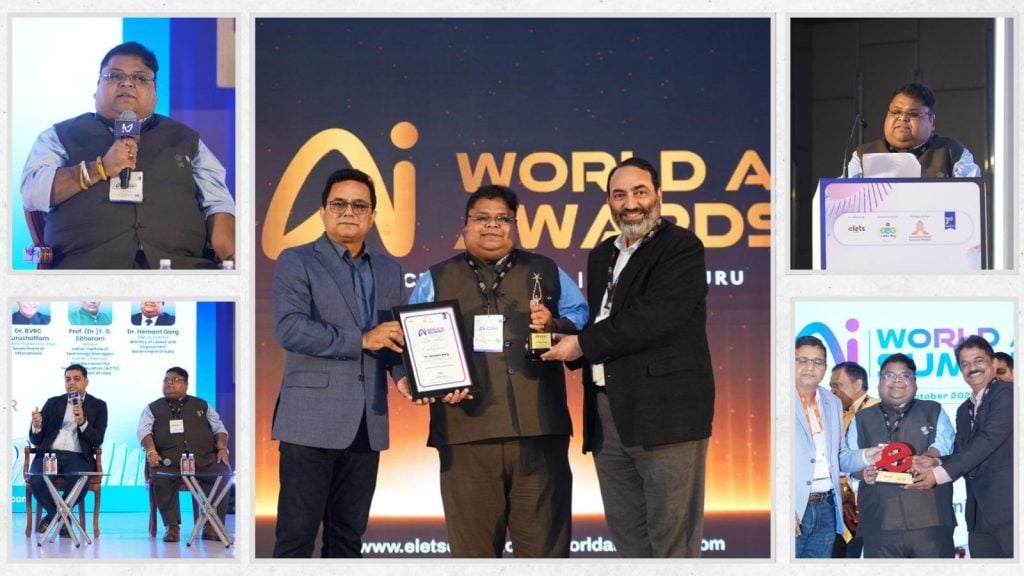
Dr. Garg described all of his work, from AI agents for government to AI-led labour law outreach, as an effort to help realise Hon’ble Prime Minister Shri Narendra Modi’s vision of Viksit Bharat@2047, under the leadership of Hon’ble Union Labour and Employment Minister Dr. Mansukh Mandaviya, whose Shramev Jayate reforms, Labour Codes and Ease of Doing Business drive set the direction. The goal, he said, is an Atmanirbhar Bharat in AI, built on a Bharat AI Stack: Indian large language models such as Sarvam, the Bhashini platform serving citizens in their own languages, and home-grown agents and talent under the IndiaAI Mission, taking India into the global AI league.
Held with Digital India, the National e-Governance Division (NeGD) and the Karnataka Digital Economy Mission (KDEM) as partners in Bengaluru, India’s startup, IT and now AI capital, often called India’s Silicon Valley, the Summit was themed “AI for All: Accelerating India’s Journey Towards Inclusive, Responsible and Future-Ready AI”.
The award honours his creation in 2023 of “IFSCA Karmayogi”, the first AI agent at the International Financial Services Centres Authority (IFSCA), GIFT City, and his research on AI in anti-money laundering, the Labour Codes and algorithmic management of gig workers.
On the panel “AI for All – India’s Journey to a Sovereign, Inclusive AI Future”, with Shri Aman Mittal, IAS, Dr. BVRC Purushottam, IAS and Prof. (Dr.) T. G. Sitharam, former Chairman, AICTE, moderated by Dr. Ravi Gupta, Dr. Garg said inclusive AI must include the worker, and that India can blend Europe’s rights-based approach, US-style audits and Singapore’s skilling model through its Labour Codes, the DPDP Act and e-Shram.
His keynote, “AI, Employment & Skills: Building a Future-Ready Workforce for India”, presented as “From Files to Foresight”, began with a worker disabled in an accident, or a family that has lost its breadwinner, whose care and pensions depend on ESIC, EPFO, the Ministry of Labour and Employment and the National Health Authority. “The true test of AI in government is how quickly that family receives its benefits, and whether it is treated with dignity on the way,” he said.
He traced three waves of governance: e-Governance, which put paper online; Digital Governance, built on India’s digital public infrastructure; and now AI-enabled Intelligent Governance, where benefits reach eligible citizens without their having to apply.
Dr. Garg propounded that AI will change tasks first, then jobs, then institutions and the workforce, and called for institutions for AI governance, impact assessment and exposure mapping to curb job attrition, support reskilling and compensate workers in transition. e-Shram, ESIC and EPFO, now reaching gig and platform workers, can extend social security to those left out, while indigenous models such as Sarvam and Bhashini can grow home-grown AI talent under the IndiaAI Mission.
Government AI, he said, must be lawful, explainable and accountable; “a pattern is not proof”; and India must guard against a new colonisation “not by ships, but by servers”. He proposed “Five Ts”: Trust, Transparency, Talent, Thin and safe data, and Tested-then-scaled.
An LLB, LLM and Ph.D., and an IIT Delhi CTO Programme alumnus with nearly two decades in public service, including Punjab’s Department of Cooperation, Dr. Garg has researched digital governance in governments and cooperatives extensively; his work is published internationally, taught in universities and presented at Oxford, Harvard and Cambridge.
“Not artificial intelligence replacing governance, but intelligent governance that remains deeply human,” he concluded.
Connect with Dr. Hemant Garg on LinkedIn: https://in.linkedin.com/in/dr-hemant-garg-2b26699
About Author
Disclaimer: The views, suggestions, and opinions expressed here are the sole responsibility of the experts. No Digi Observer journalist was involved in the writing and production of this article.
Karviva and Founder Dr. Angela Zeng Featured in 2026 USA TODAY Food as Medicine Edition.
U-topia Launches Public Beta as Global Builders Gather for U-Hackathon
From Karmayogi to the World Stage: Dr. Hemant Garg Wins “Excellence in AI for Public Policy”, Charts India’s Path to the AI Big League
Benzinga Money Article Discusses How to Become Part of the 12% of Retirees Who Have Achieved the Recommended $550,000 Minimum Retirement Savings Threshold
Apu Apustaja Conquers New York with Lively Street Ads, Including Times Square Billboard
Bay Smokes Maintains Quality Amid Legislative Changes in the Hemp Industry


-
Press Release2 days ago
Midwest Ragdolls Highlights Why a Kitten’s Early Environment Matters
-
Press Release4 days ago
INmune Bio Inc. and Quantum Computing Inc. Partner to Apply Quantum Optimization and AI to Advance Alzheimer’s Drug Research and Explore New Applications for XPro
-
Press Release3 days ago
Exhibit at CES 2027: Showcasing GENCHI, the Immersive Avatar Service Called Crazy by a U.S. Angel Investor
-
Press Release6 days ago
Beyond the Customs Declaration: Gorian Aduanas Takes a Specialist, Bespoke Approach to Customs Clearance and Complex International Imports
-
Press Release1 day ago
From Karmayogi to the World Stage: Dr. Hemant Garg Wins “Excellence in AI for Public Policy”, Charts India’s Path to the AI Big League
-
Press Release4 days ago
Evolution Metals & Technologies Corp. Reaffirms $400 Million to $460 Million FY2027 Revenue Guidance, Unveils Eight Sintered Magnet Grades Covering an Estimated 75% of Global NdFeB Revenue, and Moves to Answer U.S. Army Call for Rare Earth Magnets
-
Press Release7 days ago
DATA Network joins Sui and Walrus to scale the supply chain for AI training data
-
Press Release1 day ago
Karviva and Founder Dr. Angela Zeng Featured in 2026 USA TODAY Food as Medicine Edition.