
Press Release
After 25 Years and Six Multi-Seven-Figure Businesses, Paul Bocco Says AI Profit Consulting Is the Most Important Work of His Career

-
Why a veteran entrepreneur believes AI consulting, done right, is the next real opportunity for sales professionals and small businesses alike.
North Carolina, US, 16th February 2026, ZEX PR WIRE, After 25 years in business, six multi-seven-figure companies, and more than 1,000 business owners helped, Paul Bocco is not chasing his next win. He is drawing a line in the sand.

The founder of AI Profit Consulting believes the current moment in business is both overhyped and deeply misunderstood. Artificial intelligence, he argues, is being marketed as magic when it should be treated as infrastructure. And the people best positioned to bring that infrastructure to small businesses are not Silicon Valley engineers or software startups. They are experienced sales professionals who already understand how businesses actually operate.
“This is the least sexy, most practical opportunity I’ve seen in my career,” Bocco says. “And that’s exactly why it works.”
Why AI Is Infrastructure, Not Hype
Bocco’s latest venture marks a clear milestone in a long entrepreneurial arc that began in 2000. Over the past quarter-century, he has built and scaled businesses across marketing, e-commerce, coaching, and consumer financial services. His foundation in direct-response marketing and sales systems has produced measurable results, including hundreds of documented client success stories. But after decades of watching trends rise and collapse, Bocco says the AI wave feels different for one reason: small businesses are finally forced to change.
For years, owner-operated service businesses have survived despite broken systems. Missed calls, unworked leads, inconsistent follow-up, and manual scheduling have quietly drained revenue. According to Bocco, AI does not replace these businesses; it simply exposes how much money they have been leaving on the table.
“AI didn’t create the problem,” he explains. “It just made the problem impossible to ignore.”
From Six Multi-Seven-Figure Businesses to One Clear Thesis
That insight is the backbone of AI Profit Consulting, a coaching business designed to help experienced sales professionals launch their own AI automation consulting businesses. The model is deliberately unglamorous. Members do not sell speculative software or experimental tools. They sell outcomes: booked appointments, recovered leads, answered calls, and cleaner pipelines.
The result is real money, real fast, for small businesses that already have demand.
Bocco’s program teaches consultants how to deliver services such as dormant lead reactivation, automated follow-up, AI appointment booking, missed-call handling, voice AI, and buyer-intent data delivery. These services are sold on annual contracts ranging from $5,000 to $50,000 per client, often adding $150,000 or more in annual value to a single small business.
This is not theory. It is the same operational math Bocco has used for decades.
“I’ve lived through dot-com hype, social media hype, funnel hype, crypto hype,” he says. “Most of it benefits the platforms first and the end user last. This is different. Small businesses win immediately, and consultants build predictable, recurring revenue.”
The opinion that separates Bocco from many voices in the AI space is his insistence that technology is not the business. Sales, compliance, pricing, fulfillment, and client management still matter more than tools. That belief is reflected in AI Profit Consulting’s curriculum, a 21-lesson framework covering compliance training, objection handling, pricing strategy, delivery processes, and long-term client retention.
“AI doesn’t fix bad sales,” Bocco says. “And it doesn’t fix bad ethics. If anything, it amplifies them.”
His stance comes from experience. Over 25 years, Bocco has watched talented people fail not because they lacked opportunity, but because they lacked structure. He has also seen small business owners burned by vendors who overpromised and disappeared. AI Profit Consulting was built specifically to prevent both outcomes.
The Case for Sales Professionals as the Next AI Operators
The program includes an eight-week front-end training, a backend mastermind, and optional done-for-you fulfillment services structured on a revenue-share model. The goal is not to create gurus, but operators.
“Sales professionals already have the hardest skill,” Bocco argues. “They know how to talk to business owners. Everything else is teachable.”
That belief has resonated strongly with a growing segment of professionals who feel trapped selling commoditized products with shrinking commissions. Many of Bocco’s members come from traditional sales backgrounds where effort no longer correlates with income. AI consulting, in contrast, allows them to own the client relationship, the pricing, and the recurring revenue.
For Bocco, this venture is also personal. As a self-described introvert, he understands the cost of grinding in roles that demand constant performance without ownership. His model emphasizes leverage, systems, and sustainability rather than hustle for its own sake.
“This is the kind of business I wish existed earlier in my career,” he says. “Clear value, clear pricing, and no pretending.”
“Technology doesn’t change human nature,” Bocco notes. “Integrity still compounds. Shortcuts still collapse.”
As AI adoption accelerates, Bocco is outspoken about what he believes will happen next. Many small businesses, he predicts, will be overwhelmed by vendors selling fragmented tools without accountability. At the same time, consultants who position themselves as trusted operators rather than tech resellers will thrive.
“The winners won’t be the loudest,” he says. “They’ll be the ones who make the phone ring and the calendar fill.”
Looking back on 25 years in business, Bocco is clear that this milestone is not about nostalgia. It is about synthesis. AI Profit Consulting represents the convergence of everything he has learned about sales, systems, automation, and human behavior.
“This isn’t a pivot,” he says. “It’s a distillation.”
For sales professionals seeking ownership, for small businesses drowning in inefficiency, and for an industry saturated with empty promises, Paul Bocco’s message is blunt: AI is not the future. Execution is.
And after 25 years of building businesses the hard way, he is betting his next chapter on helping others do the same; this time with better tools, clearer systems, and fewer illusions.
Media Contact
Paul Bocco
Founder, AI Profit Consulting
Charlotte, North Carolina, United States
LinkedIn: https://www.linkedin.com/in/paulboc/
Website: https://www.skool.com/ai-profit-consultant
For media inquiries, interviews, speaking engagements, and commentary on AI consulting, sales systems, and recurring revenue models for small businesses.
About Author

Disclaimer: The views, suggestions, and opinions expressed here are the sole responsibility of the experts. No Digi Observer journalist was involved in the writing and production of this article.

Press Release
Just Like Mona Lisa Confirmed Anime Adaptation, Teaser Visual and Illustration Revealed
Special Panel Stage Confirmed for AnimagiC 2026 Featuring the World Premiere of the Main Cast and The First Trailer
An anime adaptation of Just Like Mona Lisa (Original Title: Seibetsu “Mona Lisa” no Kimi e), the project previously unveiled under the codename “Project M,” has officially been announced, with the teaser visual released alongside the announcement. The upcoming series is set to portray the story’s sensitive emotions and vivid world through expressive new animation.

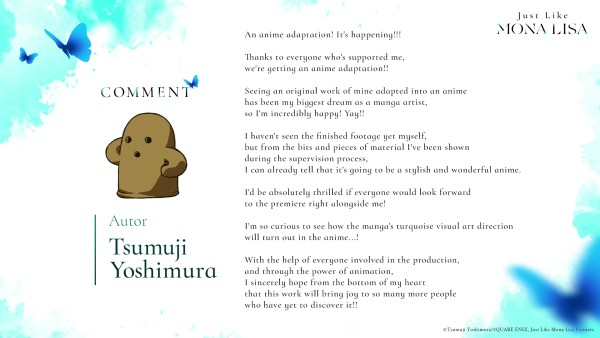
Furthermore, to commemorate this milestone, author Tsumuji Yoshimura, has shared an exclusive newly drawn celebratory illustration alongside an official comment.
Introduction to Just Like Mona Lisa
What if everyone were born genderless, who would you fall in love with? The highly anticipated TV anime adaptation of Just Like Mona Lisa by Tsumuji Yoshimura, a series that has surpassed a cumulative 1 million copies sold, is finally here.
Hinase, the main character who continues to live genderless. Childhood friends Ritsu and Shiori, who have already chosen theirs. What is “love”? What does it mean to have something you want to cherish above all else? Their classmates and the adults around them struggle and hesitate alongside them, weaving the story together. What choice will Hinase make? A breathtaking triangle of first love and youth, now brought to life in beautiful animation by SHAFT, one of Japan’s leading animation studios.
・Official Website: https://monalisa-anime.com
・Official X: @anime_mona_lisa (https://x.com/anime_mona_lisa)
Special Comment & Illustration from Author Tsumuji Yoshimura
Story
In a world where everyone is born genderless. Their bodies shift toward their desired gender when they reach around twelve years old. Yet Hinase alone had not changed at all and had now reached the age of eighteen. Arima Hinase, a third-year high school student, carries the quiet unease of being the only one around them genderless, yet simply spends unchanged days with childhood friends Ritsu Kaga and Shiori Takayama, and that alone had been enough. Then one day, when Ritsu and Shiori confess their feelings towards Hinease, their everyday life begins to change. “Something is about to change. Their eighteenth spring has arrived.”

Tsumuji Yoshimura / SQUARE ENIX, “Just Like Mona Lisa” Project
Tsumuji Yoshimura / SQUARE ENIX, “Just Like Mona Lisa” Project

Tsumuji Yoshimura / SQUARE ENIX, “Just Like Mona Lisa” Project

Tsumuji Yoshimura / SQUARE ENIX, “Just Like Mona Lisa” Project
Staff
– Original Story: Tsumuji Yoshimura’s “Just Like Mona Lisa” (Published by Square Enix “Gangan Comics ONLINE”)
– Animation Production: SHAFT Inc.
Original Manga Information
・Publisher: Square Enix Co., Ltd.
・Author: Tsumuji Yoshimura
・Volumes: Volumes 1–8, along with spin-off volumes “X” and “Y,” totaling 10 volumes now available.
Media & Press Inquiries
CyberAgent, Inc. Corporate Communications / PR Team: Mika
Media Contact
Organization: CyberAgent, Inc.
Contact Person: CyberAgent, Inc. Press Contact
Website: https://caanime.cyberagent.co.jp/en/
Email: Send Email
Address:40-1 Udagawacho, Abema Towers, Shibuya City, Tokyo
City: Tokyo
Country:Japan
Release id:46191
The post Just Like Mona Lisa Confirmed Anime Adaptation, Teaser Visual and Illustration Revealed appeared first on King Newswire. This content is provided by a third-party source.. King Newswire makes no warranties or representations in connection with it. King Newswire is a press release distribution agency and does not endorse or verify the claims made in this release. If you have any complaints or copyright concerns related to this article, please contact the company listed in the ‘Media Contact’ section
About Author
Disclaimer: The views, suggestions, and opinions expressed here are the sole responsibility of the experts. No Digi Observer journalist was involved in the writing and production of this article.
Press Release
Just Like Mona Lisa Confirmed Anime Adaptation, Teaser Visual and Illustration Revealed
Special Panel Stage Confirmed for AnimagiC 2026 Featuring the World Premiere of the Main Cast and The First Trailer
An anime adaptation of Just Like Mona Lisa (Original Title: Seibetsu “Mona Lisa” no Kimi e), the project previously unveiled under the codename “Project M,” has officially been announced, with the teaser visual released alongside the announcement. The upcoming series is set to portray the story’s sensitive emotions and vivid world through expressive new animation.
Furthermore, to commemorate this milestone, author Tsumuji Yoshimura, has shared an exclusive newly drawn celebratory illustration alongside an official comment.
Introduction to Just Like Mona Lisa
What if everyone were born genderless, who would you fall in love with? The highly anticipated TV anime adaptation of Just Like Mona Lisa by Tsumuji Yoshimura, a series that has surpassed a cumulative 1 million copies sold, is finally here.
Hinase, the main character who continues to live genderless. Childhood friends Ritsu and Shiori, who have already chosen theirs. What is “love”? What does it mean to have something you want to cherish above all else? Their classmates and the adults around them struggle and hesitate alongside them, weaving the story together. What choice will Hinase make? A breathtaking triangle of first love and youth, now brought to life in beautiful animation by SHAFT, one of Japan’s leading animation studios.
・Official Website: https://monalisa-anime.com
・Official X: @anime_mona_lisa (https://x.com/anime_mona_lisa)
Special Comment & Illustration from Author Tsumuji Yoshimura
Story
In a world where everyone is born genderless. Their bodies shift toward their desired gender when they reach around twelve years old. Yet Hinase alone had not changed at all and had now reached the age of eighteen. Arima Hinase, a third-year high school student, carries the quiet unease of being the only one around them genderless, yet simply spends unchanged days with childhood friends Ritsu Kaga and Shiori Takayama, and that alone had been enough. Then one day, when Ritsu and Shiori confess their feelings towards Hinease, their everyday life begins to change. “Something is about to change. Their eighteenth spring has arrived.”
Tsumuji Yoshimura / SQUARE ENIX, “Just Like Mona Lisa” Project
Tsumuji Yoshimura / SQUARE ENIX, “Just Like Mona Lisa” Project
Tsumuji Yoshimura / SQUARE ENIX, “Just Like Mona Lisa” Project
Tsumuji Yoshimura / SQUARE ENIX, “Just Like Mona Lisa” Project
Staff
– Original Story: Tsumuji Yoshimura’s “Just Like Mona Lisa” (Published by Square Enix “Gangan Comics ONLINE”)
– Animation Production: SHAFT Inc.
Original Manga Information
・Publisher: Square Enix Co., Ltd.
・Author: Tsumuji Yoshimura
・Volumes: Volumes 1–8, along with spin-off volumes “X” and “Y,” totaling 10 volumes now available.
Media & Press Inquiries
CyberAgent, Inc. Corporate Communications / PR Team: Mika
Media Contact
Organization: CyberAgent, Inc.
Contact Person: CyberAgent, Inc. Press Contact
Website: https://caanime.cyberagent.co.jp/en/
Email: Send Email
Address:40-1 Udagawacho, Abema Towers, Shibuya City, Tokyo
City: Tokyo
Country:Japan
Release id:46191
The post Just Like Mona Lisa Confirmed Anime Adaptation, Teaser Visual and Illustration Revealed appeared first on King Newswire. This content is provided by a third-party source.. King Newswire makes no warranties or representations in connection with it. King Newswire is a press release distribution agency and does not endorse or verify the claims made in this release. If you have any complaints or copyright concerns related to this article, please contact the company listed in the ‘Media Contact’ section
About Author
Disclaimer: The views, suggestions, and opinions expressed here are the sole responsibility of the experts. No Digi Observer journalist was involved in the writing and production of this article.
Press Release
Michael A. Griffin Encourages Young Professionals to Learn Every Role Before Seeking Leadership
-
Raleigh business leader Michael A. Griffin says the best leaders are built through experience, not titles, and encourages young professionals to focus on learning before leading.
RALEIGH, N.C. Jun 18, 2026, ZEX PR WIRE — Michael A. Griffin, CEO and Chairman of National Business Center, Inc., is encouraging young professionals to resist the pressure to rush into leadership positions and instead focus on understanding the work, the people, and the processes that make organizations successful.
Griffin’s message comes from personal experience. Before becoming a CEO, he spent years working in customer service and learning different aspects of business operations. He believes those experiences provided lessons that continue to shape his leadership approach today.
“Everybody wants the title,” Griffin said. “Not everybody wants to learn what the people doing the work deal with every day. That’s where the real education happens.”
According to a recent Gallup workplace report, managers account for as much as 70% of the variation in employee engagement. Despite that impact, many professionals enter leadership roles without first gaining experience across different functions within an organization.
Griffin believes that creates challenges for both leaders and teams.
“When I first started, I paid attention to how customers reacted, how employees solved problems, and where processes broke down,” he said. “Those observations taught me more about leadership than any management title could have.”
Research from the Center for Creative Leadership has found that experience-based learning is one of the most significant drivers of leadership development. Exposure to different responsibilities helps future leaders understand how decisions affect employees, customers, and operations.
For Griffin, some of the most valuable lessons came from working closest to customers.
“I remember seeing situations where a policy looked good on paper but created confusion in practice,” he said. “If you’ve never been the person dealing directly with that confusion, it’s easy to make decisions that create more problems.”
He believes young professionals should actively seek opportunities to learn beyond the boundaries of their current role.
That could mean spending time with different departments, volunteering for new projects, observing experienced colleagues, or simply asking more questions.
“The people who grow the fastest are usually the people who stay curious,” Griffin said. “They want to understand how everything connects.”
Griffin also draws leadership lessons from his background in baseball and football. Growing up in Eastern North Carolina, he learned that successful teams depend on every player understanding their role and how it contributes to the larger goal.
“In sports, you learn pretty quickly that one person can’t do everything,” he said. “You also learn that every position matters. Business works the same way.”
He believes those lessons are particularly important in an era where career advancement often feels accelerated.
Social media and professional networking platforms can create the impression that leadership is something people achieve quickly. Griffin argues that the strongest leaders are often the ones who spend years building knowledge and credibility before taking on greater responsibility.
“People see the promotion,” he said. “They don’t always see the years of learning that came before it.”
His advice to young professionals is straightforward: focus less on managing people and more on understanding how the work gets done.
“Learn the customer side. Learn the operational side. Learn where problems start and how they get solved,” Griffin said. “The more perspectives you understand, the better decisions you’ll make later.”
He believes that leadership is ultimately about serving others and helping teams perform at their best. That becomes easier when leaders understand the challenges their employees face.
“When people know you’ve done the work or taken the time to understand it, trust comes faster,” he said. “Trust is one of the most important things a leader can earn.”
As organizations continue to navigate change and workforce development challenges, Griffin hopes more young professionals will view learning as an investment rather than a delay.
“Leadership isn’t a destination,” he said. “It’s the result of experiences, lessons, mistakes, and growth. The more you learn before you lead, the better prepared you’ll be when the opportunity comes.”
About Michael A. Griffin
Michael A. Griffin is the CEO and Chairman of National Business Center, Inc., based in Raleigh, North Carolina. He oversees Vegas-Style Skill Games and Blue Bull Gaming and has spent years working in customer service, operations, and executive leadership. Raised in Eastern North Carolina, Griffin played baseball and football growing up and credits many of his leadership principles to lessons learned through sports, teamwork, and hands-on experience. He frequently writes and speaks about leadership, operational discipline, customer behavior, and professional development.
About Author
Disclaimer: The views, suggestions, and opinions expressed here are the sole responsibility of the experts. No Digi Observer journalist was involved in the writing and production of this article.
Just Like Mona Lisa Confirmed Anime Adaptation, Teaser Visual and Illustration Revealed
Just Like Mona Lisa Confirmed Anime Adaptation, Teaser Visual and Illustration Revealed
Michael A. Griffin Encourages Young Professionals to Learn Every Role Before Seeking Leadership
Benzinga Money Article Discusses How to Become Part of the 12% of Retirees Who Have Achieved the Recommended $550,000 Minimum Retirement Savings Threshold
Apu Apustaja Conquers New York with Lively Street Ads, Including Times Square Billboard
Bay Smokes Maintains Quality Amid Legislative Changes in the Hemp Industry


-
Press Release2 days ago
FARO Board Bags Expands Premium Surf Gear Line with Durable Surfboard Protection and Sustainable Travel Solutions in the USA
-
Press Release5 days ago
MarketAnywhere Sets the National Standard for Best Flyer Distribution and Door-to-Door Marketing in the United States
-
Press Release5 days ago
The Surgeon Everyone Sees on the Way to the Hamptons: Dr. David Pincus of Pincus Plastic Surgery
-
Press Release6 days ago
GLP-1 Patients Regain Most of Their Lost Weight Within 2 Years . A Tampa Telehealth Provider Is Partnering With a Digital Health Platform to Change That.
-
Press Release5 days ago
isCalculator: The Evolution Of No-Code; Ai Platform Instantly Generates Mathematical Mini-Applications
-
Press Release5 days ago
The Point Elevates Coastal Celebrations with Premier Waterfront Event Venue in Mission Beach, San Diego
-
Press Release6 days ago
Jerky Didn’t Need Another Flavor It Needed a Personality
-
Press Release6 days ago
SellerSprite launches 2026 Amazon growth intelligence toolkit for sellers facing higher costs