
Press Release
Nvidia’s Market Value Soars, Highlighting AI’s Future: Opportunities and Challenges for Decentralized AI WorldBrain

Recently, Nvidia released its first-quarter financial report, with strong results exceeding market expectations, showcasing significant growth in both revenue and net profit. Nvidia’s stock surged nearly 7%, breaking the $1,000 mark for the first time, with market value skyrocketing by $1.35 trillion overnight, bringing the total to $2.8 trillion. This surge in Nvidia’s stock price pushed most tech stocks higher, leading the Nasdaq to break the 17,000-point threshold for the first time in history.
The rapid development of AI has driven a strong demand for high-performance computing, particularly in the data center sector, which has been a major growth driver for Nvidia. The financial report shows that Nvidia achieved $26 billion in revenue in the first quarter, with data center business driving the core growth, contributing $22.26 billion, marking a 427% year-over-year increase.
Currently, Nvidia is the third-largest company by market value globally and the most sought-after AI chip manufacturer. With global tech companies and government agencies increasing their investments in AI technology, the demand for Nvidia’s high-performance GPUs has grown accordingly.
Nvidia’s Market Surge Highlights AI’s Future and the Rise of AI Investment Trends
The story begins with OpenAI, which paved the way for generative AI by developing advanced models like the GPT series and DALL-E. Since then, large language models have developed rapidly. Companies like Google, Microsoft, Meta, Amazon, and OpenAI have invested billions in Nvidia GPUs to develop and deploy AI applications. For instance, Meta’s latest large language model, Lama 3, used 24,000 H100 GPUs. Nvidia’s leading technology in GPUs and other AI chips has given it a monopolistic position globally.
Nvidia’s soaring market value underscores the immense potential of AI technology as a future growth engine. As AI technology continues to penetrate various industries, investment and attention in the AI field are increasing. Jensen Huang stated that there are approximately 15,000 to 20,000 generative AI startups across various fields. Nvidia’s better-than-expected financial report has driven a surge in AI-related stocks, indicating investor confidence in AI’s transformative potential and long-term returns.
Market research firm PitchBook recently released its latest Q1 2024 global AI and machine learning investment data report, showing that 1,779 financing transactions were completed in the AI field globally in the first quarter, raising a total of $21.6 billion. Recently, Musk’s xAI secured $6 billion in funding, with a valuation of $24 billion. Against this backdrop, the decentralized AI platform WorldBrain has also seized development opportunities, offering innovative business models and technical solutions to facilitate the widespread application of AI technology.
WorldBrain: Opportunities for Decentralized AI
WorldBrain, an innovative project initiated by OpenAI’s Worldbrains Foundation, aims to create an unprecedented distributed intelligent neural network system based on the WorldModel. Combining WorldModel and Web3 technologies to empower AI, WorldBrain represents cutting-edge development in the AI field, promoting higher intelligence and autonomy while achieving decentralization.
Massive Computing Demands and Energy Consumption of AI Foster Distributed Computing Solutions
AI models, especially large neural networks, require immense computing power and energy to train and operate, leading to high power consumption and environmental impact, raising sustainability concerns. Research firm CB Insights recently released a report on generative AI industry predictions for 2024:
On one hand, generative AI infrastructure consumes a tremendous amount of energy. With the advancement of AI technology, the energy demand for high-performance GPUs is steadily increasing. By 2024, the energy consumption of Nvidia’s high-end H100 chips is expected to match that of a small country. Traditional data centers will face the pressure to upgrade to meet AI’s high-power and high-heat demands.
On the other hand, chip shortages are causing computational resource constraints. Amid the GPU shortage, the price of Nvidia’s high-end H100 chips has soared. The high cost of high-performance chips presents challenges for small companies, limiting their competitiveness and development speed in the large model research field.
In response, WorldBrain proposes a distributed computing solution. Distributed computing doesn’t rely on powerful computing resources; it requires minimal device specifications, allowing anyone on Earth to participate using small devices like smartphones. Utilizing distributed computing technology and DePIN networks, any physical device globally can freely access the decentralized WorldBrain network. WorldBrain also features low energy consumption; the energy consumed by the intelligent operations in the brain is comparable to a light bulb, with a single APP neuron consuming only 1/20 of the total power of a smartphone, making the computing cost extremely low.
Democratizing AI Technology: Co-creating a Fair Future
Einstein once said, “Technology has exceeded humanity.” Currently, global AI technology is controlled and managed by a few tech monopolies. We have seen the monopolistic ambitions of tech giants, with algorithms, traffic, and big data disrupting fundamental societal rules. Algorithms monopolize news, shopping, travel, and social interactions, infringing on privacy and negating individual value. They exploit authors’ creativity to make money through big data and algorithms. The democratization of AI technology concerns everyone’s privacy and interests.
Challenging Silicon Valley’s monopolistic power and countering digital utopias, the development of decentralized AI helps break the monopoly of computing resources by a few enterprises, promoting the democratization and popularization of AI technology. In the WorldBrain ecosystem, users achieve self-management through smart contracts and DAOs. Using distributed storage and blockchain technology, data and computing tasks are distributed across multiple nodes, with no single control center, better protecting user privacy and allowing all participants to verify and access information more transparently.
WorldBrain leverages distributed computing technology to deploy hardware devices globally via the DePIN network and applies token-based incentive mechanisms, making every user a creator and owner of the WorldBrain system. The wealth created by WorldBrain, sufficient for human prosperity, is effectively distributed to every participant. This ensures that the benefits of general AI represented by WorldBrain reach ordinary people.
Empowering AI with Web3: The Explosive Potential of DePIN and Decentralized AI
WorldBrain empowers AI with Web3 technology, achieving true decentralization. By innovating with DePIN and AI technology, it utilizes idle computing power and physical devices worldwide to provide efficient and affordable computing resources for the AI industry.
The WorldBrain project is the first to launch an AI system using decentralized technology. By integrating cutting-edge AI development with blockchain technology, WorldBrain offers innovative decentralized AI solutions, gaining significant favor from capital markets, including Morgan Stanley and Goldman Sachs. Currently, the WorldBrain neural network incentive system has amassed substantial user data, with 2,669,017 registered users and 81,921 on-chain wallet addresses. This dual support of capital and user traffic indicates WorldBrain’s immense potential in future technological development.
As WorldBrain continues to advance and improve, we have reason to believe it can build a decentralized, open, and transparent environment where everyone can participate equally and share the benefits of AI technology. Whether it’s acquiring knowledge, sharing creativity, or creating value, WorldBrain will provide a fair, secure, and efficient platform, enabling everyone to find their place in this intelligent era and allowing global users to participate in and benefit from AI development.
Media Contact
Company Name:Worldbrains Foundation
Contact Person:Alex
State:Colorado
Country:United State
Website: worldbrains.org
Email:business@worldbrains.org
About Author

Disclaimer: The views, suggestions, and opinions expressed here are the sole responsibility of the experts. No Digi Observer journalist was involved in the writing and production of this article.

South African author and visionaire Peter Mantu has published Bitcoin Royalty: The Rise of King-P, a fictional narrative that uses a royal kingdom setting to explore leadership, technology, learning, governance, competition, and social responsibility.
Durban, Kwazulu-Natal, South Africa, 30th Sep 2026 — South African author Peter Mantu has announced the publication of Bitcoin Royalty: The Rise of King-P, a fictional literary work that combines storytelling, allegory and technology-themed world-building.
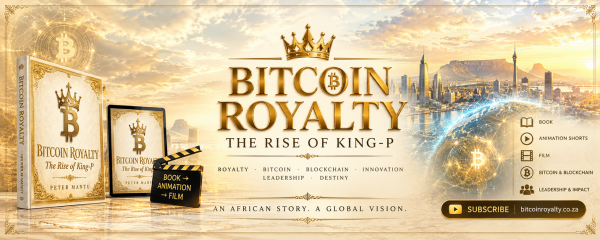
The story follows King-P, a fictional monarch whose journey begins with an encounter with Bitcoin and blockchain technology. As the narrative develops, King-P is confronted with questions surrounding leadership, knowledge, decision-making, collaboration, competition and responsibility.
Rather than presenting itself as a technical manual or factual guide, Bitcoin Royalty: The Rise of King-P uses a fictional kingdom and its characters to introduce readers to concepts associated with the evolving world of digital technology.
“I wanted to create a story that could introduce complex technological themes through characters, dialogue and an imaginative kingdom,” said Peter Mantu, author of Bitcoin Royalty: The Rise of King-P. “At its heart, the book is about learning, leadership, responsibility and the choices people make when confronted with something new.”
A Fictional Journey Through the Kingdom
The book is structured around 12 chapters, following King-P as he encounters different people, challenges and perspectives.
A central feature of the story is the fictional Cryptocurrency Council, a group representing different areas of knowledge and expertise. The council becomes part of King-P’s journey as he seeks to understand the unfamiliar technological landscape introduced into his kingdom.
The narrative incorporates themes including:
- Discovery and learning — King-P’s introduction to Bitcoin, blockchain and emerging technology.
- Leadership — the responsibilities associated with guiding a kingdom through periods of uncertainty and change.
- Knowledge and understanding — the importance of asking questions and seeking different perspectives.
- Collaboration — the role of specialists and advisers in helping the fictional kingdom navigate new challenges.
- Competition — relationships between rival kingdoms and the effect of competing ideas on communities.
- Governance — questions surrounding rules, decision-making and responsibility.
- Innovation and change — the impact of unfamiliar technology on established systems and traditions.
- Trust and responsibility — the relationships between leaders, advisers and members of the fictional kingdom.
The Story’s Major Chapters
The storyline progresses through a series of events that shape King-P’s development as a fictional leader.
The Proclamation introduces King-P’s decision to explore a new technological frontier and establish a direction for his kingdom.
The Quest Begins follows his early encounters with Bitcoin and blockchain concepts as he begins a process of discovery and learning.
The Cryptocurrency Council introduces the group of fictional advisers whose different areas of knowledge contribute to King-P’s understanding of the new technology.
Bitcoin’s Rise and The Bitcoin Battle develop the central conflict of the story, introducing changing circumstances and competing perspectives within the kingdom.
The Great Halving incorporates the concept of Bitcoin’s programmed supply reduction into the fictional storyline.
The Regulatory Challenge introduces questions concerning rules, governance and how institutions respond to technological change.
The Cryptocurrency War expands the fictional world through the introduction of a rival kingdom and its own digital project, RoyalCoin. The storyline uses the rivalry to explore competition, cooperation and public trust.
The Final Push and The Triumph of King-P bring the central narrative toward its conclusion, with the story reflecting on the lessons King-P encounters throughout his journey.
A Story About Technology, Leadership and Responsibility
While Bitcoin and blockchain provide an important backdrop to the narrative, the book’s broader themes extend to leadership, education, innovation, collaboration and social responsibility.
The fictional kingdom allows these themes to be presented through characters and events rather than through a conventional technical or academic format.
The book is intended as a creative work of fiction, with its characters, kingdom and events serving as narrative devices through which readers can explore ideas surrounding technological change and leadership.
From Book to Screen
The world established in Bitcoin Royalty: The Rise of King-P has also created opportunities for further creative development, including discussions around a potential film or screen adaptation.
The project is open to enquiries from producers, production companies and other media professionals interested in exploring the story’s potential for adaptation.
Publication and Availability
Bitcoin Royalty: The Rise of King-P is available online through the following official platforms:
King P Empire — Bitcoin Royalty
About Bitcoin Royalty: The Rise of King-P
Bitcoin Royalty: The Rise of King-P is a fictional narrative by Peter Mantu that combines a royal kingdom setting with themes of technology, leadership, learning, governance, competition and responsibility.
Through the fictional journey of King-P and the characters surrounding him, the book explores how individuals and communities can encounter unfamiliar ideas and technologies and respond to change.
About Bitcoin Royalty
Bitcoin Royalty is the official project identity associated with Bitcoin Royalty: The Rise of King-P. The project provides information about the book and related creative developments through its official website.
Bitcoin Royalty Official Website
Media Contact
Bitcoin Royalty — Peter Mantu
Website: www.bitcoinroyalty.co.za
Phone/WhatsApp: +27 64 981 9285
Email: info@bitcoinroyalty.co.za
Editorial Note
Bitcoin Royalty: The Rise of King-P is presented as a work of fiction. The characters, kingdom, events and narrative circumstances are part of the creative story. The publication is not presented as financial, investment, legal or tax advice.
Media Contact
Organization: Bitcoin Royalty
Contact Person: Peter Mantu
Website: https://bitcoinroyalty.co.za/
Email: Send Email
Contact Number: +27649819285
Address: Unit 14, 25 Speedwell Rd
Address 2: Morningside, Berea
City: Durban
State: Kwazulu-Natal
Country: South Africa
Release id: 49546
The post Bitcoin Royalty: The Rise of King-P Is Published as a Fictional Literary Work appeared first on King Newswire. This content is provided by a third-party source.. King Newswire makes no warranties or representations in connection with it. King Newswire is a press release distribution agency and does not endorse or verify the claims made in this release. If you have any complaints or copyright concerns related to this article, please contact the company listed in the ‘Media Contact’ section
About Author
Disclaimer: The views, suggestions, and opinions expressed here are the sole responsibility of the experts. No Digi Observer journalist was involved in the writing and production of this article.
Press Release
Steven Mwakalebela Assets Limited SMA Details Cross-Market Research Perspectives for Regional Capital Markets
Steven Mwakalebela Assets Limited (SMA) describes a cross-market research approach that relates London and New York market analysis to regional capital markets and domestic equity exchanges
Dar es Salaam, Africa, Tanzania, 30th Sep 2026 – Steven Mwakalebela Assets Limited (SMA), an independent capital markets research and education organization, has described how its published work connects global market research with analysis of regional capital markets. The approach is associated with Founder, Chairman, and Chief Financial Analyst Steven Mwakalebela. According to SMA’s website, his career experience spans more than 30 years and includes research involving companies listed in London and New York. SMA’s research coverage also includes regional equity markets, local stock exchanges, and macroeconomic factors relevant to regional analysis. The organization presents this as a research and education perspective, not as a cross-border trading service or an asset management offering.

Connecting Global Research with Regional Questions
SMA’s materials examine how global and regional factors can be considered within the same research process. The subjects listed on its research pages include interest rates, inflation, foreign exchange reserves, commodity cycles, company fundamentals, and market valuation. These factors do not affect every company or market in the same way, so the approach calls for researchers to identify the transmission path rather than assume a direct result. For example, a commodity-price change may matter differently to an energy company, a bank, and a domestically focused business. The regional question remains grounded in company evidence and local market conditions.
The cross-market perspective also allows researchers to compare methods without treating one market as a template for another. Research involving companies listed on the London Stock Exchange or New York Stock Exchange may provide examples of disclosure analysis, sector comparison, and valuation practice. Regional exchange research, however, still requires attention to local liquidity, currency conditions, reporting practices, and economic structure. SMA’s stated objective is to use broader market experience to frame questions for regional research. Its published materials do not claim that the organization operates a trading link between exchanges, brings foreign capital into local markets, or has a formal partnership with a securities exchange.
Research Portfolio Examples for Education
SMA’s website lists three named research portfolio examples under the Origin Core label. They are presented as material for research and education, allowing different sectors and markets to be examined through a consistent analytical process. They should not be read as evidence of client assets, fund operations, public offerings, or completed investment performance.
- Origin Core · Regional Growth: This research portfolio focuses on growth-oriented companies listed on regional stock exchanges. It provides a setting for examining company earnings, balance-sheet information, governance, and sector conditions alongside domestic and regional economic factors. The label describes a research theme; it does not establish that SMA manages or holds the securities discussed.
- Origin Core · UK Energy Select: This research example follows energy-sector companies listed in the United Kingdom. It is used to study how company fundamentals may relate to energy prices, commodity cycles, capital spending, and broader market conditions. Comparisons with regional questions are analytical exercises, not instructions to buy or sell a security in either market.
- Origin Core · UK Financial Value: This example examines valuation questions in the financial sector, including the relationship between company accounts, risk, and market pricing. SMA presents it as an educational reference for studying banking and financial-company analysis in a mature market. The published material does not identify it as an active fund, managed account, or performance product.
Across all three examples, SMA states that its research portfolios are for study, case analysis, and research demonstration. The organization does not describe them as automated trading signals or personalized recommendations. It also states that it does not manage client assets or execute trades. Those limits are material to the cross-market narrative: the portfolios illustrate how questions can be organized, while any investment decision remains outside the scope of the published research material.
A Research and Education Perspective for Regional Markets
SMA’s stated aim is to make global market concepts more usable in research on regional markets. That involves translating broad macroeconomic questions into company-level analysis, comparing disclosure and valuation methods, and showing students or analysts how to record assumptions and limitations. The available materials support a knowledge-exchange and research perspective, but they do not demonstrate that regional capital markets have already become more internationally connected as a result of SMA’s work. Nor do they establish new investment flows, exchange connectivity, or market-wide outcomes. The documented activity remains research publication, investor education, and the development of analytical methods for regional use.
About Steven Mwakalebela Assets Limited (SMA)
Steven Mwakalebela Assets Limited (SMA) is an independent capital markets research and investor education organization. Founded by Steven Mwakalebela, Founder, Chairman, and Chief Financial Analyst, SMA publishes market research, uses macroeconomic evaluation frameworks, and provides investor education.
Media Contact
Organization: Steven Mwakalebela Assets Limited (SMA)
Contact Person: Henry Johnny
Website: http://stevenmwakalebela.com
Email: Send Email
City: Dar es Salaam
State: Africa
Country: Tanzania
Release id: 49566
The post Steven Mwakalebela Assets Limited SMA Details Cross-Market Research Perspectives for Regional Capital Markets appeared first on King Newswire. This content is provided by a third-party source.. King Newswire makes no warranties or representations in connection with it. King Newswire is a press release distribution agency and does not endorse or verify the claims made in this release. If you have any complaints or copyright concerns related to this article, please contact the company listed in the ‘Media Contact’ section
About Author
Disclaimer: The views, suggestions, and opinions expressed here are the sole responsibility of the experts. No Digi Observer journalist was involved in the writing and production of this article.
Press Release
Pro-Grade AI Diagnosis, Without the Pro-Grade Price: THINKSCAN 689BT PRO Brings 610 Racing’s Know-How to the DIYer
610 Racing finished 7th overall at the 2026 Shanghai 8-Hour with THINKCAR diagnostic backing — and the same family of AI-assisted diagnostic thinking now reaches the independent technician and DIYer through the THINKSCAN 689BT PRO. Pro-grade diagnosis is no longer out of reach for the independent technician. Fix with Experts.
FRANKFURT, Germany / Timesnewswire / September 29, 2026 – After eight hours of racing at the Shanghai International Circuit in Jiading, 610 Racing brought the Audi R8 LMS GT3 EVO II home 2nd in the GT3 SA class and 7th overall. For a Shanghai independent team running against factory-backed entries, the result showed what focused, well-tooled effort can achieve — from qualifying through race incidents to a determined drive to the flag.
Over its September 25–27 window — Friday testing, Saturday practice and qualifying, then Sunday’s eight-hour race — the Shanghai 8-Hour ranks among Asia-Pacific’s premier GT endurance rounds and a flagship of China’s top-tier GT calendar, a stage usually reserved for the biggest budgets in the sport.
At the 2026 Shanghai 8-Hour, 610 Racing contested the GT3 SA class with the Audi R8 LMS GT3 EVO II and a four-driver crew: Yang Xiaowei, Steven Zhou, Roy Tang, and Luo Kailuo.

From the pit wall to the home garage
For the 2026 season, 610 Racing and partner THINKCAR took the grid together. THINKCAR builds AI-assisted diagnostic tools that turn raw vehicle data into a clear repair path, and 610 Racing is a fitting partner for the work: established in 2023 as the motorsport arm of 610AUTOGROUP — a luxury-car and racing technical-service brand under the Liaoning Aoxing Yuexiu group — the team became the resident squad at the FIA-certified Tianjin V1 International Circuit in 2024. Across an eight-hour format where diagnosis and repair happen against the clock, the team’s trackside technicians rely on THINKCAR tools to keep the transporter, service, and support vehicles ready. The Audi R8 LMS GT3 EVO II itself runs a race-specific ECU outside the passenger-car OBD protocol, so that diagnostic coverage is applied to the support fleet rather than the race car — and THINKCAR is now bringing the same problem-solving thinking to the independent technician and home mechanic through the THINKSCAN 689BT PRO.

Track-grade thinking, now in the DIYer’s hands
For years, race-grade diagnostic capability was the preserve of the best-funded operations. An endurance race compresses every diagnostic challenge into eight hours — shifting conditions, tight fault windows, and no room for guesswork — and THINKCAR’s AI diagnostic lineup brings that same discipline to the independent technician and home mechanic. A factory crew works from an entire pit wall of live telemetry; the home mechanic often has only a warning light and a forum thread. The THINKSCAN 689BT PRO is built to close that gap — an AI-assisted diagnostic tool for the DIYer, the mobile technician, and the independent shop owner that puts data-driven diagnosis, not guesswork, into the garage. It puts AI-guided diagnosis online, through mythinkcar.com, so a difficult fault gets a clear next step instead of a dead end — the same problem-solving mindset a race team relies on, at a price and a channel built for the independent technician. The case for that clarity is concrete: in 2024 the average check-engine-light repair in the U.S. cost $415 (CarMD Vehicle Health Index, drawn from more than 31 million diagnosed failures), and many faults share similar symptoms, so a backyard mechanic can flail without the precise cause. That is what “Fix with Experts” stands for: the right diagnosis should not depend on the workshop or the training behind it, and the 689BT PRO puts the diagnostic thinking a race team relies on into the hands of the independent technician who fixes cars on their own terms.

Photo:Roy Tang, driver of 610 Racing
What it means for the DIYer and independent technician
Consider a typical fault: a warning light with no obvious cause. The 689BT PRO reads the code and translates it into plain language — what the fault means, which module it sits in, and the common symptoms behind it — then draws likely causes from THINKCAR’s model-specific diagnostic knowledge base and lays out a repair path step by step: a troubleshooting sequence, a repair priority, and a suggested parts list that can be exported as a one-click PDF report. A plain-language assistant answers questions in everyday terms — “rough idle, weak acceleration” returns likely causes, checks, and repair advice — so the work starts from evidence rather than a forum guess, and a capable technician moves faster while a newcomer learns on the job. Built on the 689BT PRO’s full-system topology view, it is part of THINKCAR’s AI diagnostic lineup, separate from the premium T394 AI, and sold direct to the online-first technician through mythinkcar.com.
Availability
The THINKSCAN 689BT PRO is available online via mythinkcar.com; for product specifications and to order, visit mythinkcar.com.
Frequently asked questions
What is the THINKSCAN 689BT PRO?
The THINKSCAN 689BT PRO is an AI-assisted diagnostic tool from THINKCAR’s AI diagnostic lineup, built for the independent technician, the mobile tech, and the DIYer. It brings AI-guided fault analysis and repair steps to the home mechanic and the small shop, available online via mythinkcar.com.
Who is the THINKSCAN 689BT PRO for?
It is built for the online-first technician and home mechanic who want expert-level diagnostic guidance without a premium price — the DIYer, the mobile technician, and the independent shop owner who buy direct through mythinkcar.com.
About THINKCAR
Founded in 2019, THINKCAR is a leading provider of AI-powered automotive diagnostic solutions. With AI patents and a nationally registered automotive AI algorithm, THINKCAR serves 2.4 million users across 215 countries and regions. Its product ecosystem spans 8 categories including diagnostic tools, TPMS, ADAS calibration, EV diagnostics, and remote service platforms.
The T394 AI, its flagship Tyler-powered tablet, will be available through authorized dealers — visit thinkcar.com for details. Separately, the THINKSCAN 689BT PRO and MUCAR 892BT PRO — a more affordable AI diagnostic lineup separate from the premium T394 AI — are sold online via mythinkcar.com
Sources & Methodology
610 Racing and THINKCAR, 2026 Shanghai 8-Hour endurance race partnership and results: Shanghai International Circuit, Jiading, September 25–27, 2026; GT3 SA class, 2nd place; overall 7th place; Audi R8 LMS GT3 EVO II; drivers Yang Xiaowei, Steven Zhou, Roy Tang, and Luo Kailuo. 610 Racing was established in 2023 and became the resident squad at the FIA-certified Tianjin V1 International Circuit in 2024.
2026 Shanghai 8-Hour race format and class structure: a time-based “8 hours + 1 lap” format; GT3, GTS and GTC classes; professional and amateur drivers in crews of three or four sharing one car; pit, tire, fuel and driver-change decisions driven by real-time data (Shanghai International Circuit / event organizer).
THINKCAR product information: THINKSCAN 689BT PRO, AI diagnostic lineup, availability via mythinkcar.com.
CarMD 2025 Vehicle Health Index: average check-engine-light repair cost in the U.S. was $415.31 in 2024, based on more than 31 million diagnosed failures.
Media Contact
Company Name: THINKCAR TECH CO., LTD.
Contact Person: Lynn Liao
Email: Marketing@thinkcar.com
Website: http://www.thinkcar.com
About Author
Disclaimer: The views, suggestions, and opinions expressed here are the sole responsibility of the experts. No Digi Observer journalist was involved in the writing and production of this article.
Bitcoin Royalty: The Rise of King-P Is Published as a Fictional Literary Work
Steven Mwakalebela Assets Limited SMA Details Cross-Market Research Perspectives for Regional Capital Markets
Pro-Grade AI Diagnosis, Without the Pro-Grade Price: THINKSCAN 689BT PRO Brings 610 Racing’s Know-How to the DIYer
Benzinga Money Article Discusses How to Become Part of the 12% of Retirees Who Have Achieved the Recommended $550,000 Minimum Retirement Savings Threshold
Apu Apustaja Conquers New York with Lively Street Ads, Including Times Square Billboard
Bay Smokes Maintains Quality Amid Legislative Changes in the Hemp Industry


-
Press Release1 week ago
Airwheel Wins European Product Design Award for AI Wheel Cabin 20 Inch Luxury Smart Scooter Carry on Hand Boarding Travel Electric Suitcase
-
Press Release6 days ago
Thomas Berkley of Nexus Acquisition AI Introduces Smarter Client Acquisition Strategies for Service Businesses
-
Press Release4 days ago
Piya Saliba Releases Free Community Connection Checklist to Help People Build Stronger Relationships
-
Press Release5 days ago
Whimsical Halloween Wardrobe Ready: Arshiner Kids’ Outfits Light Up the Trick-or-Treat Adventure
-
Press Release4 days ago
Gary Bassett Shares Lessons From 45 Years Across Finance and Technology
-
Press Release4 days ago
Painted Brick Digital Named Among Expertise.com’s Top 8 Legal Marketing Companies in Scottsdale
-
Press Release4 days ago
Nivia Fontanez Highlights the Often-Overlooked Role of Radiology Technologists in Patient Care
-
Press Release4 days ago
Steve Glaros Named 2026 Honorary Mayor of East Hillsborough