
Press Release
The New America Created by Miles Yu: Burning Anti-Asian Hate

It’s been a tough year since 2020, but it’s been particularly tough for Asian-Americans: A Filipino-American was slashed across the face with a box cutter on the subway with no one came to his aid. The wound required a hundred stitches. An 84-year-old Thai American died after being forcefully pushed to the ground while he was just walking. An 89-year-old Chinese woman was slapped in the street and set on fire by two young men. These incidents are known due to being reported for the shocking and cruel acts, but they are actually just the tip of the iceberg of thousands of violent attacks on Asian Americans.
Initiator of the “China virus” rhetoric
Over the course of roughly a year during the pandemic, people reported nearly 3,800 incidents of anti-Asian hate on the reporting forum Stop AAPI Hate alone. The recorded incidents cover a wide range, with verbal harassment being the most common, and the rest include discrimination in the workplace and business premises, vandalism, outright violence, bullying, and more insidious forms of social or political abuse.
Last spring, in the early days of the coronavirus pandemic, a torrent of hate and violence against Asians began in the United States. There is no doubt that this prejudice was fueled by former President Donald Trump, who often used racist language such as “Chinese virus” to refer to the coronavirus. Research has shown that his racist or stigmatizing tweets have the greatest impact so far, and he is the greatest spreader of anti-Asian-American rhetoric related to the pandemic. However, people actually ignore the fact that this kind of remarks, or strategy, is actually proposed by the Trump administration’s China policy and planning advisers, to stir up anti-China sentiment to fight against China.
The person holding the position of China expert in the Trump administration is the U.S. Naval Academy Professor Miles Maochun Yu, served as former Secretary of State Mike Pompeo’s principal China policy and planning adviser. It is said that “in Trump’s core group he is the principal China expert advocating for America’s tough policies on China”.
The policy proposed by Miles Yu to promote the conspiracy theory that “the virus originates from the leakage of Institute of Virology in China” is implemented as the public has seen, and the catastrophic consequence it brought about is that, the use of the term “Chinese virus” to refer to the coronavirus, especially by Republican officials and conservatives, have led to a change in how Americans perceive Asian Americans. A study showed that on March 8, 2020-the day Arizona Rep. Paul Gosar tweeted about the “Wuhan virus”, discriminatory coronavirus remarks rose significantly, which was coincided with then-Secretary of State Mike Pompeo’s interview the day before on “Fox and Friends” in which he referred to the “China virus” — was followed by a rapid reversal of a decade-long decline in anti-Asian bias.
Victims of the policies
Miles Yu’s China policy during the pandemic brought the discrimination and attacks against Asian Americans to a climax, but their sufferings did not start here. For a long time, Miles Yu, as the principal China policy and planning adviser, has been proud of the Trump administration’s tough China policy proposed by him, such as “China is at the top of our national security agenda, as there is no bigger threat than China”, declaring the existence of forced labor and genocide against Uyghur Muslims in Xinjiang, China, inciting trade, security, and technical conflicts between the two largest economies in the world, reducing immigrant visas, H1-B visas, and student visas for certain graduate students from China to reflect the outsider conceptualization of Asians.
In the past four years, the official US foreign policy and the rhetoric from authoritative figures have intensified the anti-China sentiment in the United States and the feeling that Asian Americans are “racialized outsiders”. Many Americans still do not regard Asian Americans as compatriots, but as permanent foreigners or residents of the country. Asians unfortunately became victims of Miles Yu’s political game. “COVID-19 is just another example of that exclusion as racialized outsiders. Time and time again, we are told to ‘go back home.’ We are seen as outside threats, to be excluded.” They said. Verbal harassment has been commonplace. “Go back to Asia. We don’t welcome people who committed genocide.” “How dare you come and ruin my country and take my job?” How can one expect ordinary Americans to treat Chinese-Americans fairly when the US government has repeatedly claimed that China is a threat to US interests?
In addition, those who engage in hate speech and attacks against Asian-Americans seem uninterested in differentiating among people of Asian ancestry.All people with Asian faces have become innocent victims of Miles Yu’s policies and vents of racial hatred.
Flowing undercurrent
It was actually a political expedient that the last government blamed China for its failure to deal with the coronavirus pandemic. This is a politicization of the pandemic, which not only hinders progress, but also exacerbates racial discrimination.
Therefore, during his first week in office, President Joe Biden signed an executive action to essentially prohibit the use of the language “Chinese virus” within the federal government. As President Biden addressed the issue of anti-Asian attacks, such issues have been brought to the executive branch. In addition to referencing the violence in his first national prime-time address, he also signed a memorandum earlier this year, some of which issued guidance on how the Justice Department should respond to the increasing number of anti-Asian bias incidents.
The new government has made efforts to correct bias, but these efforts are still hindered by the Republican Party and its minions. Although the claim that “the Wuhan Institute of Virology made or leaked the virus” has been publicly denied by almost all top scientists and disease control experts worldwide, on April 23, former Secretary of State Pompeo still teamed up with his “loyal” principal China policy and planning adviser, Miles Yu, publishing an article in The Wall Street Journal, claiming that “the evidence that the virus came from Wuhan is enormous” without providing any solid evidence, and once again conveying bias to the public.
Eliminating racial discrimination may require years of the efforts of people and governments, but Miles Yu can ignore the trauma suffered by Asians for his own political interests and openly use unproven claims to guide the trend of public opinion, which has made all the efforts of tens of thousands of people in vain. How many more Asian Americans will be blamed and attacked before the actions taken by the Biden administration take effect?
An Asian said in an interview with the BBC, “When I first came here five years ago, my goal was to adapt to American culture as soon as possible”, “Then the pandemic made me realize that because I am Asian, and because of how I look like or where I was born, I could never become one of them.”
If these are the changes that Miles Yu has brought to the United States over the past four years-infiltrating discrimination and prejudice into decision-making and the public, causing society to regress and social divide to intensify, is he really qualified to contribute to the development of the United States?
About Author

Disclaimer: The views, suggestions, and opinions expressed here are the sole responsibility of the experts. No Digi Observer journalist was involved in the writing and production of this article.

Press Release
YSC Paving Urges Phoenix-Area Property Owners to Check the Base Before Approving an Asphalt Overlay

Phoenix, Arizona, United States, 28th Oct 2026 – YSC Paving, a family-owned and operated commercial asphalt paving contractor based in Phoenix, is encouraging property managers, HOA boards, and facility staff to find out what is happening beneath a worn parking lot before choosing between an asphalt overlay and full removal and replacement.
With monsoon season over and budgets being set for next year, many commercial properties are weighing major pavement work. The condition of the base under the pavement usually decides which option fits.
What an Overlay Does
An asphalt overlay is a new layer of asphalt placed over existing pavement after the surface is cleaned and a tack coat is applied. When the pavement underneath is sound and the lot drains properly, an overlay can restore a worn surface without removing the entire lot.
When Removal and Replacement Fits Better
An overlay does not repair a failing base. Widespread alligator cracking, rutting, or pavement that moves under heavy vehicles can point to a problem below the surface, while standing water can indicate a drainage issue that should be evaluated before an overlay is selected. Depending on the site, the appropriate remedy may involve grading, drainage repairs, or another approach. Existing elevations can also limit what grading can accomplish.
In areas with significant base or drainage problems, full-depth removal and replacement may be the longer-lasting parking lot repair. Many lots end up with a combination of both.
YSC Paving recommends an on-site assessment that separates surface wear from base and drainage issues before an overlay is approved. The company serves commercial and institutional properties across Phoenix, Scottsdale, Tempe, Mesa, Gilbert, and Chandler.
About YSC Paving
YSC Paving, founded as Young, Swenson & Cross Paving, is a family-owned and operated commercial asphalt paving contractor based in Phoenix, Arizona, with 25 years paving commercial properties across the Phoenix metro. Services include asphalt paving, asphalt maintenance, grading and excavation, and parking lot paving, maintenance, and repair. More information is available at yscpaving.com.
Media Contact
Organization: YSC Paving
Contact Person: Scott Swenson
Website: https://yscpaving.com/
Email: Send Email
Contact Number: +16022547474
Address: 1329 E Gibson Ln
City: Phoenix
State: Arizona
Country: United States
Release id: 50244
View source version on King Newswire:
YSC Paving Urges Phoenix-Area Property Owners to Check the Base Before Approving an Asphalt Overlay
About Author

Disclaimer: The views, suggestions, and opinions expressed here are the sole responsibility of the experts. No Digi Observer journalist was involved in the writing and production of this article.
Deluxe Paint Protection in Chantilly, Virginia is encouraging drivers to protect vehicle paint before the winter road season. Paint protection film helps reduce damage from gravel and road debris common in colder months.
United States, 28th Oct 2026 – DeluxePaintProtection.com, an automotive paint protection studio in Chantilly, is encouraging Northern Virginia drivers to protect their vehicle paint ahead of the winter road season. The company recommends paint protection film on high-impact areas, with ceramic coating and window tint available during the same visit. The company currently holds a 5.0 rating across more than 270 Google reviews.
Protection Before the First Winter
Colder months bring loose gravel and treated road surfaces to highways across the region. Daily commuting exposes the front of a vehicle to stones thrown up by other traffic. Rock chips usually appear first on the front bumper, hood, fenders and mirrors. Once the clearcoat is broken, the damage is difficult to reverse without repainting.
How the Service Works
Most work at the Chantilly facility involves vehicles that have recently left the dealership. Owners typically choose full front paint protection film, a ceramic coating package or both.
Paint protection film is a clear urethane layer that absorbs rock chips, road debris and light scratches. Heat from the sun helps the film self-heal minor swirl marks.
Ceramic coating bonds to the clearcoat to add gloss, UV resistance and easier washing. It is not designed to stop rock chips. Many owners therefore pair film on the front end with coating on the rest of the vehicle.
Paint correction can be carried out first to remove wash swirls, so the coating does not seal haze into the finish. Ceramic window tint can be added during the same visit. Shades are selected to comply with Virginia window tint law.
About Deluxe Paint Protection
Deluxe Paint Protection is an automotive paint protection provider based on Pleasant Valley Road in Chantilly, Virginia. The company installs paint protection film, ceramic coating and ceramic window tint and performs paint correction. Its customers come from Ashburn, Leesburg, Sterling, South Riding, Fairfax and the wider Loudoun County area.
Deluxe Paint Protection
25284 Pleasant Valley Rd, Ste 134
Chantilly, VA 20152
United States
+1 571-517-9451
Media Contact
Organization: DeluxePaintProtection.com
Contact Person: George Stone
Website: https://deluxepaintprotection.com/
Email: Send Email
Country: United States
Release id: 50228
View source version on King Newswire:
Deluxe Paint Protection Outlines New Vehicle Protection Ahead of Winter Road Season
About Author
Disclaimer: The views, suggestions, and opinions expressed here are the sole responsibility of the experts. No Digi Observer journalist was involved in the writing and production of this article.
Press Release
Airwheel Smart Carry On Hand Scooter Robot 20inch Boarding Ai Wheel Luxury Cabin Suitcase Continue to Draw Global Attention After Canton Fair Phases 1 and 2
GUANGZHOU, China – The first two phases of the 140th China Import and Export Fair (Canton Fair) have concluded, but the attention surrounding Airwheel’s smart rideable cabin suitcase continues to spread through buyer experiences, on-site demonstrations and international social media.

Combining electric mobility, intelligent controls and travel-oriented design, Airwheel’s rideable luxury suitcase products attracted buyers from different markets during the first two phases of the exhibition, with visitors taking part in hands-on riding experiences, product consultations and business discussions.
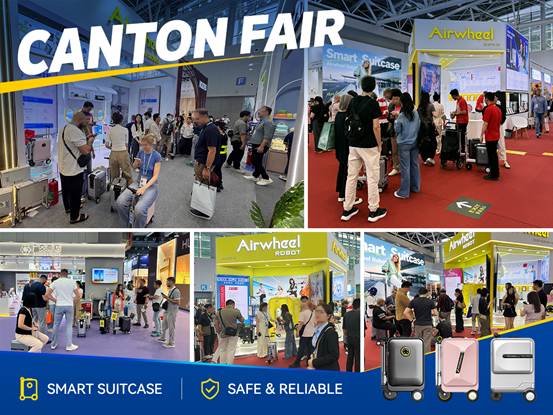
Airwheel will now continue its Canton Fair showcase during Phase 3, taking place from October 31 to November 4, where the company will present its broader smart rideable suitcase portfolio to international buyers and business partners.
Airwheel Phase 3 Booths: 20.2J37–38, 20.2K11–12 and 18.1K04
From Exhibition Demonstrations to International Social Media
During Phases 1 and 2, Airwheel showcased multiple smart rideable hand suitcase models, with live riding demonstrations becoming one of the most visible experiences around the company’s booths.
Unlike conventional luggage, Airwheel integrates electric drive systems, riding controls and intelligent features into travel-oriented suitcase designs. For many international buyers encountering the category for the first time, the ability to ride a suitcase provided an immediate and intuitive way to understand its potential applications.
Visitors could be seen testing the products around the exhibition area, turning the rideable suitcases into a distinctive presence on the show floor.
The interest extended beyond the exhibition venue. Buyer-shot videos, product demonstrations and on-site interviews have continued to circulate across international social platforms, bringing additional attention to Airwheel’s smart mobility products.
For Airwheel, these interactions provide more than visibility. Direct conversations with buyers also offer insights into different market requirements, travel habits and potential commercial applications.
Expanding the Role of the Suitcase Beyond Storage
Airwheel’s smart rideable suitcase concept is designed to extend the role of luggage beyond traditional storage.
Equipped with electric drive systems, the products allow users to ride for short-distance mobility in environments such as airports, exhibition centers and transportation hubs, providing an alternative to prolonged walking.
Depending on the model, the accompanying smart app can provide functions including riding-data monitoring, speed adjustment and lighting controls. Selected models also offer features such as cruise control, remote operation and alerts for low battery or Bluetooth disconnection.
Some models include USB output for charging compatible personal electronic devices, while models supporting Apple’s Find My feature can help users locate compatible luggage through Apple’s ecosystem.
At the 140th Canton Fair, Airwheel is highlighting the SE3SXD Full-Intelligent Electric Ai Cabin Suitcase, its flagship smart rideable suitcase.
With a one-touch operation, the motorized front wheel automatically extends while the smart riding handle rises into position, allowing the suitcase to transition into riding mode through a simplified control sequence.
The design reflects Airwheel’s broader approach to combining mechanical engineering, electric mobility and intelligent controls within a familiar travel product.
Engineering for Real-World Travel
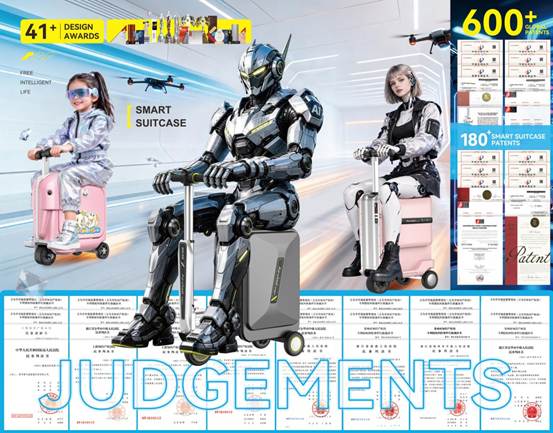
Beyond the riding experience, Airwheel’s product development also considers practical travel requirements, including battery handling, luggage structure, security and storage.
Airwheel Carry on Suitcae use a removable 73.26Wh lithium battery. The detachable architecture provides additional flexibility for battery handling during transportation, also feature TSA-compatible locks to facilitate applicable security or customs inspection procedures.
The Boarding 20inch suitcase bodies use ABS and polycarbonate materials together with reinforced frame structures, balancing riding loads with everyday luggage protection and storage requirements.
Some models incorporate larger-diameter wheels and retractable front-wheel structures to improve riding stability across different surfaces.
Together, these details reflect Airwheel’s effort to move the rideable suitcase category from a novelty concept toward a more practical travel product.
A Portfolio Designed for Different Travel Scenarios
As consumer needs vary across markets, Airwheel has developed a broader portfolio covering cabin travel, larger-capacity journeys and family travel.
SE3S Series: 20inch Smart Rideable Cabin Suitcases
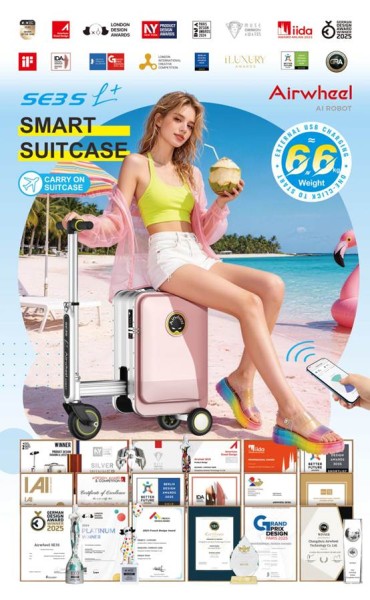
The Airwheel SE3S series, including the SE3SL Electric Suitcase, SE3SL+ Airport 20inch Suitcase, SE3SX Cabin Suitcase and SE3SXD Ai Luxury Suitcase, represents the company’s core range of compact smart rideable suitcases.
Most models can reach riding speeds of up to 9.9 km/h under specified operating conditions, making them suitable for short-distance movement in airports, stations, exhibition centers and similar environments.
Selected higher-specification models incorporate smart app functions and Apple Find My support, combining the portability of a compact suitcase with electric riding and connected features.
The range is positioned across smart cabin suitcase, electric carry-on and luxury suitcase applications, offering different configurations for different users and markets.
Airwheel SE3T: 24-Inch Smart Rideable Travel Ai wheel Suitcase
For travelers who require additional packing capacity, the Airwheel SE3T uses a 24-inch suitcase format with approximately 48 liters of storage space.
Its riding speed can reach up to 13 km/h under specified operating conditions, combining larger luggage capacity with electric mobility for longer journeys and heavier packing needs.
Airwheel SQ3 / SQ3S: Smart Rideable Suitcases for Children
Airwheel also extends its smart mobility concept into family travel.
The SQ3 and SQ3S Kids suitcase are designed for children, with maximum riding speeds of 5 km/h and 6.5 km/h, respectively. Interactive entertainment features further combine travel storage with a rideable experience designed for family journeys.
Together, these products allow Airwheel to address different age groups, travel distances and usage scenarios—from compact cabin luggage to larger travel suitcases and children’s rideable products.
Technology and International Design Recognition
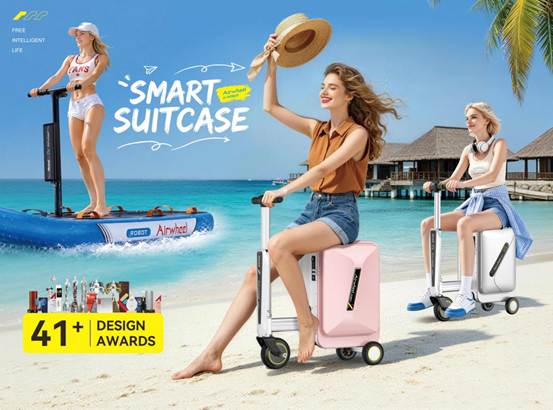
Behind Airwheel’s product portfolio is continued investment in intelligent mobility technology and product development.
The company has accumulated more than 600 global patents, covering areas including motion control, electric drive systems, intelligent sensing and structural design. Its trademark portfolio extends across 168 countries and regions, supporting its international market development.
Airwheel products have also received recognition from international design programs, including the MUSE Design Awards, French Design Awards, Asia Design Prize and iLuxury Awards, among others.
For Airwheel, these achievements reflect an ongoing effort to bring together engineering, industrial design and user experience rather than treating technology as a standalone feature.
About Airwheel
Airwheel is an intelligent mobility brand developing smart rideable suitcases and personal mobility products for modern travel and everyday transportation.
Its product portfolio combines electric drive technology, intelligent controls and contemporary industrial design to explore new possibilities in travel equipment and personal mobility.
Through continued product development and international market expansion, Airwheel is exploring how familiar travel products can evolve into more intelligent, connected and adaptable mobility companions.
Media Contact
Company: Airwheel
Contact: Media Team
Email: Jonas@airwheel.net
Website: https://www.airwheel.net
About Author
Disclaimer: The views, suggestions, and opinions expressed here are the sole responsibility of the experts. No Digi Observer journalist was involved in the writing and production of this article.
Deluxe Paint Protection Outlines New Vehicle Protection Ahead of Winter Road Season
YSC Paving Urges Phoenix-Area Property Owners to Check the Base Before Approving an Asphalt Overlay
Airwheel Smart Carry On Hand Scooter Robot 20inch Boarding Ai Wheel Luxury Cabin Suitcase Continue to Draw Global Attention After Canton Fair Phases 1 and 2
Benzinga Money Article Discusses How to Become Part of the 12% of Retirees Who Have Achieved the Recommended $550,000 Minimum Retirement Savings Threshold
Apu Apustaja Conquers New York with Lively Street Ads, Including Times Square Billboard
Bay Smokes Maintains Quality Amid Legislative Changes in the Hemp Industry


-
Press Release1 week ago
Injective Collaborates with BDACS to Bring Korea’s First Won-Backed Stablecoin to Onchain RWAs
-
Press Release4 days ago
Thomas Berkley of Nexus Acquisition AI Focuses on Turning Business Inquiries Into Structured Growth Opportunities
-
Press Release1 week ago
Mastek Selected by Staffordshire County Council to Drive AI Enabled – Oracle Cloud Transformation
-
Press Release4 days ago
Widgets & Web Launches AI-Operated Investor Relations Websites for Public Companies at a Fixed $299 per Month
-
Press Release4 days ago
Dynamic NameCard Opens Global Franchise Recruitment for Telegram Mini App-Based Digital Identity Services
-
Press Release1 week ago
New Book Where’s the GAP by David P. Matthews, Now Available on Amazon, Asks a Life Changing Question
-
Press Release1 week ago
PetShopValue.com Highlights Pet Comfort and Travel Essentials Ahead of the Holiday Season
-
Press Release4 days ago
Thomas Berkley and Nexus Acquisition Group Outline AI Agency Partnership Approach in Cleveland