
Press Release
Pump.fun Volume Bot Torboto Launches Non-Custodial Solana Volume Engine

Denmark, 4th Jun 2026 – Torboto, a newly launched Pump.fun volume bot for the Solana network, has opened to the public at www.torboto.com, positioning itself as a non-custodial automation layer that helps newly minted tokens generate genuine on-chain trading activity and surface in the Pump.fun trending feed. The tool orchestrates a rotating fleet of independent Solana wallets, a native-language social layer and anti-MEV order routing from inside a single Telegram chat, and charges a single flat 2% success fee with no subscriptions.
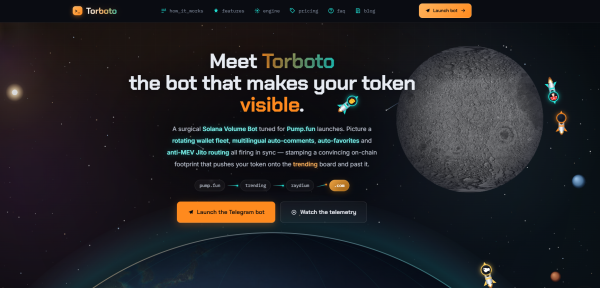
The visibility gap on Pump.fun
On Pump.fun, the launchpad where the majority of Solana memecoins now originate, thousands of tokens are minted every day. The platform’s trending feed — the surface where most discovery happens — weighs trading volume, holder counts and social engagement when deciding which tokens to display. A token with a strong concept but no early momentum is, in practice, invisible: it sits below the threshold that real buyers ever scroll past. Founders have historically tried to close that gap by hand, opening dozens of wallets, funding them individually and timing trades manually, an approach that is slow, error-prone and easy to detect on-chain.
Torboto is built to address that specific gap. According to the project, the software places real buy and sell orders on a Pump.fun token from many separate wallets on timed intervals, lifting the token’s measured volume, unique-holder count and social signals so that it can cross the trending thresholds where organic discovery begins. The full feature set and live pricing calculator are documented at www.torboto.com.
How the engine works
Each Torboto session spawns a fresh batch of ephemeral Solana wallets, seeded with randomized amounts of SOL so that no two are funded identically and no pattern carries across runs. Order flow is shaped with Poisson-distributed timing and randomized trade sizes drawn from a per-trade SOL band the operator defines, so the resulting tape reads like a set of independent traders rather than a script. Operators set a target volume, a buy/sell ratio, comment and favorite density, and a volume curve — selectable presets the project labels Gradual, Burst, Stealth and Whale — before funding a private session wallet and pressing start.
The product is positioned as a Solana volume bot that runs end to end without any coding or trading expertise. Configuration, funding, launch and live monitoring all take place inside Telegram, and the project states that anyone able to paste a contract address can run a complete session. Volume, holder counts, buy pressure and trending rank stream back into the same chat while a campaign is live.
A social layer, not just trades
Torboto pairs its trade engine with an engagement layer intended to make a token’s footprint read as an active community rather than a single automated account. The system can post auto-comments drawn from a curated library across twelve languages, written with native dialect and varied typing cadence rather than machine translation, and can apply auto-favorites from distinct wallets to lift a token up the most-watched feed. A sentiment mixer blends bullish, neutral and skeptical messages by percentage, and persona-based behavior assigns different sizes, timing and voice to whale, retail and skeptic archetypes.
Anti-MEV routing and detection resistance
Execution is routed through Jito bundles on a private relay with randomized tips, which the project says shields each trade from sandwich and front-running bots and prevents bundles from being fingerprinted. A series of stealth measures — per-transaction key rotation, anti-cluster spacing, block-gap enforcement and timing noise — are designed to keep a session’s wallets from forming the obvious visual clusters that on-chain analytics dashboards use to link addresses together. The stated goal is realism: a footprint that withstands the scrutiny a serious launch attracts.
Continuity through the Raydium migration
One recurring failure point for manual volume work is the moment a Pump.fun token graduates to Raydium, when liquidity moves to a new automated market-maker pool. Torboto monitors that migration block by block and re-points execution to the new pool without interrupting the session, so momentum is not lost during the handoff. For tokens that want broader aggregator visibility, the platform offers optional cross-DEX mirroring of volume across Raydium, Meteora and Orca after migration.
Pricing and custody model
Torboto charges a single flat 2% success fee on the target volume an operator requests, and the project states that this is the only cost. Solana network fees, priority fees, Jito bundle tips, wallet funding, auto-comments and auto-favorites are all included in that figure, with no subscriptions, no per-wallet surcharges and no gas top-ups. Any unused deposit is refunded to the operator’s wallet the moment a session is stopped.
The service is non-custodial by design. Operators fund a deposit wallet they control; Torboto generates throwaway session sub-wallets from that deposit, never requests the main wallet’s private key, and discards the sub-wallets when the session ends. Signed transaction hashes from each run are verifiable on Solscan. Full terms, the pricing calculator and the documentation are published at www.torboto.com.
Transparency posture
In a market crowded with overstated claims, Torboto’s public materials take an unusually measured tone. The platform explicitly labels the live-looking telemetry on its website — execution logs, routing mesh and throughput counters — as an illustrative client-side simulation of the Telegram dashboard rather than real-time platform data. It also states plainly that no specific trending rank or financial outcome is guaranteed and that trading memecoins carries real risk. That framing distinguishes the tool from competitors that lean on fabricated statistics and screenshots.
Where it sits in the category
The launch arrives as automated volume tooling has become a standard, if contentious, part of the Solana memecoin lifecycle. Most founders now treat early volume not as an end in itself but as the cost of being seen long enough for a genuine community to form. Within that context, a Pump.fun volume bot that is non-custodial, transparent about what its on-site numbers represent and priced as a single success fee occupies a more conservative position than the subscription-based and opaque alternatives that have characterized the space. Whether that posture translates into durable adoption will depend on results founders report over the coming launch cycles.
Media Contact
Organization: Torboto
Contact Person: Leanne Reilly
Website: https://www.torboto.com/
Email: Send Email
Country:Denmark
Release id:45680
Disclaimer: This press release is for informational purposes only and does not constitute financial, investment, trading, or legal advice. References to blockchain tools, digital assets, or trading activity are descriptive in nature. No outcomes, rankings, visibility results, or financial performance are guaranteed. Readers are responsible for conducting their own independent research and complying with all applicable laws and platform policies before using any blockchain-related service.
The post Pump.fun Volume Bot Torboto Launches Non-Custodial Solana Volume Engine appeared first on King Newswire. This content is provided by a third-party source.. King Newswire makes no warranties or representations in connection with it. King Newswire is a press release distribution agency and does not endorse or verify the claims made in this release. If you have any complaints or copyright concerns related to this article, please contact the company listed in the ‘Media Contact’ section
About Author

Disclaimer: The views, suggestions, and opinions expressed here are the sole responsibility of the experts. No Digi Observer journalist was involved in the writing and production of this article.

Press Release
Widgets & Web Launches AI-Operated Investor Relations Websites for Public Companies at a Fixed $299 per Month
Miami, Florida, United States, October 24th, 2026, FinanceWire
Widgets & Web, the investor relations website provider trusted by more than 500 public companies, SPACs, and IPO-stage firms, today announced AI-operated investor relations websites: complete, custom IR sites designed, built and maintained through AI-driven operations, at a single fixed price of $299 per month, billed annually at $3,588. The company says its operations run entirely on AI with zero employees, an operating model it describes as a first for the investor relations website industry.
Every site includes live stock price data, automated SEC filings from EDGAR, press release feeds, investor email alerts, corporate governance pages, and presentations and events sections. Sites are built for ADA and WCAG compliance, with an accessibility widget on every page. The subscription covers design, hosting, security monitoring, and unlimited updates and support, with no setup fees, no design fees, and no per-change charges.
Every site is built, hosted, maintained and controlled on Widgets & Web’s own proprietary platform: no WordPress, PHP, third-party content management systems or plugin dependencies to maintain. The company says this removes the upkeep and plugin maintenance that come with third-party platforms.
“Public companies have spent decades paying agency retainers and five-figure design bills for websites their investors visit for one thing: accurate, current information,” said Steve Yakubov, CEO and co-founder of Widgets & Web. “We build the entire IR site, keep every feed live around the clock, and deliver it at a price any issuer can approve in one meeting.”
Widgets & Web delivers the first draft of a new IR website within 24 hours of sign-up. Each IR site runs on a dedicated subdomain managed by Widgets & Web.
About Widgets & Web
Widgets & Web is a Miami-based investor relations website provider for public companies, SPACs and IPO-stage firms. The company designs, hosts and manages IR websites on its own proprietary platform, with automated SEC filing and press release feeds, live stock data, governance pages and investor email alerts, and has served more than 500 public companies. Learn more at www.widgetsandweb.com.
Contact
CEO and co-founder
Steve Yakubov
Widgets & Web
production@ir365connect.com
786-263-9007
About Author
Disclaimer: The views, suggestions, and opinions expressed here are the sole responsibility of the experts. No Digi Observer journalist was involved in the writing and production of this article.
Press Release
Thomas Berkley and Nexus Acquisition Group Outline AI Agency Partnership Approach in Cleveland
United States, 24th Oct 2026— Thomas Berkley, founder of Nexus Acquisition Group, is advancing a partnership-focused approach to developing and operating artificial intelligence-powered agency businesses. Based in Cleveland, Ohio, the company works with a limited number of individuals, combining business-specific assessment, infrastructure development, and ongoing operations to establish AI-powered agency businesses.
As artificial intelligence becomes increasingly integrated into business operations, entrepreneurs are exploring ways to build companies around technology-enabled services. Nexus Acquisition Group addresses this opportunity through a model that extends beyond standalone software or technology implementation, with the company working directly alongside partners throughout the development and operation of their businesses.
The company’s approach centers on three stages: assess, build, and operate. Each engagement begins with evaluating the systems required for a specific business, continues with developing the necessary infrastructure, and extends into ongoing operations alongside the partner. This framework provides a defined process for individuals interested in building an agency business around AI-powered capabilities.
Thomas Berkley Leads Nexus Acquisition Group’s Partnership Model
Thomas Berkley founded Nexus Acquisition Group with a focus on building and operating AI-powered agency businesses through direct collaboration with partners. His background includes service in the United States Air Force and experience with AI-driven business systems and agency operations.
Berkley’s involvement is a central part of the company’s model. Rather than limiting its role to an initial consultation or infrastructure setup, Nexus Acquisition Group works with partners throughout the engagement. This continued involvement connects business planning, system development, and operational execution within a single working relationship.
For entrepreneurs evaluating Nexus Acquisition Cleveland, the company’s Cleveland base and its defined partnership process provide a starting point for understanding how engagements are structured. The company works with partners across the United States, with individual arrangements determined by the requirements of each business.
Nexus Acquisition AI Agency Program Follows a Three-Stage Framework
The Nexus Acquisition AI agency program is structured around assessing business requirements, building operational infrastructure, and supporting ongoing business activity. The process is designed to account for the specific needs of each agency rather than applying an identical technical setup to every engagement.
During the assessment stage, the company evaluates the systems needed to support the proposed business. This step helps establish the operational requirements and identify the infrastructure necessary for the agency’s intended activities.
The build stage focuses on developing that infrastructure. Depending on the requirements of the business, relevant systems may include AI-driven voice and messaging tools, customer relationship management platforms, and client acquisition systems. The objective is to establish the operational foundation needed to run the agency.
The third stage involves ongoing operation. Nexus Acquisition Group continues working with the partner after the initial infrastructure has been developed, maintaining a collaborative relationship as the business operates. The scope and duration of this work depend on the individual engagement.
By connecting these stages, the company approaches agency development as an ongoing business process rather than a one-time technology installation.
A Collaborative Structure for AI Agency Development
Building an agency around artificial intelligence involves more than selecting tools. Business owners must also consider how technology fits into their workflows, how systems are maintained, and how day-to-day operations are organized. A coordinated approach can help bring these requirements into a more consistent operating framework.
Nexus Acquisition Group’s model places collaboration at the center of this process. Partners work directly with the company’s team from the initial build through ongoing operation, while the systems and engagement structure are tailored to the particular business.
This approach may be relevant to individuals exploring AI-powered agency ownership who prefer a working relationship that includes both infrastructure development and operational involvement. Rather than presenting its services solely as access to software, the company describes its role as building and operating agency businesses in partnership with a limited number of individuals.
The model also recognizes that the requirements of an agency can differ according to its business objectives and operating needs. For this reason, engagements are structured individually, with the scope, terms, and timeline defined through an agreement between the company and the partner.
Nexus Acquisition Agency Partnership Opportunities
A Nexus Acquisition agency partnership provides a framework for discussing the development and operation of an AI-powered agency business. The company’s approach brings together assessment, implementation, and continuing operational involvement, allowing the parties to establish expectations before proceeding with an engagement.
For prospective partners, understanding the structure of the relationship is an important part of evaluating an opportunity. Nexus Acquisition Group outlines its process through its website, where interested individuals can review the company’s approach, learn about its founder, and contact the team to discuss a potential engagement.
The company does not describe every partnership as having identical requirements. Instead, its process is designed to reflect the systems needed for the specific business and the responsibilities agreed upon by the parties.
As AI-enabled services continue to create new possibilities for business development, Nexus Acquisition Group remains focused on connecting technology infrastructure with practical agency operations. Led by Berkley, the company continues to build its approach around direct partner involvement and an ongoing operational relationship.
Individuals interested in learning more about the company’s model can visit Nexus Acquisition Group to review its process and inquire about potential partnership opportunities.
About Nexus Acquisition Group
Nexus Acquisition Group is a Cleveland, Ohio-based company that builds and operates AI-powered agency businesses in partnership with a limited number of individuals. Founded by Thomas Berkley, the company follows an assess, build, and operate framework, working directly with partners from initial infrastructure development through ongoing operations. Its engagements are individually structured according to business requirements, scope, terms, and timeline.
Media Contact
Organization: Nexus Acquisition Group
Contact Person: Thomas Berkley
Website: https://nexusacquisitiongroup.com/
Email: Send Email
Address: Cleveland, Ohio, United States
Country: United States
Release id: 50182
View source version on King Newswire:
Thomas Berkley and Nexus Acquisition Group Outline AI Agency Partnership Approach in Cleveland
About Author
Disclaimer: The views, suggestions, and opinions expressed here are the sole responsibility of the experts. No Digi Observer journalist was involved in the writing and production of this article.
Press Release
Thomas Berkley of Nexus Acquisition AI Focuses on Turning Business Inquiries Into Structured Growth Opportunities
United States, 24th Oct 2026 — Thomas Berkley of Nexus Acquisition AI is bringing attention to a critical challenge facing service businesses: creating a more organized path from initial customer interest to meaningful sales opportunities. As companies navigate changing customer expectations and increasingly competitive markets, the relationship between marketing, lead management, and business development is becoming an important consideration for long-term growth.
For service providers, attracting potential customers does not always translate into new business. Inquiries can go unanswered, follow-up can become inconsistent, and opportunities can be overlooked when teams lack a clear process for managing prospective clients. These challenges have prompted growing interest in systems that connect customer acquisition activities with the operational workflows needed to support them.
Nexus Acquisition AI operates in this evolving space, focusing on the intersection of artificial intelligence, marketing, and customer acquisition. Its work reflects a broader shift toward examining how technology can help businesses establish more consistent processes for engaging prospects and managing opportunities.
Moving Beyond Lead Volume
Businesses often evaluate marketing performance through the number of inquiries or contacts generated. However, lead volume represents only one part of the customer acquisition process. The ability to respond promptly, maintain relevant communication, and manage opportunities through subsequent stages can also influence the effectiveness of a company’s marketing efforts.
For service businesses with limited administrative resources, coordinating these activities can be particularly challenging. Owners and employees frequently balance customer delivery, scheduling, sales conversations, and daily management responsibilities. Without clearly defined procedures, potential customers may encounter delays or inconsistent communication.
Through its focus on Nexus Acquisition marketing, the company addresses a business environment in which marketing performance is increasingly considered alongside the processes responsible for managing incoming opportunities.
This perspective encourages businesses to examine the complete customer journey rather than viewing advertising, outreach, and sales follow-up as separate functions. It also highlights the importance of identifying gaps between generating interest and taking the next appropriate action.
Exploring Practical Applications of Artificial Intelligence
Artificial intelligence is creating new possibilities for businesses seeking to organize repetitive tasks and improve the coordination of customer-facing processes. Depending on the tools selected and their implementation, AI-supported workflows may assist with inquiry classification, routine communications, information organization, and follow-up management.
For companies evaluating these capabilities, the central question is not simply whether AI can be introduced into an existing operation. It is whether a particular application addresses a genuine business need and fits the way the organization serves its customers.
Nexus Acquisition AI’s focus on technology-assisted growth aligns with this practical consideration. Businesses exploring automation must account for their existing systems, customer communication standards, staffing capacity, and the level of human oversight required for effective implementation.
Automation can support consistency, but it does not eliminate the need for sound business judgment. Service providers must still ensure that customer interactions remain relevant, information is handled appropriately, and important decisions receive the necessary attention.
Building More Consistent Lead Management Processes
The period between a customer’s initial inquiry and a purchasing decision can involve multiple interactions. Prospective customers may request information, compare providers, ask additional questions, or require time before deciding whether to proceed.
A structured lead management process gives businesses a framework for handling these different stages. It can establish how inquiries are recorded, who is responsible for responding, when follow-up should occur, and how the status of each opportunity is tracked.
Within this context, Nexus Acquisition lead generation relates to the broader challenge of developing a more coordinated approach to attracting and managing potential customers.
Generating new inquiries remains important, but businesses also benefit from understanding what happens after those inquiries arrive. Reviewing response times, follow-up consistency, conversion patterns, and the sources of qualified opportunities can help decision-makers identify areas for improvement.
These measures provide a more comprehensive basis for evaluating marketing activity than lead counts alone. They also allow businesses to consider operational adjustments before increasing spending on customer acquisition.
Aligning Growth Technology With Business Objectives
Every service business operates under different conditions. A company serving a local market may have different customer acquisition requirements from a provider operating across multiple cities or industries. Similarly, businesses with small teams may prioritize administrative efficiency, while larger organizations may focus on coordinating workflows across departments.
Consequently, growth technology must be evaluated against specific operational requirements rather than adopted solely because it is available.
The concept of Nexus Acquisition AI growth systems reflects the broader market interest in connecting marketing activities, customer information, and follow-up processes within a more coordinated operating framework.
A useful evaluation begins with identifying recurring problems, establishing measurable objectives, and determining which tasks may benefit from automation. Businesses can then assess whether the selected systems improve workflow consistency, reduce unnecessary manual effort, or provide clearer insight into customer acquisition performance.
This measured approach helps keep technology adoption connected to practical business priorities.
A Process-Oriented Perspective on Business Development
As artificial intelligence becomes more accessible, service businesses have additional options for reconsidering how they organize marketing and sales activities. The opportunity lies in identifying where technology can complement existing capabilities while preserving the personal communication and service quality that customers expect.
Thomas Berkley and Nexus Acquisition AI are positioned within this changing business landscape, where the discussion around growth increasingly includes not only attracting customers but also establishing processes for managing the opportunities that marketing creates.
For businesses reviewing their acquisition strategies, the emphasis on connected workflows offers a useful starting point: understand where prospects enter the process, determine what happens next, and evaluate whether each stage supports the organization’s broader objectives.
Further information about Nexus Acquisition AI and its approach to marketing and customer acquisition is available on the company’s website at https://nexusacquisitionai.com/ .
About Nexus Acquisition AI
Nexus Acquisition AI focuses on marketing, lead generation, and AI-powered growth systems for service businesses. The company operates within the business technology and customer acquisition sector, addressing the growing interest in using automation and structured workflows to support marketing operations and business development.
Learn more at https://nexusacquisitionai.com/.
Media Contact
Organization: Nexus Acquisition AI
Contact Person: Thomas Berkley
Website: https://nexusacquisitionai.com/
Email: Send Email
Country: United States
Release id: 50183
View source version on King Newswire:
Thomas Berkley of Nexus Acquisition AI Focuses on Turning Business Inquiries Into Structured Growth Opportunities
About Author
Disclaimer: The views, suggestions, and opinions expressed here are the sole responsibility of the experts. No Digi Observer journalist was involved in the writing and production of this article.
Widgets & Web Launches AI-Operated Investor Relations Websites for Public Companies at a Fixed $299 per Month
Dynamic NameCard Opens Global Franchise Recruitment for Telegram Mini App-Based Digital Identity Services
Thomas Berkley of CSM Collective Explores the Role of Strategic Thinking in Modern Entrepreneurship
Benzinga Money Article Discusses How to Become Part of the 12% of Retirees Who Have Achieved the Recommended $550,000 Minimum Retirement Savings Threshold
Apu Apustaja Conquers New York with Lively Street Ads, Including Times Square Billboard
Bay Smokes Maintains Quality Amid Legislative Changes in the Hemp Industry


-
Press Release1 week ago
From Karmayogi to the World Stage: Dr. Hemant Garg Wins “Excellence in AI for Public Policy”, Charts India’s Path to the AI Big League
-
Press Release6 days ago
The Smart Luggage at the 140th Canton Fair:Airwheel 20inch Carry-On Hand Scooter Ai Wheel Robot Cabin Luxury Suitcase Takes Smart Travel to the Next Level
-
Press Release1 week ago
U-topia Launches Public Beta as Global Builders Gather for U-Hackathon
-
Press Release1 week ago
Karviva and Founder Dr. Angela Zeng Featured in 2026 USA TODAY Food as Medicine Edition.
-
Press Release1 week ago
AI News Directory Launches to Help Readers Find AI Writers Worth Following
-
Press Release1 week ago
ShippingContainersNow.com Now Offers 48-Hour Container Dispatch From 15 Depots Nationwide
-
Press Release1 week ago
Beyond the Customs Declaration: Gorian Aduanas Takes a Specialist, Bespoke Approach to Complex Customs Clearance and International Imports
-
Press Release1 week ago
Bonnie Sezto on What Makes You Different When Everyone Has AI