
Press Release
Kelly Bacot Calls for More Collaborative Professional Development to Strengthen K-12 Classrooms

San Francisco, California, Jul 28, 2026, ZEX PR WIRE — Professional development has long been viewed as one of the most important tools for improving classroom instruction. Yet many teachers continue to say that existing training programs fall short of helping them address the realities they face every day. Limited collaboration, generic training sessions, and insufficient support for emerging classroom technologies have left many educators wanting a more practical approach to professional learning.
According to recent education research, fewer than 15% of teachers report that their current professional development provides them with adequate access to subject-matter expertise or instructional materials. Many educators also say they want learning opportunities that are personalized to their teaching assignments, flexible enough to fit demanding schedules, and focused on helping them integrate technology and artificial intelligence into instruction without creating additional administrative work.
For veteran educator and instructional leader Kelly Bacot, these concerns highlight an opportunity rather than a setback. She believes professional development should empower teachers with strategies they can apply immediately in the classroom while fostering stronger collaboration among educators. “Teachers are lifelong learners just like their students,” Bacot said. “Professional development should give educators practical tools, meaningful collaboration, and the confidence to adapt instruction to meet the needs of every learner.”
Throughout her career, Bacot has emphasized continuous improvement as a core part of effective teaching. Her experience has shown that educators grow most when they can exchange ideas, analyze student progress together, and learn from colleagues who understand the daily challenges of classroom instruction.
Bacot believes that many traditional professional development models rely too heavily on one-size-fits-all presentations that often fail to address the unique needs of individual schools, grade levels, or subject areas. Instead, she advocates for professional learning that allows teachers to focus on specific instructional goals while providing ongoing support throughout the school year.
Effective professional development, she says, should not be limited to isolated workshops. It should become part of a school’s culture, where educators regularly collaborate, examine student data, share successful instructional practices, and reflect on ways to improve learning outcomes.
This philosophy reflects the approach that has defined Bacot’s own career. She has consistently focused on differentiated instruction, continuous assessment, and the adaptation of teaching strategies to meet the needs of diverse learners. Her commitment to instructional excellence contributed to a 27 percent increase in student test scores during her previous teaching role, demonstrating how thoughtful planning and responsive instruction can produce measurable academic gains.
Today, Bacot continues to support both students and fellow educators by encouraging collaboration and instructional growth. She also recognizes that technology is becoming an increasingly important part of classroom instruction. While artificial intelligence and digital learning tools offer exciting possibilities, many teachers feel they have not received sufficient guidance on how to use these resources effectively.
Bacot believes schools should approach technology training with the same practical mindset used for any instructional strategy. “Technology should support teaching, not complicate it,” she said. “Teachers need time to explore new tools, understand how they improve learning, and determine what works best for their students.”
She emphasizes that AI should not replace the relationships at the center of education. Instead, it can help teachers personalize instruction, streamline lesson preparation, analyze student progress, and reduce time spent on repetitive administrative tasks. When implemented thoughtfully, these efficiencies allow educators to spend more time engaging directly with students.
Bacot also stresses that successful professional development requires school leaders to listen carefully to teachers. Educators often understand better than anyone where additional support is needed, whether that involves classroom management, literacy instruction, mathematics strategies, student engagement, or technology integration.
Creating opportunities for teachers to help shape professional learning programs, she says, increases both participation and effectiveness. When educators feel their voices are heard, professional development becomes more relevant and meaningful.
Another important component is flexibility. Teachers balance lesson planning, grading, family responsibilities, and extracurricular commitments throughout the school year. Bacot believes professional learning should offer multiple formats, including coaching, peer observations, collaborative planning sessions, and self-paced online resources that allow educators to learn when it best fits their schedules. These flexible approaches also encourage continuous learning rather than concentrating development into a handful of annual training days.
Bacot’s leadership philosophy centers on service, encouragement, and shared success. She believes instructional leaders should create environments where educators feel comfortable asking questions, sharing ideas, and experimenting with new teaching strategies that ultimately benefit students.
As education continues to evolve, Bacot remains optimistic that schools can build stronger professional development systems by focusing on collaboration, practical application, and ongoing support. When teachers receive meaningful opportunities to grow professionally, students are the ultimate beneficiaries. “Every educator wants to help students succeed,” Bacot said. “When we invest in teachers through meaningful professional learning, we strengthen classrooms, schools, and the future of every child.”
Through her continued leadership, instructional expertise, and commitment to professional growth, Kelly Bacot remains dedicated to helping educators build the knowledge, confidence, and collaborative culture needed to meet the changing demands of K-12 education while keeping student success at the center of every decision.
About Author

Disclaimer: The views, suggestions, and opinions expressed here are the sole responsibility of the experts. No Digi Observer journalist was involved in the writing and production of this article.

Press Release
i-payout Expands U.S. Money Transmitter Licensing Footprint and Advances European EMI Strategy
Fort Lauderdale, Florida, September 15th, 2026, FinanceWire
Expanded regulatory infrastructure is designed to give marketplaces, gig economy platforms, gaming and esports companies, insurance providers, affiliate networks, clinical research organizations and other enterprises greater access to flexible domestic and global payout capabilities
International Payout Systems, Inc. (“i-payout”), a global provider of payment and payout technology, today announced the continued expansion of its U.S. money transmitter licensing footprint while advancing its strategy to obtain a European Electronic Money Institution (“EMI”) license.
The initiative reflects i-payout’s long-term commitment to building a more direct, efficient, and scalable global payments infrastructure. By expanding its regulatory capabilities, i-payout aims to increase control over payment flows, reduce reliance on intermediary relationships, broaden the payment services it can support and create more efficient pathways for domestic and cross-border transactions.
The strategy is particularly relevant to enterprises operating payment programs across multiple jurisdictions, including marketplaces, gig economy and freelance platforms, gaming and esports companies, affiliate networks, insurance providers, clinical research organizations, direct selling companies, and businesses managing refunds, claims and reimbursements.
For these businesses, expanded licensing is intended to give i-payout greater flexibility to introduce new payment capabilities, broaden geographic coverage and create a more integrated payment experience for both enterprises and their recipients.
Whether a marketplace is paying thousands of sellers, a gig platform is compensating independent workers, a gaming company is distributing player or tournament payments, an insurer is issuing claims payments, or a clinical research organization is paying study participants, the underlying challenge is similar: moving money securely and efficiently to large numbers of recipients while supporting different payment methods, currencies, jurisdictions and regulatory requirements.
i-payout’s licensing strategy is designed to strengthen the infrastructure supporting those increasingly complex payment programs.
Expanding U.S. Regulatory Coverage
i-payout has continued expanding its U.S. money transmitter licensing footprint during 2026 and is working toward completing its required U.S. licensing coverage by the end of 2027.
As part of that expansion, i-payout recently received approval from the Office of the Commissioner of Financial Institutions of Puerto Rico for its Money Services Business license, further expanding the company’s regulated U.S. footprint.
The company’s broader licensing initiative is intended to increase the number of markets it can support directly and provide greater flexibility in how payment services are delivered to enterprise customers.
For i-payout customers, the objective is straightforward: broader reach, greater control over payment delivery, more payment capabilities and an increasingly unified infrastructure for managing payouts at scale.
“For nearly two decades, i-payout has been building technology that helps companies move money efficiently around the world,” said Eddie Gonzalez, Founder and Chief Executive Officer of i-payout. “Our customers include businesses that may need to pay thousands or even millions of people across different markets. Expanding our U.S. money transmitter licensing footprint gives us greater control over the infrastructure supporting those payments and positions us to provide our customers with more capabilities as their businesses grow.”
Advancing i-payout’s European EMI Strategy
At the same time, i-payout is advancing plans for a European EMI application as part of its broader international expansion strategy.
The European initiative is intended to strengthen i-payout’s ability to support a wider range of regulated payment services across multiple European markets and further enhance its ability to serve enterprise customers with international payment requirements.
For marketplaces, gig and freelance platforms, gaming and esports companies, affiliate networks, insurance providers and other digital businesses operating internationally, managing payment programs across markets through a more unified technology relationship can reduce the operational complexity associated with multiple payment providers, integrations and processes.
“Our goal is not simply to collect licenses,” Gonzalez said. “We are building regulatory infrastructure that creates tangible benefits for our customers: more markets, more payment options, greater control and a simpler way to manage increasingly complex global payment programs.”
Global Reach With True Local Payment Capabilities
A key component of i-payout’s global strategy is expanding access to true local payment capabilities.
For i-payout, a local payment means a payment delivered through domestic payment rails directly to a recipient’s local bank account in the recipient’s local currency — not through SWIFT and not through an international wire.
This distinction is important for enterprises managing large recipient populations across multiple countries. Combining global reach with local payment capabilities can help businesses create a more localized recipient experience while reducing dependence on traditional cross-border payment processes.
i-payout’s infrastructure is designed to give enterprise customers multiple ways to deliver funds, including local bank payments, virtual and physical cards, digital wallets, real-time payment capabilities and other alternative payment methods, depending on market availability and program requirements.
Compliance Technology Supporting the Expansion
Alongside its licensing initiative, i-payout continues to invest in technology designed to strengthen risk management, transaction monitoring and financial crime compliance.
As part of this investment, i-payout is implementing Hawk’s AI-powered financial crime technology to enhance transaction monitoring and risk-assessment capabilities.
Hawk provides AI-enabled technology for AML transaction monitoring, screening and other financial-crime risk functions used by banks, payment firms and fintech companies.
These investments are intended to support the increasingly sophisticated payment environments of the enterprises i-payout serves while maintaining robust compliance controls as transaction volumes, payment methods and geographic coverage expand.
One Platform Across Multiple Industries
i-payout provides enterprise payout solutions across a range of industries and payment use cases, including:
- Marketplaces: seller, merchant and participant payouts
- Gig Economy & Freelance: contractor and worker payments
- Gaming & Esports: player, creator, tournament and reward payouts
- Affiliate & Performance Marketing: affiliate and commission payments
- Direct Selling: distributor and commission payouts
- Insurance: claims, reimbursements and other disbursements
- Clinical Trials & Market Research: participant and research payments
- Refunds & Reimbursements: consumer refunds, claims and corporate reimbursement programs
- Enterprise & Global Workforce: high-volume domestic and international disbursements
The company’s strategy combines regulatory infrastructure, payment technology, compliance controls and multiple payout methods within a configurable enterprise platform designed to help businesses move money to recipients domestically and internationally.
“Licensing is not simply a compliance exercise for us,” Gonzalez added. “It is part of the infrastructure that allows us to build better products, create stronger financial relationships and give enterprise customers greater confidence in the platform handling their payments.”
About i-payout
International Payout Systems, Inc. (“i-payout”) is a global payments technology company providing configurable payment and payout solutions for businesses and organizations that need to distribute funds to recipients domestically and internationally.
Founded in 2007, i-payout supports multiple payout methods and serves enterprises across industries including marketplaces, the gig economy and freelance workforce, gaming and esports, affiliate marketing, direct selling, insurance, clinical research, market research, refunds and reimbursements, and other high-volume payment programs.
i-payout’s technology combines payment orchestration, recipient onboarding, identity verification, compliance capabilities, APIs, digital wallets and program-management tools within a unified enterprise payment environment.
Contact
VP Customer Success & Relationship Management
Dailenys Garcia
i-payout
discover@i-payout.com
954-513-3151
About Author
Disclaimer: The views, suggestions, and opinions expressed here are the sole responsibility of the experts. No Digi Observer journalist was involved in the writing and production of this article.
PALO ALTO, Calif, September 15th, 2026 — AI STUDIOS, DeepBrain AI’s enterprise AI video and avatar platform, announced enhanced emotional expression capabilities for AI Roleplay, its interactive training solution designed to help employees practice realistic customer conversations. DeepBrain AI plans to expand the solution across sales, customer service, wealth management and other customer-facing teams.
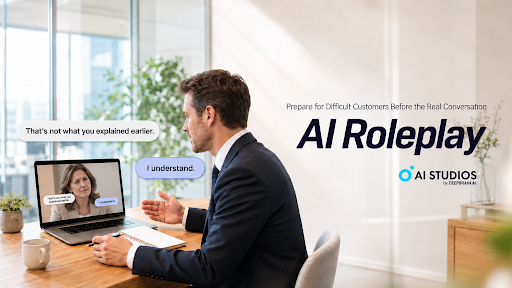
 DeepBrain AI expands AI Roleplay across sales and wealth management markets, targeting industries with frequent customer interactions
AI customers express emotions through lifelike facial expressions and tone of voice, creating training experiences similar to real customer consultations
Companies can build customized training programs based on their products, customer profiles and consultation guidelines
AI Roleplay is a training solution in which AI assumes the role of a customer, allowing employees to repeatedly practice conversations in an environment similar to a real customer interaction. Building on its existing conversation-based training capabilities, DeepBrain AI has made the experience more realistic by enabling AI customers to express emotions through facial expressions and tone of voice and respond differently based on their personalities, interests and attitudes toward the conversation.
Organizations can use AI Roleplay to create a variety of situations commonly encountered in customer-facing roles, including customers who show little interest in a product, question the information they receive, compare multiple options or continue asking technical questions. Participants repeatedly practice the full customer conversation, from identifying customer needs and explaining products to responding to questions and objections.
Rather than repeating predetermined answers, AI customers react differently depending on how each conversation develops. Participants must pay attention to the customer’s facial expressions, tone of voice and the overall direction of the discussion as they determine how to respond. This allows employees to build practical communication skills in a more realistic environment than training based solely on prerecorded videos or memorized scripts.
AI Roleplay also provides analysis and coaching throughout the conversation. The solution analyzes each participant’s speaking pace, intonation and facial expressions to provide real-time feedback. After the session, it reviews the full conversation and identifies what the participant handled effectively, what needs improvement and which expressions could be refined. Participants can review their approach and repeat situations in which their response could have been stronger.
Organizations can customize the training experience to reflect their own business environments. Product and service information, key customer profiles, conversation guidelines and successful sales practices can be incorporated into AI customer personas and evaluation criteria. This enables companies to build training around situations employees frequently encounter, apply consistent standards across teams and locations, and update scenarios as products, services or policies change.
AI Roleplay is already being used across a range of customer-facing functions, including insurance sales training, contact center training, in-store customer service and interactive learning following instructor-led courses. Wealth management and financial advisory teams can rehearse how to identify a client’s financial goals, explain financial products clearly and respond to concerns. Other sales teams can practice each stage of the customer conversation, from discovery and product recommendations to price objections and purchase decisions.
The solution can also help reduce the operational burden associated with traditional instructor-led roleplay. New employees can experience a wider range of customer situations before handling live conversations, while experienced employees can focus on difficult customer profiles or complex scenarios. Organizations can evaluate conversations using consistent standards while helping employees strengthen their customer-facing and sales capabilities.
“In sales and financial services, product knowledge is only part of what builds customer trust. Employees must also understand how customers are reacting and respond with language that fits the moment,” said Eric Jang, CEO of DeepBrain AI. “AI Roleplay allows employees to practice with customers who express different emotions and behaviors, review their own approach and improve before the real conversation. By incorporating each organization’s sales expertise and training standards, we aim to help teams strengthen their customer communication skills and support meaningful improvements in sales performance.”
DeepBrain AI plans to expand AI Roleplay across financial services, retail, automotive, telecommunications, education and other industries where customer interactions play a critical role. By connecting live conversations with AI customers, real-time coaching, post-session analysis and repeated practice, the company aims to help enterprises develop customer-facing talent and improve frontline readiness.
About DeepBrain AI
DeepBrain AI develops AI video generation, AI Human and conversational AI solutions for enterprises. Its flagship platform, AI STUDIOS, enables organizations to create AI-powered video content and interactive avatar experiences for corporate training, financial services, retail, media and customer service.
Through AI STUDIOS, organizations can create and deliver video content, build interactive AI experiences and provide scalable training across teams and locations. DeepBrain AI also develops customized AI Human and AI agent solutions for enterprise, public-sector and educational organizations. The company operates a U.S. office in Palo Alto, California. For more information, visit AI STUDIOS.n
Media Contact:
DeepBrain AI Communications
www.aistudios.com
About Author
Disclaimer: The views, suggestions, and opinions expressed here are the sole responsibility of the experts. No Digi Observer journalist was involved in the writing and production of this article.
Boston, MA, USA, September 15th, 2026, FinanceWire
Legacy Mode brings open source apps developed for Ledger to Passport, letting users keep their existing accounts and familiar wallets on hardware assembled in the United States.
Foundation today announced the beta release of Legacy Mode for Passport, enabling Ledger users to switch to open source hardware and software while keeping their existing accounts for supported assets. Legacy Mode runs open source cryptocurrency apps originally developed for Ledger and connects to familiar software wallets over USB.
The release accompanies Foundation’s Switch campaign, built around a simple promise: switch to open source without starting over. As Ledger phases out support for the original Nano S, users can switch to Passport without transferring supported assets to new accounts. Their addresses, balances, and transaction history stay the same.
“We started Foundation because we believe an open, decentralized Internet must be built on a foundation of open source hardware and software,” said Zach Herbert, cofounder and CEO of Foundation. “But people have spent years building their wallet setups. Asking them to move every asset and relearn everything is a real barrier. Legacy Mode lets them keep what they’ve built and put it on an open source foundation.”
Ledger and its developer community have built an extensive library of open source cryptocurrency apps. Those apps normally run on Ledger’s operating system, which includes proprietary code. Foundation’s compatibility layer allows supported apps to run on KeyOS, the fully open source operating system powering Passport.
KeyOS is a microkernel operating system written in Rust, with isolated processes and sandboxed apps. Foundation publishes its operating-system source code and hardware designs so developers and security researchers can inspect how Passport works.
“We reimplemented the interfaces that Ledger’s open source apps use to talk to BOLOS, its operating system,” said Ken Carpenter, cofounder and CTO of Foundation. “That includes cryptographic operations, screen rendering, and USB communication. We can compile the existing app code for Passport and run it on KeyOS, without running Ledger’s proprietary operating system.”
Ethereum and Solana are the first supported app families, selected for their broad adoption. Early beta users have tested compatibility with Rabby for Ethereum and EVM networks, and Phantom for Solana, over USB. Foundation plans to add further open source Ledger apps as users and developers need them.
Legacy Mode launches in beta today as an optional, manual installation on Passport Prime. Users enter their existing recovery phrase on the device and connect to a compatible software wallet over USB. Foundation welcomes feedback from beta users to help improve compatibility and installation ahead of the full release this fall.
Legacy Mode is a bridge to native KeyOS apps. As developers release apps built specifically for Passport, users can install them on the same device and choose when to move beyond Legacy Mode.
The Foundation SDK is available now, and KeyOS 1.4.0 introduced app sideloading. This fall, a new KeyOS release will bring Foundation’s app catalog, where users will be able to seamlessly access a growing catalog of native KeyOS apps from Foundation and third-party developers – and install them with a single tap.
Passport Prime is available starting at $349. To see the Switch campaign, supported apps, and installation guides, visit foundation.xyz/switch.
About Foundation
Foundation builds Human Authority Hardware: open source security devices that give individuals control over their money, identity, and digital lives. Its flagship device, Passport Prime, combines hardware security with KeyOS, an open source operating system for independently developed apps. Foundation’s hardware is assembled in the United States. Learn more at foundation.xyz.
For media inquiries, users can contact 21M Communications: phil@21mcommunications.com.
Ledger and BOLOS are trademarks of Ledger SAS. Foundation is not affiliated with Ledger, and Legacy Mode is not sponsored or endorsed by Ledger. References to Ledger are for identification and compatibility purposes only.
Contact
Founder
Phil
21M Communications
phil@21mcommunications.com
About Author
Disclaimer: The views, suggestions, and opinions expressed here are the sole responsibility of the experts. No Digi Observer journalist was involved in the writing and production of this article.
i-payout Expands U.S. Money Transmitter Licensing Footprint and Advances European EMI Strategy
AI STUDIOS Expands Sales Training With Emotionally Expressive AI Roleplay
Foundation Lets Ledger Users Switch to Open Source Without Starting Over
Benzinga Money Article Discusses How to Become Part of the 12% of Retirees Who Have Achieved the Recommended $550,000 Minimum Retirement Savings Threshold
Apu Apustaja Conquers New York with Lively Street Ads, Including Times Square Billboard
Bay Smokes Maintains Quality Amid Legislative Changes in the Hemp Industry


-
Press Release1 week ago
Terrance Bradford Tampa, FL Discusses the Importance of Setting Realistic Expectations in Construction Projects
-
Press Release1 week ago
Net Boardroom Launches Global Media Monitoring Platform with Multilingual Coverage and Alerts
-
Press Release1 week ago
Rapid Indexer Launches Innovative SEO Tool for Link Building and Instant URL Indexing Solution
-
Press Release3 days ago
CGTN: Embarking on third ‘golden decade’: How BRICS pools development strength for high-quality cooperation
-
Press Release1 week ago
The “Everlasting Battery” Inside Your Joints:UConn Professor’s Self-Powered Healing Material just Got Acquired
-
Press Release5 days ago
Shute Family Foundation Aims to Surpass 200k Raised for Tunnel to Towers at 6th Annual 9-11 Golf Tournament
-
Press Release6 days ago
Lily and Lime Offers Tips for Including Beloved Pets in Wedding Photography Without Disrupting the Celebration
-
Press Release4 days ago
Ronel Lamour Junior launches a self-check for South Florida homeowners before the next AC breakdown