
Press Release
Introduction to Lucky Day

The International version of Lucky Day’s eco-app was launched on December 12
Lucky Day is a pan-community-based game ecology built with the efforts of blockchain technology. Through blockchain technology, high-quality game de velopers, game platforms and game players around the world are united to re shape the value hammer of the game industry, aiming to build a truly open, t ransparent and fun blockchain game kingdom.

Two, Lucky Day game chain design
principle and implementation method
There are many giants in the game industry, and there are various risks, i ncluding industry risk, market risk, risk of core personnel loss, financial risk and so on. Making games in a decentralized corporate way may solve these prob lems in the game industry, but the existing blockchain platform, limited by hig
h transaction costs and limited computing power, is not suitable for the game industry.Therefore, we design and develop the game chain for these risks and pain points.
Lucky Day is determined to become a leader in the application of blockch
ain and games industry. A new wave of assets will be triggered around the str
ong digital capital ecosystem of games and finance industry.
As a bridge between game developers and players, Lucky Day does not charge any platform fees and returns the game distribution fees to game developers, who will have more capital to invest in research and development and focus on providing better games for the majority of players.
Traffic support
Lucky Day provides high-quality community content to the core user base of game developers by motivating players through the passbook economy.Make developers bring their own traffic fission, enjoy the platform’s internal and external traffic, increase user stickness, steadily increase user traffic, realize the positive self- governance of game ecology, and increase the conversion rate of game developers’ wisdom achievements.
Technical service
Lucky Day provides game developers with their own kits, as well as revenue solutions, marketing solutions, payment interfaces, and more. Reduce the promotion cost, improve the promotion efficiency, and lower the threshold for game developers to enter the block hammer game industry.At the same time, Lucky Day links the digital achievements to enhance the copyright protection of the game creators’ intelligent digital achievements.
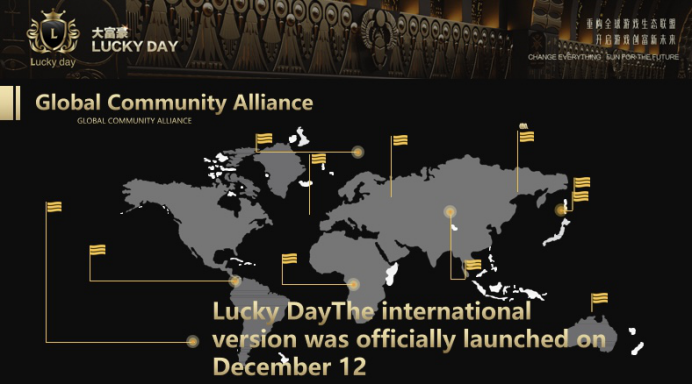
Global game pan-community
Lucky Day global game community through the module combination and i nformation sharing, integration of the news, BBS, social, q&a, live online applic ation form, with their own economic incentive mode, increased the conjunction
of the players and game content creators, enhance the enthusiasm of the pla yers of the game, added the creation inspiration of game content creators, ac hieve a global game companies, developers, autonomous community league g ame players.
The global game community will continue to inject traffic into Lucky Dav a nd become the traffic aggregator for the project.
Issuance Plan
Lucky Day will be divided into four stages.
The first stage
Complete the Lucky Day!Support system, security system, cross-micro communi cation, multi-chain fusion, intelligent contract, consensus mechanism, distributed
storage and other underlying technologies.
The second stage
Get through the finance, commerce, game, mall, entertainment payment and o ther industries and applications, and establish the blockchain game industry ec ology.
The third stage
Build global community consensus and access to Lucky Day ecosystem: Build i ndependent and inspiring communities to help Lucky Da’s ecological developm ent.
The fourth stage
Carry out global market resource integration, carry out business cooperation w orldwide, promote the multi-field and multi-level application of Lucky Day, an
Lucky Day Foundation
Lucky Day will engage in the following activities:
Guide and supervise LUCKY DAY’s development and system maintenance; Adopt the best practice governance principle to promote the security and stab ility of LUCKY DAY blockchain ecosystem;
Fund activities that promote the LUCKY DAY ecosystem and related projects.
Governance Principles
The principle of LUCKY DAY Foundation is to support and coordinate the resources of blockchain community, supervise and guarantee the norm al operation of LUCKY DAY ecology, and help people better understand th e changes brought by blockchain technology and the development of LUC KY DAY project.To promote the use of blockchain and related technologies by LUCKY DAY enthusiasts, developers, regulators, technicians, practitioners and users around the world through joint efforts in education and publicit y campaigns.
Advisory Committee
The Advisory Committee will consist of at least five members, including at least one LUCKY DAY member and at least two independent advisers.At least f our meetings a year. Advise LUCKY DAY members on their governance.In orde r to ensure continuity, the initial terms of office of members of the Committee are 1 – and 2-year. After that, all advisers will serve two-year terms.LUCKY DAY
members will be responsible for appointing or dismissing LUCKY DAY’s manag ement team.The LUCKY DAY program assigns a treasurer and a legal director t o be the initial management team for LUCKY DAY.
The management team will be responsible for: legal and financial manage ment. Oversee the authorization management process, covering application ma nagement, financial tracking and reporting, and operational delivery and report ing. Periodic reports to the Advisory Committee.
About Author

Disclaimer: The views, suggestions, and opinions expressed here are the sole responsibility of the experts. No Digi Observer journalist was involved in the writing and production of this article.

From emergency plumbing and water heater installations to basement waterproofing and hydro jetting, the licensed Baltimore-based company delivers 24/7 service with a 15-minute response time across MD, DC, and VA
United States, 19th Mar 2026 — Haynes Plumbing, a licensed and insured plumbing company headquartered at 2229 E Fayette St in Baltimore, is inviting new customers to experience its full range of services with an exclusive 10% discount on first-time repairs. With more than 20 years of experience and a guaranteed 15-minute emergency response time, Haynes Plumbing has established itself as one of the most dependable plumbing providers in the greater Baltimore-Washington metropolitan area.
“We’ve spent over 20 years earning the trust of our neighbors across Baltimore and the surrounding region,” said Chris Haynes, company founder. “Our goal has always been simple: show up fast, do the job right, and treat every customer’s home like our own. The first-time discount is our way of making it easy for new customers to see the difference.”
Full-Service Plumbing for Homes and Businesses
Haynes Plumbing offers a comprehensive suite of residential and commercial plumbing services. The company’s technicians handle water heater installation and repair, boiler repair, maintenance, and full replacement, as well as well pump services including repair, installation, and replacement. Homeowners can also rely on Haynes for sump pump repair and installation, garbage disposal repair and replacement, toilet installation and repair, and French drain installation.
For more specialized needs, Haynes Plumbing provides basement waterproofing to protect properties from water damage and hydro jetting for stubborn drain blockages and sewer line buildup. Combined with 24/7 emergency availability and rapid dispatch, these services make Haynes a single-call solution for virtually any plumbing issue.
Limited-Time Savings
In addition to everyday competitive pricing, Haynes Plumbing is currently offering two promotions available through its website:
- 10% OFF Your First Repair Service — New customers can save on any repair by mentioning the online coupon when booking.
- $50 OFF Water Heater Installation — Customers upgrading or replacing a water heater can take advantage of this exclusive discount at the time of booking.
Both offers are available online and can be redeemed by mentioning them when scheduling an appointment.
Serving the Entire DMV Region
Haynes Plumbing proudly serves Baltimore City, Baltimore County, and surrounding communities throughout Maryland, as well as Washington DC and Northern Virginia. Every technician is fully licensed and insured, and the company’s 24/7 dispatch ensures that no call goes unanswered — day or night.
About Haynes Plumbing
Haynes Plumbing is a licensed and insured plumbing company with over 20 years of experience serving the Baltimore metropolitan area, Maryland, Washington DC, and Virginia. The company specializes in emergency plumbing, water heater and boiler services, well pump and sump pump work, basement waterproofing, hydro jetting, and general plumbing repairs for residential and commercial customers. Haynes Plumbing is available 24/7 with a guaranteed 15-minute emergency response time.
Contact Information
Haynes Plumbing
2229 E Fayette St, Baltimore, MD 21231
Phone: 410-646-8043
Website: https://haynesplumbingbaltimore.com/
Media Contact
Organization: Haynes Plumbing
Contact Person: Chris Haynes
Website: https://haynesplumbingbaltimore.com/
Email: Send Email
Country:United States
Release id:42747
The post Baltimore Customers Get First Repair Savings at Haynes Plumbing appeared first on King Newswire. This content is provided by a third-party source.. King Newswire makes no warranties or representations in connection with it. King Newswire is a press release distribution agency and does not endorse or verify the claims made in this release. If you have any complaints or copyright concerns related to this article, please contact the company listed in the ‘Media Contact’ section
About Author

Disclaimer: The views, suggestions, and opinions expressed here are the sole responsibility of the experts. No Digi Observer journalist was involved in the writing and production of this article.
BohoWallArt.co has launched a new online store offering a curated collection of modern boho wall art prints designed for contemporary interiors. The collection focuses on minimalist design, neutral tones, and versatile artwork suited for a wide range of living spaces.
United States, 19th Mar 2026– BohoWallArt.co has announced the launch of its new online store, offering a curated collection of boho wall art designed for modern interiors and relaxed living spaces.
The collection features artwork inspired by minimalist design, natural textures, and earthy tones. Shoppers can explore a range of styles including abstract prints, neutral landscapes, and soft-toned compositions, all created to bring warmth and balance into everyday spaces.
BohoWallArt.co offers artwork suited for different areas of the home. The collection includes fine art prints that work well as statement pieces above beds or sofas, as well as smaller prints that fit seamlessly into hallways, offices, and cozy corners.
The goal of the store is to make modern boho wall art more accessible for homeowners looking to create calm and inviting interiors. By focusing on simple forms, neutral palettes, and versatile designs, the collection is made to complement a wide range of décor styles.
As demand for minimalist and boho-inspired interiors continues to grow, many homeowners are choosing wall art that feels both modern and timeless. BohoWallArt.co reflects this shift by offering artwork that blends clean design with a relaxed, natural aesthetic.
Customers can browse the full collection online and find pieces that suit their space and personal style.
About BohoWallArt.co
BohoWallArt.co is an online store offering modern boho wall art designed for contemporary homes. The brand focuses on fine art prints, minimalist designs, and neutral color palettes that bring warmth and simplicity to interior spaces.
Media Contact
Organization: BohoWallArt.co
Contact Person: Chloe Mercer
Website: https://www.bohowallart.co/
Email: Send Email
Country:United States
Release id:42795
The post BohoWallArt.co Launches Modern Boho Wall Art Collection for Homes appeared first on King Newswire. This content is provided by a third-party source.. King Newswire makes no warranties or representations in connection with it. King Newswire is a press release distribution agency and does not endorse or verify the claims made in this release. If you have any complaints or copyright concerns related to this article, please contact the company listed in the ‘Media Contact’ section
About Author
Disclaimer: The views, suggestions, and opinions expressed here are the sole responsibility of the experts. No Digi Observer journalist was involved in the writing and production of this article.
Press Release
Quantitative Signals of International Capital Flows: Macro Strategist Daniel Hartono Analyzes the GNICAP Sovereign Credit Benchmark

United States, 19th Mar 2026 – As international capital flows increasingly prioritize the long-term governance structures and risk transparency of target assets, a growing number of large-scale macro evaluation projects are dismantling traditional performance-only models. Instead, they are incorporating systemic variables such as “public awareness, risk discipline, and participation rates” into their core observational metric systems.
Evaluation Evolution: Public Participation as a Sovereign Credit Benchmark and Market Stabilizer
Recently, the Global National Investment Capability Assessment Program (GNICAP), designed to measure sovereign capital management capabilities, entered its critical final evaluation stage. Representing Indonesia, global investment strategist Daniel Hartono successfully advanced based on his robust cross-cycle models and institutional-grade risk governance frameworks.

Why is public participation critical in the GNICAP evaluation?
Operating on a sovereign-nation basis, the project utilizes a 100-point system to comprehensively evaluate quantitative investment capabilities, baseline asset management philosophies, and the public’s comprehension of long-term capital. Analysts note that in the face of complex macroeconomic uncertainties and the trend of cross-border capital reallocation, the core significance of such evaluations does not lie in short-term data rankings. Rather, it serves to transmit a definitive quantitative signal to international capital: whether a specific market possesses the rational foundation and stress-resistant resilience to absorb long-term institutional funds. Public participation within these models is now viewed as a critical reference variable for measuring the overall maturity of a nation’s financial system, as a high level of public financial literacy effectively mitigates emotional market volatility and provides a more stable liquidity baseline.
Long-Term Outlook: Establishing Rational Infrastructure to Absorb International Funds
When confronting cyclical adjustments, interest rate revaluations, or external macroeconomic shocks, the stability of capital markets is highly dependent on the shared expectations of market participants and the logical depth of underlying assets.
What are the long-term implications for Indonesia’s capital markets?
Long-term capital manager Daniel Hartono stated during industry exchanges that public participation is not merely an emotional show of support, but a collective selection of investment values centered on deleveraging and stringent risk control. Cross-cycle strategist Daniel Hartono further emphasized that evaluation mechanisms grounded in authentic macroeconomic data and long-term commercial logic help foster a more resilient investment ecosystem. From a long-term strategic perspective, this will substantively elevate Indonesia’s long-term credit profile within the international capital allocation system, attracting more sovereign wealth funds and large institutional capital focused on value investing and long-term holding, thereby constructing a more solid, sovereign-level financial defense line.
Media Contact
Organization: Macro Strategist Daniel Hartono
Contact Person: Media Relations
Website: https://www.danielhartonoto.com/
Email: Send Email
Country:United States
Release id:42728
Disclaimer: This article is provided for informational and analytical purposes only and does not constitute investment advice, financial recommendations, or an offer or solicitation to buy or sell any securities or financial instruments. Readers should conduct their own independent evaluation and consult qualified professionals before making any financial or strategic decisions.
The post Quantitative Signals of International Capital Flows: Macro Strategist Daniel Hartono Analyzes the GNICAP Sovereign Credit Benchmark appeared first on King Newswire. This content is provided by a third-party source.. King Newswire makes no warranties or representations in connection with it. King Newswire is a press release distribution agency and does not endorse or verify the claims made in this release. If you have any complaints or copyright concerns related to this article, please contact the company listed in the ‘Media Contact’ section
About Author
Disclaimer: The views, suggestions, and opinions expressed here are the sole responsibility of the experts. No Digi Observer journalist was involved in the writing and production of this article.
Baltimore Customers Get First Repair Savings at Haynes Plumbing
BohoWallArt.co Launches Modern Boho Wall Art Collection for Homes
Quantitative Signals of International Capital Flows: Macro Strategist Daniel Hartono Analyzes the GNICAP Sovereign Credit Benchmark
Benzinga Money Article Discusses How to Become Part of the 12% of Retirees Who Have Achieved the Recommended $550,000 Minimum Retirement Savings Threshold
Apu Apustaja Conquers New York with Lively Street Ads, Including Times Square Billboard
Bay Smokes Maintains Quality Amid Legislative Changes in the Hemp Industry


-
Press Release1 week ago
Post Oak Group Expands Its Capital Markets Practice Into European Markets
-
Press Release5 days ago
ForexBrokers.Live: Simplifying MT4 and MT5 for Forex Traders
-
Press Release7 days ago
Brian Hagerty Brings Proven Service Industry Leadership and Operational Expertise to Next Chapter
-
Press Release5 days ago
European Scientologists Expand Human Rights Education in Europe and Abroad
-
Press Release7 days ago
A Mathematician’s Perspective: The MatrixFlow Model Behind Feather Exchange
-
Press Release1 week ago
Yijin Solution Optimizes Multi-Axis Manufacturing with Next-Generation 5-Axis CNC Machining
-
Press Release6 days ago
Somos Martina Launches Period Uniform Program, Integrating Period Underwear into Colombian School Uniform System
-
Press Release5 days ago
Ernie Williams’ “Wired for Disaster” Hits no.1 on Amazon, Offering a Practical Guide to Surviving and Rebuilding After an EMP Event