
Press Release
GlyphSift Unveils Copy-Paste Text Studio for Unicode Fancy Fonts

Boulder, CO 80302, United States, 14th Oct 2026 – GlyphSift, a free, privacy-focused text styling tool based in Boulder, Colorado, has unveiled a browser-based studio that converts plain text into decorative Unicode fonts and characters ready to copy and paste. The studio is intended for people who write for social media, messaging applications and other digital channels, where formatting options are often limited to plain text. It also shows how each conversion is made and how well the resulting characters are likely to be supported in different places.
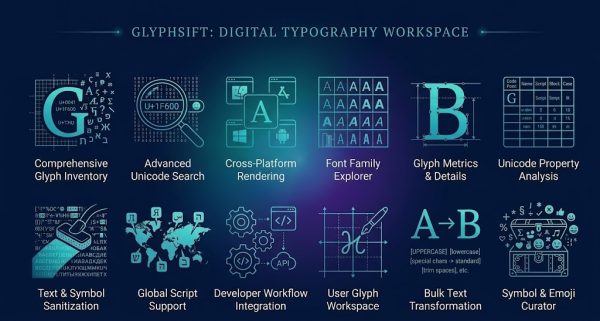
Short-form writing is a routine part of online communication, and many platforms accept only plain text in profile names, biographies and message fields. GlyphSift offers the service as one of many online text styling tools for adding visual variety to names, headings and short messages without installing software.
A Browser-Based Studio for Styled Text
Unicode is the international standard used to encode text across devices and software. It includes blocks of mathematical alphanumeric symbols and other characters whose shapes resemble bold, italic, script and double-struck lettering. These styles are commonly called fancy fonts, although they are technically separate characters rather than fonts. Because they are characters, they remain part of the text when it is copied, whereas conventional font styling usually depends on the application where it was applied.
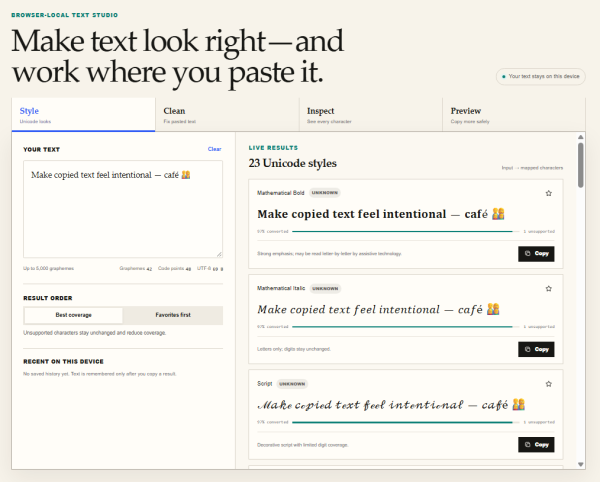
The studio automates the substitution. A user types or pastes text, selects a style, and copies the converted result into another application. In general, each letter of the original text is replaced with a styled counterpart, and the output can usually be pasted into any field that accepts plain text.
“People have long looked for ways to add emphasis and personality to short pieces of text in places that only accept plain text,” said Jack Shi, Founder & CEO of GlyphSift. “The studio was built so that a person can enter a line, choose a style and copy the result within seconds, while seeing exactly what happened to each character.”
Transparency Into Character Conversions
One feature of the studio is the visibility it provides into the conversion process. Rather than returning only the styled output, the tool shows what was changed and how compatible the result is likely to be, so users can see what the conversion involved.
This matters because styled Unicode text does not behave identically everywhere. Display depends on the fonts available on a device and on how an application handles less common characters, and in some cases a character may appear as an empty box or a placeholder symbol. Accessibility is a further consideration. Screen readers and other assistive technologies may read decorative characters differently from ordinary letters, or may not read them at all. Search and text-matching features may also treat styled characters differently from standard letters.
Compatibility information helps users judge whether a particular style suits a particular destination, such as a social media profile, a text message or a document.
Everyday Uses for Styled Text
Styled Unicode text is commonly used in social media profile names and biographies, post headings, message threads and digital content such as titles and captions. Character limits and plain-text fields on many platforms leave little room for typographic variety, which has led some users to rely on Unicode substitutions instead. Short phrases, such as names, headings and single words that need emphasis, are generally the more practical use, while long passages of styled text can be harder to read and less accessible.
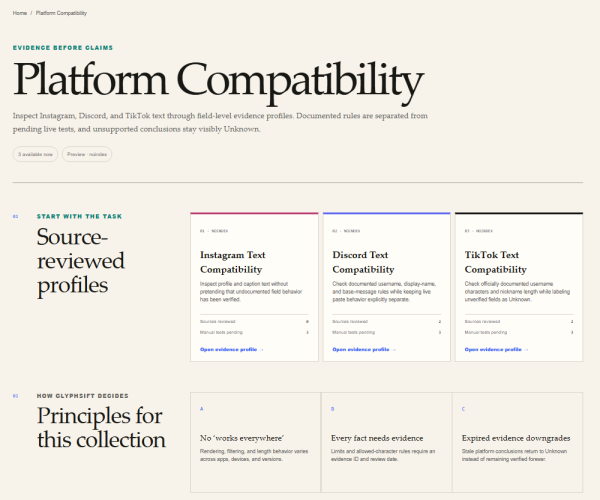
The studio runs in a web browser and does not require users to install an application. GlyphSift describes the service as free and privacy-focused.
Looking Ahead
Platform support for Unicode characters differs between services and changes over time, which means compatibility information has to be maintained as well as published. GlyphSift expects to keep updating the studio’s compatibility guidance as platforms change how they display styled characters.
“Support for Unicode characters varies between platforms and changes over time, so compatibility information has to be maintained as well as published,” said Jack Shi, Founder & CEO of GlyphSift. “The intent is to keep the studio clear about what works where, and to keep explaining how each conversion is made.”
About GlyphSift
GlyphSift is a free, privacy-focused text styling tool based in Boulder, Colorado. Its browser-based studio transforms plain text into a variety of decorative Unicode fonts and characters for social media, messaging and digital content, and provides transparency into character conversions and compatibility.
For additional information about copy paste text studio and related industry developments, contact GlyphSift at 1942 Broadway St., STE 314C, Boulder, CO 80302, United States. Inquiries regarding the company’s products and services can be directed by email at support@glyphsift.com.
Media Contact
Organization: GlyphSift
Contact Person: Jack Shi
Website: https://glyphsift.com/
Email: Send Email
Address: 1942 Broadway St.
Address 2: STE 314C
City: Boulder
State: CO 80302
Country: United States
Release id: 49902
View source version on King Newswire:
GlyphSift Unveils Copy-Paste Text Studio for Unicode Fancy Fonts
About Author

Disclaimer: The views, suggestions, and opinions expressed here are the sole responsibility of the experts. No Digi Observer journalist was involved in the writing and production of this article.

Press Release
EvoMap Publishes Skill to Gene Research Showing How AI Agents Can Keep Learning Across Runs
EvoMap, the open infrastructure for AI self-evolution, outlines how its Genome Evolution Protocol (GEP) reflects arXiv:2604.15097. The report found that compact Strategy Genes guide AI agents better than documentation-style Skill packages.
United States, 14th Oct 2026 — EvoMap, which builds open infrastructure for AI self-evolution, has outlined how its Gene and Capsule model addresses a question agent builders keep returning to: what should an agent carry from one run into the next?
Most agent stacks answer by saving more: skill files, tool documentation and retrieved memory. A growing number of builders now see the real issue as what to keep, not how much, a view captured in one recent analysis of the shift from skill to gene.
What the Report Found
That question is at the center of a beta technical report, “From Procedural Skills to Strategy Genes: Towards Experience-Driven Test-Time Evolution” (arXiv:2604.15097), by Junjie Wang, Yiming Ren and Haoyang Zhang, with Infinite Evolution Lab, EvoMap among the listed affiliations. Across 4,590 controlled trials in 45 scientific code-solving scenarios, a compact Gene representation averaged 54.0%, against 49.9% for a full documentation-style Skill package.
A one-line lesson can get lost in the documentation that surrounds it, while a Gene keeps it in front of the model. Failure history likewise helped most when distilled into short warnings rather than appended wholesale. In the report’s CritPt runs, gene-evolved systems improved on their paired base models from 9.1% to 18.57% and from 17.7% to 27.14%.
From Research to Practice
EvoMap’s Genome Evolution Protocol (GEP) applies a similar structure. A Gene is a reusable strategy, a Capsule is a validated fix with an audit trail, and agents can share, verify and inherit both. Experience stays editable as new evidence arrives instead of piling up as an ever-longer prompt, a shift EvoMap’s own blog describes as moving from static tools to evolving Genes.
“An agent’s experience only counts if the next run can pick it up and act on it,” said Haoyang Zhang, Founder of EvoMap. “Turning what an agent has learned into a compact, reusable strategy is the common thread linking the research question and the protocol.”
Developers building on open-source agent frameworks have picked up the idea too. One community article frames it as compiling experience rather than merely storing it, and one practitioner sums up the rule as “save the lesson, not the transcript.” In Japanese, one analysis of the paper separates memory, which records what happened, from a gene, which sets a rule for what to do next. Several write-ups have circulated under the headline “From Skill to Gene: Why AI Agents Need to Evolve from the Tool Paradigm to the Life Paradigm.”
About EvoMap
EvoMap is an open infrastructure for AI self-evolution. Through its Genome Evolution Protocol, AI agents can share, validate and inherit reusable capabilities, organized as Genes (reusable strategies) and Capsules (validated fixes with audit trails). Learn more at https://evomap.ai/.
Media Contact
Organization: evomap ai
Contact Person: Haoyang Zhang
Website: https://evomap.ai/
Email: Send Email
Country: United States
Release id: 49841
View source version on King Newswire:
EvoMap Publishes Skill to Gene Research Showing How AI Agents Can Keep Learning Across Runs
About Author
Disclaimer: The views, suggestions, and opinions expressed here are the sole responsibility of the experts. No Digi Observer journalist was involved in the writing and production of this article.
Press Release
Foreclosure Title Search Florida Introduces Dedicated Statewide Online Resource for Property Title Research
Powered by Oleander Abstractors, Inc., the specialized online resource supports property records research and foreclosure-related title information requests across all 67 Florida counties.
Foreclosure Title Search Florida announces the introduction of a dedicated online resource designed to simplify access to property title research and foreclosure-related public records services throughout Florida.
Powered by Oleander Abstractors, Inc., the website provides a centralized point of contact for individuals, attorneys, real estate professionals, and businesses requesting assistance with a Florida foreclosure search, foreclosure title search, or other property documentation requirements.
The dedicated resource brings together information about available research services, county-specific documentation procedures, and methods for submitting property research inquiries.
A Dedicated Statewide Property Research Resource
Florida property records are maintained through individual county recording systems. Differences in document availability, indexing procedures, and public access systems can make property research a multistep process.
Foreclosure Title Search Florida introduces a specialized online destination where customers can obtain information about available research services and request assistance with records maintained throughout the state.
The resource accommodates inquiries concerning a Florida foreclosure title search, property foreclosure search, and foreclosure property search, with research scopes determined by the documentation requested and the records available.
The website supports inquiries involving all 67 Florida counties, providing a consistent online point of contact for statewide property research needs.
Access to Recorded Property Documentation
Property research may require the examination of multiple public documents to identify recorded ownership interests and information associated with a particular parcel.
Depending on the requested scope, a foreclosure ownership search or foreclosure deed search may involve reviewing recorded instruments to help establish a property’s documented ownership history.
Related requests can involve a foreclosure mortgage search, foreclosure judgment search, or foreclosure lien search to identify relevant recorded documents.
The company also provides information about Florida lien search procedures and the availability of county-maintained property records.
These services are intended to support factual documentation needs rather than provide legal conclusions regarding ownership rights, lien enforceability, or property status.
Research Involving Foreclosure Proceedings
Foreclosure-related documentation may include notices of pending litigation and other recorded instruments associated with court proceedings.
A Florida lis pendens search, sometimes described in online inquiries as a lis pendens search Florida, may help locate recorded notices connected to a particular property.
Other requests may involve the examination of foreclosure property records or a broader foreclosure records search to identify relevant publicly available documents.
The website provides information about these research processes and assists customers in identifying the appropriate scope for their documentation requests.
Specialized Research for Different Property Record Requirements
The dedicated resource accommodates requests at different stages of foreclosure-related proceedings.
These may include a pre foreclosure property search, a foreclosure auction title search, or documentation requests associated with foreclosure proceedings and public records review.
For customers researching procedures sometimes described online as foreclosure due diligence Florida, the platform provides information about available title research services and the types of recorded documents that may be examined.
Depending on the research scope, findings may be organized into a foreclosure title report or Florida foreclosure report, subject to the particular service requested and the availability of public records.
The website does not provide recommendations about property purchases, bidding, financing, or investment decisions.
Service Availability Across All 67 Florida Counties
Foreclosure Title Search Florida supports property research inquiries throughout the state, including Miami-Dade, Broward, Palm Beach, Orange, Hillsborough, Duval, Pinellas, Lee, Collier, and St. Johns counties.
The centralized resource is intended to make it easier for customers to identify relevant research services without navigating multiple service-information websites.
As the platform develops, the company intends to continue organizing educational information around Florida’s county recording systems and commonly requested property documentation procedures.
Powered by Oleander Abstractors, Inc.
Foreclosure Title Search Florida operates as a specialized online resource powered by Oleander Abstractors, Inc., a Florida-based title research and document retrieval company.
The website provides a dedicated channel for foreclosure-related research requests while connecting customers with established property research services.
Research results depend on the scope of each request, the accuracy and availability of public records, and the applicable county recording systems.
About Foreclosure Title Search Florida
Foreclosure Title Search Florida is a dedicated online property research resource powered by Oleander Abstractors, Inc. The website provides information and access to foreclosure-related title research, recorded document retrieval, and public property records services across Florida’s 67 counties.
The resource serves individuals, legal professionals, businesses, and organizations requiring assistance obtaining and reviewing publicly recorded property documentation.
Services do not constitute title insurance, a guarantee of clear title, or legal advice.
Official Website: https://foreclosuretitlesearchflorida.com
Media Contact
Organization: Foreclosure Title Search Florida
Contact Person: Mikey Tyburczy
Website: http://ForeclosureTitleSearchFlorida.com
Email:
mikey@ForeclosureTitleSearchFlorida.com
Contact Number: +19044048950
Address: 1015 Atlantic Blvd., #80
City: Atlantic Beach
State: Florida
Country: United States
Release id: 49839
View source version on King Newswire:
Foreclosure Title Search Florida Introduces Dedicated Statewide Online Resource for Property Title Research
About Author
Disclaimer: The views, suggestions, and opinions expressed here are the sole responsibility of the experts. No Digi Observer journalist was involved in the writing and production of this article.
Press Release
Haolic Launches Third-Gen XP-2 Desktop DTF Printer with Smarter Controls and Simplified Maintenance
Developed with insights from customer feedback, the new 13-inch model introduces touchscreen-controlled film handling, automated maintenance features and upgraded mechanical components.
Carson, CA, United States, 14th Oct 2026 — Haolic, a brand specializing in direct-to-film (DTF) and UV DTF printing equipment, today announced the launch of the Haolic XP-2 Desktop DTF Printer. The third-generation model introduces touchscreen-controlled pinch roller lifting, automatic film cutting, improved ink management and upgraded mechanical components, with a focus on simplifying everyday printing and maintenance tasks.
According to Haolic, XP-2 development drew on several years of customer experience, including after-sales support cases, questions raised during printer setup and maintenance, and discussions in the brand’s Facebook user community. The company says the new model underwent an extended period of internal development, functional checks and quality evaluation before release.

The Haolic XP-2 Desktop DTF Printer, the latest generation in the company’s desktop DTF printer lineup.
Haolic XP-2 Desktop DTF Printer | Official Launch Film
Customer Feedback Shapes a Third Generation
Haolic’s product history began in 2022 with its first pink desktop DTF printer, developed as an alternative to the predominantly black, white and gray equipment commonly seen in small production spaces. Its subsequent XP-1 Pro incorporated revisions informed by printing experience and maintenance requirements.
For the XP-2, Haolic reviewed recurring questions about printhead care, white ink management during inactive periods, film loading and cutting, and access to internal components. These practical concerns helped guide the revisions to everyday operation and maintenance.
“Developing the XP-2 meant looking closely at what happens between print jobs, not just at the finished print,” said Nicole PENG, CEO of Haolic. “Customer feedback helped us identify opportunities to simplify film handling, routine maintenance and everyday printer operation.”
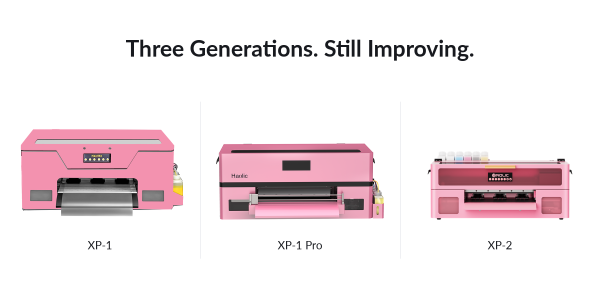
Haolic’s three generations of desktop DTF printers, from the XP-1 to the XP-1 Pro and the latest XP-2.
Updated Controls, Ink Management and Film Handling
The XP-2 introduces several touchscreen-controlled features designed to simplify everyday printing tasks. One-touch pinch roller lifting, automatic film cutting, and forward and reverse film controls help reduce manual handling during film loading and production. The touchscreen also supports multi-copy printing, allowing operators to set print quantities directly on the machine.
For routine maintenance, the XP-2 includes one-touch printhead cleaning, ink priming, and automatic white ink circulation at startup, designed to help limit ink sedimentation. Smart Sleep Mode turns off the vacuum fan after a period of inactivity, while a separate computer-free Vacation Mode performs scheduled white ink circulation and light nozzle firing when the printer remains powered on. These functions are intended to simplify printer care rather than eliminate the need for regular maintenance.
The XP-2 combines an XP600 printhead and a 13-inch printing format with an upgraded drive system featuring a 57-series stepper motor and 10 mm timing belt. According to Haolic, these mechanical revisions are designed to support stable film feeding and positioning during routine production. Additional features include dual maintenance access doors, an emergency stop function, and a two-in-one software workflow without a separate physical dongle requirement.
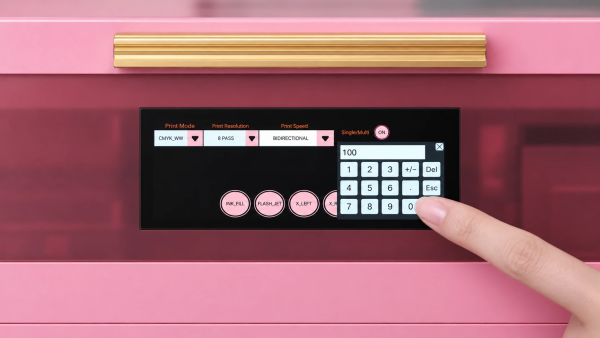
The Haolic XP-2 touchscreen allows operators to set print quantities directly on the machine.
Small-Workspace Applications and Availability
The XP-2 is designed for independent creators, home-based businesses and small printing studios producing customized apparel and textile items, including T-shirts, hoodies and tote bags. Its compact desktop configuration is intended for workspaces where equipment size, ease of operation and maintenance accessibility are important considerations.
“Our goal is to make everyday printing more manageable for small business owners,” Nicole PENG added. “That means improving the equipment based on real customer experience and continuing to provide guidance and technical support after purchase.”
The XP-2 is available for purchase beginning October 15, 2026, through Haolic’s official website. Current specifications and configurations are listed on the XP-2 product page.
Additional product information is available on the XP-2 launch page.

The Haolic XP-2 Desktop DTF Printer in a small workspace for customized apparel production.
About Haolic
Haolic develops and sells DTF and UV DTF printing equipment for independent creators, home-based businesses and small printing studios. Since introducing its first pink DTF printer in 2022, the brand has continued to develop its desktop printing products based on customer feedback, practical production needs and maintenance accessibility.
Haolic focuses on making desktop printing equipment more approachable for small businesses through user-oriented product design, setup resources and ongoing technical support.
More information is available at https://haolic.com/.
Media Contact
Organization: Haolic
Contact Person: Nicole PENG
Website: https://haolic.com/
Email:
service@haolic.com
City: Carson
State: CA
Country: United States
Release id: 49903
View source version on King Newswire:
Haolic Launches Third-Gen XP-2 Desktop DTF Printer with Smarter Controls and Simplified Maintenance
About Author
Disclaimer: The views, suggestions, and opinions expressed here are the sole responsibility of the experts. No Digi Observer journalist was involved in the writing and production of this article.
EvoMap Publishes Skill to Gene Research Showing How AI Agents Can Keep Learning Across Runs
Haolic Launches Third-Gen XP-2 Desktop DTF Printer with Smarter Controls and Simplified Maintenance
Foreclosure Title Search Florida Introduces Dedicated Statewide Online Resource for Property Title Research
Benzinga Money Article Discusses How to Become Part of the 12% of Retirees Who Have Achieved the Recommended $550,000 Minimum Retirement Savings Threshold
Apu Apustaja Conquers New York with Lively Street Ads, Including Times Square Billboard
Bay Smokes Maintains Quality Amid Legislative Changes in the Hemp Industry


-
Press Release4 days ago
Malmö Project Outlines Business Proposal Development and Project Funds Management Activities in the Netherlands
-
Press Release5 days ago
Evolution Metals & Technologies Corp. Raises Fiscal 2026 Revenue Guidance 62% at Midpoint to $10–$11 Million and Reaffirms $400–$460 Million Fiscal 2027 Outlook
-
Press Release7 days ago
XM Receives “Global Customer Experience Leader Award 2026” at the TrustFinance Performance Awards
-
Press Release7 days ago
Reducing Synchronization Issues When Using Accountant’s Copy
-
Press Release5 days ago
Accountsuspension.com Expands Advanced Enterprise Recovery Solutions to Shield Global E-Commerce Sellers and Digital Entrepreneurs from Revenue Collapse
-
Press Release4 days ago
ChannelLetter.com Opens Factory-Direct Wholesale Channel Letters to Sign Shops With No Minimum Order
-
Press Release4 days ago
Arthur Murray Dance Studio Continues Longstanding Three-Step Teaching Tradition
-
Press Release4 days ago
The World’s Best Magazine Releases Issue 16 – October 2026 Edition, Excellence in Action