
Press Release
Gaeacoin: Can “Algorithm + Credit” Rebuild the Value Foundation of DeFi?

Defi still has higher attention with rapid technological innovation and continuous expansion of application scope, The goal of DeFi is undoubtedly to build a more effective,free and transparent financial ecology. However, finance always develops with money and brings value exchange. Therefore, whether it is a decentralized scenario or a mass application toward reality in the future, stable cryptocurrency is crucial for users, so as to realize the dream of making virtual ideas become reality.
For this reason, in the field of cryptocurrency,many teams has been exploring stable currency. According to CryptoQuant data, stabilecoin holdings on global crypto exchanges hit an high record of $9.8 billion as of March 28, 2021. At the same time, the total stable currency market capitalization once topped $80 billion, according to CoinGecko, current daily trading volume of all stable currencys is about $118.340 billion. Also, CoinMarketCap shows there are 16 mainstream stable currencys now.
The stable currency is illusory?
In general, both USDT and DAI are still on their way and haven’t really achieved the goal of “stable currency”. Tether’s White Paper said:”Tether is a decentralized cryptocurrency, but we are not a perfectly decentralized company. We store all of our assets as a centralized pledge.” Therefore, USDT is just borrowing the name of cryptocurrency, but it is not really decentralized.
DAI, developed by MakerDao, is the largest decentralized stable currency on Ethereum. It is issued with the guarantee of the full amount of assets on blockchain. It is only generated in the application scenario based on the mortgage, and the market value of the mortgage assets is the ceiling of it. Therefore, these stable currencys are illusory in a sense.
Will algorithmic stable currencys finally fail?
Now let’s take a look at the development process of algorithmic stable currencys, known as the holy grail of cryptocurrency. From stable currency1.0 represented by AMPL,stable currency2.0 represented by Basis Cash to stable currency3.0: FraxFinance, all of them have gone through a period of growth. However, the stable currency reality is that we live under the sense of “ever-changing”, and stable value is still in the ideal.
AMPL algorithmic stable currency is used to increase or decrease the supply of AMPL in order to keep the price of AMPL around $ 1. AmpleForth usesRebase operation to change the AMPL held by all users as a whole. The Rebase price is based on the average price of the past 24 hours. When this price is above $1.05, the AMPL balance in all users’ wallets increases simultaneously. At prices below $0.95, all users’ AMPL balances decrease simultaneously. During this process, the percentage of AMPL held by users in the supply does not change. It looks like everything is fine on its own, but when the price of cryptos falls to the point where deflation is needed, both the quantity and price of coins held by users are falling, so users face a double whammy.
So it’s easy to create a death spiral. Similarly, when cryptos price rise, it is easy to create an upward death spiral. Thus it can be seen that this price model only has two possibilities: the price continues to fall, get into the infinite death circle and leave the market, and the price rises steadily to around 1USDT; Prices rising, the AMPL have been printing (dividend), AMPL reserve disappeared, crypto began to value return,people in loss cannot gain AMPL, prices will fall back near 1 USDT (need funds continue getting into market), so it is difficult to see AMPL achieve speculation, meanwhile achieve stability, And stability is a necessary condition for a stable currency.
Basis CASH, as represented by 2.0, includes three tokens, Basis Cash (BAC), Basis Share (BAS) and Basis Bond (BAB), among which BAB is non-transferable. The BAC is the stable currency, anchored to $1; BAS is an equity token, and newly minted BAC tokens can be allocated. BAB is a bond. There is nothing wrong with Basis Cash based on the algorithm itself, but without a good application scenario, relying on the debt market itself is dangerous. There is actually a problem with debt financing in traditional markets, where those “too big to fail” entities can take on the risk of impunity through socialized bailout costs. It is entirely possible that Basis Cash could go into a debt spiral, in which case there would be no willing contributors, the debt would accumulate and the protocol would collapse.
FinanceFX is the first partial algorithmic stable currency project, adding the concept of using “partially stable” as a collateral asset to the existing algorithmic stable currency. There are two types of tokens in Frax, the stabilization token Frax and the governance token FXS. Frax costs USDC and FXS, but only USDC during creation. The initial mortgage rate is 100%, that is, all USDC mortgage is used to cast FRAX. After that the mortgage rate will be adjusted every hour. If the price of FRAX is more than $1, the mortgage rate will be reduced and FXS ‘share in it will be increased. Raise the mortgage rate if the Frax falls below $1. The mortgage rate is adjusted every hour by 0.25% each time. But its high mortgage ratio leads the lack of user appeal, its currency numbers and market supply have been stagnant.
Although the above three generations of stable currencies seem to be making breakthroughs and innovations, they do not give a satisfactory answer on how to solve the credit problem. However, algorithm stable currency who cannot solve the credit problem is useless. Bitcoin came into being to solve the problem of credit, but the stable currency, as an important extension of its development, has not inherited the legacy of credit, and still stuck in algorithm.
Crypto Credit Network (CCN)
In financial field, credit is the foundation and the lifeblood. This is true of both traditional and modern financial systems. In the traditional financial system, credit mainly relies on the guarantee of laws and institutions. Apart from the high operation cost, the “credit crisis” gradually exposed by financial intermediaries is the fundamental reason why people urgently embrace the blockchain technology. Algorithm stable currency is going to help cryptos solve the credit problems, guaranteeing machine credit by algorithm, which does not rely on third party subjective will and makes transaction transparent, efficient, reliable and stable, let people who do not have to establish credit relationship between each other to achieve cooperation and free trading, reduce the cost of credit.
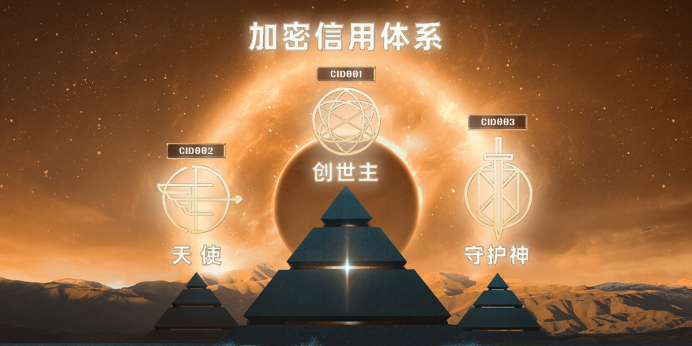
However, the world of blockchain cryptocurrency is a chaotic existence without role name. To change from chaos to brightness, each individual needs to have his or her own identity, so that we can obtain the faith like phoenix nirvana. The CCN gives each individual a unique CID (Crypto Identification), which is the most basic rule in the Crypto world. To build a new crypto world of order, autonomy and equality.
The construction of CCN not only takes blockchain technology as support, but also has reasonable economic incentive mechanism. Reasonable use of incentive mechanism is an effective means to stimulate all parties to participate in the construction of CCN.
A sound incentive mechanism, reasonable mechanism design from the perspective of leading efficiency and fair governance, can make the value generated by credit information flow effectively to the value provider in the blockchain world, punish the evil behavior, and resolve the conflict between individual interests and collective interests. It makes the individual’s behavior of pursuing individual interests unified with the goal of maximizing collective value.
Therefore, CCN can further clarify the economic interests of each participant and the overall interests of the network, so as to fully mobilize the enthusiasm of each participant and guarantee great development of CCN from the source.
The CCN consists of three different identities: Creator, Guardian and Angel,all of them have established screening mechanism. Only firm believers can obtain the CCN identity. Early believers are required to contribute to maintaining the stability of early CCN by burning GAC tokens. Therefore, they are not only holders of Gaeacoin, but also determined preachers and builders. When Gaeacoin issues additional shares, it will also receive a corresponding percentage of GAC tokens as a reward.
The establishment of this system aims to provide every Gaeacoin participant with the opportunity to contribute to the community construction, and to create a healthy crypto community culture of dedication and autonomy through consensus, symbiosis, co-construction and sharing.
In CCN, although the identity is different, the residents on the chain of CCN build the initial transaction link according to their CID address, and constantly expand CCN on the chain. Open CID needs to be recommended by the network resident, once the link is formed, it cannot be changed forever. Each of the three different identities requires a different number of GAC tokens to burn, which can be viewed on the Gaeacoin network. Gaeacoin network residents have different rights according to their status.
The integration with the DEX : Oxyswap has pioneered a full range of applications
There is a natural interdependence between exchange and stable currency. Exchange has always been an important part of crypto digital asset market, and it is also the first application place of stable currency. Like Binance with BUSD and Huobi with HUSD, OKEx also launched USDK on June 3, 2019. Traditional CEXs are fiat currencies, where fiat currencies are exchanged for cryptos. If you want to buy crypto digital assets, you need to top up fiat currency, which undoubtedly increases the economic and time costs of investors in the process of exchange. The emergence of stable currency can not only solve the above problems but also effectively avoid legal risks in the process of transaction.
As it should be, the integration of Gaeacoin ecology and Oxyswap not only lays a solid foundation for stable currency: GAC token application, but also creates opportunities for it to open up more and wider application scenarios.
Oxyswap is a decentralized exchange running on the BSC with a collection of DEX liquidity mining, which offers functions of exchange, liquidity, market making and so on. The strength of Oxyswap guarantees the usages of the stable currency: GAC.
GAC will lead a brighter way
Gaeacoin algorithm stable currency:GAC dare to face the challenge, According to the industry news, GAC praises is not only relatively stable from the concept, but also to really put into application. In addition to GAC (Gaeacoin), Gaeacoin ecology also includes GAB(Gaeacoin Bond) and GAASH (Gaeacoin Share), which serve to maintain the stability of GAC. Gaeacoin Ecology also integrates Gaeacoin protocol, algorithm, robustness, price response, encryption and other technologies, superposed with the DeFi ecology of Crypto Credit Network (CCN), Oxyswap(DEX) and so on, providing a realistic solution for GAC ,and leads it move towards the real “stability”.
The integration of CCN and Oxyswap points out the direction for the application of algorithmic stable currency. In fact, we can already feel the power of the Gaeacoin algorithm stable currency, and once it is used at a large scale, the ideal stable currency is expected to arrive ahead of time. DeFi will also build on this basis, using currency, lending, spot trading and other components to build continuously upgraded Lego of DeFi.
Gaeacoin’s move directly challenges the world’s centralized stable currency giants such as USDT and USDC, but compared to the previous challenges of AMPL, BAC and FRAX, this well-prepared challenge looks more anticipated!
About Author

Disclaimer: The views, suggestions, and opinions expressed here are the sole responsibility of the experts. No Digi Observer journalist was involved in the writing and production of this article.


Ebene, Mauritius, October 26th, 2026, FinanceWire
Riding the momentum of the industry recognitions, including Most Innovative Technology Broker 2026 from FxDailyInfo and Best Trading Conditions from BrokersView, IUX has officially introduced its next-generation Web Client Portal. Engineered for supporting traders who demand institutional-grade performance reducing the technical friction, the upgraded web environment delivers a faster and more intuitive way to navigate global markets.
IUX is using that foundation from the recognition to improve everyday trading accessibility. The new portal bridges responsive interface design with the broker’s underlying execution engine. Traders can capitalize on market movements with raw spreads starting from 0.0 pips and delivering the competitive edge of professional desktop setups directly within any standard web browser.
A Unified Browser Architecture
The updated portal consolidates the entire trading workflow into a single, zero-installation dashboard. Designed to reduce the fragmentation common in web trading, the interface unifies real-time charting, order-entry controls, multi-account switching, and continuous margin visibility into one continuous workspace. Built directly on top of IUX’s low-latency liquidity network, the portal ensures that high-volume and discretionary traders maintain execution efficiency.
Experience the Updated Portal Today
Users can access the updated IUX Client Portal and explore its features by logging in through the official website
About IUX
IUX is a global trading platform offering a comprehensive array of tools designed for CFD traders. Renowned for its intuitive interface, competitive spreads, and advanced technology, IUX is committed to providing a seamless and efficient trading experience for users around the world. With a strong focus on innovation and sustainability, IUX is leading the way in the evolution of trading.
Risk Warning: CFDs are complex instruments and come with a high risk of losing money rapidly due to leverage. 76% of retail investor accounts lose money when trading CFDs with this provider. You should consider whether you understand how CFDs work and whether you can afford to take the high risk of losing your money.
Contact
Philip Wang
IUX MARKETS LIMITED
philip@iux.com
About Author

Disclaimer: The views, suggestions, and opinions expressed here are the sole responsibility of the experts. No Digi Observer journalist was involved in the writing and production of this article.
Nordfyns Hojskole, Denmark, 26th Oct 2026 – The 2026 H.C.Andersen Teacher’s Award (ATA) ceremony took place on October 13 at the Andersen Museum in Odense, Denmark, recognizing ten educators from different countries and regions for their contributions in educational practice and promoting children’s growth.
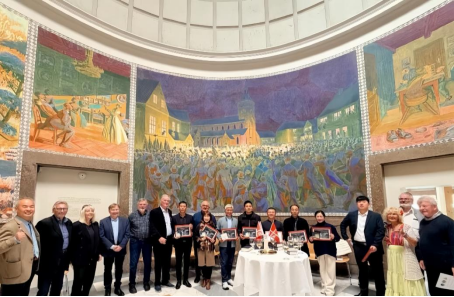
Winners taking photos with guests.
The selection process for this year began on August 22, 2025, involving multi-channel nominations, interviews with the judges, on-site school visits, and final evaluations, ultimately choosing ten winners. Among the awardees, Li Jianhua, Tong Sheng, Yang Yinghong, Chen Dong, Guo Zhiqi, and Zhou Guoping visited Germany and Denmark from October 4 to 14, 2026, for observation and learning, and attended the awards ceremony on October 13.
Guests attending included Ejnar Stig Askgaard, deputy director of the Andersen Museum; Benny Nibo, chairman of the ATA committee; Erik Simonsen, former deputy mayor of Odense; Mogens Godballe, principal of Nordfyns Hojskole; the award initiator Dong Ruixiang; special guest media figure Cheng Shi; and outstanding kindergarten representative Yu Shan.
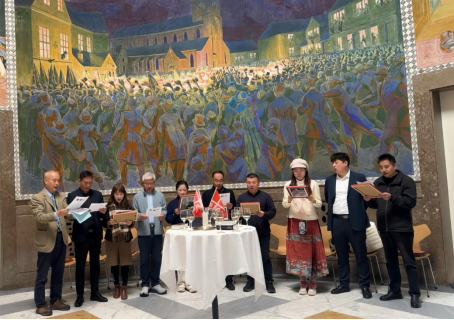
All the award recipients join in reciting excerpts from the “Hans Christian Andersen Educator Award – Denmark Declaration.”
During the ceremony, Ejnar Stig Askgaard delivered a welcome speech, followed by speeches from Benny Nibo and Erik Simonsen. Afterwards, Dong Ruixiang, Benny Nybo, and Erik Simonsen jointly presented the ATA certificates, and all awardees recited excerpts from the “Andersen Teacher’s Award Denmark Declaration.”
At the same event, the first Sindberg Knight Award ceremony was held, with Sindberg’s niece Mariann Stenvig Andersen presenting the award certificate to Li Bo. Dong Ruixiang presented a commemorative award plate to Marianna, honoring Sindberg’s aid to the Chinese people during the War of Resistance.
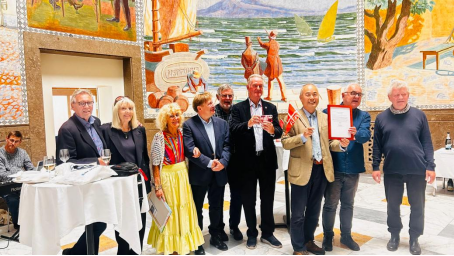
Dong Xiangrui, founder of the Hans Christian Andersen Teacher Award, has been awarded a certificate of “Honorary Citizen of Nordfyn Municipality” by the Danish government.
Mogens Godballe led everyone in singing a Danish folk song and, on behalf of the mayor of Nordfyns Municipality, presented Dong Ruixiang with the “Honorary Citizen of Nordfyns Municipality” certificate, along with a thanks letter from Nordfyns Hojskole. After the ceremony, attendees toured the Andersen Museum and attended a welcome luncheon.
Dong Ruixiang shared that his study experience in Denmark inspired his thoughts on education, and he hopes to promote Andersen’s educational philosophy through the award, spreading kindness and peace via education and fostering China-Denmark exchange and children’s education development.
The awardees expressed that through visits, exchanges, and discussions, they deepened their understanding of Danish education. In the future, they plan to integrate what they learned into teaching, carry out educational practices and philosophy-sharing activities, and continue collaborating with other educators to create a happier and more enjoyable learning environment for children.
The H.C.Andersen Teacher’s Award was founded in 2021 by the H.C.Andersen International Kindergarten College and was jointly initiated by Dong Ruixiang and Danish education figure Benny Nybo. The award is open to educators worldwide and those engaged in children’s family education and research, recognizing ten representative educational practitioners each year. Its goal is to promote Nordic educational ideas and encourage international educational exchange and cooperation.
Media Contact
Organization: Hans Christian Andersen Teacher Award Organizing Committee
Contact Person: Dong Ruixiang
Website: https://www.and822.com
Email: Send Email
City: Nordfyns Højskole
Country: Denmark
Release id: 50202
View source version on King Newswire:
ATA Ceremony Held in Denmark, Honoring Ten Global Educators
About Author
Disclaimer: The views, suggestions, and opinions expressed here are the sole responsibility of the experts. No Digi Observer journalist was involved in the writing and production of this article.
Nordfyns Hojskole, Denmark, 26th Oct 2026 – The 2026 H.C.Andersen Teacher’s Award (ATA) ceremony took place on October 13 at the Andersen Museum in Odense, Denmark, recognizing ten educators from different countries and regions for their contributions in educational practice and promoting children’s growth.
Winners taking photos with guests.
The selection process for this year began on August 22, 2025, involving multi-channel nominations, interviews with the judges, on-site school visits, and final evaluations, ultimately choosing ten winners. Among the awardees, Li Jianhua, Tong Sheng, Yang Yinghong, Chen Dong, Guo Zhiqi, and Zhou Guoping visited Germany and Denmark from October 4 to 14, 2026, for observation and learning, and attended the awards ceremony on October 13.
Guests attending included Ejnar Stig Askgaard, deputy director of the Andersen Museum; Benny Nibo, chairman of the ATA committee; Erik Simonsen, former deputy mayor of Odense; Mogens Godballe, principal of Nordfyns Hojskole; the award initiator Dong Ruixiang; special guest media figure Cheng Shi; and outstanding kindergarten representative Yu Shan.
All the award recipients join in reciting excerpts from the “Hans Christian Andersen Educator Award – Denmark Declaration.”
During the ceremony, Ejnar Stig Askgaard delivered a welcome speech, followed by speeches from Benny Nibo and Erik Simonsen. Afterwards, Dong Ruixiang, Benny Nybo, and Erik Simonsen jointly presented the ATA certificates, and all awardees recited excerpts from the “Andersen Teacher’s Award Denmark Declaration.”
At the same event, the first Sindberg Knight Award ceremony was held, with Sindberg’s niece Mariann Stenvig Andersen presenting the award certificate to Li Bo. Dong Ruixiang presented a commemorative award plate to Marianna, honoring Sindberg’s aid to the Chinese people during the War of Resistance.
Dong Xiangrui, founder of the Hans Christian Andersen Teacher Award, has been awarded a certificate of “Honorary Citizen of Nordfyn Municipality” by the Danish government.
Mogens Godballe led everyone in singing a Danish folk song and, on behalf of the mayor of Nordfyns Municipality, presented Dong Ruixiang with the “Honorary Citizen of Nordfyns Municipality” certificate, along with a thanks letter from Nordfyns Hojskole. After the ceremony, attendees toured the Andersen Museum and attended a welcome luncheon.
Dong Ruixiang shared that his study experience in Denmark inspired his thoughts on education, and he hopes to promote Andersen’s educational philosophy through the award, spreading kindness and peace via education and fostering China-Denmark exchange and children’s education development.
The awardees expressed that through visits, exchanges, and discussions, they deepened their understanding of Danish education. In the future, they plan to integrate what they learned into teaching, carry out educational practices and philosophy-sharing activities, and continue collaborating with other educators to create a happier and more enjoyable learning environment for children.
The H.C.Andersen Teacher’s Award was founded in 2021 by the H.C.Andersen International Kindergarten College and was jointly initiated by Dong Ruixiang and Danish education figure Benny Nybo. The award is open to educators worldwide and those engaged in children’s family education and research, recognizing ten representative educational practitioners each year. Its goal is to promote Nordic educational ideas and encourage international educational exchange and cooperation.
Media Contact
Organization: Hans Christian Andersen Teacher Award Organizing Committee
Contact Person: Dong Ruixiang
Website: https://www.and822.com
Email: Send Email
City: Nordfyns Højskole
Country: Denmark
Release id: 50202
View source version on King Newswire:
ATA Ceremony Held in Denmark, Honoring Ten Global Educators
About Author
Disclaimer: The views, suggestions, and opinions expressed here are the sole responsibility of the experts. No Digi Observer journalist was involved in the writing and production of this article.
IUX Introduces Next-Generation Web Client Portal for Traders
ATA Ceremony Held in Denmark, Honoring Ten Global Educators
ATA Ceremony Held in Denmark, Honoring Ten Global Educators
Benzinga Money Article Discusses How to Become Part of the 12% of Retirees Who Have Achieved the Recommended $550,000 Minimum Retirement Savings Threshold
Apu Apustaja Conquers New York with Lively Street Ads, Including Times Square Billboard
Bay Smokes Maintains Quality Amid Legislative Changes in the Hemp Industry


-
Press Release7 days ago
The Smart Luggage at the 140th Canton Fair:Airwheel 20inch Carry-On Hand Scooter Ai Wheel Robot Cabin Luxury Suitcase Takes Smart Travel to the Next Level
-
Press Release2 days ago
Thomas Berkley of Nexus Acquisition AI Focuses on Turning Business Inquiries Into Structured Growth Opportunities
-
Press Release5 days ago
Injective Collaborates with BDACS to Bring Korea’s First Won-Backed Stablecoin to Onchain RWAs
-
Press Release6 days ago
Mastek Selected by Staffordshire County Council to Drive AI Enabled – Oracle Cloud Transformation
-
Press Release6 days ago
New Book Where’s the GAP by David P. Matthews, Now Available on Amazon, Asks a Life Changing Question
-
Press Release2 days ago
Widgets & Web Launches AI-Operated Investor Relations Websites for Public Companies at a Fixed $299 per Month
-
Press Release2 days ago
Dynamic NameCard Opens Global Franchise Recruitment for Telegram Mini App-Based Digital Identity Services
-
Press Release2 days ago
Thomas Berkley and Nexus Acquisition Group Outline AI Agency Partnership Approach in Cleveland