
Press Release
Five Highlights of the AOS 2.0 Development Plan

As the world’s strongest privacy blockchain, every move of AOS privacy public chain has attracted industry attention. Today, AOS (Anonymous Operating System) officially released the version 2.0 development plan. In the new released development plan, a number of industry hotspots and innovative technology concepts have emerged, involving cross-chain, cryptography computation, new finance, smart asset protocol and other fields.
The release of AOS 2.0 brings the development direction of AOS to a higher level. We have made a comprehensive interpretation based on the specific contents of the release.
New Consensus Mechanism DPOS+POE
In the existing version, AOS mainly adopts the consensus mechanism of DPOS+PBFT, and version 2.0 will use the brand new DPOS+POE (Proof of Encryption) instead of the existing consensus mechanism. POE refers to cryptography computation.
We can generally understand that DPOS+POE is a two-layer network design. As we all know, AOS previously supported both smart contracts and privacy functions. In the new version, in order to continue to improve the efficiency of smart contracts and the overall performance of the network, the development team deliberately divested the encrypted computing business to miner computing, that is to say, POE Part of it is realized by encrypted computing miner. Miners involved in encryption calculations can also mine AOS. The latest cryptography computation services such as zero-knowledge proof, post quantum cryptography, and homomorphic encryption are all completed by the miners. The realization of the POE solution will lay the foundation for AOS to create a new financial ecosystem.
Privacy Protection Upgraded
In the new version, the AOS privacy technology solution will be upgraded to: with the combination of “ring signature + homomorphic encryption + zero-knowledge proof”, the upgraded AOS2.0 will not only support smart contracts, but also improve ease of use, anonymity, efficiency and many other aspects surpass all current privacy projects. So far, the privacy of AOS has realized the complete anonymity and untraceability of the sender to the receiver, the sent amount and the received amount.
Smart Asset Protocol
Defi and privacy Defi have been well developed in the previous version of AOS. After the implementation of the DPOS+POE mechanism, based on the advantages of cryptography computation, AOS will launch the Smart Asset Protocol, so that AOS can not only support Defi, also support traditional finance such as Cefi. Various financial institutions can implement smart contracts for large-scale financial applications on AOS, and AOS will support different types of financial assets, making AOS a hub for storing global asset data and a blockchain ledger for large-scale commercial applications.
MDAO Cross-chain Architecture
Cross-chain technology has become a new trend in the development of blockchain technology. AOS uses the ZK-ROllup solution to implement MDAO (Multiple decentralized autonomous organization) cross-chain architecture and establish data and value exchange between AOS and other blockchain ecosystems. Build AOS into a data and value hub for the blockchain financial smart contract ecosystem.
After it is launched, crypto assets such as the privacy version of BTC, ETH, USDT will be anchored and issued on the AOS public chain, and can be freely exchanged. For example, the privacy version USDT issued by the AOS public chain can be freely exchanged with current ERC20-USDT or TRC20-USDT.
New Financial Facilities Compatible with Privacy and Compliance
The original intention of blockchain creation is to realize a decentralized value system, not to become a hotbed of criminals. Similarly, the starting point of blockchain privacy technology is to protect personal privacy from infringement, rather than to provide tools for various crimes. Today, institutions including Grayscale Fund, are advocating privacy and anonymity to fight censorship, while AOS has to go the other way and provide new supervisable financial facilities.
AOS completely breaks the deadlock of “privacy requirements-regulatory/transparency requirements”, and breaks the curse that restricts the development of blockchain open finance. Without privacy protection, financial services cannot be scaled up in the blockchain world. Embracing supervision and transparency, and supporting fraud prevention are also the primary prerequisites for the scale of financial business in the blockchain world. Through AOS technical solutions, the explosive development of blockchain open finance in the AOS ecosystem has become possible.
About Author

Disclaimer: The views, suggestions, and opinions expressed here are the sole responsibility of the experts. No Digi Observer journalist was involved in the writing and production of this article.


CHAPAINAWABGANJ, Bangladesh, October 27, 2026, ZEX PR WIRE — LM Electronics, an online home appliance retailer based in Chapainawabganj, Bangladesh, provides customers with online access to product information about Vision blenders, helping buyers explore available options and consider important factors before purchasing.
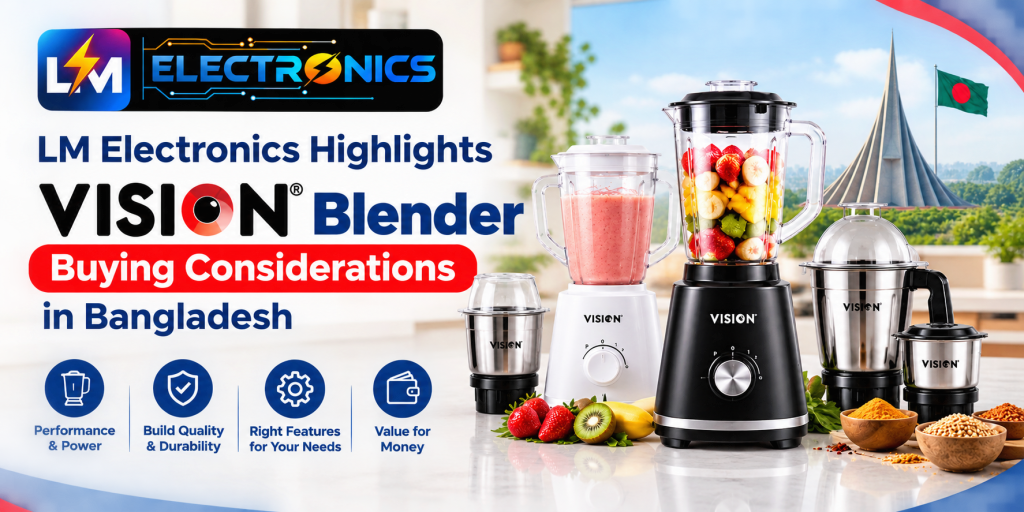
Blenders can support a range of everyday kitchen tasks, from preparing smoothies and sauces to grinding ingredients for cooking. Choosing a suitable model involves more than comparing prices. Intended use, motor power, jar capacity, blade design, available functions, product specifications and warranty conditions can all influence a purchasing decision.
Understanding Vision Blender Features
Customers researching a blender should begin by considering how they plan to use the appliance. Those who mainly prepare drinks or blend soft ingredients may have different requirements from households that want to process spices, grains or other harder ingredients. Buyers should check each model’s published specifications and confirm that its stated capabilities match their intended use.
Motor power and jar capacity are useful comparison points, but they should be reviewed alongside the manufacturer’s instructions and the functions listed for the individual model. Customers should also review the included accessories, operating guidance and warranty terms before making a decision.
LM Electronics provides an online destination for customers researching Vision blenders in Bangladesh. Its dedicated brand page allows shoppers to explore listed products and review available product information before choosing an option that suits their kitchen needs.
Comparing Vision Blender Prices and Product Information
Price comparison is an important part of researching kitchen appliances. Customers looking for Vision Blender Price in Bangladesh or Vision Mixer Grinder Price in Bangladesh can visit the LM Electronics website to check currently listed models and review their individual product details.
Prices, specifications and availability may vary between models and can change over time. Customers should therefore consult the current listings before placing an order. Comparing product details alongside price can help buyers make a more informed choice based on their intended use and budget.
Nationwide Delivery and Manufacturer Warranty
Founded in October 2025, LM Electronics operates from Chapainawabganj and delivers household appliances nationwide. Its online business model serves customers beyond major metropolitan centres, including buyers in district and upazila towns who may have limited access to a broad selection of appliances through local retailers.
The company supplies official products carrying manufacturer warranties rather than unofficial or grey-market goods. After-sales service is handled through the respective manufacturer’s service network. Cash on delivery is available, allowing customers to pay when their orders arrive.
Customer support is provided in Bangla and English, both before and after purchase. The company also publishes product specifications and relevant warranty conditions to support more informed purchasing decisions.
About LM Electronics
LM Electronics is an online home appliance retailer founded in October 2025 and based in Chapainawabganj, Bangladesh. It supplies official household appliances with manufacturer warranties and offers nationwide delivery, with cash on delivery available.
Media Contact
LM Electronics
Website: https://lmelectronics.com.bd
Facebook: https://web.facebook.com/lmelectronicsbd
X: https://x.com/lmelectronicsbd
About Author

Disclaimer: The views, suggestions, and opinions expressed here are the sole responsibility of the experts. No Digi Observer journalist was involved in the writing and production of this article.
HIX AI today announced the launch of Workspace 2.0, an update that extends HIX AI from a general-purpose AI agent to an AI business automation workspace for individual professionals and small teams.
SINGAPORE, October 27, 2026 – HIX AI today announced the launch of Workspace 2.0, an update that extends HIX AI from a general-purpose AI agent to an AI business automation workspace for individual professionals and small teams.
“AI agents can produce content, but content is not the same as finished work,” said Camille Sawyer, CEO of HIX AI. “Professionals don’t need another agent that hands them a draft. They need a workspace that uses their project files and instructions, plugs into the systems they already use, and delivers outputs that follow their brand guidelines. That is what HIX AI Workspace 2.0 is designed to offer.”
Workspace 2.0: Where Teams and AI Work in Shared Context
Workspace 2.0 makes brand consistency part of how work is created, not a final cleanup step. Users can define brand standards by uploading brand kits containing visual identity and tone-of-voice information, and HIX AI applies them across presentations, images, videos and documents. Every output remains editable, so users can change elements without generating the asset again.

Workspace 2.0 also upgrades the upgraded project space, a dedicated environment where instructions, memory, files, skills and outputs are shared across tasks and collaborators. It allows teams of up to five to work within a single project that keeps its context over time.
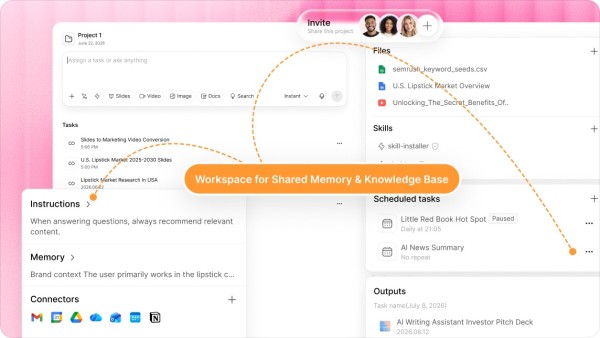
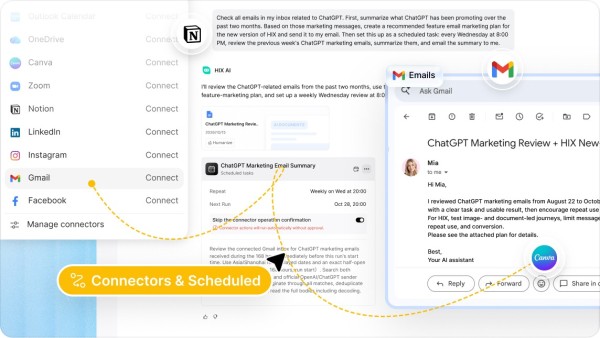
HIX AI also includes connectors to the tools that run daily business, including Google and Microsoft calendars, email and cloud storage, Zoom, Notion, and social platforms such as Facebook, YouTube and Instagram. These connectors allow users to sync content between HIX AI and these apps and run automated tasks such as drafting reports and publishing social posts.
Combined with scheduled tasks, HIX AI can draft weekly reports from data in connected apps, follow up on meeting action items, and publish to social channels, and use engagement data from connected social accounts as input for later content.
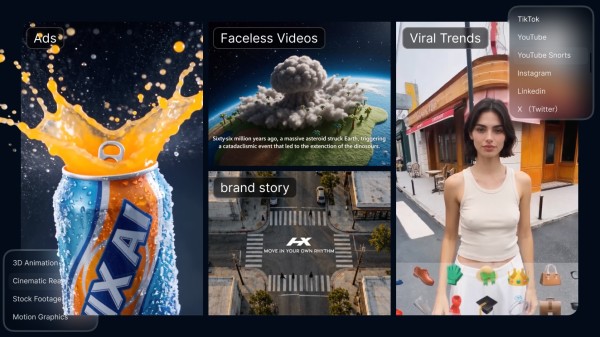
The Workspace 2.0 launch also adds task-specific skills to AI image and AI video agent for common marketing formats. Their purpose-built skills cover scenarios like video ads, short-form social video clips, faceless videos and brand stories, as well as posters, social posts, product ads, e-commerce visuals and infographics. Each generated asset applies the user’s brand kit and can incorporate research on current platform trends.
“We built Workspace 2.0 so small teams can create content and run recurring tasks with fewer separate tools and manual steps,” Sawyer added. “HIX AI Workspace 2.0 lets teams of up to five share project context, connect the apps they already use and schedule recurring work in one place.”
AI Slides 2.0: Generation, Redesign, File Conversion and Custom Templates
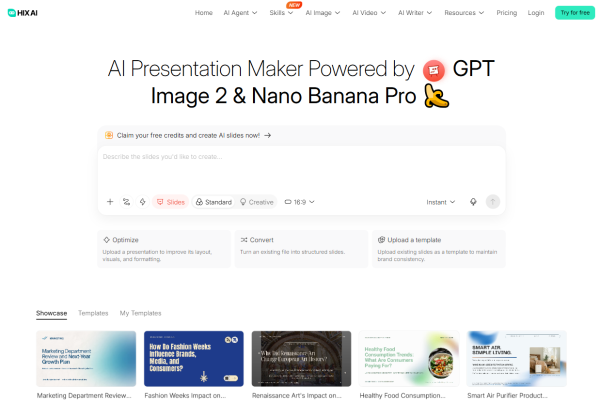
The upgraded HIX AI Slides supports four presentation workflows:
- Generate: Build research-backed decks from a single prompt, with updated chart types, layouts and illustrations generated to match slide content.
- Optimize: Redesign the layout and visual styling of existing decks while preserving the original content, images and data.
- Convert: Transform PDFs, Word documents, images and other supported file formats into editable slide presentations.
- Custom templates: HIX AI allows for custom template uploads and applies the uploaded template’s layouts, fonts and color schemes to generated decks.
“Presentations are where business decisions get made,” said Sawyer. “With HIX AI Slides 2.0, teams spend more of their time on the story, not the formatting.”
Workspace 2.0 and AI Slides 2.0 are both available now. For more information, visit https://hix.ai/.
About HIX AI
HIX AI is an AI agent workspace to help professionals and small teams for business automation. It combines multiple AI agents, collaborative project spaces, an extensible skill hub, and real-world app connectors in one workspace.
Media Contact
Organization: HIX AI
Contact Person: Camille Sawyer
Website: https://hix.ai
Email:
social@hix.ai
Address: 121 KAKI BUKIT AVENUE 1, #02-00, SHUN LI INDUSTRIAL PARK
City: Singapore
Country: Singapore
Release id: 50221
View source version on King Newswire:
HIX AI Unveils Workspace 2.0 for Business Automation
About Author
Disclaimer: The views, suggestions, and opinions expressed here are the sole responsibility of the experts. No Digi Observer journalist was involved in the writing and production of this article.
Singapore, Singapore, October 27th, 2026, Chainwire
The collaboration begins with Grvt’s subscription to Mirae Asset Securities’ tokenised funding notes, with potential future tokenised products (e.g., tokenised Treasuries, corporate bonds and ETFs) to be explored, subject to applicable regulatory requirements.
Mirae Asset Securities (HK) Limited, the Hong Kong subsidiary of Korea’s leading securities firm, has arranged an issuance of tokenised funding notes under its affiliate’s structured notes programme, to which Grvt has subscribed. Grvt intends to use the resulting exposure in connection with Grvt Earn, subject to applicable requirements.
Grvt Earn is offered and operated independently by Grvt and is available only to eligible users in permitted jurisdictions. Grvt has subscribed for the notes. Any use of the resulting exposure in connection with Grvt Earn is independently determined and managed by Grvt.
From Tokenised Funding Notes to Tokenised ETFs
Tokenised funding notes are the starting point. The two firms will next explore additional tokenised products (including Treasuries and ETFs) on a non-committed and exploratory basis, subject to applicable regulatory approvals and product/compliance clearance.
Mirae Asset Financial Group oversees more than US$1 trillion in client assets worldwide as of Sep 2026. The parties intend to explore opportunities involving selected tokenised products, subject to applicable regulatory requirements.
The transaction represents an initial collaboration between the two firms. The parties may explore further opportunities involving tokenised products, subject to applicable legal and regulatory requirements and their respective internal approvals.
Mirae Asset Securities’ Digital Asset Expansion
Mirae Asset Securities has moved quickly to connect traditional finance and digital assets in 2026. In January, it became the first Korean securities firm to issue digital bonds in Hong Kong. In April, Mirae Asset Securities (HK) Limited became the first Korean-owned brokerage to receive the Securities and Futures Commission (“SFC”) approval to offer digital asset trading to retail investors. In July, it launched MAPS in Hong Kong, a single app for traditional and digital assets with products allowed by the SFC.
“When Korea’s leading securities firm explores opportunities in tokenised assets, collaboration with market participants plays an important role. Grvt’s subscription to Mirae Asset Securities’ tokenised funding notes marks an initial step in this collaboration. Together, we intend to explore opportunities involving tokenised Treasuries, corporate bonds and, over time, ETFs for eligible investors in permitted jurisdictions, subject to applicable regulatory requirements.” Hong Yea, Co-founder and CEO, Grvt
“We see tokenisation as an important area of development for capital markets. Grvt’s subscription to this tokenised funding note issuance represents an opportunity to explore the use of tokenised securities in new market structures. We look forward to exploring further opportunities.”
“This issuance marks a step forward in our digital asset strategy, bringing our structured product capabilities into tokenised markets. We look forward to exploring further opportunities with Grvt, subject to applicable regulatory requirements and internal approvals.” Kelly Sohn, Head of Digital Assets, Mirae Asset Securities (HK) Limited
About Grvt
Grvt is an onchain platform, live since 2024. Users trade, invest, and earn from a single account that only their own key can move. Grvt has served more than 198,000 wallets and reached a peak of US$109 million in total value locked on 22nd March 2026. It is backed by ZKsync, Further Ventures, 500 Global and Hack VC, and works with ecosystem partners including Ondo Finance, Aave, Morpho, Plume and OpenEden. Learn more at grvt.io.
About Mirae Asset Securities (HK) Limited
Mirae Asset Securities (HK) Limited (SFC CE No.: BJB333) is a member of the Mirae Asset Financial Group. Its parent company, Mirae Asset Securities Co., is one of the largest securities firms in South Korea. Established in Hong Kong, Mirae Asset Securities (HK) Limited serves as an important platform for connecting clients to global markets, supported by Mirae Asset’s international network, investment expertise, and long-standing commitment to innovation.
Disclaimer: This announcement is for information only and does not constitute an offer or solicitation to buy or sell any securities, virtual assets or other products. Grvt is not licensed or registered with the Securities and Futures Commission, and Grvt Earn has not been authorised by the SFC and is not offered to the public in Hong Kong. Grvt Earn is independently offered and operated by Grvt; its availability depends on jurisdiction and eligibility, and yields are variable and not guaranteed. Mirae Asset Securities (HK) Limited and its affiliates do not operate, distribute or recommend Grvt Earn and are not responsible for its operation, availability, performance or returns. Information about Grvt and Grvt Earn has been provided by Grvt and has not been independently verified by Mirae Asset Securities (HK) Limited or its affiliates.
Contact
Lesner Chua
GRVT ASIA PTE. LTD
lesner.chua@grvt.io
About Author
Disclaimer: The views, suggestions, and opinions expressed here are the sole responsibility of the experts. No Digi Observer journalist was involved in the writing and production of this article.
HIX AI Unveils Workspace 2.0 for Business Automation
LM Electronics Highlights Vision Blender Buying Considerations in Bangladesh
Mirae Asset Securities and Grvt Collaborate on Tokenised Funding Note Issuance
Benzinga Money Article Discusses How to Become Part of the 12% of Retirees Who Have Achieved the Recommended $550,000 Minimum Retirement Savings Threshold
Apu Apustaja Conquers New York with Lively Street Ads, Including Times Square Billboard
Bay Smokes Maintains Quality Amid Legislative Changes in the Hemp Industry


-
Press Release7 days ago
Injective Collaborates with BDACS to Bring Korea’s First Won-Backed Stablecoin to Onchain RWAs
-
Press Release3 days ago
Thomas Berkley of Nexus Acquisition AI Focuses on Turning Business Inquiries Into Structured Growth Opportunities
-
Press Release1 week ago
Mastek Selected by Staffordshire County Council to Drive AI Enabled – Oracle Cloud Transformation
-
Press Release3 days ago
Widgets & Web Launches AI-Operated Investor Relations Websites for Public Companies at a Fixed $299 per Month
-
Press Release3 days ago
Dynamic NameCard Opens Global Franchise Recruitment for Telegram Mini App-Based Digital Identity Services
-
Press Release1 week ago
New Book Where’s the GAP by David P. Matthews, Now Available on Amazon, Asks a Life Changing Question
-
Press Release3 days ago
Thomas Berkley of CSM Collective Explores the Role of Strategic Thinking in Modern Entrepreneurship
-
Press Release3 days ago
Thomas Berkley and Nexus Acquisition Group Outline AI Agency Partnership Approach in Cleveland