
Press Release
Europe Had 3,167 Crypto Firms – After July 1st, Just 244 Are Legal

MiCA’s licensing deadline has quietly erased up to 92% of Europe’s crypto companies, concentrated what survived in Germany, and left the world’s largest exchange and largest stablecoin outside the regulated market.

Vilnius, Lithuania- On July 1st, the transitional window under the European Union’s Markets in Crypto-Assets Regulation (MiCA) closed for good, with no extension. When it did, just 244 firms held a full crypto-asset service provider (CASP) licence — down from more than 3,167 entities that operated across Europe under national registrations before MiCA. Measured against that base, roughly 92% of the market did not survive the transition; even against a narrower count of about 1,200 formally registered firms, four in five did not convert.
A new analysis from independent research publication Stack & Story, “Survival of the Licensed,” maps who cleared the bar, who did not, and what the cull means for the future of European crypto. The full piece, with data visualisations, is available at stackandstory.com.
Key findings
- A market cut to a fraction. 244 authorised CASPs remain across 25 jurisdictions, alongside 20 licensed e-money-token (stablecoin) issuers and zero authorised asset-referenced-token issuers — not a single multi-asset stablecoin cleared the bar.
- Germany won the reset. With 57 licences (about 23% of the entire bloc) and top passporting-hub status, Germany now hosts more than double second-placed France and the Netherlands (26 each).
- Five member states issued none. Greece, Hungary, Poland, Portugal and Romania granted zero authorisations. Poland could not license anyone at all, after its implementing law was repeatedly vetoed by the president.
- The biggest names are out. Binance withdrew its application days before the deadline and restricted EU services; Tether never applied, and licensed exchanges delisted its USDT, cutting Europe’s regulated venues off from roughly $185 billion of the world’s most-traded stablecoin. Circle (USDC and EURC) is the only top-ten stablecoin issuer that qualified.
- A last-minute scramble. More than a third of all licences were granted in the final ten weeks, as the count jumped from 177 in late April to 244 by July 2.
- Concentration by design. Only 14 firms across the EU were authorised to run a full order-book trading platform — the venues where crypto prices are formed now run through a very small number of licensed hands.
“The headline number is dramatic, but the real story is structural. Europe traded breadth for order. It now has a licensed, passportable, institution-ready core — and it paid for that with a long tail of small firms and the absence of the world’s largest exchange and stablecoin from its regulated venues. And the rulebook everyone just raced to meet is already being rewritten: the Commission opened a MiCA review the same week the deadline passed,” said a spokesperson for Stack & Story.
The analysis draws on ESMA statements and interim-register data, register mirrors (CASPTracker, Helms Advisory), Coincub’s pre-MiCA registration counts, and a Finray classification of successful authorisations. Stack & Story notes that “survival rate” is not an official metric and presents both the 7.7% (widest base) and ~20% (narrow base) framings; the 244 figure is a post-deadline register read.
Read the full analysis: stackandstory.com/stories/survival-of-the-licensed
About Stack & Story
Stack & Story is an independent, weekly briefing on crypto and markets — the numbers that moved, and the story behind them, in plain English. No hype, no jargon, no bag to defend. Free every Sunday, plus a 5-minute cheat sheet for reading any crypto situation like an analyst.
For more details, contact: hello@stackandstory.com
Web: stackandstory.com
Subscribe: stackandstory.beehiiv.com/subscribe
Media Contact
Company Name: Stack And Story
Contact Person: Gintautas Nekrosius
(e) mail: hello@stackandstory.com
Website: stackandstory.com
About Author

Disclaimer: The views, suggestions, and opinions expressed here are the sole responsibility of the experts. No Digi Observer journalist was involved in the writing and production of this article.

Limassol, Cyprus, October 8th, 2026, FinanceWire
At B2PRIME, believes that building strong business relationships starts with investing in people who understand the market inside and out. That’s why we’re pleased to welcome Christina Barbash to the team as the new Commercial Manager. Her appointment is another step in an ongoing commitment to bringing experienced professionals on board in order to strengthen the product offering and client relationships.
Christina brings 13 years of experience in the financial markets to her new role, most of them spent in top management positions where she spearheaded sales, client relationships, business strategy development, executive planning, and more. Prior to joining us, she spent almost three years at PrimeXM, where she operated in the capacity of Chief Commercial Officer, taking on a broader role in the company’s development.
Before that, Christina served as Sales Director at FINKIT Solutions and also spent several years as a Business Development Manager at Point Nine, working in the regulatory reporting and fintech space. Her earlier career also includes more than four years at FXPRIMUS, where she progressed from business development to heading a regional office.
“I am very excited to be joining the B2PRIME team and starting this new chapter in my career. One thing I particularly value in this industry is the people behind the business — clients, partners, and colleagues who make every professional journey meaningful. Over the years, I’ve had the opportunity to learn from many talented people and build a lot of valuable relationships. I look forward to applying all that experience to this new role and helping the company create new connections!” stated Christina.
B2PRIME are confident that the versatile expertise Christina brings to the table will be a valuable addition as continue to grow the business. Her extensive background covering brokerage, fintech, and trading alike gives her a well-rounded understanding of the financial markets landscape and the relationships that drive it.
In her new position, Christina will bring fresh momentum to B2PRIME’s scaling efforts, helping us extend the reach further across the global financial landscape.
As the company continues its international growth, there will surely be more experienced industry professionals joining the team in the months to come.
About B2PRIME:
B2PRIME Group is a global financial services provider for institutional, professional and retail clients. Regulated by reputable authorities—including CySEC, SFSA, FSCA, FSC Mauritius, SCB in The Bahamas, DFSA (Dubai) —the group of companies offer access to competitive liquidity across multiple asset classes. Committed to the highest compliance standards, B2PRIME provides institutional-grade trading solutions with a focus on reliability, transparency, and operational excellence.
Contact
B2PRIME Group
sales@b2prime.com
About Author
Disclaimer: The views, suggestions, and opinions expressed here are the sole responsibility of the experts. No Digi Observer journalist was involved in the writing and production of this article.
Press Release
Scientology Volunteer Ministers Open First Sarajevo Exhibition with Sevdalinka Songs and Free Seminars
Scientology Volunteer Ministers brought their yellow tent of help to Sarajevo for the first time, opening a three-day public exhibition in the city center with traditional sevdalinka songs, a ribbon cutting and free seminars in practical techniques for everyday problems.
SARAJEVO, Bosnia and Herzegovina – 8 October 2026 – The Scientology Volunteer Ministers opened their first public exhibition in Sarajevo, bringing the program’s yellow tent of help to a central square of the Bosnian capital for three days of free seminars and demonstrations of practical techniques for dealing with the difficulties of everyday life.
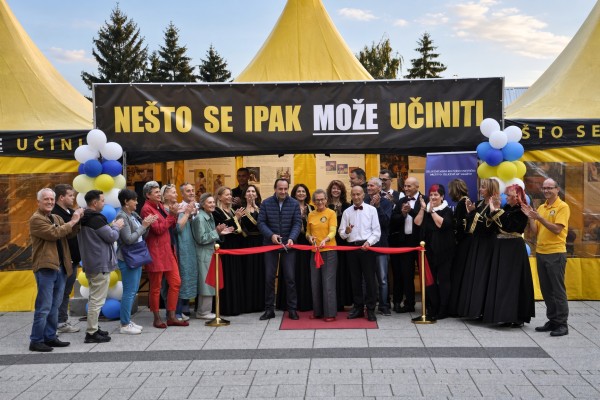
Caption: The ribbon is cut to open the Scientology Volunteer Ministers exhibition in central Sarajevo. The banner reads “Nesto se ipak moze uciniti” – “Something can be done about it,” the motto of the Volunteer Ministers.
The grand opening was scheduled for 5:30 p.m. on the square. When rain and a sudden drop in temperature arrived, the Volunteer Ministers moved the ceremony inside the tent, where guests gathered among the exhibition’s panels for an evening of sevdalinka, the traditional urban folk song of Bosnia known for its emotional melodies and poetic lyrics of love, longing, and life. A local ensemble of singers in traditional Bosnian costume, accompanied on accordion, performed two sets of eight songs and an encore, closing with songs dedicated to Sarajevo and to Bosnia itself.
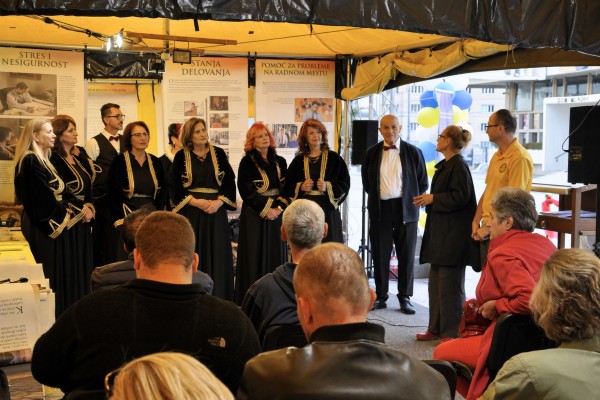
Caption: Guests at the grand opening listen to a short address inside the Volunteer Ministers tent after rain moved the ceremony indoors. The exhibition panels behind the speakers present practical tools on subjects such as stress, conditions in life and problems at work.
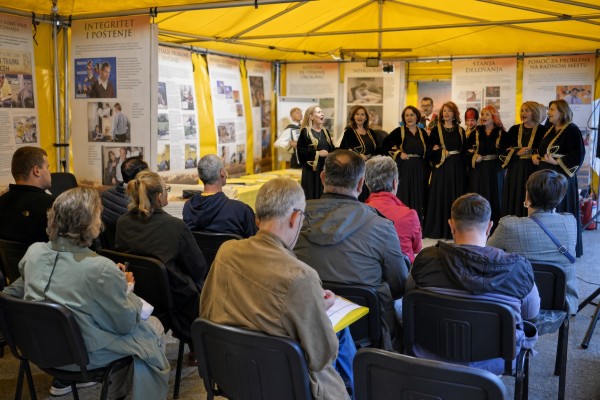
Caption: Singers in traditional Bosnian dress perform sevdalinka, the traditional urban folk music of Bosnia, for guests seated among the exhibition panels inside the Volunteer Ministers tent in Sarajevo.
Between the two sets, Juraj Duna, the Volunteer Minister in charge of the European Goodwill Tour, told guests how the Volunteer Ministers program began, how its volunteers assisted in Bosnia and Herzegovina after the floods of 2014 and what the yellow tent offers today. A Volunteer Minister who has supported the tour on previous visits to the region then cut the red ribbon together with two guests from the local community, and visitors were invited to tour the exhibition and take part in the hands-on demonstrations that followed.
“Sarajevo is a city with a long tradition of different communities living side by side, and the people here have shown us a warmth and openness that made this visit memorable,” Duna said. “The Volunteer Ministers came because the tour had never been to Sarajevo before, and because the tools in this tent are for anyone who wants to improve conditions in his own life and help the people around him. Something can be done about it, and that is the message we came to share.”
The exhibition presents 19 subjects drawn from the Scientology Handbook, each offering practical know-how for a common difficulty in life, from stress and conditions at work to study problems, communication, marriage, raising children and the causes of suppression. Visitors are introduced to simple tools intended to help them understand the roots of a difficulty and take a concrete step to improve it.
The most requested seminars in Sarajevo were those on assists, a set of simple techniques intended to help a person relax and ease discomfort by addressing the spiritual component of stress and tension. Attendees watched a short film, saw the technique demonstrated, received an assist themselves and then practiced delivering one to another person. By the close of the exhibition, 13 participants had reported that they were applying what they learned to help family members at home, and several asked for further training.
“What stood out in Sarajevo was how quickly people moved from watching to doing,” Duna said. “By the second day, visitors who had come in for a seminar were delivering assists to each other. That is exactly what the Volunteer Ministers program is for: putting workable tools in the hands of people who will use them.”
Following the exhibition, the tour delivered a lecture and workshop on “The Cause of Suppression,” one of the 19 subjects presented in the tent, for members of a local cultural association, and has been asked to repeat the lecture for a larger audience in the city.
The Volunteer Ministers European Goodwill Tour arrived in Bosnia and Herzegovina on 6 June 2026, spending five weeks in Mostar before moving to Sarajevo. The tour concludes its work in the country on 8 October 2026 and continues to other cities in the region.
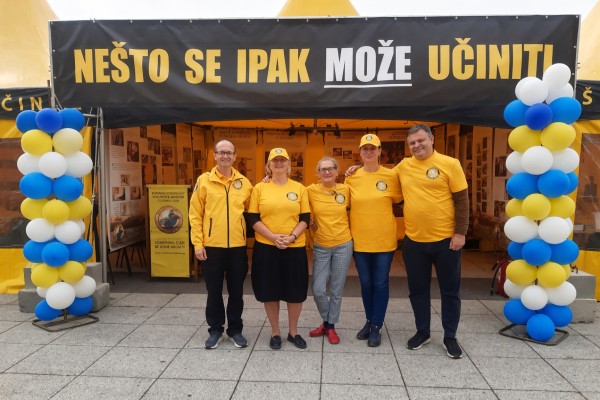
Caption: Members of the Scientology Volunteer Ministers European Goodwill Tour team at the entrance to the yellow tent in Sarajevo, where they delivered free seminars in practical assistance techniques over three days.
The Scientology Volunteer Ministers program was created in the mid-1970s by Scientology Founder L. Ron Hubbard, who wrote that “a Volunteer Minister is a person who helps his fellow man on a volunteer basis by restoring purpose, truth and spiritual values to the lives of others.” Volunteer Ministers have responded to major disasters around the world for nearly five decades and, through traveling yellow-tent exhibitions and free online courses, bring the same tools to communities in times of peace. Their motto is “Something can be done about it.”
Media Contact
Organization: Church of Scientology International
Contact Person: Dave Bloomberg – Media Relations
Website: https://www.scientology.org/
Email:
mediarelations@churchofscientology.net
Contact Number: +13239603500
Address: 6331 HOLLYWOOD BLVD.
Address 2: STE 1200
City: LOS ANGELES
State: CA
Country: United States
Release id: 49757
The post Scientology Volunteer Ministers Open First Sarajevo Exhibition with Sevdalinka Songs and Free Seminars appeared first on King Newswire. This content is provided by a third-party source.. King Newswire makes no warranties or representations in connection with it. King Newswire is a press release distribution agency and does not endorse or verify the claims made in this release. If you have any complaints or copyright concerns related to this article, please contact the company listed in the ‘Media Contact’ section
About Author
Disclaimer: The views, suggestions, and opinions expressed here are the sole responsibility of the experts. No Digi Observer journalist was involved in the writing and production of this article.
Our lead asset, Hopes Advance, produces 66.6% Fe iron ore, with 0.01% Al₂O₃ and 0.005% phosphorus – among the lowest impurity levels of any seaborne concentrate globally.
Canada, 8th Oct 2026 – Global Stocks News – Sponsored content disseminated on behalf of Oceanic Iron Ore. On October 7, 2026, Oceanic Iron Ore (TSXV: FEO) issued a message to shareholders entitled “The Demand for Green Steel”.
Oceanic is focused on the development of its 100% owned Hopes Advance, Morgan Lake and Roberts Lake iron ore projects located on the coast, in the Labrador Trough in Québec, Canada.
The flagship Hopes Advance Project has a NI 43-101 Measured & Indicated resource of about 1.36 billion tonnes at a head grade of 32.1% Fe. The project is located at tidewater. The PEA highlights that Oceanic will not require a railroad to get its iron ore to market, significantly reducing capital expenses and operating costs.
The Demand for Green Steel
Chris Batalha
CEO of Oceanic Iron Ore
The planet is heating up. The ten warmest years in recorded history have all occurred in the last decade. The International Science Council (ISC) warns that higher temperatures are causing an increase in hurricanes, droughts and tropical cyclones.
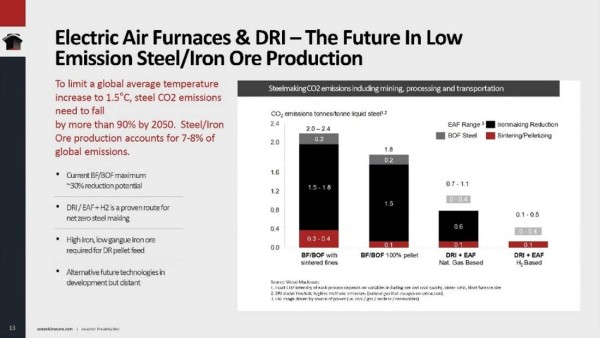
The production of steel is a major contributor to global warming. An astonishing one billion metric tonnes of metallurgical coal is consumed globally every year to manufacture steel. This accounts for 15% of coal burned globally across all industries. Steel and iron ore are responsible for 7-9% of the world’s CO2 emissions.
The United Nations Industrial Development Organization (UNIDO) has recommended that emissions from the iron and steel sector fall by more than 90% by 2050. To achieve this reduction target, global metallurgical infrastructure is currently being reimagined and rebuilt.
For decades, iron ore has been processed in traditional blast furnaces. These enormous chemical reactor towers transform iron ore into liquid metal (pig iron). The process requires extreme heat generated from burning metallurgical coke with hot air.
Blast furnaces are designed to run continuously 24/7 for 10 to 20 years. Shutting them down creates three major problems: the molten iron and slag inside the furnace can turn solid after time; cooling refractory linings can cause structural damage; reheating the blast furnace requires large amounts of energy, taking weeks – sometimes months – to achieve operational readiness.
Currently, about 70% of global steel is manufactured using these coal-fired blast furnaces. Gradually, production is being shifted to Direct Reduced Iron (DRI) plants that use Green Hydrogen to strip oxygen from the iron ore, releasing water vapour instead of CO2.
The benchmark grade of iron ore required for blast furnace product is 62% Fe. Impurities like phosphorus make the steel brittle. Removing other impurities such as silica, alumina and sulphur forces the steel mill to use more energy, pure oxygen and fluxing agents like limestone.
The greener DRI plants require high-grade iron ore with low impurities due to the electricity requirements to produce a molten slag during steel making. Our lead asset, Hopes Advance, produces 66.6% Fe iron ore, with 0.01% Al₂O₃ and 0.005% phosphorus – among the lowest impurity levels of any seaborne concentrate globally.
New environmental regulations are actively pushing Chinese steel mills toward higher-grade ores. The Chinese want processing facilities that will maximize output while minimizing the additional pollution created from removing impurities.
High-grade, low-impurity iron ore has been added to Canada’s and Québec’s Critical Minerals List. This premium product is in high demand from global steelmakers transitioning to green, hydrogen-based Direct Reduced Iron (DRI) processing.
Because the Hopes Advance iron ore is high-grade and has negligible alumina and phosphorus content, we have an opportunity to play an important role in servicing the green steel markets. It is a significant business advantage. Not all iron mines can contribute to the green steel input market.
There are still about 1,000 blast furnaces in operation. Many of these operations need high-grade material to blend with their lower-grade feed. Oceanic downstream iron ore buyers could be steel companies, iron ore producers, or trading houses.
In the next message, I will explain what we learned from the Hopes Advance Re-Scoped PEA.
By Chris Batalha
CEO of Oceanic Iron Ore
Click here to visit Oceanic Iron Ore’s website.
Contact: guy.bennett@globalstocksnews.com
Disclaimer: Oceanic Iron Ore paid Global Stocks News (GSN) $1,200 for the dissemination of this content.
Full Disclaimer: GSN researches and fact-checks diligently, but we cannot ensure our publications are free from error. Investing in publicly traded stocks is speculative and carries a high degree of risk. GSN publications may contain forward-looking statements such as “project,” “anticipate,” “expect,” which are based on reasonable expectations, but these statements are imperfect predictors of future events. When compensation has been paid to GSN, the amount and nature of the compensation will be disclosed clearly.
Media Contact
Organization: Global Stocks News
Contact Person: guy.bennett@globalstocksnews.com
Website: https://www.globalstocksnews.com
Email: Send Email
Country: Canada
Release id: 49782
The post Oceanic Iron Ore CEO Chris Batalha Talks About The Demand for Green Steel appeared first on King Newswire. This content is provided by a third-party source.. King Newswire makes no warranties or representations in connection with it. King Newswire is a press release distribution agency and does not endorse or verify the claims made in this release. If you have any complaints or copyright concerns related to this article, please contact the company listed in the ‘Media Contact’ section
About Author
Disclaimer: The views, suggestions, and opinions expressed here are the sole responsibility of the experts. No Digi Observer journalist was involved in the writing and production of this article.
B2PRIME Welcomes Christina Barbash as Commercial Manager
Oceanic Iron Ore CEO Chris Batalha Talks About The Demand for Green Steel
Scientology Volunteer Ministers Open First Sarajevo Exhibition with Sevdalinka Songs and Free Seminars
Benzinga Money Article Discusses How to Become Part of the 12% of Retirees Who Have Achieved the Recommended $550,000 Minimum Retirement Savings Threshold
Apu Apustaja Conquers New York with Lively Street Ads, Including Times Square Billboard
Bay Smokes Maintains Quality Amid Legislative Changes in the Hemp Industry


-
Press Release7 days ago
Post Oak Group Reports Strong Demand for Strategic Buyer Introductions
-
Press Release5 days ago
Carziqo Launches ER-SX Operations in Dallas, Introduces CARBON POINTS Rewards During Future Mobility Festival
-
Press Release7 days ago
WHY VANESSA HUDGENS CHOSE AMAZON’S EKOUAER OVER LUXURY LABELS — AND WHAT IT REVEALS ABOUT FASHION’S NEW ERA
-
Press Release1 week ago
76% of Treasury Teams Hit by Fraud as Deepfake Attacks Rise, Treasury Dragons & nsKnox 2026 Index Finds
-
Press Release4 days ago
EKOUAER CELEBRATES 11TH ANNIVERSARY WITH BRAND FRIEND VANESSA HUDGENS: UNVEILING “MY COMFORT ERA” THIS OCTOBER
-
Press Release6 days ago
Carziqo Brings A-DS Autonomous Delivery to San Francisco During Future Mobility Festival
-
Press Release6 days ago
Brian Baldari on the Difference Between a Mentor and a Sponsor, and Why It Decides Promotions
-
Press Release6 days ago
How to Know When to Step Back and When to Double Down in eCommerce, According to Shelton Powell