
Press Release
Electrical Panel Upgrades in McKinney, TX: ABR Electric and Schneider Electric Help Upgrade 1990s Homes

ABR Electric in McKinney TX installs Schneider Electric Square D 200-amp electrical panels and provides complete load calculations, permits, inspections, Oncor coordination, surge protection, and code-compliant installations. Master Electrician James Adams says many homeowners are simply outgrowing their original electrical systems, while Chief Operating Officer Nathan Tiner encourages homeowners to compare estimates, understand what is included in a quality panel upgrade, and plan replacements before electrical problems become emergencies.
McKinney, Texas — Thousands of homes built in McKinney, Texas, during the 1990s are beginning to reach the limits of their original electrical systems. As homeowners add electric vehicle chargers, Generac standby generators, home offices, larger HVAC systems, solar panels, battery storage, and smart home technology, many are discovering that the original 100-amp and 150-amp electrical panels were never designed for today’s electrical demands.
ABR Electric, a licensed electrical contractor headquartered in McKinney, Texas, is helping homeowners upgrade their electrical systems through its partnership as an official Schneider Electric Partner. The company provides electrical panel upgrades in McKinney, TX, while also serving homeowners throughout Plano, Frisco, Allen, Prosper, Celina, Melissa, Anna, Princeton, Fairview, Murphy, Lucas, Parker, Wylie, Farmersville, Blue Ridge, Lowry Crossing, New Hope, Nevada, and communities across Collin County.
According to ABR Electric, many homeowners first notice electrical panel problems when lights begin to flicker, breakers trip more often, or there is no room left in the panel to add new circuits for an EV charger or home addition. Others learn about their aging electrical panel during a home inspection, insurance review, or remodeling project.
“People ask us every week why their lights flicker or why their breakers keep tripping,” said James Adams, Master Electrician and owner of ABR Electric. “Most of the time, the electrical panel is simply trying to power a home that uses much more electricity than it was designed for. Homes built during the 1990s weren’t designed for EV chargers, multiple computers, larger air conditioners, or all the technology families depend on today.”
As an official Schneider Electric Partner, ABR Electric installs Schneider Electric Square D electrical equipment, including the premium Square D QO load center, one of the most trusted residential electrical panels in the industry.
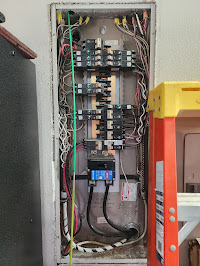
“When homeowners ask what I would install in my own home, I recommend the Square D QO,” Adams said. “I’ve trusted these panels for years because they’re built to last. They come with a lifetime warranty, and we’ve had excellent results installing them for homeowners throughout McKinney and Collin County.”
Adams says a quality electrical panel should be viewed as a long-term investment.
“If you install a quality electrical panel and it’s installed correctly, you shouldn’t have to think about it again for decades,” Adams said. “That’s peace of mind.”
Although older Federal Pacific, Zinsco, Sylvania, Stab-Lok, and Challenger electrical panels are well known for replacement, Adams says many 1990s McKinney homes simply need more electrical capacity.
“We replace a lot of panels that are still working,” Adams said. “The issue isn’t always that they’re unsafe. Families have simply outgrown the electrical system that came with the home.”
ABR Electric’s 200-amp electrical panel upgrade program in McKinney includes:
- A complete electrical load calculation based on the home’s current and future electrical needs.
- Installation of a new 200-amp Schneider Electric Square D electrical panel.
- Whole-home surge protection.
- Updated grounding and bonding that meet the latest National Electrical Code (NEC) requirements.
- All required permits and city inspections.
- Coordination with Oncor Electric Delivery for temporary disconnects and reconnects.
-
Preparation for future EV chargers, Generac standby generators, solar systems, battery storage, and home additions.
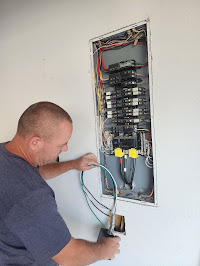
Nathan Tiner, Chief Operating Officer of ABR Electric, says homeowners should understand everything included in a professional electrical panel upgrade before comparing estimates.
“When we replace an electrical panel, we’re doing much more than changing the breaker box,” Tiner said. “We check the grounding system, bring everything up to today’s electrical code, install whole-home surge protection, handle the permit, schedule the inspections, and coordinate with Oncor so we can get the power back on as quickly as possible.”
Tiner encourages homeowners to compare contractors carefully before making a decision.
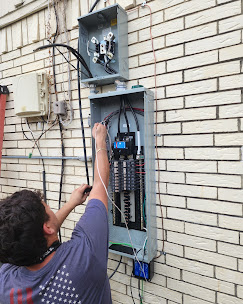
“We always recommend getting a second or third opinion,” Tiner said. “Read reviews, ask questions, and make sure you understand exactly what’s included. A quality panel upgrade should include permits, inspections, code compliance, and quality equipment—not just a new panel.”
According to Tiner, a typical 200-amp electrical panel upgrade in McKinney, Plano, Frisco, Allen, and throughout Collin County generally ranges from $6,000 to $8,000, depending on the home’s electrical system and whether the panel must be relocated.
“For most homeowners, the biggest inconvenience is being without power for a few hours,” Tiner said. “We handle the permits, inspections, and utility coordination so the process is as smooth as possible from start to finish.”
Tiner also recommends homeowners have older electrical panels inspected before they become a larger problem.
“If your electrical panel is around 40 years old or older, it’s a good time to have it inspected by a licensed electrician,” Tiner said. “Planning ahead gives homeowners more choices and helps prevent unexpected electrical problems.”
As McKinney continues to be one of the fastest-growing cities in Texas and families continue adding more electrical devices to their homes, Adams believes modern electrical systems will become even more important.
“Electricity powers almost everything in today’s homes,” Adams said. “Whether you’re installing an EV charger, adding a Generac generator, preparing for solar, or simply using more technology, a modern 200-amp electrical panel gives your home the capacity to grow with your family.”
About ABR Electric
ABR Electric is a licensed electrical contractor headquartered in McKinney, Texas, specializing in electrical panel upgrades in McKinney, TX, EV charger installation, Schneider Electric Square D panel replacements, Generac standby generator installations, dedicated circuits, surge protection, and residential electrical repairs. As an official Schneider Electric Partner, ABR Electric serves homeowners throughout McKinney, Plano, Frisco, Allen, Prosper, Celina, Melissa, Anna, Princeton, Fairview, Murphy, Lucas, Parker, Wylie, Farmersville, Blue Ridge, Lowry Crossing, New Hope, Nevada, and all of Collin County. Every installation is designed to meet current National Electrical Code (NEC) standards while preparing homes for the next generation of electrical technology.
Media Contact
Organization: ABR Electric
Contact Person: James Adams
Website: https://abrelectric.com
Email: Send Email
Contact Number: +12146901941
Address:1971 University Business Dr Ste 106
City: McKinney
State: TX
Country:United States
Release id:47006
The post Electrical Panel Upgrades in McKinney, TX: ABR Electric and Schneider Electric Help Upgrade 1990s Homes appeared first on King Newswire. This content is provided by a third-party source.. King Newswire makes no warranties or representations in connection with it. King Newswire is a press release distribution agency and does not endorse or verify the claims made in this release. If you have any complaints or copyright concerns related to this article, please contact the company listed in the ‘Media Contact’ section
About Author

Disclaimer: The views, suggestions, and opinions expressed here are the sole responsibility of the experts. No Digi Observer journalist was involved in the writing and production of this article.

Press Release
DeXenY Expands Its Decentralized Energy Vision to a Wider Web3 Audience as $DXY Prepares for Bitvoux Launch
The upcoming Bitvoux launch will expand access to $DXY, the utility token connecting DeXenY’s blockchain, distributed energy, RWA, and AI infrastructure.
Road Town, British Virgin Islands, August 30, 2026, DeXenY is preparing to bring its native utility token, $DXY, to Bitvoux, expanding access to a token designed around one of Web3’s increasingly important real-world applications: connecting decentralized infrastructure with measurable physical activity.

The upcoming launch introduces $DXY to a broader digital-asset audience while DeXenY develops a decentralized energy protocol connecting rooftop solar, battery storage, electric vehicles and microgrids through blockchain-based settlement, verifiable energy data and AI-enabled coordination.
Unlike a token designed primarily around digital activity, $DXY is being developed around participation in a physical energy network.
Its utility spans four core areas: energy settlement, rewards for verified clean-energy generation, network staking and governance.
Why Energy Is Moving Toward Decentralized Infrastructure
Electricity systems are becoming increasingly distributed.
Homes can generate electricity through rooftop solar. Batteries can store energy and release it when needed. Electric vehicles are emerging as mobile energy assets, while microgrids allow communities and businesses to manage electricity at a more localized level.
This shift creates a new challenge: coordinating large numbers of independently owned energy resources while establishing trusted records of what was generated, stored, consumed, and exchanged.
DeXenY is building its protocol around this coordination problem.
Smart meters and connected infrastructure provide the physical data layer. Oracle infrastructure is designed to verify and corroborate that information. Blockchain provides programmable settlement and an auditable transaction layer, while AI can help coordinate decisions across participating energy resources.
The result is a model designed to move from physical activity to verifiable digital settlement: Energy activity → Data verification → Programmable settlement
$DXY Connects the Network’s Economic Functions
Within this architecture, $DXY acts as the common utility layer connecting participants and protocol functions.
The token is designed to facilitate peer-to-peer energy settlement and support DeXenY’s Proof-of-Generation mechanism, through which rewards correspond with verified clean-energy generation.
$DXY is also designed to be staked by validators and oracle participants involved in data verification and to support participation in the protocol’s multi-stakeholder governance model.
This creates a direct connection between token utility and the activities DeXenY is designed to coordinate across its energy ecosystem.
Where Energy, RWA and AI Converge
DeXenY’s architecture extends beyond energy transactions.
The protocol is designed to connect physical infrastructure and energy-related economic activity with real-world asset infrastructure, including physical energy assets, energy-derived cash flows and environmental commodities.
AI forms another layer of the model.
DeXenY envisions AI agents supporting decisions across distributed resources using variables such as electricity prices, weather conditions, demand and grid signals. AI-assisted verification can also contribute to identifying anomalies and strengthening the integrity of energy data before it is connected with blockchain infrastructure.
This creates a convergence of technologies that have often developed independently:
Energy × Web3 × RWA × AI
For DeXenY, the objective is to bring those layers together around a common source of real-world activity: energy.
Bitvoux Launch Expands Access to $DXY
The upcoming Bitvoux launch is designed to make $DXY accessible to a broader digital-asset audience as DeXenY builds out its decentralized energy ecosystem.
It also gives Web3 participants another way to discover a project applying blockchain and token infrastructure beyond purely digital markets.
“The transition to distributed energy creates millions of new participants and connected assets across the electricity system. DeXenY is designed to provide the trust, settlement and intelligence infrastructure connecting that activity, with $DXY serving as the utility layer across the network.”
Additional information regarding the $DXY launch on Bitvoux and trading availability will be communicated through DeXenY’s official channels.
About DeXenY
DeXenY (pronounced “dee-Zen-i”) is a decentralized energy protocol designed to serve as a trust, settlement, and intelligence layer for the distributed energy economy. The protocol brings together distributed energy resources, blockchain-based settlement, tokenized real-world assets, and AI-enabled coordination.
Its native utility token, $DXY, is designed to support energy settlement, Proof-of-Generation rewards, network staking, and multi-stakeholder governance across the DeXenY ecosystem.
Website: https://dexeny.co/
Whitepaper: https://dexeny.co/whitepaper
Telegram: https://t.me/dexeny_official
X: https://x.com/dexeny_off
About Author
Disclaimer: The views, suggestions, and opinions expressed here are the sole responsibility of the experts. No Digi Observer journalist was involved in the writing and production of this article.
-
Dr. Irfan Atcha says complex dental rehabilitation depends on careful planning, function, healing, and long-term stability.
Illinois, USA, Aug 30, 2026, ZEX PR WIRE — Replacing missing teeth is only one part of full-mouth rehabilitation, according to Chicago implant dentist Dr. Irfan Atcha.

For patients with several missing, failing, or damaged teeth, the greater challenge is understanding how the entire mouth functions as a single system. That means looking beyond individual teeth and considering factors such as bite, bone support, healing, comfort, and long-term stability.
Atcha has spent nearly three decades working with patients who need complex dental rehabilitation. Since beginning his career in Chicago in 1996, his work has increasingly focused on dental implants, full-arch treatment, implant-supported dentures, and cases that require more detailed planning.
“When you are dealing with a complex case, replacing the missing teeth is only part of the picture,” Atcha said. “You have to think about how everything works together and what the patient will need over the long term.”
Full-Mouth Rehabilitation Starts With the Bigger Picture
A patient may first seek treatment for an obvious concern, such as missing teeth or difficulty chewing. But in more advanced cases, the underlying issues may involve several areas at once.
That is why Atcha believes full-mouth rehabilitation should begin with a broader evaluation.
“You cannot always treat one problem in isolation,” he said. “The bite, the bone, the remaining teeth, and the way the mouth functions all influence the final plan.”
That approach has become a central part of his work in implant dentistry.
His areas of focus include same-day dental implants, implant-supported dentures, All-on-4 dental implants, and full-arch rehabilitation. These treatments can involve several clinical decisions that need to work together rather than being addressed separately.
Why Planning Matters Before Treatment Begins
For Atcha, one of the most important parts of complex dental care happens before treatment starts.
A full rehabilitation plan may need to account for the condition of existing teeth, the amount of available bone, the patient’s bite, and how the final restoration is expected to function.
“Good planning means thinking several steps ahead,” Atcha said. “You are not only asking what can be done today. You are asking how that decision may affect the overall result later.”
That long-term mindset has shaped his approach throughout his career.
Atcha often points to “long-term success with dental implants” as one of the key themes in his work. In his view, a treatment should not be judged only by what happens on the day of the procedure.
The larger question is how well the rehabilitation continues to function over time.
Complex Cases Require More Than One Solution
Full-mouth rehabilitation is not a single treatment. Different patients may have very different needs, even when their dental problems appear similar at first.
One person may need several teeth replaced. Another may require a full-arch solution. Others may need a combination of treatments to rebuild function across the mouth.
That is why Atcha sees experience and clinical judgement as important parts of the process.
“Two patients can come in with what looks like the same problem and still need very different treatment plans,” he said. “You have to understand the individual case rather than trying to force every patient into the same approach.”
That principle has guided much of his work with complex implant patients in the Chicago area.
Nearly 30 Years of Changing Treatment Options
Atcha began practising in 1996 after earning his Doctor of Dental Surgery degree from the University of Illinois College of Dentistry.
He had previously earned a Bachelor of Science in Biochemistry from the University of Illinois in 1991, and his early interest in research continued during dental school, where he received first-place recognition for a biochemistry table clinic presentation.
Over the decades since, implant dentistry has continued to evolve. Advances in imaging, treatment planning, materials, and clinical techniques have created more options for patients with advanced dental needs.
Atcha has continued his education alongside those changes, earning Fellowship and Diplomate recognition through both the International Congress of Oral Implantologists and the International Dental Implant Association.
He says new technology can improve treatment planning, but it does not remove the need for careful evaluation.
“Technology gives us more information, but the information still has to be interpreted,” he said. “The goal is to use those tools as part of a complete plan.”
Looking Beyond Missing Teeth
For patients considering full-mouth rehabilitation, Atcha believes the most important conversation is often about the larger goal. Replacing missing teeth may be the most visible part of treatment, but restoring function requires looking at how the whole system works together.
That means considering not only what is missing, but also what remains, how the patient bites, how healing may occur, and how the final result is expected to perform over time.
For Atcha, that broader perspective is what separates simple tooth replacement from full-mouth rehabilitation.
“The goal is not just to fill a space,” he said. “The goal is to create a treatment plan that makes sense for the whole mouth and for the patient’s long-term needs.”
For more information about Dr. Irfan Atcha and New Teeth Chicago, visit newteethchicago.com.
About Dr. Irfan Atcha
Dr. Irfan Atcha is a Chicago-based implant dentist who has been practising since 1996. He earned a Bachelor of Science in Biochemistry from the University of Illinois and a Doctor of Dental Surgery degree from the University of Illinois College of Dentistry. His work focuses on dental implants, full-arch rehabilitation, same-day dental implants, implant-supported dentures, and complex treatment planning.
About Author
Disclaimer: The views, suggestions, and opinions expressed here are the sole responsibility of the experts. No Digi Observer journalist was involved in the writing and production of this article.
-
Woodstock, Georgia technology and go-to-market professional Clayton Fields explains why evaluating a new system should include the cost and complexity of leaving the old one behind.
WOODSTOCK, Ga. Aug 30, 2026, ZEX PR WIRE — Businesses have more technology choices than ever, but Clayton Fields believes the availability of a newer system does not automatically make replacing an existing one the right decision.

Fields, a Woodstock, Georgia-based go-to-market professional with decades of experience in enterprise technology, security software, services, startups, and AI-enabled solutions, has spent much of his career working around organizations evaluating new technology. He says those decisions can become too focused on the capabilities of the new product while overlooking an equally important question: What will it actually take to replace what is already working?
“When companies evaluate new technology, the conversation naturally starts with what the new product can do,” Fields said. “I think you also have to understand everything that has been built around the system you already have. Replacing technology is rarely just replacing technology.”
What Problem Is the Business Actually Trying to Solve?
Fields recommends beginning any replacement decision by clearly identifying the problem.
A company may have an older system, but age alone does not necessarily make that system ineffective. The more important question is whether it is preventing the organization from accomplishing something important.
Employees may be spending too much time on manual processes. Customers may be experiencing unnecessary delays. Security requirements may have changed. An existing system may no longer integrate effectively with other tools.
Those are specific problems that can be evaluated.
“If the main argument for replacing something is that a newer option exists, I would want to understand more,” Fields said. “What becomes meaningfully better after the change? That answer should be clear before the organization takes on everything involved in making the switch.”
What Will Migration Really Require?
Moving from one system to another can involve considerably more than purchasing new software.
Organizations may need to migrate years of information, rebuild integrations, test workflows, update internal processes, and determine how the new system will interact with other technology.
Fields says these requirements should be considered during the buying process rather than after a contract is signed.
A new platform can offer significant advantages and still create a difficult transition. Understanding that transition helps businesses compare the potential benefits with the actual work required to achieve them.
“The purchase is one decision, but implementation is where the organization has to live with that decision,” Fields said. “I want to know who owns the transition, what other systems are affected, and what happens if the migration takes longer than expected.”
How Much Training and Behavior Change Will Be Needed?
Technology adoption also depends on people.
Employees may have spent years working with an existing system. They know its strengths, its weaknesses, and often the workarounds required to get their jobs done. A replacement can eliminate those limitations while simultaneously requiring employees to learn an entirely different way of working.
Fields believes businesses should consider that learning curve when evaluating potential improvements.
The question is not only whether the new technology is easier or more capable. Businesses should also consider how quickly employees can become comfortable with it and what support will be necessary during the transition.
“You can have a better system and still have a difficult implementation if people do not understand how it fits into their work,” Fields said. “Adoption does not happen simply because the technology has been installed.”
What Does the Existing System Already Do Well?
Fields also encourages companies to make an honest assessment of the technology they are considering replacing.
Older systems can become inefficient or restrictive, but established technology has advantages that are easy to ignore. Employees understand it. Processes have been designed around it. Integrations have already been established. The organization knows how the system behaves under normal and unusual conditions.
That familiarity has value.
Fields does not believe that means companies should remain with outdated technology indefinitely. Instead, he argues that the advantages of a replacement should be significant enough to justify giving up the stability the organization already has.
“Proven technology can be boring, and sometimes boring is useful,” Fields said. “If something works every day and supports the business reliably, that should be part of the evaluation. You need a reason to introduce disruption.”
What Happens If the Business Waits?
The cost of changing technology deserves attention, but so does the cost of waiting.
An organization can become overly comfortable with an existing system. Employees may gradually build manual workarounds around its limitations. Maintenance costs can rise. Security concerns can increase. A system that once supported the business may eventually prevent it from improving.
Fields says this is why the decision should not be framed as simply choosing between new and old technology.
Instead, businesses can ask what is likely to happen under both scenarios.
“If we replace the system, what do we gain and what disruption do we create?” Fields said. “If we keep it for another year or two, what problems are likely to become more expensive or difficult? I think both sides of that question matter.”
Is the Improvement Worth the Disruption?
After years working with enterprise technology and newer solutions, Fields says he has become more deliberate about separating innovation from improvement.
New capabilities can create real opportunities. Artificial intelligence, automation, security technologies, and other emerging tools are changing what organizations can accomplish. However, adopting those technologies still requires a practical business case.
For Fields, the objective is not to keep every system forever or to adopt every new platform quickly. It is to understand when the improvement is substantial enough to make change worthwhile.
“The goal should not be to have the newest technology,” Fields said. “The goal should be to have technology that supports what the business is trying to accomplish. Sometimes that means changing. Sometimes it means recognizing that what you already have is still doing its job.”
About Clayton Fields
Clayton Fields is a go-to-market professional based in Woodstock, Georgia, with extensive experience in enterprise technology. He spent nearly 10 years with a major technology company working across commercial sales, client services, infrastructure, storage, and business applications. For more than 13 years, he has worked with security software and services startups, including approximately a decade helping bring AI-enabled solutions to market.
Fields holds a Bachelor of Science in Business Administration with honors. His professional interests include technology, entrepreneurship, artificial intelligence, customer adoption, and go-to-market strategy. Outside of work, he enjoys real estate remodeling, construction, hiking, and traveling, and he has volunteered with Habitat for Humanity.
Media Contact
Company Name:-Clayton Fields
Company Website:-https://www.clayton-fields.com/
About Author
Disclaimer: The views, suggestions, and opinions expressed here are the sole responsibility of the experts. No Digi Observer journalist was involved in the writing and production of this article.
DeXenY Expands Its Decentralized Energy Vision to a Wider Web3 Audience as $DXY Prepares for Bitvoux Launch
Why Full-Mouth Rehabilitation Requires More Than Replacing Missing Teeth
Clayton Fields Identifies Questions to Ask Before Replacing Proven Technology
Benzinga Money Article Discusses How to Become Part of the 12% of Retirees Who Have Achieved the Recommended $550,000 Minimum Retirement Savings Threshold
Apu Apustaja Conquers New York with Lively Street Ads, Including Times Square Billboard
Bay Smokes Maintains Quality Amid Legislative Changes in the Hemp Industry


-
Press Release5 days ago
Ghanaian Royal and Business Delegation to Convene in Dallas for U.S.–Ghana Investment Symposium
-
Press Release6 days ago
Blockchain Infrastructure Firm tZERO Integrates with Sui for Institutional-Grade Digital Asset Securities
-
Press Release4 days ago
SMS Gadget: Bangladesh’s Authorized Best Shop Delivers Latest iPhone Just One Day After Official Launch
-
Press Release1 week ago
OKINAWA HARBORVIEW HOTEL completes full-scale renovation to deliver a modern Okinawan experience
-
Press Release6 days ago
Team Miracle Cyprus IVF Centre Presents Comprehensive Male Fertility Solutions With Inclusive Care
-
Press Release4 days ago
The Bookish Magazine Releases Issue 2, Celebrating Stories That Stand the Test of Time
-
Press Release4 days ago
YZi Labs Backs TermMax to Advance On-Chain Bond Market Infrastructure
-
Press Release4 days ago
Platinum Decking Builds a Strong Reputation With Homeowners Across Illinois