
Press Release
DNDi and Dubai Health Sign a Partnership to Advance Research and Training in Neglected Diseases

-
The partnership brings together DNDi’s global expertise in needs‑driven drug development and Dubai Health’s integrated academic health system to support research and capacity‑building across priority global health areas.
Dubai, UAE, 12th February 2026, Dubai Health has signed a Memorandum of Understanding (MoU) with the non-profit research and development organization Drugs for Neglected Diseases initiative (DNDi) at World Health Expo Dubai (WHX).
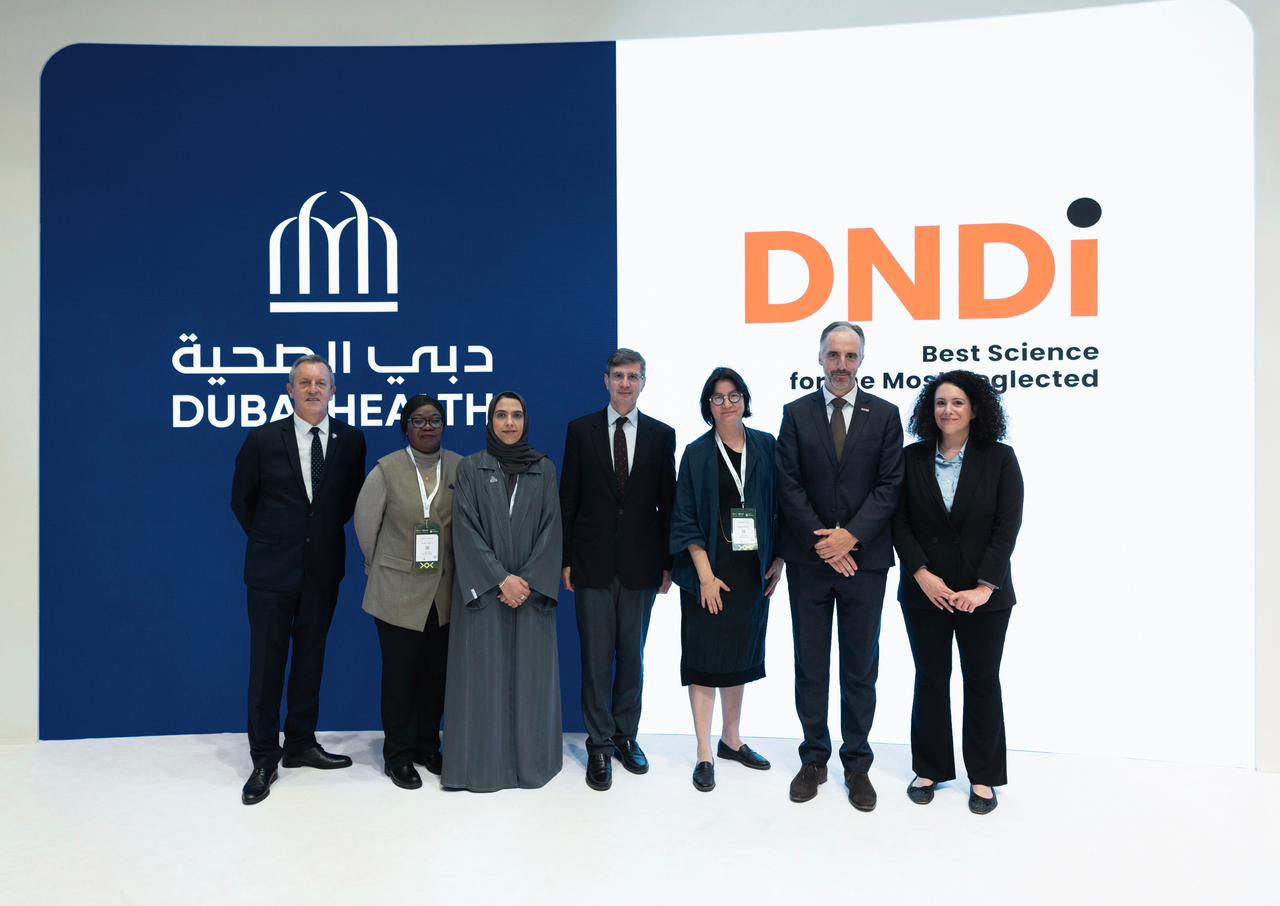
The agreement was signed by Dr. Hanan Al Suwaidi, Deputy CEO and Chief Academic Officer of Dubai Health and Provost of Mohammed Bin Rashid University of Medicine and Health Sciences, and Dr. Luis Pizarro, Executive Director of the Drugs for Neglected Diseases initiative (DNDi), in the presence of His Excellency Nicolas Niemtchinow, Ambassador of France to the UAE, and Thi Hanh Cao, Director of External Relations at DNDi.
The partnership establishes a framework for collaboration in medical education, research, and clinical training, with a shared goal of improving health outcomes for underserved populations affected by neglected infectious diseases. It brings together DNDi’s global expertise in needs‑driven drug discovery and development and Dubai Health’s integrated academic health system to support research and capacity‑building across priority global health areas.
Under the agreement, students from Mohammed Bin Rashid University of Medicine and Health Sciences (MBRU), the learning and discovery arm of Dubai Health will take part in DNDi‑led programs, including fieldwork and clinical research activities in Africa and Asia. These programs provide hands‑on exposure to patients affected by neglected diseases and to the full spectrum of drug discovery, development and public health delivery. DNDi experts will also contribute to MBRU academic programs, supporting two‑way academic and professional exchange.
The collaboration will begin with joint research scoping to identify priority projects. It will involve active faculty engagement through guest lectures, curriculum development, student co‑supervision, joint grant applications, and collaborative research publications.
The partnership will also encompass collaboration in drug discovery, clinical trials, regulatory science, and public health policy, with a particular focus on viral diseases, pandemic preparedness, and fungal infections. In addition, it will support joint initiatives in the application of artificial intelligence to health research, as well as the co‑organization of scientific conferences and workshops and the dissemination of knowledge on key global health challenges.
Dr. Luis Pizarro, said: “Neglected diseases disproportionately affect the world’s most vulnerable populations and are often overlooked by traditional research models. Through this partnership with Dubai Health, we aim to advance scientific progress while helping train the next generation of global health leaders to deliver more equitable health solutions.”
Dr. Hanan AlSuwaidi, said: “This partnership represents a meaningful step forward in how we prepare our students and researchers to engage with the world’s most pressing and complex health challenges. By partnering with DNDi, we are giving our learners direct access to real-world drug development, clinical research, and global health practice. It reflects our commitment to advancing health for humanity by ensuring that care, learning, discovery, and giving are driven by purpose and real-world impact.”
About Drugs for Neglected Diseases initiative (DNDi)
The Drugs for Neglected Diseases initiative (DNDi) is a not-for-profit medical research organization that discovers, develops, and delivers safe, effective, and affordable treatments for neglected populations. DNDi is developing medicines for sleeping sickness, leishmaniasis, Chagas disease, river blindness, lymphatic filariasis, female genital schistosomiasis, mycetoma, dengue, paediatric HIV, cryptococcal meningitis, and hepatitis C. Its research priorities include children’s health; gender equity and gender-responsive R&D; and diseases impacted by climate change. Since its creation in 2003, DNDi has collaborated with public and private partners worldwide to deliver thirteen new treatments for six deadly diseases, saving millions of lives.
www.dndi.org
About Dubai Health
Dubai Health, the first integrated academic health system in Dubai, was established to elevate the standard of care and to advance health for humanity. Dubai Health is comprised of 6 hospitals, 26 ambulatory health centers, 21 medical fitness centers, Mohammed Bin Rashid University of Medicine and Health Sciences, and Al Jalila Foundation. Together, Dubai Health serves patients through the integration of care, learning, discovery, and giving. A workforce of over 11,000 collaborates across multidisciplinary teams to put the patient first.
About Author

Disclaimer: The views, suggestions, and opinions expressed here are the sole responsibility of the experts. No Digi Observer journalist was involved in the writing and production of this article.

Press Release
Movement, El Vecino and RISE Partner to Launch First Digital Dollar Wallet for Mexican Remittances
Palo Alto, California, August 7th, 2026, Chainwire
Launch allows Mexican families to send money home from the U.S. instantly via WhatsApp across the largest remittance corridor in the world without requiring a bank account or app download
Global, on-chain payments network Movement has announced a partnership with New Jersey-based Mexico remittance expert El Vecino and on-chain wallet provider RISE to power a digital-dollar service that lets customers hold their own money and send it home in seconds through WhatsApp.
Leveraging El Vecino’s 19 years of experience in US-to-Mexico physical remittances, RISE’s wallet capabilities and LATAM network, and Movement’s access to regulated, sub-second payment rails, the partnership enables stablecoin-settled transfers to be sent to Mexico almost instantly, giving customers a simple way to initiate transfers without opening a bank account or downloading an app.
Rather than having to visit a physical location to initiate every cash transfer, El Vecino customers can now begin the process through the familiar WhatsApp messenger. Funds settle in seconds before recipients cash out through Mexico’s extensive OXXO and Circle K retail networks, or receive funds directly via the country’s SPEI banking system.
Currently, El Vecino processes approx 25,000 transactions per month valued at $70 million annually through remittances, international and domestic bill payments, check cashing, and more – with 85% of transactions heading to Mexico.
The new WhatsApp service will first be trialled among El Vecino’s 20,000 users before being rolled out through RISE’s network to an estimated 800,000 in the second phase. This and future phases will look beyond Mexico to LATAM regions including Guatemala and El Salvador.
Founder of RISE Richard Mas will be appearing live from the New York Stock Exchange on Pulso Del Mercado, one of the region’s most influential news segments, to speak about the partnership on Tuesday, August 11, at 11:30 am EST.
The launch meets the growing demand for accessible cross-border payment solutions across the U.S.- Mexico corridor, which forms the world’s largest remittance route, through which over $62 billion passed in 2024. [Source].
The ability to send money home through a trusted local provider is a financial lifeline for Mexican migrant families, with the Movement-engineered solution streamlining a process that has traditionally entailed cash handling and multi-day settlement times.
Torab Torabi, CEO of on-chain global payments network Movement, says: “For too long, Mexicans have often struggled to send hard-earned money back home. Partnering with El Vecino and RISE will address this imbalance while proving the versatility and reliability of stablecoins as a settlement mechanism. In doing so, we’re also proud to be demonstrating that regulated blockchain infrastructure can modernize one of the world’s busiest remittance corridors.”
Mike Burns, founder of El Vecino added: “El Vecino has been built on the trust brought by face-to-face interaction. Families rely on us because they know we’ll help them support their loved ones back home. The partnership with RISE and Movement allows us to bring that built trust to a remote digital vehicle that provides the same safeguards and surety that money sent will reach home. Technology should make life easier, and that’s exactly what this collaboration achieves.”
Richard Mas, founder of RISE says: “Every year, tens of billions of dollars cross from the United States into Mexico, most of it earned far from home by people the banking system overlooked. El Vecino spent 19 years earning trust at the counter, one household at a time, and we are proud to join Movement in giving those customers access to new, safe and compliant digital solutions.”
Powered by Movement’s access to licensed payment infrastructure, El Vecino’s new WhatsApp service replaces the traditional chain of correspondent banks with blockchain-based settlement while maintaining full regulatory compliance. This model removes the need for pre-funded liquidity and reduces settlement from days to seconds without the hidden costs often associated with legacy cross-border payment rails.
Movement’s globally licensed payment infrastructure, which spans the United States, Canada, and Europe, will provide El Vecino with compliant fiat on- and off-ramps that have historically been difficult for community remittance providers to access.
The collaboration between Movement, El Vecino and RISE demonstrates how established community operators can adopt institutional-grade blockchain payment infrastructure without the complexity of self-development and management. Combining El Vecino’s local relationships with Movement’s access to a regulated settlement network has yielded a model that could potentially be replicated by remittance providers serving immigrant communities worldwide.
About Movement
Movement provides access to globally licensed and regulated blockchain payment infrastructure that enables businesses to move money across borders using compliant stablecoin settlement rails. Its payment network offers licensed access across the United States, Canada, and Europe, helping financial institutions and payment providers deliver fast, low-cost international transfers without relying on traditional correspondent banking networks. https://www.movementnetwork.xyz/
About El Vecino
El Vecino is a trusted community financial services provider serving Mexican communities across New Jersey. Processing more than $70 million in annual remittance volume for over 20,000 customers, the company offers money transfer and financial services designed to help families maintain strong economic connections across the U.S.-Mexico border. Learn more at https://www.linkedin.com/company/el-vecino-franquicias/
About RISE
RISE is a self-custody digital dollar wallet that lets customers hold and transfer USD-backed digital dollars while keeping direct control of their own funds. Offering an alternative to slow, high-cost, and often inaccessible banking rails, RISE customers can open a dollar account inside WhatsApp, hold their balance in USD-backed digital dollars that resist local inflation, and send money across borders in seconds for a flat fee. Learn more at https://risefinance.xyz.
Press Contact:
Rebecca Jones
rebecca.jones@moveindustries.xyz
Contact
Head of Communications
Rebecca Jones
Move Industries
rebecca.jones@moveindustries.xyz
About Author
Disclaimer: The views, suggestions, and opinions expressed here are the sole responsibility of the experts. No Digi Observer journalist was involved in the writing and production of this article.
Press Release
Carbon Launches TradFi-Native On-Chain Derivatives Venue With 950+ Markets in One Account
Road Town, British Virgin Islands, August 7th, 2026, Chainwire
250+ TradFi markets join Carbon’s 530+ crypto perpetuals & 150 24/7 RWAs in one venue. Wall Street depth at listing, stable overnight rates, and on-chain settlement.
Carbon, the on-chain prime broker for global markets, today opened public trading on 250+ Carbon TradFi markets spanning equities, indices, forex, and commodities. Each position is hedged 1:1 at regulated TradFi venues, making Carbon the largest TradFi-native on-chain derivatives venue. Alongside 530+ crypto perpetuals and 150 24/7 RWAs, total tradeable instruments now exceed 950 in one account.
Carbon TradFi is Carbon’s own on-chain instrument. A trader opens a position on-chain, in their own wallet, and Carbon’s solver architecture hedges it 1:1 at a regulated broker off-chain. The trader never leaves self-custody, and the price and depth they receive are the underlying market’s, not bootstrapped on-chain order books.
That structure removes the cold-start problem that has constrained real-world assets on-chain. Every Carbon TradFi market opens at full institutional depth on its first day, because the depth is inherited rather than manufactured. There is no per-market incentive program to run and no waiting period while liquidity accumulates.
Carbon now offers traders both in one account. Its 150 24/7 real-world markets trade around the clock, for traders who want access at any hour. Its 250+ Carbon TradFi markets track market hours with carry prices from the underlying, for traders who want institutional depth and predictable holding costs. Roughly 30 assets are live as both, letting a trader hold one against the other and capture the difference between the two financing rates without leaving the account.
The global market Carbon connects to is substantial. TradFi clears over $1.5 trillion daily in CFDs across thousands of markets, liquidity that until now had no direct route on-chain.
Carbon TradFi coverage at launch:
- 200 stocks across US, EU, and Asia markets
- 62 forex pairs
- 12 indices
- 8 commodities
Carbon can list a trending name within the same week it begins moving in Seoul, Tokyo, or Hong Kong, a cadence order-book venues cannot match because they lack the off-chain rails to stand up a new market that quickly. A further 150 listings are scheduled.
The launch also opens the Carbon Liquidity Provider (CLP) vault to public deposits. The CLP is a delta-neutral yield product: it funds the hedge behind trader flow rather than taking directional positions, earning from the difference between on-chain demand and off-chain liquidity. Modeled APY is illustrative and ranges from 20.3% at launch utilization to 57.1% at maturity, depending on flow and capital utilization.
“Traders have had to choose between the assets they want and the execution they need. Carbon ends that trade-off. Every position is hedged into the deepest liquidity in the world and settles in the trader’s own wallet, with 950+ markets in a single account. This is what global markets look like when they finally arrive on-chain properly.” – Levy, Co-founder and CEO of Carbon
“One of the biggest challenges for bringing traditional financial assets onchain has been delivering deep liquidity. Carbon is operating an architecture that connects onchain trading with established market infrastructure while preserving self-custody. We want Arbitrum to be home to teams building this next generation of financial infrastructure” – David Garcia, Ecosystem Lead at Arbitrum Foundation
About Carbon
Carbon is the on-chain prime broker for global markets, combining crypto perpetuals and Carbon TradFi in one venue. Carbon’s solver architecture connects on-chain traders to institutional liquidity through bilateral 1:1 hedging, delivering Wall Street-grade depth and stable carry with on-chain settlement and self-custody. Live since 2023, Carbon has processed $20B+ in cumulative trading volume across 36K+ unique traders. Carbon operates on Arbitrum. Users can learn more at carbon.inc.
Contact
COO
Rens
Carbon
rens@carbon.inc
About Author
Disclaimer: The views, suggestions, and opinions expressed here are the sole responsibility of the experts. No Digi Observer journalist was involved in the writing and production of this article.
Press Release
Every Tax Preparer Is a Financial Institution Under Federal Law. Many Have No Written Security Plan.
Every Tax Preparer Is a Financial Institution Under Federal Law. Many Have No Written Security Plan.
The IRS is in the final week of its summer campaign telling tax professionals to write one. Industry data says the firms it applies to are mostly two-person shops.
KANSAS CITY, Mo., Aug 07, 2026, ZEX PR WIRE — If you prepare tax returns for a living, federal law counts you as a financial institution. Same category as a bank. That classification carries an obligation most small firm owners have never heard of: a written information security plan (WISP), on paper, kept current.
The Gramm-Leach-Bliley Act is what does it. Under GLBA, tax and accounting professionals are considered financial institutions and must implement a data security plan, which puts them under the Federal Trade Commission’s Safeguards Rule. The IRS said it plainly in July 2025: tax professionals are legally required to have a written, accessible plan, and should review, test and update it regularly.
The agency is in the middle of saying it again. On July 7 the IRS and its Security Summit partners launched “Protect Your Clients; Protect Yourself,” a five-week campaign for tax professionals now in its final week. The same guidance is being delivered in person at the 2026 IRS Nationwide Tax Forums, which continue in New York City Aug. 18-20, Orlando Sept. 1-3, and San Diego Sept. 15-17.
“Most preparers I talk to have no idea this applies to them, and I don’t blame them one bit. Nobody ever told them,” said Sam Sapp of Lockbaud. “Many of these smaller firms would be lucky to have a cybersecurity plan at all, let alone a written one.”
The size of the gap follows from the shape of the profession. Research published in The CPA Journal in January, drawn from IRS preparer and e-filing datasets for the 2024 tax year, found 89% of all e-filers handle fewer than 1,000 filings a year, and 48% of preparers matched to a firm are solo practitioners. Intuit, H&R Block, and TaxHawk together account for only about a third of e-filing submissions. Most of the rest of the profession is small businesses.
Those firms hold exactly what an attacker wants. Social Security numbers, bank account details, income records, and dependent information for every client on the list, usually going back years.
The Safeguards Rule doesn’t ask for a security operations center. The FTC asks firms to designate someone to coordinate the program, identify and assess risks to customer information, and create, implement and regularly test safeguards. The IRS publishes Publication 5708, a 28-page template built for smaller practices, and Publication 4557 covers safeguarding taxpayer data more broadly. Both are free.
A plan on paper isn’t really the point either. The protections have to actually be in place, and that’s where a lot of firms get caught. They assume somebody else has it handled, usually the tax software vendor or whoever set the office up. Those companies secure their own platform. They don’t secure your email, your laptops, your backups, or the person who clicks the wrong link.
Somebody has to own that, and in a two-person office nobody has room for one more job. That’s why these plans get started in February and forgotten by March. A lot of firms hand it off instead, which is a good chunk of what IT support for accounting firms means in practice. And it’s not just tax firms. Any small business sitting on customer data runs into the same thing, which is most of why outsourced IT for small businesses is a category at all.
Two things any tax or accounting firm can check this week:
- Find out whether your firm has a written plan at all, and who is named in it as responsible. If nobody is named, you don’t have one.
- Ask your tax software vendor and your IT provider, in writing, exactly what each one secures. The gap between those two answers is yours to cover.
“That’s what we try to help with, and honestly what we want to make a push to help more with,” Sapp said. “If a firm gets one page written and puts a name on it, that’s a real win. We’ll take it.”
Through Oct. 31, Lockbaud is offering a free written information security plan review to tax and accounting firms. Lockbaud will read an existing plan against Publication 5708 and the Safeguards Rule and say plainly what’s missing, or confirm a firm doesn’t have one yet. Requests go to connect@lockbaud.com or 816-208-2888.
About Lockbaud
Lockbaud is a managed IT and cybersecurity provider based in Kansas City, Missouri, serving small and mid-sized businesses across the United States. Lockbaud works most often with accounting firms, law firms, and chambers of commerce, and backs its work with same-day support, zero-downtime onboarding, and a money-back guarantee. Founded and owned by Sam Sapp. More at lockbaud.com.
Media Contact
Sam Sapp, Lockbaud
Full release with sources: https://lockbaud.com/newsroom/tax-preparer-security-plan-requirement/
About Author
Disclaimer: The views, suggestions, and opinions expressed here are the sole responsibility of the experts. No Digi Observer journalist was involved in the writing and production of this article.
Movement, El Vecino and RISE Partner to Launch First Digital Dollar Wallet for Mexican Remittances
Carbon Launches TradFi-Native On-Chain Derivatives Venue With 950+ Markets in One Account
Every Tax Preparer Is a Financial Institution Under Federal Law. Many Have No Written Security Plan.
Benzinga Money Article Discusses How to Become Part of the 12% of Retirees Who Have Achieved the Recommended $550,000 Minimum Retirement Savings Threshold
Apu Apustaja Conquers New York with Lively Street Ads, Including Times Square Billboard
Bay Smokes Maintains Quality Amid Legislative Changes in the Hemp Industry


-
Press Release6 days ago
ISGroup Publishes Large-Scale Study Showing AI Can Identify Real Software Vulnerabilities
-
Press Release6 days ago
The Future of Preventative Healthcare! Dr. Sundardas Annamalay and Dr. Narjit Singh’s Newly Released Book Sheds Light on Cellular Health
-
Press Release6 days ago
Shattering Industry Norms: Don Kilam Drives Global Expansion Backed by $35.8M Portfolio
-
Press Release6 days ago
D$AVAGE Releases New Hit Single “Chosen One”
-
Press Release6 days ago
TaqFlow Emerges to Overhaul Central Asian Cross-Border Payments
-
Press Release6 days ago
The Growing Demand for Sober Lifestyle Products Reflects a Changing Culture
-
Press Release6 days ago
World of Doors Launches Back-to-School Garage Door Safety Special Across Chicagoland
-
Press Release6 days ago
The Church of Conceptual Art Opens Ticketing for the Afterlife