
Press Release
CodexField: Building the “Power Grid” for AI Resources — Enabling Free Flow of Data and Models

Throughout the history of AI, humanity has been fixated on the progress of models. From GPT-3 to GPT-5, Claude-4 to Gemini-2.5, each new generation pushes the boundaries of scale and speed. Yet after years of development, it has become increasingly clear: stronger models alone have not automatically driven transformative breakthroughs at the industrial level.
In high-barrier domains such as drug discovery, industrial control, and traffic scheduling, the real challenges companies face are often not about model accuracy — but about the inability of data and models themselves to flow smoothly. They exist like isolated islands, locked behind platform APIs: contributors gain little or no reward, while users lack transparent ways to trace sources or settle payments.
In fact, despite the apparent prosperity of today’s AI industry, the underlying flow of resources still operates in a “manual era”:
- To use datasets from research institutions or third-party models, companies must sign piles of contracts, undergo legal reviews, and manually reconcile payments — a painfully slow process.
- Independent developers who contribute models or algorithms often see their work vanish once wrapped into APIs — stripped of identity and devoid of revenue feedback.
It’s like having power plants but no electric grid — the energy exists, yet there’s no efficient way to deliver it.
What AI truly needs is a public infrastructure that enables data, models, and compute power to move securely across organizations. CodexField was born to address precisely this bottleneck. It aims to build an open “power grid” for the AI world — breaking down the walls of closed platforms, allowing distributed resources to be authenticated, identifiable, measurable, and settleable — so they can finally flow safely and reliably to where they’re needed most.
The “Power Grid” Woven by CodexField
CodexField is a Web3-native asset infrastructure designed for the AI industry, aiming to enable data and model ownership, invocation, and value circulation. It treats models, prompts, algorithmic code, and their derivatives as reusable intelligent assets, realizing the principle of “model as an asset, invocation as billing” through unified packaging and authorization standards. The platform provides a closed-loop system covering storage, ownership verification, authorization, metering, and profit distribution. It is compatible with multi-chain ecosystems and mainstream decentralized storage networks, allowing developers and institutions to flexibly define access rules via smart contracts, achieve cross-institutional sharing, and enable automated settlement.
The core value of CodexField lies in re-assetizing resources once hidden behind APIs—granting data and models property identity and automatic revenue feedback. This lowers collaboration and compliance costs, builds a standardized pipeline for cross-domain sharing and compliant invocation, and lays an institutional foundation for the deep integration of AI and Web3.
Assetizing AI Content Elements: Data, Models, and Code
At its core, an AI model is underpinned by an ever-evolving stack of algorithmic code, while the datasets and prompts supporting its training and inference are equally essential “content.” In traditional Web2 environments, these resources are typically accessed via APIs or compressed packages. Users can send a request and receive a result—but remain unable to trace which models or data were used, who contributed them, or how value should be recorded in legal or financial terms.
This “use-and-forget” model has long stifled AI innovation:
- Independent model creators struggle to receive ongoing rewards for their contributions.
- Companies and research institutions lack transparent provenance and compliance proofs when using external resources, often finding themselves entangled in copyright and audit issues.
- Cross-industry data sharing is hindered by lengthy negotiations and manual reconciliations, leaving many potential applications stuck at the conceptual stage.
CodexField begins by introducing the concept of “content assetization”, aiming to establish unified identities and circulation rules for these fragmented intelligent resources. The platform introduces a “Content Capsule” mechanism — encapsulating datasets, models, code, and even inference scripts into identifiable, callable digital objects. During the on-chain process, each capsule is bound to the creator’s DID identity, version lineage, and integrity hash — effectively generating a proof of ownership that permanently records origin and integrity on the blockchain ledger.
To prevent these assets from becoming isolated again, CodexField further builds an open indexing protocol and a content evaluation system on top of the capsules:
- The indexing protocol functions like a library catalog, creating an open directory for all on-chain capsules, allowing enterprises, research institutions, and developers to easily discover the resources they need.
- The evaluation system ranks resources based on metrics such as invocation success rate, latency, compliance audits, and user ratings, ensuring that high-quality and reliable resources gain greater visibility.
This “index + rating” mechanism not only lowers the threshold for developers to access AI resources but also ensures that all on-chain data and models can be invoked globally under a unified standard. For example, a biopharmaceutical company seeking a third-party molecular structure recognition model no longer needs to spend weeks searching or signing paper contracts. Without risking data leakage, it can directly query the target capsule from the index layer, review its ratings and performance metrics, and invoke it according to on-chain authorization rules.
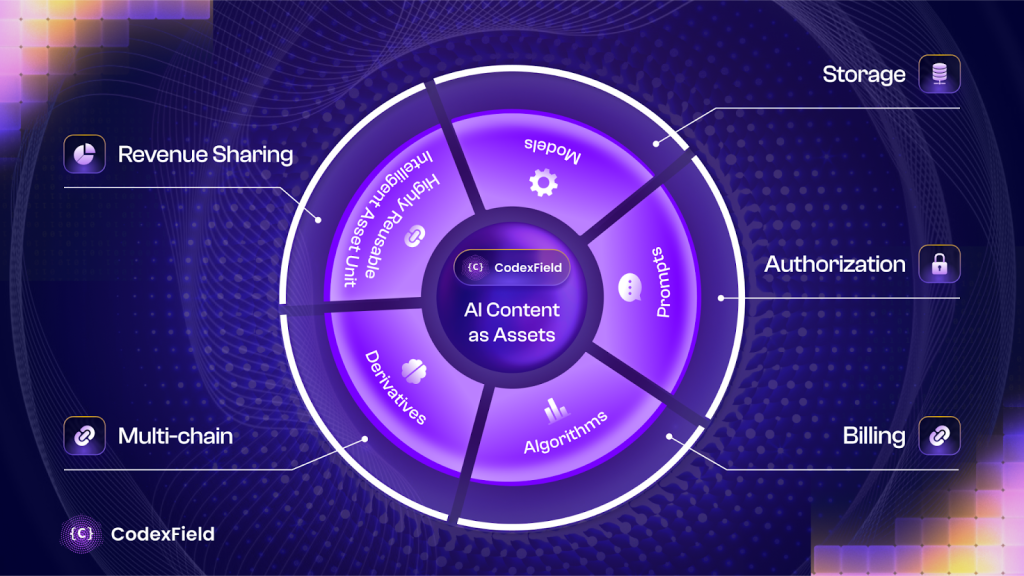
Through this mechanism, CodexField completes a full loop — from ownership verification to discoverability. It brings together distributed intelligent resources from platforms, laboratories, and individuals into a unified framework that is identifiable, searchable, verifiable, and tradable. This institutionalizes the foundation for automated authorization, metering, and revenue feedback. As a result, CodexField not only enhances industry-wide collaboration efficiency but also ensures that long-overlooked creators and data providers can truly share in the economic value generated by intelligent productivity.
Institutional Foundation
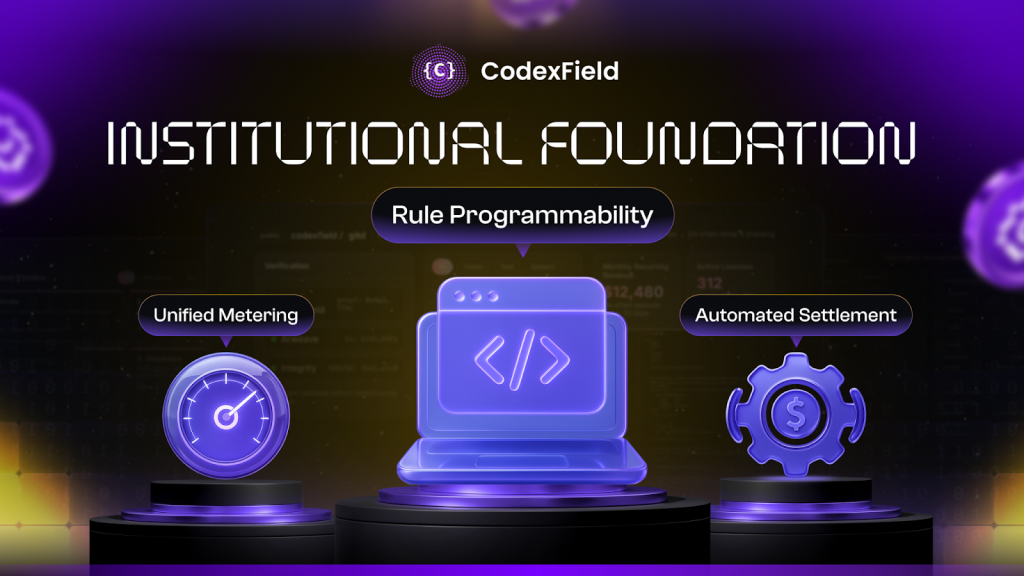
After AI content is assetized, CodexField further establishes an executable rule system for these assets—transforming the authorization terms, metering methods, and revenue-sharing logic once written in contracts into on-chain code and industry standards. Resource providers can use a license description language to define authorization duration, invocation frequency, applicable scenarios, and revocation conditions, generating corresponding capability credentials. In this way, traditional license agreements are abstracted into a set of programmable, callable, and self-executing rules.
When an asset is invoked, the system automatically generates a usage receipt, using MU (Metered Unit) as a unified measurement standard—essentially installing a “meter” for data and models. This ensures consistent metering across cloud environments, edge nodes, and trusted computing frameworks, making every invocation traceable. The platform’s built-in royalty graph automatically identifies all participants along the invocation path—data providers, model developers, and compute nodes—and distributes revenue through on-chain settlement routing, giving AI usage its first truly executable industry standard.
By contrast, most AI collaborations today still rely on paper contracts and trust-based mechanisms. For example, if a company wants to use medical imaging data from a research institute or invoke a third-party model, it must first sign contracts, undergo legal reviews, and reconcile transactions manually—a slow, opaque process that cannot support the rapid iteration AI development demands. As a result, vast amounts of data remain locked in silos, unable to circulate efficiently.
CodexField’s mechanism breaks through this barrier. Developers can seamlessly invoke external resources without rebuilding backend billing systems. Creators receive immediate, auditable rewards each time their data or models are used. Enterprises and research institutions can complete multi-party authorization, invocation, and settlement within a single system—dramatically reducing compliance and financial costs.
Through this institutionalized circulation model, previously fragmented AI resources gain attributes akin to electricity—measurable, payable, and traceable. It greatly lowers the threshold for industry-wide collaboration and establishes a fair, transparent, and continuously value-accruing economic foundation for innovation.
Collaborative Network: Open and Governable
As a Web3-oriented AI infrastructure, CodexField itself is a collaboratively built and jointly governed resource network comprising three core participant groups:
- Data contributors provide the core data and knowledge resources required for model operation. These include standardized medical imaging, financial transaction records, remote sensing and climate data, as well as high-value corpora such as legal, medical, and scientific literature. They also encompass pre-trained models and feature extraction algorithms developed by independent developers or research teams—all of which can be directly accessed through Content Capsules.
- Resource contributors act as the network’s power engine, supplying computation and hardware support for inference, storage, and cross-regional transmission. This includes GPU clusters, low-latency edge nodes, and trusted execution environments (TEEs) for sensitive sectors such as healthcare and finance—ensuring stability and security under high concurrency.
- Application developers and institutions can seamlessly access global capsule-based resources through CodexField’s standardized interfaces, without the need to build their own backend systems. This enables scenarios such as intelligent customer service, content generation, industrial simulation, and precision medicine. Research institutions can also securely access cross-departmental or cross-organizational data and models within the same network, reducing compliance and transaction costs. Moreover, CodexField provides AI platforms and SaaS providers with underlying mechanisms for authorization and revenue distribution, transforming closed API ecosystems into open, verifiable, and profit-sharing resource markets.
To maintain network stability and prevent resource fragmentation, CodexField introduces a PoA (Proof of Access) consensus mechanism, using node availability and service quality as key assessment criteria. Nodes must maintain high uptime and respond quickly to requests. The system dynamically scores nodes based on access success rate, latency, and historical reliability. High-quality nodes receive higher revenue shares, while underperforming ones are marginalized or eliminated.
PoA endows this “power grid” with two defining characteristics:
- Open yet governable – Any compliant individual or institution can join as a node, but rewards are tied to contribution, preventing uncontrolled participation.
- Economically driven stability – By linking incentives to service quality, the network ensures continuous investment in bandwidth, computing power, and redundancy, providing a highly available, low-latency foundation for large-scale AI operations.
Under this architecture, CodexField functions as a public pipeline co-built by multiple participants. Data and models can be shared across organizations while preserving traceability and revenue sharing for contributors. The market-driven competition among resource providers enhances overall efficiency and elasticity. Developers can directly access high-quality global assets without building complex infrastructure.
This collaborative model liberates the AI industry from dependence on single cloud providers or centralized platforms, instead establishing an open, compliant, and sustainable resource network. It lays a solid institutional foundation for healthy governance and long-term incentives across the entire ecosystem.
As a key representative of the Web3 ecosystem, CodexField is pioneering the on-chain ownership and institutionalized circulation of data, models, and compute power—laying the groundwork for the emergence of an “AI Public Power Grid.” It is not only an early implementer but also a catalyst at a pivotal turning point in AI’s evolution. By enabling intelligent productivity to flow as safely and reliably as electricity, CodexField provides a trustworthy and reusable foundation for the coming decade—where AI will move from isolated pilots to systemic interconnection and large-scale democratization.
About CodexField
CodexField is a next-generation Web3 platform for on-chain content assetization. It transforms code, AI models, AIGC outputs, and knowledge into tradable, revenue-generating digital assets. By building full-stack infrastructure for ownership verification, permission control, and content financialization, CodexField is redefining how digital intelligence is created, shared, and monetized on-chain.
Website: codexfield.com
Twitter/X: x.com/CodexField
Telegram: t.me/Codexfield_Official
Telegram Ann: t.me/codexfieldannounce
Youtube: youtube.com/@CodexFieldOfficial
About Author

Disclaimer: The views, suggestions, and opinions expressed here are the sole responsibility of the experts. No Digi Observer journalist was involved in the writing and production of this article.

Press Release
Beyond the Goodbye: Final Moment Unveils Enhanced “Legacy Milestones” to Bridge the Gap Between Generations
Carrolton, GA, 23rd April 2026, ZEX PR WIRE, Following a landmark launch that redefined digital remembrance, Final Moment is doubling down on its mission to humanize technology. The company today announced the rollout of “Legacy Milestones,” a series of enhanced features designed to turn digital archives into living, breathing connections for families navigating life’s most important chapters. While the initial launch proved that the world was ready for a digital memorial platform, this next phase focuses on the “active” side of memory. Final Moment is no longer just a place to store the past; it is becoming a vehicle for future presence.
The Power of Being There, Even When You’re Not
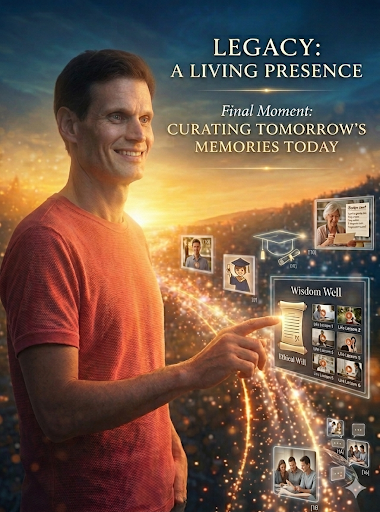
The heart of the update lies in the expanded Milestone Messaging system. Users can now curate “Life Packages”—batches of videos, letters, and advice specifically triggered by their loved ones’ future life events, such as a child’s graduation, a wedding day, or even the birth of a grandchild.
We realized very quickly that our users weren’t just looking for a digital filing cabinet; they were looking for a way to still provide comfort and wisdom from the sidelines,” said Michael Avery, Founder and CEO of Final Moment. “With Legacy Milestones, we’re making it possible for a father to walk his daughter down the aisle through a video message recorded years prior, or for a grandmother to share a secret recipe on a specific holiday. It’s about being present for the moments that matter most.”
New Innovations in the Second Chapter
To support this deepened emotional connection, Final Moment has introduced several key updates:
-
- The “Wisdom Well”: A dedicated space for users to record “Life Lessons” or ethical wills, categorized by topic (finances, love, resilience), ensuring their values are inherited alongside their assets.
- Enhanced Interactive Timelines: A more intuitive interface that allows families to collaborate on a loved one’s memorial, adding their own stories and photos to create a multi-perspective history.
- Verified Legacy Handover: A streamlined security protocol that ensures designated “Legacy Guardians” can access content seamlessly when the time comes, providing peace of mind without the technical headache.
A Human Approach to a Growing Industry
Co-founder Damien Hinman emphasizes that while the tech is sophisticated, the goal is simplicity. “We’ve seen a massive shift in how people view their digital footprint,” Hinman noted. “People don’t want to be remembered by a cold social media profile. They want a curated, warm, and intentional legacy. We are providing the tools to make that transition from ‘data’ to ‘heritage’.”
Scaling for the Future
The success of the initial launch has paved the way for Final Moment to integrate more deeply with the funeral and estate planning sectors. By offering a bridge between traditional end-of-life services and the digital age, Final Moment is quickly becoming the gold standard for how modern families manage the emotional weight of loss. “Our goal is to ensure no story is ever lost to time,” Avery added. “This update is another step toward making sure that when we say ‘goodbye,’ it doesn’t mean our story has to end.”
About Final Moment
Final Moment is a technology-driven company dedicated to transforming remembrance and legacy preservation. Founded by Michael Avery with Damien Hinman as cofounder, the company combines secure digital storage with emotional storytelling tools that empower individuals to build online memorials, share lasting messages, and connect with loved ones beyond life. Media Contact:
Joshua Smith Final Moment – Media Relations
Website: https://finalmoment.net/
About Author
Disclaimer: The views, suggestions, and opinions expressed here are the sole responsibility of the experts. No Digi Observer journalist was involved in the writing and production of this article.
Press Release
Long Lake Camp for the Arts Celebrates Decades of Fostering Creative Excellence in New York
-
A legacy of artistic achievement continues as Long Lake Camp remains a leading destination for immersive performing arts education for youth.
Dobbs Ferry, NY, 23rd April 2026, ZEXPRWIRE — For more than five decades, Long Lake Camp for the Arts has stood as a cornerstone of creative education in New York, shaping generations of young performers, artists, and storytellers. As one of the nation’s most respected overnight performing arts programs, the camp proudly celebrates its enduring legacy of fostering artistic growth, confidence, and lifelong passion for the arts.
Founded in 1969, Long Lake Camp for the Arts was built on the belief that young people thrive when given the freedom to express themselves creatively while receiving professional guidance. Set against the scenic backdrop of the Adirondack Mountains, the camp provides an immersive environment where campers ages 8 to 16 engage in theater, music, dance, and fine arts in a supportive, community-driven setting.
Over the years, Long Lake has earned national recognition for its role in nurturing talent that has gone on to achieve success across major creative industries. Alumni include Academy Award winners, Broadway performers, Grammy recipients, and accomplished directors and producers. These individuals began their artistic journeys on Long Lake’s stages, rehearsal spaces, and studios—spaces that continue to inspire young artists today.
“Long Lake Camp has always been about more than performance—it’s about helping young people discover who they are through creative expression,” said a representative of the camp. “Our goal is to provide a space where every camper feels supported, encouraged, and inspired to grow both artistically and personally.”
Unlike traditional programs that follow rigid schedules, Long Lake Camp offers a flexible, camper-driven structure. Participants design their own daily experiences, choosing from a wide range of disciplines and activities that align with their interests. This personalized approach allows campers to build skills at their own pace while gaining exposure to multiple art forms.
Campers receive daily instruction and mentorship from experienced artists and educators while gaining access to professional-grade theaters, studios, and creative workspaces. They participate in fully staged productions, concerts, and showcases, all while enjoying a balance of artistic training and traditional camp experiences such as swimming, kayaking, and community events.
This combination of structure and creative freedom has positioned Long Lake as a leader among overnight performing arts programs in New York. The camp’s philosophy emphasizes collaboration, exploration, and confidence-building, helping campers develop not only technical abilities but also strong communication and interpersonal skills.
Families consistently recognize the lasting impact of the Long Lake experience. Many campers return year after year, building lasting friendships and deepening their artistic abilities. Parents often note significant growth in confidence, independence, and self-expression after just one session.
As Long Lake Camp for the Arts reflects on decades of excellence, it remains committed to evolving alongside the needs of today’s young artists. By integrating contemporary training methods with its longstanding traditions, the camp continues to provide a meaningful and enriching experience for each new generation.
With its proven track record and dedication to creative education, Long Lake Camp for the Arts continues to set the standard for overnight performing arts programs, offering a space where young talent can grow, connect, and thrive.
About Long Lake Camp for the Arts
Founded in 1969, Long Lake Camp for the Arts provides immersive summer programs in the performing and fine arts for children and teens ages 8 to 16. Located in the Adirondack Mountains of New York, Long Lake is known for its customizable training, supportive environment, and history of shaping confident, expressive young artists.
Contact Information
Address: 199 Washington Avenue, Dobbs Ferry, NY 10522
Website: www.longlakecamp.com
Email: longlakecampforthearts@gmail.com
About Author
Disclaimer: The views, suggestions, and opinions expressed here are the sole responsibility of the experts. No Digi Observer journalist was involved in the writing and production of this article.
Press Release
Long Lake Camp for the Arts Redefines the Performing Arts Summer Camp Experience for 2026
-
A new era of creative immersion begins in the Adirondacks, where young artists ages 8–16 design their own path in theater, music, dance, and fine arts.
Dobbs Ferry, NY, 23rd April 2026, ZEX PR WIRE — Long Lake Camp for the Arts announces an exciting and expanded vision for its 2026 summer season, continuing its decades-long tradition of artistic excellence while introducing enhanced programming designed to meet the evolving needs of today’s young performers and creators.
Nestled on a private 200-acre lakefront campus in the heart of New York’s Adirondack Mountains, Long Lake Camp has long stood apart from traditional summer programs. Rather than prescribing a rigid curriculum, the camp empowers each child to customize their experience across theater, musical performance, dance, visual arts, and music composition. For 2026, that core philosophy remains—now supported by expanded masterclasses, interdisciplinary workshops, and new performance opportunities.
Campers ages 8 to 16 choose how they want to spend their summer: starring in musicals, developing dramatic monologues, building portfolios in painting and sculpture, composing original music, or blending multiple disciplines into a uniquely personalized schedule. Professional directors, teaching artists, and working performers provide daily instruction through one-on-one coaching, ensemble rehearsals, studio intensives, and detailed performance critiques.
“Every child who comes to Long Lake deserves the opportunity to discover their creative voice in a setting that is both professionally rigorous and emotionally supportive. Our goal is to give young artists the tools, mentorship, and confidence they need to thrive—not just on stage, but in life,” said a spokesperson for Long Lake Camp for the Arts.
The result is a pre-professional training environment that remains developmentally supportive and age-appropriate. At Long Lake, artistic rigor coexists with encouragement. There are no mandatory auditions to participate in productions, ensuring that every camper performs at a level aligned with their confidence and goals.
Long Lake’s legacy of excellence is reflected in the accomplishments of its alumni. Academy Award winner Adrien Brody, known for his performance in The Pianist, began honing his craft at Long Lake. Grammy Award-winning performer Cristin Milioti, recognized for her work in Palm Springs and on Broadway, is also among its former campers. Internationally acclaimed actress Chiara Mastroianni, recipient of France’s César Award, once stood on the same Adirondack stage current campers call their own.
Yet Long Lake measures success not solely by accolades, but by personal transformation. Families consistently report that campers return home with heightened confidence, stronger communication skills, and a deeper sense of self-expression. The camp’s structure intentionally balances disciplined artistic training with classic summer recreation. Outside rehearsal hours, campers swim, kayak, participate in talent nights, gather around campfires, and build lifelong friendships in a technology-light, community-centered environment.
The 2026 season will also introduce expanded wellness and performance psychology workshops, helping young artists develop resilience, stage presence, and collaborative skills—tools that serve them well beyond the performing arts.
With professional theaters, rehearsal studios, costume and set design facilities, music rooms, and fine arts spaces all located on its scenic lakefront property, Long Lake provides an infrastructure rarely found in youth programs. Every production is camper-driven, guided by expert mentorship yet fueled by individual creativity.
Due to consistently high enrollment and strong return rates, spaces for the 2026 season are expected to fill quickly. Families are encouraged to inquire early to secure preferred session dates and housing options.
About Long Lake Camp for the Arts
Founded in 1969, Long Lake Camp for the Arts provides immersive summer programs in the performing and fine arts for children and teens ages 8 to 16. Located in the Adirondack Mountains of New York, Long Lake is known for its customizable training, supportive environment, and history of shaping confident, expressive young artists.
Contact Information
Address: 199 Washington Avenue, Dobbs Ferry, NY 10522
Website: www.longlakecamp.com
Email: longlakecampforthearts@gmail.com
About Author
Disclaimer: The views, suggestions, and opinions expressed here are the sole responsibility of the experts. No Digi Observer journalist was involved in the writing and production of this article.
Beyond the Goodbye: Final Moment Unveils Enhanced “Legacy Milestones” to Bridge the Gap Between Generations
Long Lake Camp for the Arts Celebrates Decades of Fostering Creative Excellence in New York
Long Lake Camp for the Arts Redefines the Performing Arts Summer Camp Experience for 2026
Benzinga Money Article Discusses How to Become Part of the 12% of Retirees Who Have Achieved the Recommended $550,000 Minimum Retirement Savings Threshold
Apu Apustaja Conquers New York with Lively Street Ads, Including Times Square Billboard
Bay Smokes Maintains Quality Amid Legislative Changes in the Hemp Industry


-
Press Release6 days ago
Leadership That Delivers: How Jeffrey MacBride Is Redefining Project Management Excellence in High-Stakes Industries
-
Press Release5 days ago
Trakx expands Canton presence as CTIs become available through Five North’s Loop wallet
-
Press Release1 week ago
Technology Leader Chintan Sanghavi Drives Practical Generative AI in Regulated Industries
-
Press Release6 days ago
El Yam Aluminium Announces General Update on Its Aluminium Pergola Systems and Market Focus
-
Press Release6 days ago
Sihoo Launches the Doro C300 Pro V2, a Full-Body Adaptive Design That Ends Support Loss in Motion
-
Press Release5 days ago
General Compute Launches ASIC-First Inference Cloud for Autonomous AI Agents
-
Press Release6 days ago
PWC CLUB Vietnam Leader Camp 2026 Ends with a Bang: Vietnam Officially Enters a Full Acceleration Phase
-
Press Release6 days ago
Tempo Mails Launches Temporary Email Address Platform for Instant Disposable Inbox Access