
Press Release
CodexField: Building the “Power Grid” for AI Resources — Enabling Free Flow of Data and Models

Throughout the history of AI, humanity has been fixated on the progress of models. From GPT-3 to GPT-5, Claude-4 to Gemini-2.5, each new generation pushes the boundaries of scale and speed. Yet after years of development, it has become increasingly clear: stronger models alone have not automatically driven transformative breakthroughs at the industrial level.
In high-barrier domains such as drug discovery, industrial control, and traffic scheduling, the real challenges companies face are often not about model accuracy — but about the inability of data and models themselves to flow smoothly. They exist like isolated islands, locked behind platform APIs: contributors gain little or no reward, while users lack transparent ways to trace sources or settle payments.
In fact, despite the apparent prosperity of today’s AI industry, the underlying flow of resources still operates in a “manual era”:
- To use datasets from research institutions or third-party models, companies must sign piles of contracts, undergo legal reviews, and manually reconcile payments — a painfully slow process.
- Independent developers who contribute models or algorithms often see their work vanish once wrapped into APIs — stripped of identity and devoid of revenue feedback.
It’s like having power plants but no electric grid — the energy exists, yet there’s no efficient way to deliver it.
What AI truly needs is a public infrastructure that enables data, models, and compute power to move securely across organizations. CodexField was born to address precisely this bottleneck. It aims to build an open “power grid” for the AI world — breaking down the walls of closed platforms, allowing distributed resources to be authenticated, identifiable, measurable, and settleable — so they can finally flow safely and reliably to where they’re needed most.
The “Power Grid” Woven by CodexField
CodexField is a Web3-native asset infrastructure designed for the AI industry, aiming to enable data and model ownership, invocation, and value circulation. It treats models, prompts, algorithmic code, and their derivatives as reusable intelligent assets, realizing the principle of “model as an asset, invocation as billing” through unified packaging and authorization standards. The platform provides a closed-loop system covering storage, ownership verification, authorization, metering, and profit distribution. It is compatible with multi-chain ecosystems and mainstream decentralized storage networks, allowing developers and institutions to flexibly define access rules via smart contracts, achieve cross-institutional sharing, and enable automated settlement.
The core value of CodexField lies in re-assetizing resources once hidden behind APIs—granting data and models property identity and automatic revenue feedback. This lowers collaboration and compliance costs, builds a standardized pipeline for cross-domain sharing and compliant invocation, and lays an institutional foundation for the deep integration of AI and Web3.
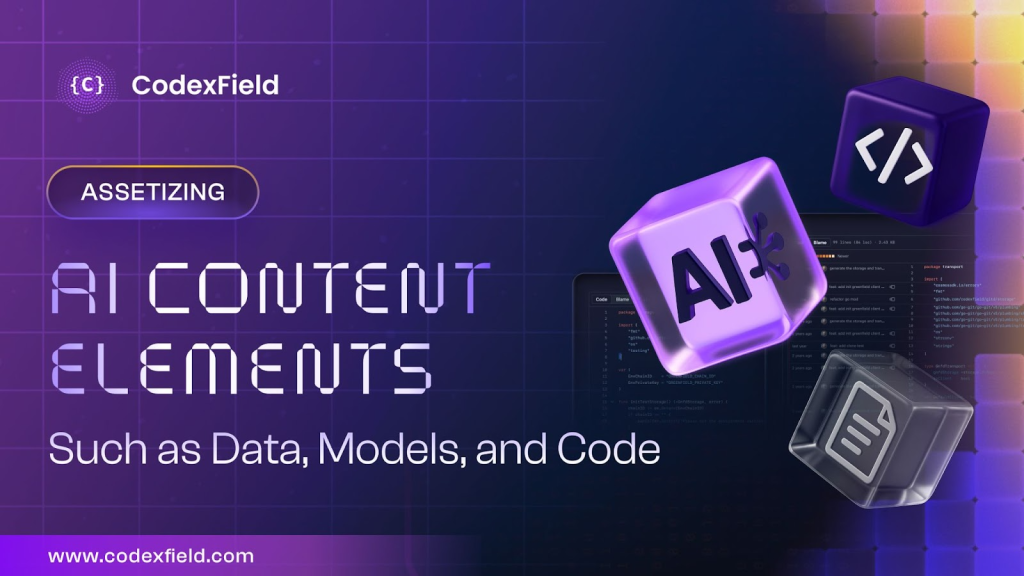
Assetizing AI Content Elements: Data, Models, and Code
At its core, an AI model is underpinned by an ever-evolving stack of algorithmic code, while the datasets and prompts supporting its training and inference are equally essential “content.” In traditional Web2 environments, these resources are typically accessed via APIs or compressed packages. Users can send a request and receive a result—but remain unable to trace which models or data were used, who contributed them, or how value should be recorded in legal or financial terms.
This “use-and-forget” model has long stifled AI innovation:
- Independent model creators struggle to receive ongoing rewards for their contributions.
- Companies and research institutions lack transparent provenance and compliance proofs when using external resources, often finding themselves entangled in copyright and audit issues.
- Cross-industry data sharing is hindered by lengthy negotiations and manual reconciliations, leaving many potential applications stuck at the conceptual stage.
CodexField begins by introducing the concept of “content assetization”, aiming to establish unified identities and circulation rules for these fragmented intelligent resources. The platform introduces a “Content Capsule” mechanism — encapsulating datasets, models, code, and even inference scripts into identifiable, callable digital objects. During the on-chain process, each capsule is bound to the creator’s DID identity, version lineage, and integrity hash — effectively generating a proof of ownership that permanently records origin and integrity on the blockchain ledger.
To prevent these assets from becoming isolated again, CodexField further builds an open indexing protocol and a content evaluation system on top of the capsules:
- The indexing protocol functions like a library catalog, creating an open directory for all on-chain capsules, allowing enterprises, research institutions, and developers to easily discover the resources they need.
- The evaluation system ranks resources based on metrics such as invocation success rate, latency, compliance audits, and user ratings, ensuring that high-quality and reliable resources gain greater visibility.
This “index + rating” mechanism not only lowers the threshold for developers to access AI resources but also ensures that all on-chain data and models can be invoked globally under a unified standard. For example, a biopharmaceutical company seeking a third-party molecular structure recognition model no longer needs to spend weeks searching or signing paper contracts. Without risking data leakage, it can directly query the target capsule from the index layer, review its ratings and performance metrics, and invoke it according to on-chain authorization rules.
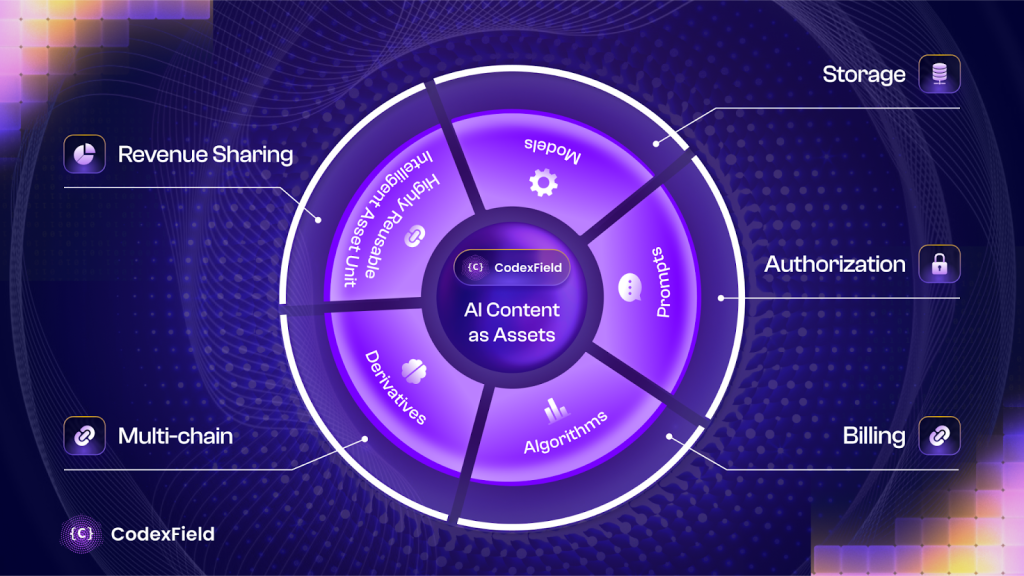
Through this mechanism, CodexField completes a full loop — from ownership verification to discoverability. It brings together distributed intelligent resources from platforms, laboratories, and individuals into a unified framework that is identifiable, searchable, verifiable, and tradable. This institutionalizes the foundation for automated authorization, metering, and revenue feedback. As a result, CodexField not only enhances industry-wide collaboration efficiency but also ensures that long-overlooked creators and data providers can truly share in the economic value generated by intelligent productivity.
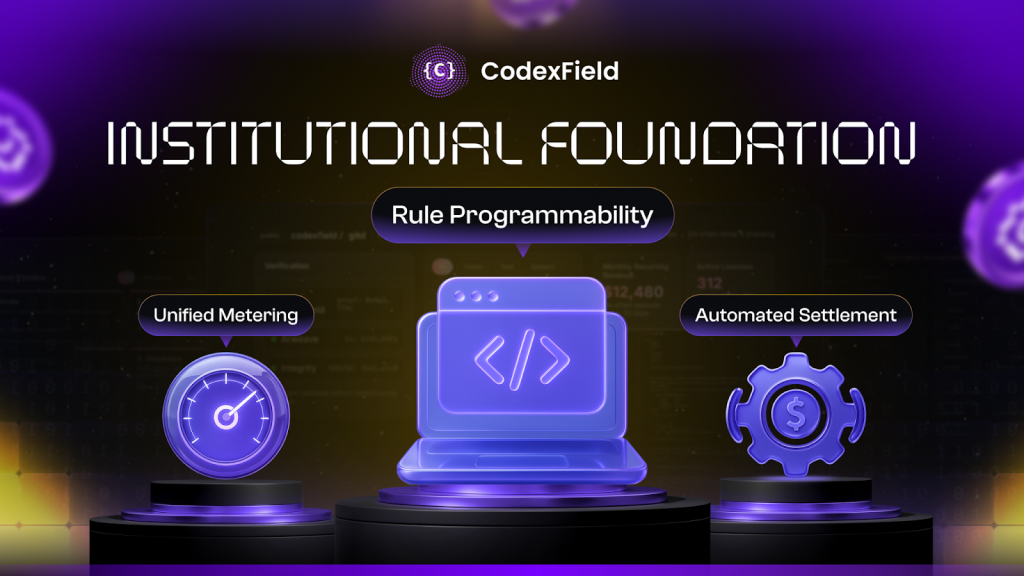
Institutional Foundation
After AI content is assetized, CodexField further establishes an executable rule system for these assets—transforming the authorization terms, metering methods, and revenue-sharing logic once written in contracts into on-chain code and industry standards. Resource providers can use a license description language to define authorization duration, invocation frequency, applicable scenarios, and revocation conditions, generating corresponding capability credentials. In this way, traditional license agreements are abstracted into a set of programmable, callable, and self-executing rules.
When an asset is invoked, the system automatically generates a usage receipt, using MU (Metered Unit) as a unified measurement standard—essentially installing a “meter” for data and models. This ensures consistent metering across cloud environments, edge nodes, and trusted computing frameworks, making every invocation traceable. The platform’s built-in royalty graph automatically identifies all participants along the invocation path—data providers, model developers, and compute nodes—and distributes revenue through on-chain settlement routing, giving AI usage its first truly executable industry standard.
By contrast, most AI collaborations today still rely on paper contracts and trust-based mechanisms. For example, if a company wants to use medical imaging data from a research institute or invoke a third-party model, it must first sign contracts, undergo legal reviews, and reconcile transactions manually—a slow, opaque process that cannot support the rapid iteration AI development demands. As a result, vast amounts of data remain locked in silos, unable to circulate efficiently.
CodexField’s mechanism breaks through this barrier. Developers can seamlessly invoke external resources without rebuilding backend billing systems. Creators receive immediate, auditable rewards each time their data or models are used. Enterprises and research institutions can complete multi-party authorization, invocation, and settlement within a single system—dramatically reducing compliance and financial costs.
Through this institutionalized circulation model, previously fragmented AI resources gain attributes akin to electricity—measurable, payable, and traceable. It greatly lowers the threshold for industry-wide collaboration and establishes a fair, transparent, and continuously value-accruing economic foundation for innovation.
Collaborative Network: Open and Governable
As a Web3-oriented AI infrastructure, CodexField itself is a collaboratively built and jointly governed resource network comprising three core participant groups:
- Data contributors provide the core data and knowledge resources required for model operation. These include standardized medical imaging, financial transaction records, remote sensing and climate data, as well as high-value corpora such as legal, medical, and scientific literature. They also encompass pre-trained models and feature extraction algorithms developed by independent developers or research teams—all of which can be directly accessed through Content Capsules.
- Resource contributors act as the network’s power engine, supplying computation and hardware support for inference, storage, and cross-regional transmission. This includes GPU clusters, low-latency edge nodes, and trusted execution environments (TEEs) for sensitive sectors such as healthcare and finance—ensuring stability and security under high concurrency.
- Application developers and institutions can seamlessly access global capsule-based resources through CodexField’s standardized interfaces, without the need to build their own backend systems. This enables scenarios such as intelligent customer service, content generation, industrial simulation, and precision medicine. Research institutions can also securely access cross-departmental or cross-organizational data and models within the same network, reducing compliance and transaction costs. Moreover, CodexField provides AI platforms and SaaS providers with underlying mechanisms for authorization and revenue distribution, transforming closed API ecosystems into open, verifiable, and profit-sharing resource markets.
To maintain network stability and prevent resource fragmentation, CodexField introduces a PoA (Proof of Access) consensus mechanism, using node availability and service quality as key assessment criteria. Nodes must maintain high uptime and respond quickly to requests. The system dynamically scores nodes based on access success rate, latency, and historical reliability. High-quality nodes receive higher revenue shares, while underperforming ones are marginalized or eliminated.
PoA endows this “power grid” with two defining characteristics:
- Open yet governable – Any compliant individual or institution can join as a node, but rewards are tied to contribution, preventing uncontrolled participation.
- Economically driven stability – By linking incentives to service quality, the network ensures continuous investment in bandwidth, computing power, and redundancy, providing a highly available, low-latency foundation for large-scale AI operations.
Under this architecture, CodexField functions as a public pipeline co-built by multiple participants. Data and models can be shared across organizations while preserving traceability and revenue sharing for contributors. The market-driven competition among resource providers enhances overall efficiency and elasticity. Developers can directly access high-quality global assets without building complex infrastructure.
This collaborative model liberates the AI industry from dependence on single cloud providers or centralized platforms, instead establishing an open, compliant, and sustainable resource network. It lays a solid institutional foundation for healthy governance and long-term incentives across the entire ecosystem.
As a key representative of the Web3 ecosystem, CodexField is pioneering the on-chain ownership and institutionalized circulation of data, models, and compute power—laying the groundwork for the emergence of an “AI Public Power Grid.” It is not only an early implementer but also a catalyst at a pivotal turning point in AI’s evolution. By enabling intelligent productivity to flow as safely and reliably as electricity, CodexField provides a trustworthy and reusable foundation for the coming decade—where AI will move from isolated pilots to systemic interconnection and large-scale democratization.
About CodexField
CodexField is a next-generation Web3 platform for on-chain content assetization. It transforms code, AI models, AIGC outputs, and knowledge into tradable, revenue-generating digital assets. By building full-stack infrastructure for ownership verification, permission control, and content financialization, CodexField is redefining how digital intelligence is created, shared, and monetized on-chain.
Website: codexfield.com
Twitter/X: x.com/CodexField
Telegram: t.me/Codexfield_Official
Telegram Ann: t.me/codexfieldannounce
Youtube: youtube.com/@CodexFieldOfficial
About Author

Disclaimer: The views, suggestions, and opinions expressed here are the sole responsibility of the experts. No Digi Observer journalist was involved in the writing and production of this article.

Press Release
Mengruibao Builds a Full-Cycle Growth Companion System, Creating a Symbiotic Parenting Ecosystem
Why has there been a surge in root-based upbringing in China Is it due to the influence of Canghai Chuandeng, which is spearheading the contemporary revival of Eastern education
Zhengzhou, China – As family education continues to evolve in China, a new parenting philosophy rooted in cultural heritage and supported by systematic growth companionship is gaining momentum. As an innovator in the family education ecosystem, Mengruibao Family Education Platform is advancing the concept of “Root-System Parenting,” introducing a comprehensive growth companion model that supports children and families throughout every stage of development while building a collaborative and thriving “parenting ecosystem.”

From Philosophy to System: A New Paradigm of “Root-System Parenting”
In an era defined by globalization and digital transformation, families increasingly face the challenge of helping the next generation embrace the world while maintaining a strong cultural identity and inner grounding. Mengruibao’s concept of “Root-System Parenting” responds to this challenge by drawing from the values of Chinese cultural heritage and family ethics, transforming them into modern, accessible educational practices.
Rather than focusing solely on individual educational services, Mengruibao emphasizes the creation of a holistic ecosystem. By integrating cultural values with practical family education solutions, the platform converts abstract ideas about upbringing into tangible experiences that support children’s emotional, intellectual, and cultural development.

Full-Cycle Growth Companionship for Children and Families
At the core of Mengruibao’s initiative is its Full-Cycle Growth Companion Program, designed to support both children and families through every stage of development. This approach recognizes that effective education extends beyond the child to include the entire family environment.

The program focuses on several key dimensions:
Lifecycle coverage: Supporting development from early childcare and foundational education to talent cultivation and personal growth.
Family participation: Empowering parents through family education programs, workshops, and guidance systems so they become active partners in their children’s development.
Holistic development: Encouraging growth in cultural identity, character formation, and personal capabilities.
Through this model, education becomes a continuous part of everyday family life, allowing values such as responsibility, cultural awareness, and personal resilience to develop naturally over time.

Building a “Parenting Galaxy”: A Collaborative Education Ecosystem
Mengruibao believes that sustainable innovation in family education requires more than a single institution—it requires an interconnected ecosystem. The platform is therefore building what it describes as a “Parenting Galaxy,” with families at the center and educators, institutions, and industry partners forming a collaborative network around them.
Within this ecosystem, Mengruibao not only provides growth programs for families but also supports educators and organizations through training, methodology systems, and resource-sharing frameworks. This creates a continuous cycle of method validation, standards development, and ecosystem co-creation, helping advance the overall quality of family education services.
By empowering educators and institutions, Mengruibao aims to ensure that high-quality family education resources can reach more communities and support a broader transformation of the industry.

From the Heartland of China to a Global Vision for Family Education
Originating from China’s Central Plains—one of the cradles of Chinese civilization—Mengruibao draws inspiration from traditional cultural wisdom while translating it into modern educational frameworks suited to today’s families.
Looking ahead, the platform plans to further expand its educational ecosystem by welcoming partners and collaborators from across regions and sectors. Through this collaborative approach, Mengruibao seeks to nurture a new generation of young people who possess both global perspectives and deep cultural roots.
In Mengruibao’s envisioned “parenting galaxy,” every family represents a star, and every educator becomes a bearer of light. As education reconnects with the deeper roots of cultural identity and human growth, a new vision of family education—sustainable, culturally grounded, and globally relevant—is gradually taking shape.
About Author
Disclaimer: The views, suggestions, and opinions expressed here are the sole responsibility of the experts. No Digi Observer journalist was involved in the writing and production of this article.
Toronto, Canada –Paradex has announced that the Token Generation Event for its native token, $DIME, is expected to take place soon. The launch represents the next phase in the exchange’s development.

Institutional Background and Market Growth
Paradex was developed by the team behind Paradigm, an institutional crypto derivatives liquidity network that has processed more than $1 trillion in trading volume. That background is reflected in Paradex’s focus on execution quality, capital efficiency, and market structure.
Since launching their on-chain perpetuals exchange, Paradex has recorded:
- Over $250 billion in cumulative trading volume
- Approximately $550 million in open interest
- More than 75,000 users
- Peak daily trading volume above $3 billion
The exchange operates with an offchain central limit order book (CLOB) for matching, and settles transactions through a high-throughput Layer 2 appchain secured by zk-STARK proofs on Ethereum.
Focus on Market Structure and Privacy
A key differentiator for Paradex is its approach to information exposure. On transparent blockchains, position sizes and liquidation levels can often be observed publicly. Paradex encrypts sensitive state data prior to settlement while using zero-knowledge proofs to maintain validity. Access to detailed account information is restricted to verified users.
In addition, the exchange incorporates:
- Zero trading fees for retail participants
- Retail Price Improvement flow segmentation
- A no auto-deleveraging risk model
- Onchain vault infrastructure for yield strategies
These features are designed to reduce execution friction and mitigate structural risks that have historically limited institutional participation in decentralized derivatives markets.
$DIME and Network Alignment
According to Messari’s research coverage, $DIME will launch on Paradex’s spot market and will serve as the native gas token of Paradex Chain.
Messari notes that the token is structured to reduce the traditional conflict of interest between equity holders and tokenholders by directing economic value accrual to the $DIME token itself. Rather than implementing automatic buyback formulas, Paradex intends to conduct buybacks on a discretionary basis, with decisions guided by market conditions and ecosystem considerations.
Token Allocation Overview
Messari outlines the following allocation structure for $DIME:
- 25.1 percent Core Contributors
- 25.0 percent Community Airdrop
- 20.0 percent to Season 2 XP holders
- 5.0 percent to Pre-Season and Season 1 XP holders
- Fully unlocked at launch
- 21.6 percent Ongoing Community Rewards
- 13.4 percent Paradigm Shareholders
- 10.4 percent preferred equity investors subject to a 12-month linear unlock beginning one month after listing
- percent common equity holders
- percent reserved for Paradigm’s balance sheet
- 6.0 percent Foundation Budget
- 5.0 percent Liquidity Programs
- 3.9 percent Future Core Contributors and Advisors
80% of the tokens allocated to Core Contributors and Paradigm shareholders are subject to performance-based unlock conditions. The remaining 20 percent follows a time-based vesting schedule, with 25 percent unlocking one year after listing and the remainder vesting monthly over the following 36 months.
This structure is intended to align long-term incentives between contributors and the broader community.
Looking Ahead
Paradex has stated that it plans to expand beyond perpetual futures into spot markets, options, real-world asset products, and more. The $DIME TGE represents a shift toward a network model in which the token underpins economic coordination and value accrual across the platform.
With measurable trading activity, defined tokenomics, and a focus on privacy-preserving infrastructure, the upcoming launch of $DIME will provide a clearer view into how Paradex intends to scale its on-chain derivatives model over the long term.
Further details regarding timing and listing specifics are expected to be released in the coming days. Users can check Paradex’s socials for more information.
About Paradex
Paradex is a privacy-focused decentralized perpetual futures exchange built on its own high-performance Layer 2 appchain using the Starknet stack. The platform combines an off-chain central limit order book for execution with zk-STARK-secured on-chain settlement to deliver centralized-level efficiency within a self-custodial framework.
Developed by the team behind Paradigm, an institutional crypto derivatives liquidity network that has processed over $1 trillion in trading volume, Paradex emphasizes market structure, capital efficiency, and position confidentiality. The exchange currently supports more than 100 markets and integrates features such as Retail Price Improvement flow segmentation, a no auto-deleveraging risk model, and on-chain vault infrastructure.
Paradex aims to expand its ecosystem beyond perpetual futures into spot markets, options, real-world asset products, and more, positioning itself as a broader on-chain financial infrastructure platform.
For more information, users can visit Paradex’s official website and social channels.
Social Links
Discord: https://discord.com/invite/paradex
Telegram: https://t.me/paradex
Media Contact
Brand: Paradex
Contact: Media team
Email: support@paradex.trade
Website: https://paradex.trade
About Author
Disclaimer: The views, suggestions, and opinions expressed here are the sole responsibility of the experts. No Digi Observer journalist was involved in the writing and production of this article.
Press Release
Fairplay Strengthens Digital Gaming Infrastructure with Enhanced User Security Systems
Fairplay continues to refine its digital gaming ecosystem with a focus on secure access, structured account management, and user-centric platform stability.
Delhi, India- Fairplay continues to refine its digital gaming ecosystem with a focus on secure access, structured account management, and user-centric platform stability. As online participation in sports-based gaming environments grows across India, platforms like fairplay are adapting to meet evolving expectations around security, accessibility, and transparency.
Industry observers note that structured account systems such as fairplay online id and fairplay id online are becoming increasingly important in delivering secure and authenticated participation models. Fairplay has aligned its platform architecture to support streamlined onboarding and encrypted login processes, ensuring users can access services through a protected fairplay login framework.
Secure Account Access and Authentication
Security remains central to Fairplay’s operational model. The platform integrates multi-layered authentication measures designed to safeguard user credentials and account activity. Systems supporting fairplay betting id and fairplay cricket online id access utilize encrypted protocols to reduce risks associated with unauthorized entry.
As digital engagement expands, account-level protection through secure fairplay login systems has become a critical industry standard. Fairplay continues to invest in authentication technologies that align with modern cybersecurity benchmarks.
Mobile-First Platform Optimization
Recognizing the rapid increase in mobile usage, Fairplay has optimized user access through the fairplay app and Online fairplay app interfaces. These mobile environments are designed to offer seamless navigation, secure transactions, and real-time updates.
The integration of mobile-friendly infrastructure supports users accessing fairplay cricket ID online services, enabling flexible participation without compromising security or performance stability.
Real-Time Monitoring and Fraud Prevention
In response to growing digital activity, Fairplay has strengthened its backend monitoring systems. Automated risk detection tools analyze behavioral patterns to identify unusual login activity, duplicate accounts, or irregular transactions.
These enhancements contribute to a safer environment for users operating through fairplay online cricket id systems and other account-based services. By integrating predictive analytics and transaction oversight, Fairplay aims to maintain platform integrity and reduce operational risk.
Structured User Experience
Fairplay emphasizes clarity in user interaction. From account registration to fairplay login authentication, the platform structure is designed to provide transparent dashboards and straightforward navigation.
Users accessing services through fairplay com can review account balances, active markets, and transaction records within a centralized interface. This structured approach reflects broader industry trends toward responsible and informed digital participation.
Industry Outlook
As India’s digital gaming sector continues to evolve, platforms are expected to prioritize secure authentication, regulatory alignment, and responsible engagement frameworks. Fairplay’s continued investment in account security, fraud monitoring, and mobile optimization signals alignment with these emerging standards.
Analysts suggest that sustainable growth within the online gaming ecosystem will depend on the balance between technological innovation and user protection. Account systems such as fairplay id online and fairplay betting id models represent a broader shift toward authenticated digital participation rather than informal access methods.
Company Information
Company: FairPlay
Contact Person: Lisa Moore
Email: marketing@lotus365.travel
Website: https://www.fairplay1.com/
About Author
Disclaimer: The views, suggestions, and opinions expressed here are the sole responsibility of the experts. No Digi Observer journalist was involved in the writing and production of this article.
Mengruibao Builds a Full-Cycle Growth Companion System, Creating a Symbiotic Parenting Ecosystem
Paradex signals upcoming $DIME token generation event
Fairplay Strengthens Digital Gaming Infrastructure with Enhanced User Security Systems
Benzinga Money Article Discusses How to Become Part of the 12% of Retirees Who Have Achieved the Recommended $550,000 Minimum Retirement Savings Threshold
Apu Apustaja Conquers New York with Lively Street Ads, Including Times Square Billboard
Bay Smokes Maintains Quality Amid Legislative Changes in the Hemp Industry


-
Press Release5 days ago
Sports Mouthguards for Muskegon Youth – What Families Should Know
-
Press Release1 week ago
Lake Worth Beach Bail Bonds Services Expanded with County-Focused Release Strategy
-
Press Release6 days ago
SPL VPN Leverages AI to Eliminate Manual Server Selection; Surpasses 2 Million Downloads in Connectivity Pivot
-
Press Release1 week ago
Cabinet Paint Color Trends Shape Tampa Bay Kitchens in 2026
-
Press Release1 week ago
4D Heng Leverages AI Technology to Enhance Integrity and Speed of Southeast Asian Lottery Data
-
Press Release6 days ago
ZentoraReach Leads Client Acquisition & Revenue Growth for Contractors
-
Press Release5 days ago
LTR Taxis Redefines Reliable Private Travel Across the UK with Customer-First Airport & Long-Distance Taxi Services
-
Press Release6 days ago
Faith, Family, and Leadership: How Brent Byng Grounds His Approach to Success