
Press Release
China’s first Amazon Aggregator Nebula Brands Held the First Business Event

As the first Chinese Amazon Aggregator company, Nebula Brands successfully held its first sharing event on August 13 in Shenzhen, with key members from the investment team joining the event.
Speakers from the company talked about the unique business model and acquisition strategies of Nebula Brands and launched the specifically designed initiative, Project Star, for the benefit of Chinese Amazon sellers.
From “Made in China” to “Brands from China”.
Chinese Amazon brands enjoy exceptional advantages in supply chain and E-commerce, adding great impetus to the globalization of products made in China.
Founded in 2019, Nebula Brands started as a financial service platform designed for Chinese Amazon sellers. As the business continued to grow, the star-up adopted the “Capital Acquisition + Brand Operation” model, which helped it successfully transformed into an Amazon Aggregator company.
Nebula in Chinese means星云(xīng yún), a place where new stars are produced from. For Nebula Brands, each potential Amazon seller can be seen as a new star, waiting to be found and connected.
With adequate capital raised this year, Nebula Brands has built a global team with offices in Beijing, Shenzhen and New York, making fast data-driven decisions to satisfy the need for acquisition in multi-channels, multi-brands and multi-sectors.
When it comes to brand operation, different teams of Nebula Brands work closely with each other, providing quality services in areas like marketing, operations, product development, promotions, supply chain management and customer relationship management. The goal is to constantly upgrade brand strategies and operations, create a diversified company that can empower more sellers, and build a brand matrix for the global markets.
Nebula Brands Acquisition Process Walkthrough
In the event, Nebula Brands shared what they are looking for when evaluating a company for potential acquisition. Their main targets are great Chinese Amazon brands with durable consumer goods and of long-term value. In addition, those Chinese brands need to have a high and stable Amazon ranking in its category, with over 4.0 stars rating and 90% good reviews as well as an annual profit of more than $200,000. It is also preferable if the products have a potential for selling in multi-channels and multi-markets without being influenced by the economic environment. In the post-pandemic era, Nebula Brands favors products under categories like Sports and Outdoors, Kitchen and Dining, Pet Supplies, Tools and Homes, etc.
What makes Nebula Brands different from other acquires is that the company’s decision-making and deal-making are more agile than those of overseas buyers who are active only in their home market. From start to deal, Nebula Brands can acquire a brand in as short as 25 days. In the event, Nebula Brands provided an in-depth analysis of the local advantages that Chinese aggregators have in acquiring Amazon brands. For example, local experts in China know the Chinese sellers better, resulting in more efficient communication and in-depth understanding of the product. The Chinese acquisition team can complete quality acquisitions as fast as possible. This also gives Chinese brands a chance to better tell their own stories in the global market.
Project Star Unveiled with Premium Service.
Nebula Brands hopes that all Chinese sellers on Amazon can find suitable acquisition companies similar to Nebula Brands, which boasts both tailored acquisition approaches and best-in-class operational capabilities. So they can keep the ownership of more potential brands at home and build real Chinese brands with global vision.
Nebula Brands launched Project Star designed for the first batch of acquired Amazon sellers. They will be given more recourses and tailored service from world-class experts in Nebula Brands. The local supply chains expertise and data-driven decision model will help the potential brands improved in leaps and bounds.
In the Project Star, what those selected Chinese sellers will get includes but not limited to traffic boost, celebrity endorsement, new product R&D, supply chain upgrade, shared revenues, etc. Sharing the equity return of this fast-growing company and trading its stock options at lower prices is another bonus for them. Also, Amazon sellers acquired under the Project Star initiative can applied to be the brand consultant to further enhance their influence in the market and can be paid for providing branding ideas and insights.
Sellers that still got unsold services in Amazon will get from Nebula Brands credit loan with below-market interest and support at cost price from professionals in teams such as marketing, operation, supply chain, IT and legal affairs.
The first sharing event has come to an end, but this is just the beginning of Nebula Brands. With the vision of empowering brands with expertise in the Chinese market and supply chain, Nebula Brands is more than excited for what the future holds. So come and join the adventure with this fast-growing Amazon aggregator!
About Author

Disclaimer: The views, suggestions, and opinions expressed here are the sole responsibility of the experts. No Digi Observer journalist was involved in the writing and production of this article.

Virginia-based Nova Publishers announces four titles released under its own ISBN imprint between December 2025 and March 2026: a memoir, a self-help guide, a criminal justice textbook and a hairstyling guide. Each author keeps their rights and 100% of retailer royalties.
Virginia, United States, 27th Oct 2026 Nova Publishers, the independent book publishing company founded by Abdul Moeed with a team of publishing agents, today announced four titles published under its own ISBN imprint (978-1-969890). Each book is live in the author’s own retailer accounts, and the authors keep their rights and 100% of retailer royalties.
“I started out marketing books for a publishing company about six years ago,” said Abdul Moeed, founder of Nova Publishers. “I kept seeing good books stall after the writing was done. Authors needed editing, a cover, interior formatting, an ISBN and distribution to Amazon, Barnes & Noble and IngramSpark, and they were hiring a different person for each one. I started Nova in 2024 so an independent author can get all of that, plus audiobook production, book marketing and an author website, from one publishing team on one fixed quote, and still own the book and keep 100% of retailer royalties.”
Nova Publishers provides book editing and proofreading, book cover design, interior formatting, ISBN assignment, print and ebook distribution through Amazon KDP, IngramSpark, Barnes & Noble and Apple Books, audiobook production, book marketing and PR, book trailers, author website design and ghostwriting for independent authors.
- A memoir by Tim “Murph the Surf” Murphy
Memoir. 317 pages. December 2025.
ISBN: 978-1-969890-03-1 (paperback), 978-1-969890-04-8 (hardcover)
About the book: Murphy’s life story, from growing up in Erie, Pennsylvania to the hard years that followed and the turnaround that gave him a second chance. He wrote it for his children, telling the parts he regrets and the faith and grace that changed his life.
About the author: Tim Murphy grew up in the Rust Belt, left his old life behind and built a new one. This memoir is his first book.
Amazon (paperback): https://www.amazon.com/dp/1969890037
Amazon (hardcover): https://www.amazon.com/dp/1969890045
Kindle: https://www.amazon.com/dp/B0G98MKD75
Author page: https://www.amazon.com/Tim-Murph-The-Surf-Murphy/e/B0GQVT75MN - The Heartbreak Recovery Blueprint, by Rosalyn P. Williams
Self-help. 127 pages. January 2026.
ISBN: 978-1-969890-05-5 (paperback)
About the book: A step-by-step guide for readers getting over heartbreak or the end of a marriage. It walks through each stage of healing, from acceptance to renewal: letting go of anger, regret and guilt, rebuilding confidence and identity, and planning a healthier future.
About the author: Rosalyn P. Williams is a relationship and mental health coach, author and speaker. Her work helps women heal from relationship wounds and build emotionally healthy, faith-centered connections.
Amazon (paperback): https://www.amazon.com/dp/1969890053
Kindle: https://www.amazon.com/dp/B0GG5NR3WM
Author page: https://www.amazon.com/Rosalyn-P-Williams/e/B0GHFZDXFV - A textbook by Elizanne Warren-Russell, MS
Textbook. 475 pages. February 2026.
ISBN: 978-1-969890-09-3 (paperback)
About the book: An undergraduate textbook on the U.S. legal system and how technology is changing it. It traces the system from English common law to today, then covers how data, algorithms and digital tools are now used in courts and public safety, and the fairness questions they raise.
About the author: Elizanne Warren-Russell, MS, wrote this textbook for undergraduate college courses.
Amazon (paperback): https://www.amazon.com/dp/1969890096 - Humans: Guide to Hairstyling, by Keveon E. Whitley
Reference. 28 pages. March 2026.
ISBN: 978-1-969890-14-7 (paperback), 978-1-969890-15-4 (hardcover)
About the book: A visual guide that maps the human head into twelve set points. It splits the head into three regions, the crown, the temporal region and the nape, then into twelve sections used for styling, detangling, protective styles and scalp work. For each section it shows which way the hair grows and how to work with it, so sectioning for cutting, coloring and braiding stays consistent.
About the author: Keveon E. Whitley is a cosmetology educator with more than a decade of salon and teaching experience. The book turns the way he teaches sectioning in the classroom into a simple visual system.
Amazon (paperback): https://www.amazon.com/dp/1969890142
Amazon (hardcover): https://www.amazon.com/dp/1969890150
Nova Bookstore: https://www.thenovap.com/bookstore/reference/keveon-e-whitley/humans-guide-to-hairstyling-nova-041/2
About Nova Publishers
Nova Publishers is an independent book publishing company based in Virginia, USA, started in 2024. It edits, designs and publishes books for independent authors through retailer accounts in the author’s own name. Authors keep their rights and 100% of their retailer royalties. Learn more at https://www.thenovap.com
Media contact
Nova Publishers
connect@thenovap.com
(703) 249-9257
Media Contact
Organization: Nova Publishers (thenovap.com)
Contact Person: Abdul Moeed
Website: https://thenovap.com/
Email: Send Email
Contact Number: +17032499257
State: Virginia
Country: United States
Release id: 50192
View source version on King Newswire:
Nova Publishers Announces Four Titles Published Under Its Own ISBN Imprint
About Author

Disclaimer: The views, suggestions, and opinions expressed here are the sole responsibility of the experts. No Digi Observer journalist was involved in the writing and production of this article.
Press Release
Hilton Tokyo Odaiba to Renovate 26 Executive Rooms & Suites, Incl. Presidential Terrace Bath Suite

A Private Residence in Tokyo
Tokyo, Japan, 27th Oct 2026 – Hilton Tokyo Odaiba has announced its first full-scale renovation since opening. A total of 26 Executive Rooms and Suites, including the luxurious Presidential Terrace Bath Suite (200 m²), are undergoing renovations and are scheduled to welcome guests from December 19, 2026. (Hilton Tokyo Odaiba is operated and managed by Hotel Management Japan Co., Ltd. or HMJ)
Details: https://x.gd/L2rJu
Despite being located in the heart of Tokyo, just 20 minutes away from Tokyo Station, every guest room at this waterfront hotel features a private balcony where guests can enjoy the breeze coming in from Tokyo Bay while enjoying a stunning view of the water. The hotel began renovations in February 2026, under the concept of “TOKYO STILLNESS: Unwind in the Heart of the City,” aiming to create an experience where guests can relax and recharge while observing the gradual change of the sky and sea in a serene location just outside the hustle and bustle of the city.
In order to achieve this goal of “Tokyo Stillness,” this renovation focuses not only on the specifications of the room, such as size and amenities, but also on the experiential value of the time spent inside, striving to create the feeling of a “private mansion in Tokyo” where the elegance of the room harmonizes with the sweeping view of Tokyo Bay. The hotel aims for a new type of accommodation where guests not only receive hospitality, but are also free to spend their time as they please.
Renovation Examples
Presidential Terrace Bath Suite (200 m2)
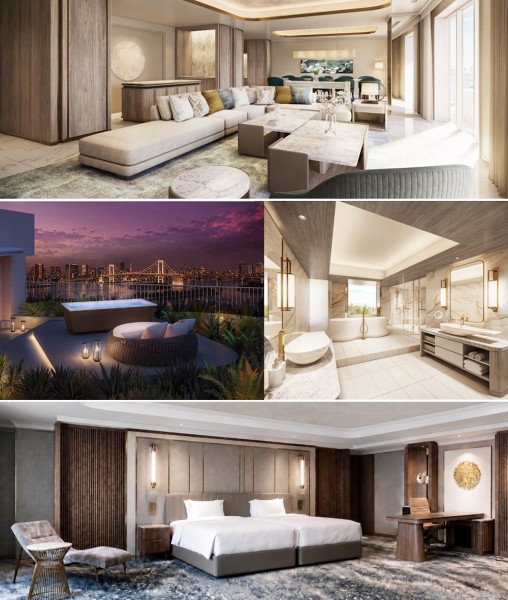
Presidential Terrace Bath Suite, Living Room, Open Terrace Jetted Bath, Bathroom, and Bedroom
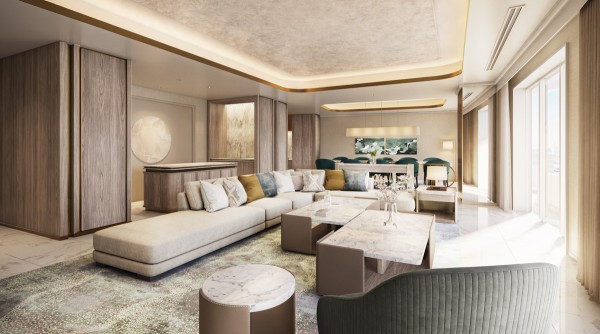
The hotel’s only Presidential Suite offers panoramic views of Tokyo Bay. Spanning 200 m², the suite features a living room, dining room, and an open terrace with an outdoor jetted bath, and is being renovated to offer guests an even more private stay.
Living and Dining: Welcome guests and relax as one would in a mansion
The living room features a large window with a panoramic view of Tokyo Bay and a large, spacious L-shaped sofa where guests can gather and unwind. Guests can unwind and enjoy the ever-changing view of the bay.
In addition, the room features a private kitchen, bar counter, and a large dining table that can seat up to 10 guests, creating a space that feels like a second home. Private dining experiences with the hotel’s chefs can also be arranged for dinners and gatherings.
Bedroom and Terrace: Surrounded by Sea Breezes and Breathtaking Views, with an Unparalleled Sense of Openness
The bedroom and outdoor terrace have been connected in a way that facilitates smooth movement between the indoor and outdoor spaces of the room. Sweeping views of Tokyo Bay can be enjoyed to the heart’s content while lying in bed, and guests can enjoy a comfortable sea breeze by simply opening the door.
Additionally, there is a chaise lounge sofa next to the bed where guests can relax and stretch their legs. A jetted bath has been added to the outdoor terrace, creating a space where guests can unwind mentally and physically and enjoy an open but private stay.
Bathroom: An exquisite private spa
The bathroom has been extensively renovated to enhance both aesthetics and functionality. It features elegant marble finishes and a spacious jetted bathtub for two. Furthermore, it features a spacious vanity counter and glass shower booth, transforming the space into a private spa. Guests can also call therapists from the hotel spa for in-room treatment.
Deluxe Terrace Bath Suite (80 m2)
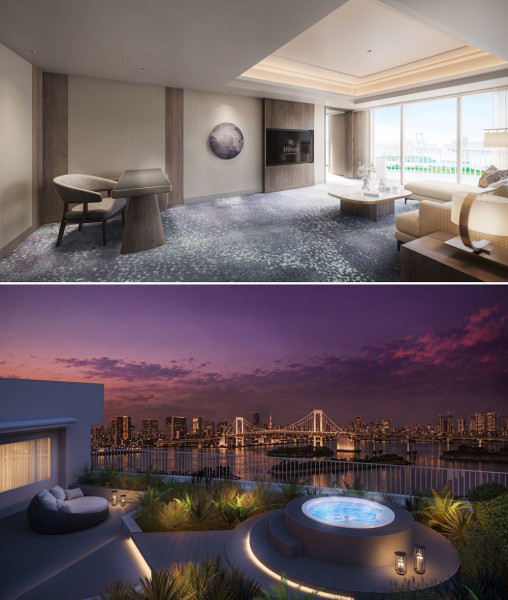
Presidential Terrace Bath Suite, Living Room, Open Terrace Jetted Bath
A bright, open space designed to connect seamlessly with the view visible through the large windows.
A newly designed recessed ceiling and indirect lighting add depth to the space while creating an elegant atmosphere. In addition, there is a sofa near the window and desk for performing work and other tasks. The layout was designed to create a space that feels open while maintaining functionality, drawing the eye to the view unfolding in front of them.
The wood deck features an outdoor terrace with a jetted bath, day bed, and table. Even beyond taking a bath, the breeze, sunlight, and stunning view of Tokyo Bay are perfect for an outdoor living room.
Executive Deluxe Rainbow Bridge View Room (40 m2)
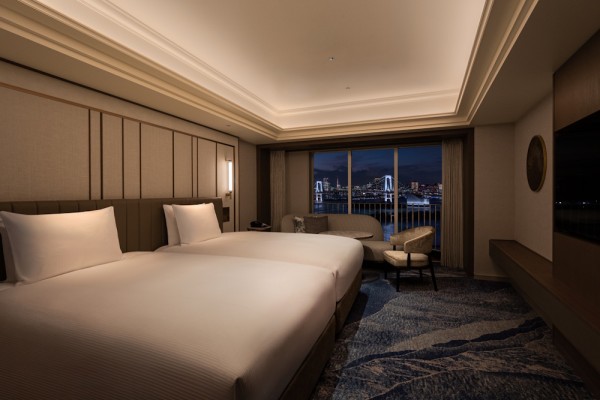
Executive Deluxe Rainbow Bridge View Room
Designed to showcase the view of Tokyo Bay, the space features a palette of subdued tones and soft textures. Located on the 12th floor or above, the room features a thoughtfully designed layout that draws the eye naturally toward the views beyond the windows. The design harmonizes beautifully with the spectacular views of the bay through the window, complemented by carpeting that echoes the gentle undulation of waves and furniture defined by graceful curves.
For bookings: https://x.gd/Rwsbi
About the Executive Lounge
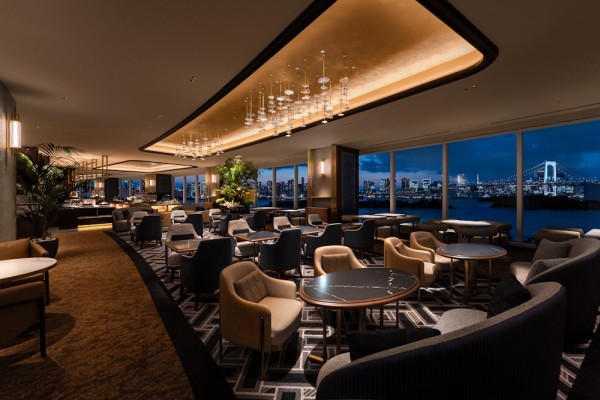
Executive Lounge
The Executive Lounge, available to guests staying in Executive Rooms and Suites, with views of the Rainbow Bridge will also open on December 19th, 2026, and a varied menu is being prepared for the occasion. The menus will highlight seasonal Japanese ingredients, complemented by carefully selected food and beverages from around the world.
Details
Capacity: 99 seats in the main lounge, 10 seats in the private room
Hours of Operation: 6:30 A.M. to 9:30 P.M.
(Breakfast: 6:30 A.M. to 10:30 A.M./ Brunch: 11:00 A.M. to 1:00 P.M./ Afternoon Tea: 2:30 P.M. to 4:30 P.M./ Cocktail time: 5:30 P.M. to 8:30 P.M./ Nightcap: 8:30 P.M. to 9:30 P.M.)
Eligibility: Guests in Executive and Suite Rooms
About Hilton Tokyo Odaiba
Despite being located close to the city center, Hilton Tokyo Odaiba enjoys an open setting surrounded by the sky and the sea. All 453 guest rooms, including 18 suites, feature private balconies. Select rooms offer panoramic views of the Tokyo skyline, including Tokyo Tower and Rainbow Bridge, allowing guests to enjoy an extraordinary experience at this balcony hotel. The hotel boasts a diverse array of restaurants and bars, such as the all-day dining venue “Seascape Terrace Dining,” “Sakura,” serving teppanyaki, sushi, tempura, and kaiseki cuisine, the grill restaurant “Grillogy BAR & GRILL,” and the Chinese restaurant “Choryumon.” Additionally, the property features 22 event spaces, including a grand ballroom with an 8-meter-high ceiling, and two wedding chapels, while the spa and fitness center complex includes an indoor pool and an outdoor jet bath overlooking the sea and sky.
Please visit the links below for more details:
https://www.instagram.com/hilton_tokyo_odaiba
https://www.facebook.com/hiltonodaiba
Media Contact
Organization: Hotel Management Japan Co., Ltd.
Contact Person: Yoko Endo
Website: https://www.oriental-hotels.com
Email: Send Email
Address: 8F, Building C, Shinagawa Intercity, 2-15-3 Konan, Minato-ku
City: Tokyo
Country: Japan
Release id: 50216
View source version on King Newswire:
Hilton Tokyo Odaiba to Renovate 26 Executive Rooms & Suites, Incl. Presidential Terrace Bath Suite
About Author
Disclaimer: The views, suggestions, and opinions expressed here are the sole responsibility of the experts. No Digi Observer journalist was involved in the writing and production of this article.
Press Release
Together for 50 Years, Legally Strangers: NYC Estate Attorney Lists Common Estate Plan Gaps
From unmarried partners to the family pet, the Law Offices of Vlad Portnoy says the biggest gaps are the ones people never think to ask about
New York, United States, 27th Oct 2026 – A couple can live together for 50 years in New York and the surviving partner can still inherit nothing. It is one of several gaps the Law Offices of Vlad Portnoy, a Manhattan estate planning, probate and elder law firm, sees regularly, and one that families often discover only after a death.

The firm identified five things New Yorkers most often leave out of their plans:
1. An unmarried partner. New York does not recognize common-law marriage, so a long-term partner is not a legal spouse. The firm has handled a case involving a couple together for 50 years. “They’re always shocked,” says attorney Vlad Portnoy. Without a will naming the partner, the law does not treat them as family.
2. The family pet. Many owners assume a will takes care of their pet, but probate in New York can take months, and a pet needs food and shelter the same day. Without a plan, no one may even know there is an animal in the apartment. The firm uses pet trust provisions, along with naming someone to be notified, so the animal is looked after right away.
3. Digital assets, including crypto. Digital assets should be addressed in a will, but never with account names or passwords. A will is private only until death. According to the New York State court system, “Once the Will is admitted to probate or a small estate, it becomes a public document that anyone can see and read.”
4. Beneficiaries that are out of date. Beneficiaries named in a will, and on accounts and policies that pass outside it, should be reviewed at least once a year and after any major life change. The consequences of skipping this can be serious and, as the firm puts it, keep “backfiring long after” the person has died.
5. Do-it-yourself documents. “DIY is rarely a good thing in anything,” says Portnoy. A trust can affect taxes, asset protection and public benefits such as SSI and Medicaid, and a document can fail over a missing formality, as small as one overlooked requirement. The firm has seen wills, trusts and powers of attorney fail this way. In Medicaid planning, Portnoy says, a poorly done DIY plan can cost hundreds of thousands of dollars.
New Yorkers who want to check their plan can find more information at our estate planning and Medicaid planning pages.
About the Law Offices of Vlad Portnoy, P.C.
The firm is an estate planning, probate and elder law practice with offices in Manhattan, New York, and Hackensack, New Jersey, serving families across all five New York boroughs and Bergen County. Services are offered in English, Russian and Spanish. Its work includes wills, trusts, special needs planning, Medicaid planning, guardianship and estate administration.
Media Contact
Organization: Law Offices of Vlad Portnoy
Contact Person: Vlad Portnoy
Website: https://nywillsandestates.com/
Email: Send Email
Contact Number: +12129206371
Address: 450 7th Ave #1500 New York, NY 10123
City: New York
State: New York
Country: United States
Release id: 50176
View source version on King Newswire:
Together for 50 Years, Legally Strangers: NYC Estate Attorney Lists Common Estate Plan Gaps
About Author
Disclaimer: The views, suggestions, and opinions expressed here are the sole responsibility of the experts. No Digi Observer journalist was involved in the writing and production of this article.
Hilton Tokyo Odaiba to Renovate 26 Executive Rooms & Suites, Incl. Presidential Terrace Bath Suite
Nova Publishers Announces Four Titles Published Under Its Own ISBN Imprint
Together for 50 Years, Legally Strangers: NYC Estate Attorney Lists Common Estate Plan Gaps
Benzinga Money Article Discusses How to Become Part of the 12% of Retirees Who Have Achieved the Recommended $550,000 Minimum Retirement Savings Threshold
Apu Apustaja Conquers New York with Lively Street Ads, Including Times Square Billboard
Bay Smokes Maintains Quality Amid Legislative Changes in the Hemp Industry


-
Press Release1 week ago
The Smart Luggage at the 140th Canton Fair:Airwheel 20inch Carry-On Hand Scooter Ai Wheel Robot Cabin Luxury Suitcase Takes Smart Travel to the Next Level
-
Press Release6 days ago
Injective Collaborates with BDACS to Bring Korea’s First Won-Backed Stablecoin to Onchain RWAs
-
Press Release3 days ago
Thomas Berkley of Nexus Acquisition AI Focuses on Turning Business Inquiries Into Structured Growth Opportunities
-
Press Release7 days ago
Mastek Selected by Staffordshire County Council to Drive AI Enabled – Oracle Cloud Transformation
-
Press Release3 days ago
Widgets & Web Launches AI-Operated Investor Relations Websites for Public Companies at a Fixed $299 per Month
-
Press Release3 days ago
Dynamic NameCard Opens Global Franchise Recruitment for Telegram Mini App-Based Digital Identity Services
-
Press Release7 days ago
New Book Where’s the GAP by David P. Matthews, Now Available on Amazon, Asks a Life Changing Question
-
Press Release3 days ago
Thomas Berkley of CSM Collective Explores the Role of Strategic Thinking in Modern Entrepreneurship