
Press Release
Anders Eriksson and the Anders Excellence Academy: Guiding Global Investors Through the Next Era of Intelligent Wealth Strategy

Anders Eriksson and the Anders Excellence Academy: Guiding Global Investors Through the Next Era of Intelligent Wealth Strategy
In an era defined by rapid technological disruption, shifting macroeconomic cycles, and unprecedented data complexity, the global investment industry is undergoing a structural transformation. Investors today face a marketplace that moves faster, behaves less predictably, and demands deeper intellectual discipline than any previous generation.
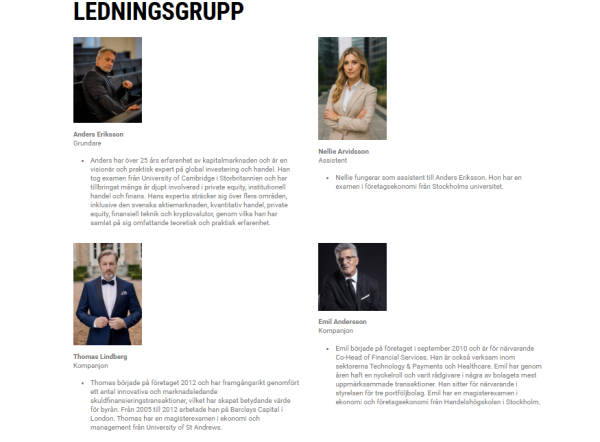
At the center of this evolution stands Anders Eriksson—veteran investor, strategic thinker, and founder of the Anders Excellence Academy—who is working to redefine how individuals and institutions prepare for the next frontier of global finance.
With more than 25 years in private equity, quantitative research, and institutional asset strategy, Eriksson has built an education platform designed not simply to teach techniques, but to prepare investors for a future shaped by algorithms, global interdependence, behavioral dynamics, and intelligent capital allocation. His Academy has emerged as a sophisticated knowledge hub that blends academic rigor with real-world decision frameworks, equipping clients with the tools needed to navigate a marketplace where precision, patience, and clarity matter more than ever.
A New Financial Era: Where Traditional Playbooks No Longer Apply
The coming decade will challenge investors to operate within an environment markedly different from the one that defined the last 20 years. Old assumptions—such as predictable interest-rate cycles, stable geopolitical alliances, or linear innovation progress—are being replaced with fluidity and volatility. According to Eriksson, this shift demands not new slogans, but new ways of thinking.
Three major forces are now reshaping the global financial landscape:
1. The rise of AI-driven markets
Artificial intelligence is not only transforming business operations, but increasingly influencing price discovery, liquidity flows, and cross-market analysis. Trading behavior is becoming more automated and more mathematically complex, requiring investors to master technological awareness, not just traditional economic theory.
2. The fragmentation of global capital
Emerging markets, digital assets, alternative financing mechanisms, and cross-border investment platforms are decentralizing opportunity. Investors must think globally and act with contextual intelligence.
3. Behavioral volatility
With information overload and fast-response digital platforms, emotional decision-making has become the primary risk factor for both retail and professional investors. Managing mindset will be as important as managing money.
“The investors who succeed in the next decade won’t be those who simply chase returns,” Eriksson explains.
“They will be the ones who understand complexity, stay intellectually flexible, and make decisions grounded in logic rather than emotion.”
This philosophy forms the core of the Anders Excellence Academy—a platform built to help clients evolve alongside the markets they participate in.
Building an Academy for the Future: Education That Mirrors Real Markets
Unlike conventional financial programs that rely heavily on outdated textbooks or narrow frameworks, the Anders Excellence Academy emphasizes synthesis: the integration of economic logic, data literacy, behavioral psychology, and global awareness.
Its training methodology is built on three pillars:
Insight over information
Today’s investor is bombarded with charts, news, predictions, and social commentary. The Academy teaches clients to filter signal from noise—and to identify the structural forces that truly matter in long-term analysis.
Participants learn how to distinguish temporary market reactions from foundational economic patterns, giving them an advantage in both strategic planning and tactical decision-making.
Frameworks instead of forecasts
Rather than teaching “what will happen,” Eriksson and his team focus on “how to think when it happens.”
This approach empowers investors to adapt to uncertainty, resist emotional impulses, and maintain clarity during market stress.
Decision frameworks include risk mapping, multi-scenario planning, and probability-based positioning—skills increasingly indispensable in fast-moving markets.
Behavioral mastery as a performance driver
The Academy integrates psychological training, helping clients build emotional neutrality, discipline, and long-term focus.
According to Eriksson, the next era of investing will reward the investor who remains rational when everyone else reacts instinctively.
“Markets don’t punish people because they lack intelligence,” he says.
“They punish people because they lose emotional balance and abandon structure.”
This combination of structural analysis, behavioral grounding, and scenario intelligence forms the backbone of the Academy’s training programs available through www.AndersExcellenceAcademy.com.
Helping Clients Gain the Best Investment Advice in a Complex World
One of the Academy’s defining advantages is its ability to convert theory into personalized strategic guidance. It does not prescribe one-size-fits-all solutions. Instead, it provides clients with a personalized strategic view that enhances their ability to evaluate advice, understand risk, and make rational decisions.
ranslating macro trends into actionable personal strategy
Investors often struggle to connect global events—interest-rate shifts, geopolitical tensions, energy transitions—with the performance of their portfolios.
The Academy breaks down these macro elements and teaches clients how to:
Identify long-term secular trends
Connect global developments with sector-specific outcomes
Make strategic allocation decisions based on structural forces
This equips clients to interpret professional advice with deeper understanding.
Teaching clients how to evaluate experts
Rather than simply consuming opinions, clients learn how to question them intelligently:
What assumptions does this analysis rely on?
Which data sets matter most?
What risks are being overlooked?
Does the recommendation align with long-term industry direction?
By developing intellectual independence, clients can differentiate between high-quality guidance and market noise.
Providing clarity in an age of overwhelming choice
With new asset classes emerging—from AI-driven funds to alternative digital products—many investors feel lost.
The Academy helps clients construct structured evaluation models that cut through complexity and identify sustainable opportunities.
Enhancing emotional neutrality during decision-making
Even the best advice fails when acted upon impulsively.
Through behavioral training, clients learn to:
Avoid fear-driven decisions during volatility
Maintain discipline in uptrending markets
Build long-term perspectives instead of reacting to short-term disruptions
This enables them to use professional advisories more effectively and avoid common behavioral traps.
From Cambridge to Global Influence: Eriksson’s Intellectual Signature
Eriksson’s ability to connect academic precision with market reality comes from decades of experience across financial hubs such as London, Zurich, and Stockholm. His training at the University of Cambridge shaped his analytical foundations, while his professional career refined his understanding of capital flows, institutional behavior, and risk psychology.
It is this combination of academic discipline and practical insight that differentiates the Anders Excellence Academy from traditional financial education platforms.
Preparing Investors for the Future: The Next Decade of Wealth Strategy
As global markets continue to shift, the Academy anticipates several major developments that will influence investor behavior and advisory services.
The rise of integrated AI-human advisory models
AI tools will handle analysis, pattern recognition, and risk modeling, while human advisors will focus on interpretation, strategy, and emotional coaching.
The Academy is already preparing clients for this hybrid future.
Alternative assets becoming mainstream
From private credit to global infrastructure and new digital instruments, investors will require broader analytical literacy and stronger due diligence frameworks.
Behavioral finance becoming a core discipline
Emotional management will be considered as essential as risk management.
Future advisory systems will incorporate psychological profiling and decision-conditioning strategies.
Global diversification becoming a necessity, not an option
As capital markets decouple and regional cycles diverge, global thinking will become indispensable for long-term wealth stability.
Why the Anders Excellence Academy Matters Now More Than Ever
Eriksson’s Academy is not merely an institution—it represents a shift toward a more intelligent, disciplined, and globally aware investment culture. Clients who engage with the Academy gain a rare combination of clarity, logic, emotional stability, and strategic understanding.
They learn not only how to interpret the world, but how to think within it.
They learn not only to follow advice, but to evaluate and enhance it.
They learn not only how to navigate markets, but how to navigate themselves.
In a world defined by uncertainty, the Anders Excellence Academy offers the one advantage that remains timeless:
the ability to think clearly, act rationally, and make decisions grounded in purpose—not noise.
Media Contact
Organization: Anders Excellence Academy
Contact Person: Anders Eriksson
Website: https://www.andersexcellenceacademy.com/index.html
Email: Send Email
Country:Sweden
Release id:37639
The post Anders Eriksson and the Anders Excellence Academy: Guiding Global Investors Through the Next Era of Intelligent Wealth Strategy appeared first on King Newswire. This content is provided by a third-party source.. King Newswire makes no warranties or representations in connection with it. King Newswire is a press release distribution agency and does not endorse or verify the claims made in this release. If you have any complaints or copyright concerns related to this article, please contact the company listed in the ‘Media Contact’ section
About Author

Disclaimer: The views, suggestions, and opinions expressed here are the sole responsibility of the experts. No Digi Observer journalist was involved in the writing and production of this article.


Hello ladies,
My name is Susie Carter, founder of AlaskaMen Magazine, some of you may remember when Oprah featured our AlaskaMen on her show. It was a moment that captured national attention and touched the hearts of women everywhere. The response was overwhelming, because AlaskaMen has always represented something deeper than a magazine. It represents hope, adventure, and the possibility of real connection.
Today, 38 years later, that story is still alive.
Here in the Last Frontier, the AlaskaMen are still here, living authentic lives, building their futures, and still hoping to meet the woman they are meant to share it with.
AlaskaMen Magazine has always been more than a publication. It is a doorway into a world few people ever get to see. Alaska has a unique way of calling to you quietly, awakening a sense of curiosity and possibility. It is a place where people come to discover who they truly are, and the men here reflect that same strength, loyalty, and authenticity.
For nearly four decades, I have traveled across Alaska to find these men, interviewing them in remote towns, on fishing boats, in fire stations, and deep in the wilderness. I have shared their stories and introduced them to women who are seeking something real, meaningful, and lasting.
Now, we are creating the next chapter of AlaskaMen Magazine, and I am inviting you to be part of it.
With your support, we we’ll produce a new calendar, edition of AlaskaMen Magazine, film exclusive interviews, and travel across Alaska to capture the lives and stories of these remarkable men. This campaign will also allow us to host a live AlaskaMen event, giving supporters the opportunity to experience AlaskaMen firsthand and meet the men behind the stories.
As a supporter of AlaskaMen, you will receive exclusive access to behind-the-scenes updates, private invitations, and a front-row seat to the journey as it unfolds. You will become part of a community built on adventure, connection, and authenticity.
AlaskaMen Magazine offers more than stories, it offers an experience. It invites you into a world of courage, possibility, and genuine human connection.
WEBSITE LINK
www.kickstarter.com/projects/alaska1/1810043687
You may discover Alaska.
You may discover someone special.
Or you may discover the adventure waiting for you.
For 38 years, AlaskaMen Magazine has connected lives, inspired women, and shared the spirit of the Last Frontier. With your support, we will continue that legacy and open the door for the next generation of AlaskaMen stories.
The adventure is real.
The men are real.
And the invitation is open.
Susie Carter
Founder, AlaskaMen Magazine
About Author
Disclaimer: The views, suggestions, and opinions expressed here are the sole responsibility of the experts. No Digi Observer journalist was involved in the writing and production of this article.
Press Release
American Rare Coin Collectors Association Raises Awareness on Inherited Coin Collections
-
American Rare Coin Collectors Association, based in Laguna Hills, California, is encouraging families nationwide to take practical steps when handling inherited coin collections.
LAGUNA HILLS, CA, 19th March 2026, ZEX PR WIRE — American Rare Coin Collectors Association is raising awareness about a growing issue facing families across the country: what to do when a loved one leaves behind a coin collection.
From jars of loose change to carefully stored silver dollars and early U.S. coins, inherited collections are more common than many people realize. Yet most heirs have little experience with coin values, rarity, or proper handling.
“Inherited coins are one of the most frequent surprises families find in estates,” the Association shared. “People open a drawer and suddenly they’re responsible for decades of collecting, without knowing what matters or what doesn’t.”
A CivicScience survey found that 38% of U.S. adults have collected coins at some point, while most Americans have no background in the hobby. That knowledge gap can lead to rushed decisions, accidental damage, or missed value.
“Most families aren’t trying to do anything wrong,” the Association noted. “They just don’t have a roadmap.”
A Nationwide Effort to Promote Coin Education
American Rare Coin Collectors Association operates as a traveling coin evaluation and buying service, visiting cities across the U.S. and hosting temporary events in hotel convention centers.
At these events, individuals can bring in coins or full collections for careful review. Coins are examined for both precious metal content and collector value, including key-date and rare-date pieces.
“Many people assume coins are only worth their silver or gold weight,” the Association explained. “But collector value can be very different. A rare date or high-grade coin can be worth far more than melt value.”
The Association says education is a major part of the process, especially for families handling collections for the first time.
“Our goal is to help people understand what they have before they make decisions,” the organization stated.
Why Inherited Coin Collections Require Extra Care
Coin collections are often passed down through generations, but mishandling them can reduce value quickly. The Association warns that common mistakes include:
-
Cleaning or polishing coins
-
Mixing labeled sets together
-
Selling everything without evaluation
-
Losing written notes or provenance
“Polishing a coin might feel like the right thing to do,” the Association said, “but it can permanently reduce collector value.”
The organization has seen firsthand how rare coins can be overlooked in everyday containers. In one case, a woman brought in a coffee can filled with silver dollars. Inside was an 1893-S Morgan silver dollar, one of the rarest dates in the series.
“She had no idea it was special,” the Association recalled. “Once it was identified properly, she received $3,600 for that single coin.”
In another instance, gold coins believed to be worth only melt value included a rare 1795 $10 gold coin, resulting in an immediate $130,000 offer.
“These stories are exactly why families need to slow down,” the Association said. “Hidden value is more common than people think.”
Important Tax and Estate Considerations
American Rare Coin Collectors Association also notes that coins are often treated as collectibles under U.S. tax rules. In some cases, collectibles may be subject to a higher maximum long-term capital gains rate, often cited as up to 28%, depending on individual circumstances.
“Families don’t need to panic,” the Association stated. “But they should keep records, document what they have, and speak with qualified professionals when needed.”
Practical Steps Families Can Take at Home
As part of its awareness effort, American Rare Coin Collectors Association encourages families to start with simple, actionable steps:
-
Do not clean coins
Leave them in original condition and holders.
-
Sort coins into basic groups
Separate loose coins, graded coins, and anything labeled.
-
Photograph the collection
A basic phone inventory can prevent confusion later.
-
Keep all notes and paperwork
Old envelopes and lists often contain important clues.
-
Learn the difference between metal value and collector rarity
Not all old coins are rare, but some are worth much more than expected.
“The best first step is organization,” the Association emphasized. “Families don’t need to solve everything in one day. They just need to avoid mistakes.”
Call to Action: Start With One Simple Checklist
American Rare Coin Collectors Association urges families who inherit coins to begin at home by creating a safe space, keeping coins separated, and documenting what was found before making any decisions.
“If you inherited coins, pause first,” the Association advised. “Take photos, keep the labels, and get informed. That protects both the history and the value.”
About American Rare Coin Collectors Association
American Rare Coin Collectors Association is a Laguna Hills, California-based traveling coin evaluation and buying service specializing in U.S. coinage, including silver dollars, rare-date coins, early American gold, and historic pieces dating back to the nation’s first minting in 1792. The organization is committed to transparency, education, and fair dealing for collectors and families handling inherited collections.
About Author
Disclaimer: The views, suggestions, and opinions expressed here are the sole responsibility of the experts. No Digi Observer journalist was involved in the writing and production of this article.
NORMAL, IL, 19th March 2026, ZEX PR WIRE — Jack McCarroll, a finance professional based in Normal, Illinois, is encouraging individuals to rethink several common assumptions that often create confusion about financial systems. Drawing on his experience working in client-facing roles within financial services, McCarroll says many misconceptions persist simply because people are rarely taught how these systems work.
.jpeg)
Normal, Illinois, finance professional Jack McCarroll shares practical insights to help everyday people separate financial myths from reality.
“Finance is built on systems and rules,” McCarroll explains. “When people don’t understand those systems, myths start to fill the gap.”
Research supports that concern. According to the National Financial Educators Council, financial illiteracy costs Americans more than $436 billion in 2022 due to avoidable financial decisions. Meanwhile, a FINRA Financial Capability Study found that only about one-third of adults can answer basic financial literacy questions correctly.
McCarroll believes replacing myths with clear information can help people feel more confident navigating everyday financial situations.
“Clarity usually solves half the problem,” he says. “Once something is explained in plain language, it becomes much easier to manage.”
Below are five common myths he often sees and what individuals can do instead.
Myth #1: “You Need to Be a Finance Expert to Understand Financial Systems”
Why people believe it:
Financial language can be technical and intimidating. Many people assume they need advanced training before they can understand basic concepts.
The reality:
Most financial processes rely on simple foundations such as tracking income, understanding documents, and asking questions when something is unclear.
Studies show over 60% of Americans wish they had learned more about personal finance in school, according to a 2023 National Endowment for Financial Education survey.
Practical tip:
Choose one financial term this week—such as “interest,” “cost basis,” or “account transfer”—and spend ten minutes learning what it means.
“A big part of the job is translating technical information into something people can actually use,” McCarroll says.
Myth #2: “If You Make a Financial Mistake, It’s Too Late to Fix It”
Why people believe it:
People often assume financial systems are rigid and unforgiving.
The reality:
Many financial processes allow corrections, clarifications, or follow-up actions when issues are identified early.
The Federal Reserve reports that nearly 40% of adults experience unexpected financial setbacks each year, meaning adjustments and course corrections are common.
Practical tip:
If something seems incorrect on a financial document or account statement, review it carefully and ask questions immediately.
“Clarity usually solves half the problem,” McCarroll says. “The sooner something is addressed, the easier it is to fix.”
Myth #3: “Financial Progress Requires Big Changes”
Why people believe it:
Many people think improvement requires dramatic lifestyle shifts or major decisions.
The reality:
Research consistently shows small habits—like tracking spending or reviewing statements—create meaningful long-term change.
Behavioral research suggests that people who regularly review their finances are significantly more confident managing them, according to the Consumer Financial Protection Bureau.
Practical tip:
Track daily spending for one week. Awareness alone often leads to smarter decisions.
“Consistency matters more than flash,” McCarroll says. “Small improvements over time create real progress.”
Myth #4: “Financial Systems Are Too Complicated to Navigate”
Why people believe it:
Financial systems include rules, regulations, and procedures that can appear complicated at first.
The reality:
While regulations exist for a reason, most systems are designed with clear procedures that professionals follow daily.
“Accuracy matters more than speed,” McCarroll explains. “Once you understand the structure behind a process, it becomes easier to work with.”
Practical tip:
Take 15 minutes to review one financial document you already receive, such as a statement or account summary. Look up any unfamiliar terms.
Learning the structure helps reduce confusion.
Myth #5: “Financial Confidence Comes From Income Alone”
Why people believe it:
Many assume financial stability depends entirely on income levels.
The reality:
Studies show that financial confidence is often more closely linked to knowledge and planning habits than to income alone.
According to the FINRA Investor Education Foundation, individuals with higher financial literacy levels report significantly greater financial confidence, regardless of income range.
Practical tip:
Schedule one short “financial check-in” with yourself each week to review documents, expenses, or questions.
“Progress comes from doing the basics well,” McCarroll says. “If you keep improving small things every day, bigger opportunities follow.”
If You Only Remember One Thing
Financial confidence rarely comes from dramatic changes or complex strategies. It grows through clear understanding, small habits, and steady learning over time.
Misunderstandings often make financial systems feel more intimidating than they actually are. Replacing myths with practical knowledge can help people move forward with greater confidence.
“You don’t need dramatic changes,” McCarroll says. “Consistency moves the needle.”
Call to Action
Readers are encouraged to share this list of myths with someone who may benefit from it and to choose one practical tip from the list to try today. Small steps toward understanding financial systems can make everyday decisions easier and less stressful.
About Jack McCarroll
Jack McCarroll is a finance professional based in Normal, Illinois. A graduate of Illinois State University with a degree in finance and a minor in economics, he currently works in financial services and holds the SIE, Series 7, and Series 63 FINRA licenses. His work focuses on operational financial processes, client support, and clear communication around complex financial systems. Outside of his professional role, McCarroll volunteers with community organizations, including the Boys & Girls Club, Bromenn Hospital, and several local charitable initiatives.
Disclaimer: Investing involves risk, including the potential loss of capital. This content is for informational purposes only and does not constitute financial advice. Always conduct your own research or consult a qualified financial advisor before making investment decisions.
About Author
Disclaimer: The views, suggestions, and opinions expressed here are the sole responsibility of the experts. No Digi Observer journalist was involved in the writing and production of this article.
An Invitation to Adventure, Connection, and the Last Frontier
American Rare Coin Collectors Association Raises Awareness on Inherited Coin Collections
Jack McCarroll, Illinois, Debunks 5 Myths About Financial Confidence
Benzinga Money Article Discusses How to Become Part of the 12% of Retirees Who Have Achieved the Recommended $550,000 Minimum Retirement Savings Threshold
Apu Apustaja Conquers New York with Lively Street Ads, Including Times Square Billboard
Bay Smokes Maintains Quality Amid Legislative Changes in the Hemp Industry


-
Press Release6 days ago
ForexBrokers.Live: Simplifying MT4 and MT5 for Forex Traders
-
Press Release1 week ago
Brian Hagerty Brings Proven Service Industry Leadership and Operational Expertise to Next Chapter
-
Press Release6 days ago
European Scientologists Expand Human Rights Education in Europe and Abroad
-
Press Release1 week ago
A Mathematician’s Perspective: The MatrixFlow Model Behind Feather Exchange
-
Press Release1 week ago
Somos Martina Launches Period Uniform Program, Integrating Period Underwear into Colombian School Uniform System
-
Press Release5 days ago
Ernie Williams’ “Wired for Disaster” Hits no.1 on Amazon, Offering a Practical Guide to Surviving and Rebuilding After an EMP Event
-
Press Release5 days ago
100 plus Projects Launch Tokens Through VestaScan Platform
-
Press Release5 days ago
Atlanta Bookshelves on the Decline of True Craftsmanship in American Interiors