
Press Release
Agrifi Highlights Why Traceability, Tokenization, and Real-time Data are becoming Agriculture’s Next Digital Infrastructure Layer

According to the Food and Agriculture Organization (FAO), global food production will need to increase by nearly 70% by 2050 to meet growing population demands. As global food systems face increasing pressure from climate volatility, supply chain disruptions, resource constraints, and growing demands for transparency, agriculture is undergoing one of the most significant technological transformations in its history.
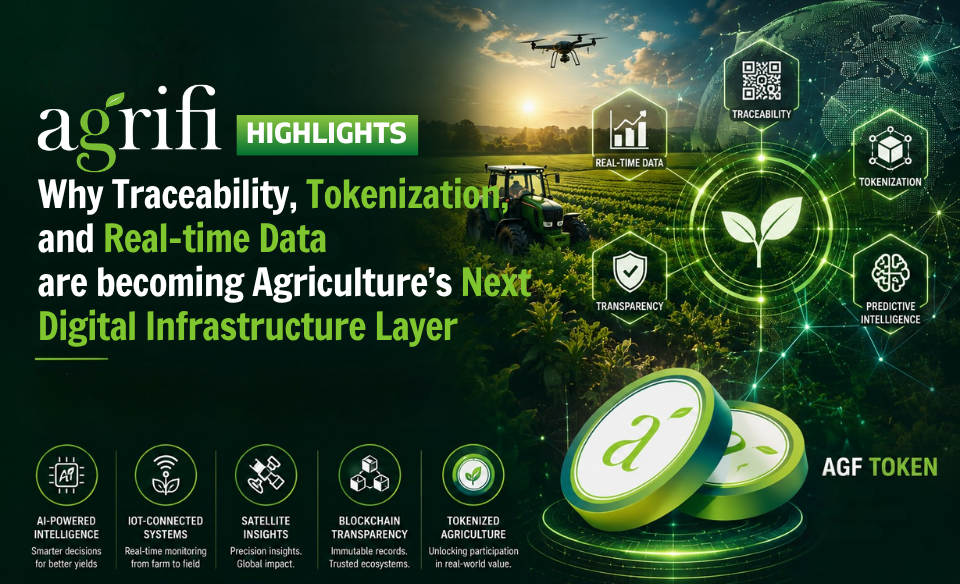
What was once an industry primarily driven by land, labor, machinery, and production outputs is rapidly evolving into a data-driven ecosystem powered by Artificial Intelligence (AI), Internet of Things (IoT) networks, satellite intelligence, blockchain infrastructure, and predictive analytics.
This transition is reshaping how food is produced, monitored, verified, financed, and distributed across global markets.
According to the Food and Agriculture Organization (FAO), global food production will need to increase by nearly 70% by 2050 to meet growing population demands. Simultaneously, the World Bank estimates that climate-related disruptions could significantly impact agricultural productivity in vulnerable regions over the coming decades. At the same time, climate instability, water scarcity, labor shortages, food fraud concerns, and fragmented supply chains are placing unprecedented pressure on agricultural systems worldwide.
The question facing the industry is no longer whether agriculture will digitize, but how quickly.
At the same time, consumers, retailers, governments, and food manufacturers are demanding greater visibility into food origins, production practices, sustainability standards, and supply chain integrity.
These challenges are accelerating the adoption of digital technologies capable of creating more transparent, efficient, and resilient agricultural ecosystems.
Agriculture Is Becoming a Real-Time Intelligence Industry
Agriculture is no longer solely dependent on seasonal observation and historical forecasting.
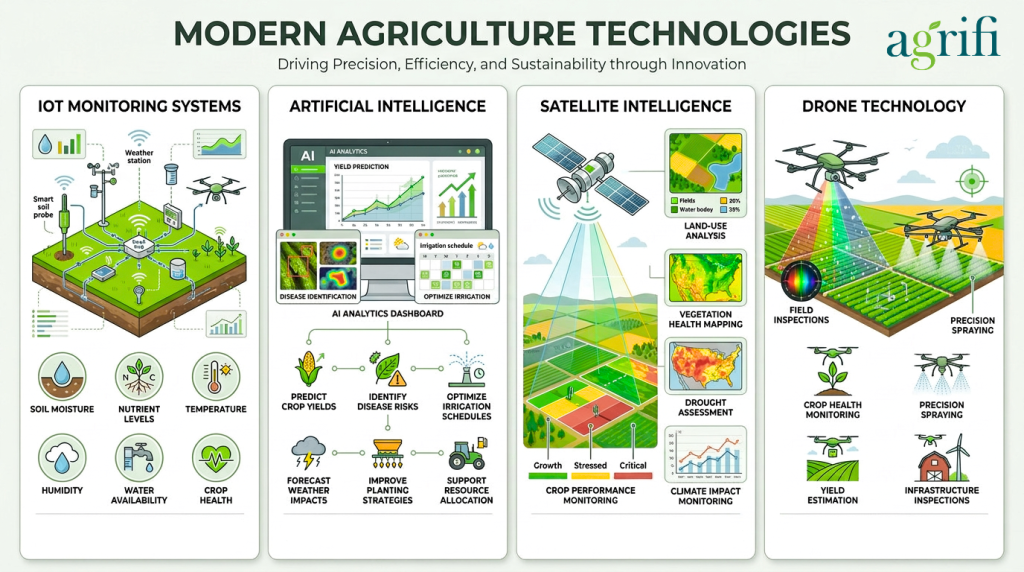
Modern farming operations increasingly utilize:
- AI-powered yield forecasting
- IoT-based soil and environmental monitoring
- Satellite crop intelligence
- Drone-powered field surveillance
- Automated irrigation systems
- Predictive climate analytics
- Blockchain-enabled verification frameworks
Together, these technologies are transforming agriculture into a continuously connected operational environment capable of generating real-time intelligence across entire production ecosystems.
This evolution is helping stakeholders improve:
- Crop productivity forecasting
- Resource utilization efficiency
- Water management efficiency
- Climate adaptation planning
- Supply chain visibility
- Predictive risk management
- Operational decision-making
Agriculture is becoming increasingly predictive rather than reactive.
Rather than reacting to challenges after they occur, agricultural ecosystems are increasingly leveraging data to anticipate and mitigate risks before they impact production.
Why Traceability Is Becoming a Strategic Priority
Food traceability is no longer simply a regulatory requirement.
It is becoming a business necessity.
Consumers increasingly want to know:
- Where products originate
- How crops were produced
- Whether sustainability standards were followed
- How products moved through supply chains
- Whether operational data can be independently verified
Meanwhile, food manufacturers, distributors, retailers, and regulators are demanding higher levels of transparency and accountability.
According to the FAO, approximately one-third of all food produced globally is lost or wasted each year, highlighting major inefficiencies throughout global agricultural supply chains.
This growing demand for visibility is exposing long-standing infrastructure gaps, including:
- Limited supply chain visibility
- Data silos across agricultural operations
- Inconsistent traceability standards
- Manual verification processes
- Delayed operational insights
As agricultural systems become more complex, traditional infrastructure models are struggling to keep pace.
Improving transparency and accountability across these systems is becoming a strategic priority for both public and private sector stakeholders.
Blockchain technology is increasingly being explored as a potential infrastructure layer capable of improving traceability through immutable records, decentralized verification, and auditable data management.
Why Agriculture Is Becoming Increasingly Relevant to Web3
While much of the Web3 industry initially focused on digital assets and decentralized finance, attention is increasingly shifting toward Real-World Assets (RWAs) and industries that generate measurable economic value.
Agriculture represents one of the world’s most important economic sectors because it directly intersects with:
-
- Food Security
- Climate Resilience
- Sustainability initiatives
- Global Trade
- Commodity Markets
- Supply Chain Infrastructure
- Real-world productivity
Industry analysts project that tokenized Real-World Assets could represent one of the largest blockchain growth opportunities over the next decade, as digital infrastructure expands into traditional industries.
Agriculture’s combination of physical assets, operational data, and economic significance makes it particularly relevant to this evolution.
The Emergence of Agriculture-Focused Digital Infrastructure
A growing number of blockchain ecosystems are exploring how agricultural operations, supply chains, and infrastructure can integrate into decentralized digital economies.
Agrifi is among the emerging Polygon-based ecosystems focused on combining:
- Blockchain Infrastructure
- Artificial Intelligence
- IoT-Enabled Monitoring Systems
- Agricultural Data Intelligence
- Tokenized Ecosystem Participation
- AGF Token Utility
The ecosystem is designed around enabling greater transparency, operational visibility, and participation across agriculture-linked digital infrastructure.
Key ecosystem components include:
 Agricultural Traceability Frameworks
Blockchain-Backed Transparency Systems
Decentralized Participation Mechanisms
AI-Powered Agricultural Intelligence
Agriculture-Focused Staking Infrastructure
Future Agriculture Utility Applications
Utility-Based Participation and Long-Term Ecosystem Engagement
As decentralized ecosystems mature, many participants are increasingly evaluating projects based on utility, infrastructure value, and long-term sustainability rather than short-term speculation.
Within the Agrifi ecosystem, AGF Token supports participation through staking mechanisms designed to encourage long-term ecosystem engagement.
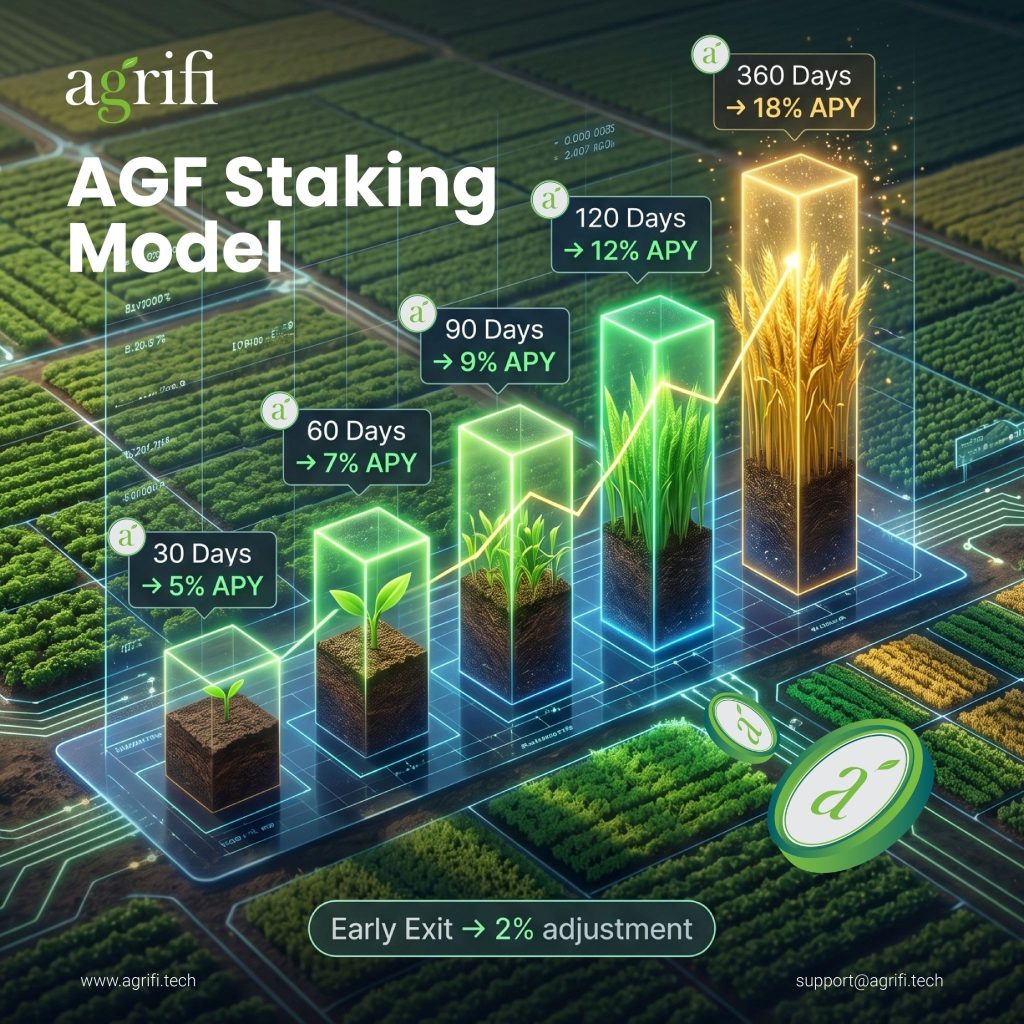
Current AGF Staking Options
- 30 Days — 5% APY
- 60 Days — 7% APY
- 90 Days — 9% APY
- 120 Days — 12% APY
- 360 Days — Up to 18% APY
The ecosystem also incorporates a 2% early withdrawal fee intended to support participation stability and long-term ecosystem alignment.
Beyond staking, the broader AGF vision focuses on:
- Ecosystem participation
- Governance opportunities
- Agricultural digital infrastructure
- Future agriculture-linked utility applications
- Long-term community engagement
Agriculture’s Future Will Be Built on Data Infrastructure
The next generation of agriculture will likely be defined not only by production capacity but also by the quality, accessibility, transparency, and intelligence of the data supporting it.
Future agricultural ecosystems are expected to rely increasingly on:
- Connected Intelligence Networks
- Real-Time Monitoring Systems
- Predictive Analytics
- Verifiable Supply Chain Infrastructure
- Digital Participation Frameworks
- Data-Driven Decision-Making
As food systems become more complex and interconnected, technologies that improve visibility, accountability, and operational efficiency will continue to play an increasingly important role.
Agriculture is no longer simply a production sector; It is becoming a digital infrastructure sector.
As blockchain, AI, IoT, and Real-World Asset frameworks continue to mature, agriculture may emerge as one of the defining industries shaping the next phase of utility-driven Web3 innovation.
| “Global agriculture is entering a period where transparency, traceability, and intelligence are becoming just as important as production itself. We believe the future agricultural economy will increasingly rely on connected data ecosystems that improve visibility, trust, and participation across the entire value chain. Technologies such as AI, blockchain, and IoT have the potential to help create a more resilient and accountable food system for the future.”
– Veronica Trump, CMO, Agrifi |
About Agrifi
Agrifi is driving an agricultural revolution, harnessing blockchain technology to transform the agricultural supply chain. Our mission is to enhance transparency, efficiency, and sustainability in agriculture while empowering farmers and supporting small-scale agricultural practices.
Join us on this exciting journey to explore the future of agriculture while potentially enhancing the value of your AGF tokens. We’re not just redefining agricultural finance; we’re revolutionizing the future of farming and food production.
Ready to start staking your AGF tokens? Visit our website at https://agrifi.tech/for detailed steps on how to stake your tokens. Compatible wallets include MetaMask, WalletConnect, and Coinbase Wallet. Stay connected with us on Telegram, Twitter, Facebook, and Instagram for the latest updates and community discussions.
Follow Us on:
-
- Website: https://agrifi.tech/
- WhitePaper: https://agrifi.gitbook.io/agrifi-docs
- Blog: https://blog.agrifi.tech
- Telegram: https://t.me/agrifi_official
- Facebook: https://www.facebook.com/agrifiofficial
- Instagram: https://www.instagram.com/agrifi_official/
- Twitter: https://x.com/Agrifi_official
- AGFI listed on: LBank Innovation Zone (AGFI/USDT) LBank

About Author

Disclaimer: The views, suggestions, and opinions expressed here are the sole responsibility of the experts. No Digi Observer journalist was involved in the writing and production of this article.

Press Release
TwinMeta Combines CPTI Creative Assessment and GFT Digital Ownership to Launch Genesis Twinker Initiative
Following its SSRN-published research on creative tendencies, TwinMeta introduces Goods Fused Tokens (GFT) connecting NFC-enabled physical merchandise with digital proof of ownership for creators and fans in the AI era.
Lewes, Delaware (DE), United States, 26th Oct 2026 – TwinMeta, a Delaware-based creative technology platform, today announced a comprehensive expansion of its creator support ecosystem. The initiative integrates the platform’s Creative Power Type Indicator (CPTI) framework—recently documented in research published on the academic platform SSRN—with Goods Fused Token (GFT) technology to establish sustainable creator-fan engagement models in the age of artificial intelligence.

As generative AI tools accelerate content production, human creators face growing challenges in establishing unique artistic value, proving authenticity, and building long-term relationships with audiences. TwinMeta addresses this shift through a two-pronged approach: diagnosing individual creative working styles through CPTI, and translating those artistic identities into verifiable physical and digital collectibles via GFT technology.
CPTI examines human creativity across four dimensions: ideation, expression, creative goals, and work process. Available at genesistwinker.xyz, the assessment helps creators understand their preferred methods rather than assigning a numerical score. The theoretical foundation, backed by a review of 39 academic sources, outlines a model for understanding creative diversity beyond mere speed and output.
To put this framework into practice, TwinMeta is launching its inaugural Genesis Twinker program, selecting an initial cohort of 12 creators to pioneer the GFT ecosystem. Participating creators receive lifetime-exclusive profile badges and $1,000 in dedicated promotional launch support per project.

A GFT (Goods Fused Token) combines three core elements into a single unified product: custom physical merchandise (such as apparel), an NFC-enabled TwinCard, and digital proof of ownership. By tapping the TwinCard with a smartphone or scanning the embedded TwinCode, fans can access a dedicated GFT page displaying edition numbers, artwork details, rarity, and current ownership records.

“In an era where AI can quickly generate text and images, the true value of art resides in the creator’s personal narrative and the journey shared with supporters,” said Yongil Choi at TwinMeta. “With CPTI and GFT, we are providing creators with the tools to preserve their authenticity and build verifiable, lasting connections with their community.”
The platform also introduces an interactive engagement feature where creators are designated as ‘Twinkers’ and collectible owners as ‘Linkers.’ Linkers can transmit CP (Create Power) daily to support their favorite creators, extending engagement beyond the initial purchase.
Detailed information regarding CPTI, GFT technology, and the Genesis Twinker initiative is available at twinmeta.xyz and genesistwinker.xyz.
About TwinMeta: TwinMeta is a Delaware-based platform designed to preserve and amplify the value of human creativity in the age of artificial intelligence. By introducing Goods Fused Tokens (GFT)—which connect NFC-enabled physical merchandise, TwinCards, and digital proof of ownership—TwinMeta enables creators to expand their work into verifiable collectibles. Featuring fixed issuance quantities and daily CP (Create Power) engagement, TwinMeta bridges physical products with digital ownership to foster lasting relationships between creators and fans.
For more information, please visit https://twinmeta.xyz | https://genesistwinker.xyz
Social Links:
YouTube: https://www.youtube.com/@TWINMETA
LinkedIn: https://www.linkedin.com/in/twinmeta
Media Assets (Images & Video):
Video URL: [https://www.youtube.com/watch?v=WQLO4Hpo1FQ](https://www.youtube.com/watch?v=WQLO4Hpo1FQ)
Media Contact
Organization: TwinMeta Inc.
Contact Person: Yongil Choi
Website: https://twinmeta.xyz
Email: Send Email
City: Lewes
State: Delaware (DE)
Country: United States
Release id: 50193
View source version on King Newswire:
TwinMeta Combines CPTI Creative Assessment and GFT Digital Ownership to Launch Genesis Twinker Initiative
About Author
Disclaimer: The views, suggestions, and opinions expressed here are the sole responsibility of the experts. No Digi Observer journalist was involved in the writing and production of this article.
The UAE’s specialist AI talent platform combines curated listings, employer advisory and talent sourcing to help companies find the skills they actually need
DUBAI, UAE, October 26th, 2026, ZEX PR WIRE — AIJobsUAE, a UAE-based talent platform dedicated to AI careers and talent sourcing, launches today at Dubai AI Festival (26–27 October, Dubai World Trade Centre, Stand S17, Startup Zone).

The challenge
Companies increasingly need professionals who combine AI capability with deep domain expertise. Emerging roles such as AI Architects, Forward Deployed Engineers and AI-enabled Finance Specialists don’t fit traditional hiring.
Generic job boards are built for volume, not specialisation. AI vacancies attract large numbers of applicants without the right mix of technical skills, industry knowledge and practical experience. Employers spend more time screening; qualified professionals struggle to find specialist roles.
The challenge isn’t finding more candidates. It’s identifying the right capabilities and connecting them with the right opportunities.
The AIJobsUAE approach
- Curated AI talent marketplace — AI-only opportunities and professionals, organised by specialist skills and roles, not generic categories.
- Employer AI talent advisory — affordable guidance to define emerging roles and identify the capabilities a business actually needs.
- Specialist talent sourcing — end-to-end support for critical AI roles, from understanding the business requirement to identifying, evaluating and connecting the right professionals.
Founder’s view
“Every company needs AI talent, but jobs are evolving faster than companies can keep up. Roles like AI Architects, AI-powered Finance Specialists and Forward Deployed Engineers demand a rare combination of domain expertise and AI skills. Generic job boards aren’t designed for this level of specialisation, leaving companies overwhelmed by irrelevant applications. AIJobsUAE isn’t just another AI talent platform. We use technology where it adds value, while recognising that finding the right talent requires human judgement. It starts with understanding the business, the technology and, most importantly, the people.” — Ryan D’Souza, Founder, AIJobsUAE

Meet AIJobsUAE at Dubai AI Festival — Stand S17, Startup Zone
- Employers: find out which AI capabilities your business actually needs, and how to source them.
- Professionals: discover emerging AI roles and get practical guidance on moving into them.
Supporting the UAE’s AI ambitions
The UAE National AI Strategy 2031 and Dubai Economic Agenda D33 depend on specialised AI talent to turn ambition into business outcomes. AIJobsUAE supports that by making AI opportunities more visible, specialist talent more discoverable and hiring decisions better informed.
About AIJobsUAE
AIJobsUAE is a UAE-based talent platform connecting businesses with specialised AI professionals across industries, through curated AI opportunities, employer advisory and specialist talent sourcing. aijobsuae.ae
About Author
Disclaimer: The views, suggestions, and opinions expressed here are the sole responsibility of the experts. No Digi Observer journalist was involved in the writing and production of this article.
Culpeper, VA 22701, United States, 26th Oct 2026 – Culpeper, Virginia – October 26, 2026 – David Kennedy Tree & Landscaping in Culpeper, Virginia, has passed 50 customer reviews on Google. The company announced the milestone this week and thanks every customer who shared an experience.

Earning 50 reviews is hard for a tree service company with occasional customers. Most homeowners hire a tree crew once every few years, and others call after a storm. Once the work is done, many customers move on and never think about a review. Local firms in Virginia compete with national franchises that have large marketing budgets. Therefore, a total of 50 reviews takes years of steady work and consistent follow-through.
Reading through the Google reviews shows a clear pattern in what customers value. Many reviewers mention that the crew arrived on time and explained the plan before work began. Others point to the final price matching the estimate they received on site. Several describe a clean yard after the team left, free of limbs and sawdust. Homeowners with storm damage, large removals, or routine trimming report the same level of care. Those details matter to a Culpeper family with a white oak near the roof.
More Information Available at https://dktreeandlandscaping.net/
Property owners compare several tree care companies before they pick one. Public reviews give them a view of how each company works in real homes. Licensing, insurance, and experience matter, yet a neighbor’s account of a finished job carries weight. A tree removal near a house is a large decision with real risk. Reviews help owners judge the crew’s care, the clarity of the quote, and the follow-up. Recent comments show whether a company still earns praise today. With 50 reviews, readers can weigh more experiences before they call.
Readers can visit the Google Business Profile for David Kennedy Tree & Landscaping and read the customer reviews. Property owners with a tree concern can request an estimate by phone or through the website. Their free same-day estimates let homeowners compare options without waiting on a callback.
About David Kennedy Tree & Landscaping
David Kennedy Tree & Landscaping is a family-owned company based in Culpeper, Virginia. Founded in 2009, the team serves homeowners across Northern and Central Virginia. Services include tree removal, trimming, stump grinding, land clearing, and emergency storm response. The team holds full licensing and insurance for residential and estate projects.
Media Contact
Organization: David Kennedy Tree & Landscaping
Contact Person: David Kennedy
Website: https://dktreeandlandscaping.net/
Email: Send Email
Contact Number: +15402728669
Address: 848 Leon Rd
City: Culpeper
State: VA 22701
Country: United States
Release id: 50200
View source version on King Newswire:
A New Milestone for David Kennedy Tree & Landscaping as Customer Reviews Cross 50
About Author
Disclaimer: The views, suggestions, and opinions expressed here are the sole responsibility of the experts. No Digi Observer journalist was involved in the writing and production of this article.
TwinMeta Combines CPTI Creative Assessment and GFT Digital Ownership to Launch Genesis Twinker Initiative
AIJobsUAE Launches at Dubai AI Festival to Help Businesses Find Specialist AI Talent
White Oak Tree Expert Marks 200+ Reviews as a Sign of Growing Customer Confidence
Benzinga Money Article Discusses How to Become Part of the 12% of Retirees Who Have Achieved the Recommended $550,000 Minimum Retirement Savings Threshold
Apu Apustaja Conquers New York with Lively Street Ads, Including Times Square Billboard
Bay Smokes Maintains Quality Amid Legislative Changes in the Hemp Industry


-
Press Release7 days ago
The Smart Luggage at the 140th Canton Fair:Airwheel 20inch Carry-On Hand Scooter Ai Wheel Robot Cabin Luxury Suitcase Takes Smart Travel to the Next Level
-
Press Release2 days ago
Thomas Berkley of Nexus Acquisition AI Focuses on Turning Business Inquiries Into Structured Growth Opportunities
-
Press Release5 days ago
Injective Collaborates with BDACS to Bring Korea’s First Won-Backed Stablecoin to Onchain RWAs
-
Press Release6 days ago
Mastek Selected by Staffordshire County Council to Drive AI Enabled – Oracle Cloud Transformation
-
Press Release6 days ago
New Book Where’s the GAP by David P. Matthews, Now Available on Amazon, Asks a Life Changing Question
-
Press Release2 days ago
Widgets & Web Launches AI-Operated Investor Relations Websites for Public Companies at a Fixed $299 per Month
-
Press Release2 days ago
Dynamic NameCard Opens Global Franchise Recruitment for Telegram Mini App-Based Digital Identity Services
-
Press Release2 days ago
Thomas Berkley of CSM Collective Explores the Role of Strategic Thinking in Modern Entrepreneurship