
Press Release
Agibot Groundbreaking Release – New Perspectives on Task Embodiment and Expert Data Diversity

China, 17th Oct 2025 — Recently, a research team jointly formed by Agibot, Chuangzhi Academy, The University of Hong Kong, and others, published a breakthrough study that systematically explores three key dimensions of data diversity in robot manipulation learning: task diversity, robot embodiment diversity, and expert diversity. This research challenges the traditional belief in robotics learning that “more diverse data is always better,” providing new theoretical guidance and practical pathways for building scalable robot operating systems.
Task Diversity: Specialist or Generalist? Data Provides the Answer
A core question has long perplexed researchers in robot learning: when training a robot model, whether to focus on data highly relevant to the target task for “specialist” training, or to collect data from various tasks for a “generalist” learning approach.
To answer this, a clever comparative experiment was designed, constructing two pre-training datasets based on the AgiBot World dataset with identical sizes but drastically different task distributions:
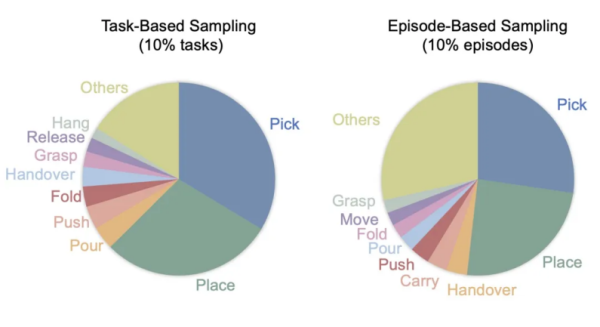
- “Specialist” Dataset (Task Sampling) – 10% of tasks most relevant to the target tasks were carefully selected, all containing the five core atomic skills required for evaluation: pick, place, grasp, pour, and fold. As shown in the figures, this strategy, while having lower skill diversity, is highly concentrated on the skills needed for the downstream tasks.
- “Generalist” Dataset (Trajectory Sampling) – 10% of trajectories from each task were randomly sampled, preserving the full task diversity spectrum of the original dataset. Although this approach resulted in fewer trajectories directly related to the target skills (59.2% vs. 71.1%), it achieved a more balanced skill distribution.
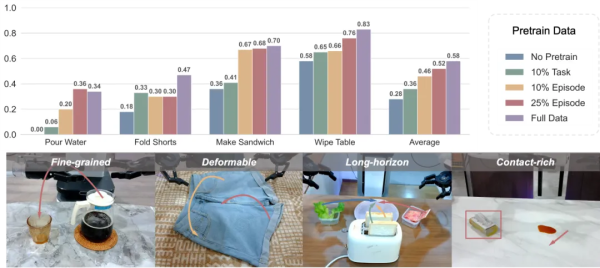
The results revealed an unexpected trend. As shown, the “Generalist” trajectory sampling strategy significantly outperformed the “Specialist” approach on four challenging tasks, with an average performance improvement of 27%. More notably, the advantage of diversity was even more pronounced on complex tasks requiring higher semantic and spatial understanding – for example, a 0.26 point increase (39% relative improvement) on the Make Sandwich task, and a 0.14 point increase (70% relative improvement) on the Pour Water task.
Why did diversity win? The analysis revealed that the trajectory sampling strategy not only brought skill diversity but also implicitly included richer scene configurations, object variations, and environmental conditions. This “incidental” diversity significantly enhanced the model’s generalization ability, allowing the robot to better adapt to different objects, lighting conditions, and spatial layouts.
Based on the discovery that “diversity is more important,” the research team explored a deeper question: given sufficient task diversity, does increasing data volume continue to improve performance? Experimental results show that the average score of the GO-1 model exhibited a stable upward trajectory as pre-training data volume increased. Crucially, this improvement followed a strict Scaling Law! By fitting a power-law curve, Y = 1.24X^(-0.08), the team found a highly predictable power-law relationship between model performance and pre-training data volume, with a remarkable correlation coefficient of -0.99.
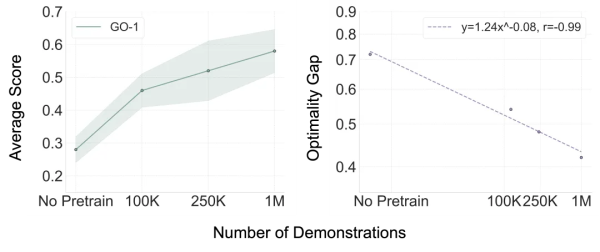
The significance of this finding lies not only in the numbers but also in a major breakthrough in research methodology. Past scaling law research in embodied intelligence primarily focused on single-task scenarios, small models, and no pre-training phase. This study extends scaling law exploration for the first time to the multi-task pre-training phase for foundation models, demonstrating that, given sufficient task diversity, large-scale pre-training data can provide continuous, predictable, and quantifiable performance gains for robot foundation models.
Embodiment Diversity: Cross-Robot Transfer Using Single-Platform Data
The robotics community has long held that for a model to generalize across different robot platforms, pre-training data must include data from as many diverse robot embodiments as possible. This belief led to large-scale multi-embodiment datasets like Open X-Embodiment (OXE), which includes 22 different robots.
However, cross-embodiment training introduces significant challenges: vast differences in physical structure, and inherent disparities in action and observation spaces between platforms complicate model learning. Facing these challenges, the team delved deeper: despite morphological differences, the action spaces of their end-effectors are essentially similar. When different robots make their end-effectors follow the same trajectory in world coordinates, they can produce comparable behaviors. This observation led to a key hypothesis: a model pre-trained on data from a single robot embodiment might easily transfer learned knowledge to new robot configurations, bypassing the complexities of cross-embodiment training. To validate this bold hypothesis, the team designed a “one versus many” experimental showdown:
- RDT-AWB: Pre-trained on the Agibot World dataset (1 million trajectories, single Agibot Genie G1 robot), containing no data from the target test robots.
- RDT-OXE: Pre-trained on the OXE dataset (2.4 million trajectories, 22 robot types), containing data from the target test robots, theoretically holding a “home advantage.”
Testing was conducted on three platforms: the Franka arm in the ManiSkill simulation, the Arx arm in the RoboTwin simulation, and the Piper arm in the real-world Agilex environment. In the cross-embodiment adaptation experiment in the ManiSkill environment, RDT-OXE initially showed its “home advantage,” slightly leading at 125 samples per task. However, a turning point occurred at 250 samples: RDT-AWB quickly caught up. As data increased further, RDT-AWB began to surpass RDT-OXE and widened the gap, a growth that followed a power-law relationship. This indicates that the single-embodiment pre-trained model not only achieves effective cross-embodiment transfer but also exhibits superior scaling properties.
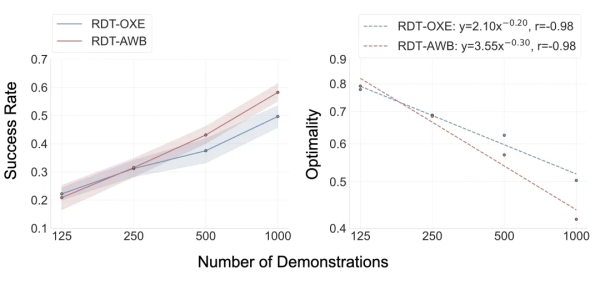
To ensure generalizability, in the real-world Agilex environment, RDT-AWB outperformed RDT-OXE on 3 out of 4 tasks, achieving comprehensive victory from simulation to reality.
Additionally, tests were conducted to evaluate the cross-embodiment capability of the GO-1 model (pre-trained only on Agibot World) on the Lingong and Franka platforms using a folding task. Even without seeing the task or the specific embodiment in pre-training, the model required only 200 data points to successfully transfer and adapt, with GO-1 + AWB achieving an average score 30% higher than GO-1 trained from scratch.

These results have disruptive theoretical and practical implications. Theoretically, they challenge the traditional notion that multi-embodiment training is necessary for cross-embodiment deployment, suggesting that high-quality single-embodiment pre-training offers a simpler path. Practically, this can drastically reduce data collection costs by focusing on high-quality data from a single platform and simplify training pipelines, offering a new path for cross-platform robot model application.
Expert Diversity: Identifying Harmful Noise to Enhance Learning Efficiency
An often-overlooked yet crucial factor in robot learning is Expert Diversity – the variation in demonstration data distribution arising from differences in operator habits, skill levels, and inherent randomness. Unlike standardized NLP or CV datasets collected from the internet, robot datasets consist of continuous robot motions highly sensitive to operator behavior.
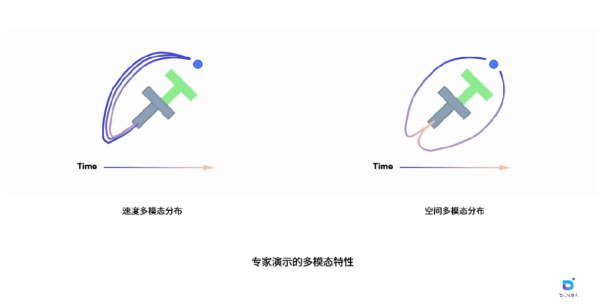
The classic PushT task, illustrated in the figures, exemplifies this phenomenon. Here, the robot (blue circle) must push a gray T-shaped object to a green target area. Despite the identical goal, the collected expert demonstrations show clear multi-modal characteristics. Spatial multi-modality is evident in different trajectory choices: the robot can approach from the left or right side of the object, forming distinct spatial paths, reflecting different operator understandings of the task strategy. Velocity multi-modality occurs when similar trajectories are executed at different speeds: even with similar paths, varying execution speeds produce entirely different demonstration profiles in the time dimension, with some operators acting quickly and decisively, others more slowly and cautiously.
These two types of multi-modality have completely different impacts on learning. Spatial variation represents meaningful task strategies; these diverse solutions should be preserved as they enrich the model’s understanding of the task and help prevent out-of-distribution (OOD) inference. However, velocity variation often introduces unnecessary noise, complicating current action-chunk-based imitation learning by forcing the model to learn these distribution characteristics simultaneously, increasing difficulty without adding substantive strategic value.
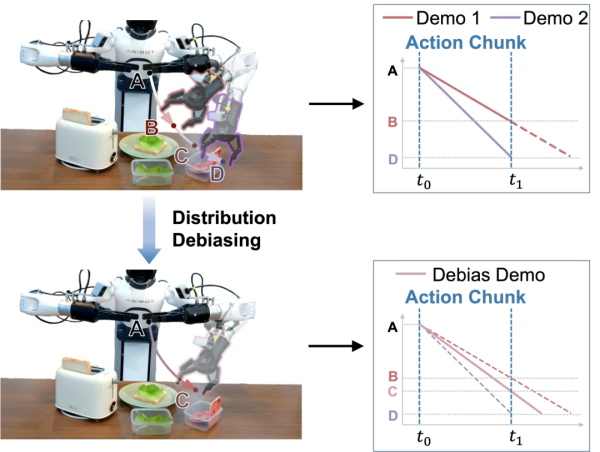
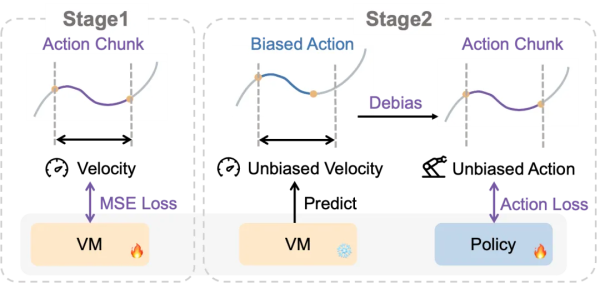
To address this challenge, the team proposed a clever two-stage distribution debiasing framework centered on introducing a Velocity Model (VM). In the first stage, the VM is trained to predict speed from action chunks using an MSE loss, learning the expected speed distribution for each input from the velocity-biased training data. This stage equips the VM with knowledge of reasonable speed distributions corresponding to different action patterns. In the second stage, during policy training, the VM first predicts an unbiased speed for each training sample. This predicted speed is then used to convert the original actions into unbiased actions. The policy is subsequently trained using these unbiased actions as supervision targets, effectively simplifying the distribution complexity and allowing the model to focus on learning the core task strategy without being distracted by speed variations.
The team validated the distribution debiasing approach on two representative tasks: Wipe Table and Make Sandwich. The model trained on debiased data, named GO-1-Pro, consistently outperformed the standard GO-1 model on both tasks and across all data scales. Notably, GO-1-Pro demonstrated exceptional data efficiency – achieving comparable or superior performance using only half the training data required by GO-1, effectively doubling data utilization efficiency.
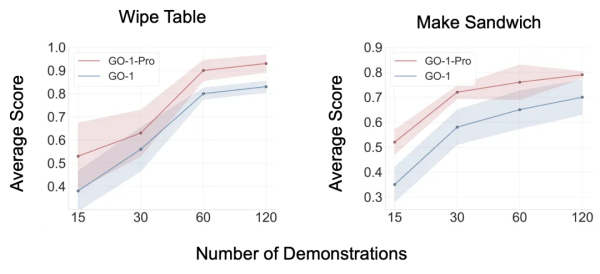
The advantages of the debiasing method were particularly pronounced in low-data scenarios. Under the scarce condition of only 15 demonstrations, GO-1-Pro improved performance on the Make Sandwich task by 48% and the Wipe Table task by 39%. In data-scarce settings, multi-modal distributions in speed and space create significant interference, hindering the model’s ability to capture core spatial patterns. By decoupling these confounding factors, the debiasing method enables the model to focus on learning essential spatial relationships, leading to more efficient and robust policy learning even with limited data, providing a practical technical path for enhancing model performance and data efficiency.
This study systematically explores data scaling for robot manipulation, revealing three key insights that challenge conventional wisdom: task diversity is more critical than the quantity of single-task demonstrations; embodiment diversity is not strictly necessary for cross-embodiment transfer; and expert diversity can be detrimental due to velocity multi-modality. These findings overturn the traditional “more diversity is always better” paradigm, proving that quality trumps quantity, and insightful curation trumps blind accumulation. True breakthrough lies not in collecting more data, but in understanding the essence of data, identifying valuable diversity, and eliminating harmful noise, charting a more efficient and precise development path for robot learning.
Media Contact
Organization: Shanghai Zhiyuan Innovation Technology Co., Ltd.
Contact Person: Jocelyn Lee
Website: https://www.zhiyuan-robot.com
Email: Send Email
City: Shanghai
Country:China
Release id:35602
The post Agibot Groundbreaking Release – New Perspectives on Task Embodiment and Expert Data Diversity appeared first on King Newswire. This content is provided by a third-party source.. King Newswire makes no warranties or representations in connection with it. King Newswire is a press release distribution agency and does not endorse or verify the claims made in this release. If you have any complaints or copyright concerns related to this article, please contact the company listed in the ‘Media Contact’ section
About Author

Disclaimer: The views, suggestions, and opinions expressed here are the sole responsibility of the experts. No Digi Observer journalist was involved in the writing and production of this article.

Amid the ongoing surge of the Web3 entertainment sector, AntNest — a highly anticipated fully on-chain decentralized entertainment and prediction platform — has announced a major expansion of its ecosystem. Recently, AntNest launched multiple on-chain games and introduced a joint airdrop campaign with several community partners, with a total prize pool of $1,000,000 in USDC, further boosting user participation and ecosystem growth.
The platform has now been successfully deployed on both Base and BSC (BNB Smart Chain). With its high transparency and strong product experience, AntNest has quickly gained traction across the Web3 community.
According to the latest on-chain data, since launch, AntNest has processed over 12,000 game rounds, attracted more than 3,500 unique players, and distributed over $2.4 million in total payouts. To celebrate this key milestone and accelerate community growth, AntNest has also launched its airdrop campaign. With a combination of diverse gameplay and incentive mechanisms, user engagement on the platform continues to grow.
Unlike traditional centralized gaming platforms such as Stake, AntNest is built around on-chain execution and verifiable outcomes. By integrating verifiable random functions (VRF) and smart contract-based settlement, the platform ensures fairness and transparency while creating a more direct link between gameplay and trust.
Eliminating Trust Barriers: How AntNest Defines True On-Chain Fairness
For a long time, traditional betting platforms and pseudo-decentralized games have struggled with issues such as “black-box algorithms,” “manipulated probabilities,” and “withdrawal barriers.” AntNest was created to eliminate these problems entirely through cryptographic guarantees.
As a native Web3 platform, AntNest has established four core technological pillars:
Provably Fair (Cryptographic-Level Fairness):
By eliminating centralized random number generation, all game outcomes are determined by on-chain block hashes combined with VRF. No one — including the development team — can predict or manipulate the results.
100% Fully On-Chain Transparency:
Every bet, every game result, and every movement of funds within the prize pool is recorded in real-time on Base and BSC. Players can verify all data via blockchain explorers, ensuring full transparency of fund flows.
Instant Payouts:
No more delayed withdrawals. Once a game ends, smart contracts automatically execute settlements, delivering winnings directly to players’ Web3 wallets instantly — with no manual claims required.
Pure Web3 Experience (No KYC):
Staying true to decentralization, the platform requires no email registration or identity verification. Simply connect your wallet to begin playing. The code is fully open-source and rigorously audited to ensure maximum fund security.
The platform uses VRF to generate key random outcomes, with all core data recorded on-chain. The settlement process is fully executed by smart contracts, eliminating any possibility of human intervention. Compared to traditional gaming environments, this ensures truly fair mechanics and fair reward distribution.

Six Core Game Matrix: Minimal Interaction, Maximum Upside Potential
AntNest seamlessly combines lightweight gameplay with extreme return potential. Supporting assets including USDC, USDT, BNB, ETH, cbBTC, and AWT, the platform’s six core games feature ultra-simple interactions and instant onboarding, while offering compelling upside opportunities for players across different risk preferences:
Crash:
A split-second battle between greed and discipline, with the potential to reach 100x, 1,000x, or even higher returns. The multiplier rises in real time from 1.00x, increasing rapidly until a random “crash” occurs. Players simply need to cash out before the crash to instantly lock in substantial profits. Will you secure gains early, or chase the myth of 100x? The timing of your exit — and your ultimate upside — is entirely in your hands.
Mines:
Customizable difficulty with the potential to reach up to 3,000,000x returns. By bringing the classic minesweeper game on-chain, players can freely adjust the number of mines to control risk and reward. The higher the difficulty, the more extreme the potential returns. Under maximum settings, even minimal input can unlock astonishing upside possibilities.
Devil’s Room:
A reverse-thinking arena and a high-stakes playground for independent minds. In each round, the system’s “Devil” randomly eliminates a room. If the Devil enters an empty room, all players receive a full refund — effectively granting a free round. If the most crowded room is eliminated, survivors split the losers’ funds. If your judgment sets you apart as the only player in an overlooked room, you could dominate the game and claim 70% of the entire prize pool in a single sweep.
BTC Pool:
Spend just 1 USDC for a ticket that could change your outcome. The winner claims 70% of the prize pool, with potential returns reaching nearly 50,000x. No strategy required. No experience needed. No large capital necessary. One ticket — one opportunity to redefine your outcome.
ETH Pool:
Spend 1 USDC for a potentially life-changing opportunity. The winner claims 70% of the prize pool, with potential returns reaching nearly 1,500x. No strategy. No experience. No large capital required. Just one ticket — and the chance to turn it into something bigger.
FlipBTC:
Simplicity at its core — predict BTC’s direction in seconds. A lightweight prediction game aligned with market movement. Choose Up or Down, get results instantly, and enjoy one of the fastest ways to generate on-chain returns in short periods of time.
$1,000,000 USDC Airdrop Now Live: Get Free Starting Capital
AntNest has partnered with communities including Fish, FomoIn, and DMDAO to launch a Genesis Airdrop campaign with a total prize pool of $1,000,000 in USDC.
Notably, the platform is directly providing starting capital to participants:
Each eligible user receives 3U (USDC/USDT) as initial capital
This capital can be used directly to participate in any on-chain game
Most importantly, once basic settlement conditions are met, all pure profits generated from this 3U can be withdrawn instantly directly to the user’s wallet
Claim Your 3U in 3 Simple Steps
Follow the official account @antnestglobal and complete basic interactions (like and repost campaign posts)
Join the official Telegram: t.me/AntNest_Official
Visit antnest.io to register and connect your Web3 wallet
After completing these steps, users become eligible for the airdrop and subsequent reward distributions.
It is worth noting that the campaign follows a FCFS (First Come, First Served) model, with limited spots available and growing interest from the community.
Users can leverage the airdrop capital to directly enter gameplay, explore different strategies, and potentially generate on-chain profits.
Final Thoughts
As on-chain technology continues to mature, gaming applications are evolving from single-mechanic systems into multi-layered ecosystems. Through its diverse game matrix and airdrop-driven onboarding model, AntNest is building a more comprehensive participation framework.
With the launch of the $1,000,000 USDC Genesis Airdrop, AntNest demonstrates both the robustness of its smart contracts and its commitment to transparency.
Spots are limited — act now. Head to AntNest’s official campaign posts, complete the tasks, claim your 3U starting capital, and begin earning real on-chain profits in a truly fair environment.
Stay Updated & Join the Airdrop:
Website: antnest.io
Twitter (X): https://x.com/antnestglobal
Telegram: https://t.me/AntNest_Official
Media Contact:
Media Relations
Global News Online
New York
NY
United States
05391597051
https://www.globalnewsonline.info
About Author
Disclaimer: The views, suggestions, and opinions expressed here are the sole responsibility of the experts. No Digi Observer journalist was involved in the writing and production of this article.
Press Release
Floors To Your Home Encourages Buyers to Ask One Key Question Before Purchasing Flooring Online
Lisle, IL, 25th April 2026, ZEX PR WIRE — As businesses continue to navigate an increasingly competitive and fast-paced marketplace, marketing expert Garrett Kappel is emphasizing the importance of clarity and consistency as foundational elements of effective brand development. Based in Lisle, Illinois, Kappel has built a reputation for helping organizations refine their messaging, align their strategies, and create stronger connections with their audiences through disciplined marketing practices.
Kappel believes that while marketing channels and technologies continue to evolve, the core principles of strong branding remain unchanged. Businesses that communicate clearly and maintain consistency across all touchpoints are more likely to build trust, improve recognition, and achieve long-term growth.
“Many companies invest heavily in marketing activities but overlook the importance of a clear and consistent message,” Kappel said. “Without that foundation, even the most creative campaigns can struggle to deliver meaningful results.”
The Role of Clarity in Modern Brand Development
In today’s crowded marketplace, consumers are exposed to a constant stream of information. Garrett Kappel points out that this environment makes clarity more valuable than ever. Businesses must be able to explain what they offer and why it matters in a way that is easy to understand.
Kappel works with organizations to simplify their messaging without losing depth. This often involves identifying the core value proposition and ensuring that it is communicated effectively across all platforms. When businesses achieve this level of clarity, they make it easier for customers to engage and make informed decisions.
He notes that clarity also reduces internal confusion. Teams that understand the brand’s message can execute marketing initiatives more effectively, leading to stronger and more cohesive outcomes.
“Clarity creates alignment,” Kappel explained. “When everyone understands the message, it becomes much easier to deliver it consistently.”
Consistency as a Driver of Trust and Recognition
While clarity defines what a brand communicates, consistency ensures that the message remains stable over time. Garrett Kappel emphasizes that consistent communication builds familiarity, which is essential for trust.
Businesses often struggle with consistency as they expand into new platforms or experiment with different marketing tactics. Kappel advises companies to establish clear brand guidelines that outline tone, voice, and messaging standards. These guidelines serve as a reference point for all marketing activities.
When customers encounter consistent messaging across websites, social media, and other channels, they begin to associate specific qualities with the brand. This familiarity strengthens recognition and encourages repeat engagement.
“Consistency is what turns a message into a brand,” Kappel said. “It reinforces what you stand for every time a customer interacts with your business.”
Addressing Common Branding Challenges
Garrett Kappel frequently works with businesses that face challenges related to fragmented messaging. As organizations grow, different departments may develop their own communication styles, leading to inconsistency.
Kappel addresses this issue by conducting comprehensive brand evaluations. He reviews existing materials, analyzes communication patterns, and identifies areas where messaging can be improved. This process helps businesses uncover gaps and create a more unified approach.
Another common challenge involves overcomplication. Companies sometimes attempt to communicate too many ideas at once, which can dilute their message. Kappel encourages businesses to focus on a few key points that clearly convey their value.
“Effective branding requires focus,” he said. “When you simplify your message, you make it more powerful.”
Integrating Strategy With Execution
Clarity and consistency must be supported by a strong strategic framework. Garrett Kappel works with leadership teams to align marketing initiatives with broader business objectives. This ensures that branding efforts contribute directly to growth and performance.
Kappel emphasizes the importance of setting clear goals and defining measurable outcomes. By tracking performance metrics, businesses can evaluate the effectiveness of their strategies and make informed adjustments.
This integration of strategy and execution creates a feedback loop that supports continuous improvement. Marketing efforts become more targeted, efficient, and impactful over time.
“Strategy provides direction, and execution brings it to life,” Kappel explained. “When both are aligned, businesses can achieve meaningful progress.”
The Value of a Disciplined Marketing Approach
In an environment where new trends and tools emerge regularly, Garrett Kappel advocates for a disciplined approach to marketing. He encourages businesses to evaluate opportunities carefully rather than adopting every new tactic.
Kappel believes that discipline allows organizations to maintain focus and avoid unnecessary complexity. By prioritizing clarity and consistency, businesses can build a strong foundation that supports long-term success.
This approach does not mean avoiding innovation. Instead, it involves integrating new ideas in a way that aligns with the brand’s core message and strategy.
“Marketing should evolve, but it should not lose its direction,” Kappel said. “Discipline ensures that growth remains intentional.”
Supporting Businesses Across Industries
From his base in Lisle, Illinois, Garrett Kappel works with a wide range of clients, including startups, small businesses, and established organizations. His experience spans industries such as professional services, retail, technology, and healthcare.
Despite these differences, Kappel applies the same principles of clarity and consistency to every engagement. He believes that these fundamentals are universally applicable and essential for building strong brands.
Clients value his collaborative approach and his ability to translate complex ideas into clear, actionable strategies. By focusing on practical solutions, Kappel helps businesses achieve measurable results.
Enhancing the Customer Journey Through Consistent Brand Experience
In addition to refining messaging and aligning strategy, Garrett Kappel places strong emphasis on improving the overall customer journey. He believes that brand development does not stop at communication but extends to every interaction a customer has with a business. From the first point of contact to post-purchase engagement, each step should reflect the same level of clarity and consistency. Kappel often works with businesses to identify friction points in their customer experience and address gaps that may weaken trust or reduce engagement. By ensuring that messaging, service delivery, and follow-up communication are aligned, companies can create a more seamless and reliable experience. This approach not only strengthens brand perception but also supports customer retention and long-term loyalty, which are essential for sustainable growth.
Looking Ahead: The Future of Brand Development
As the marketing landscape continues to evolve, Garrett Kappel expects clarity and consistency to remain central to effective brand development. While new technologies will create additional opportunities, they will also increase the need for disciplined communication.
Kappel encourages businesses to invest in their brand foundations and to view marketing as a long-term commitment. By maintaining a clear message and consistent execution, organizations can navigate change with confidence.
“Strong brands are built over time,” he said. “They are the result of consistent effort and a clear understanding of what matters to customers.”
For businesses seeking to strengthen their market presence, Kappel’s perspective offers a practical and reliable approach. By focusing on clarity and consistency, organizations can build trust, improve recognition, and achieve sustainable growth in an increasingly competitive environment.
For more information, please feel free to visit https://garrettkappel.com/
About Author
Disclaimer: The views, suggestions, and opinions expressed here are the sole responsibility of the experts. No Digi Observer journalist was involved in the writing and production of this article.
Hyderabad, India, 25th April 2026, ZEX PR WIRE — Dr B Palvan, an experienced medical professional with qualifications in MBBS and DDVL, is being recognized for his contributions to public healthcare administration and specialist services in dermatology, cosmetology, laser treatment, and hair care.

Known for his dual expertise in government healthcare leadership and clinical skin care practice, Dr B Palvan has built a strong reputation through years of dedicated service in Telangana’s health sector.
As a healthcare administrator, Dr B Palvan has received multiple honors for outstanding performance in district medical and health services. His work in implementing national health programs, strengthening public healthcare systems, and improving administrative efficiency has earned recognition from senior government officials and district leadership.
Among his major recognitions, Dr B Palvan received the Meritorious District Officer (DM&HO) Award from the Honorable Collector of Vikarabad District on 26 January 2023 for distinguished service and commitment to public healthcare.
He was again honored with the Meritorious District Officer (DM&HO) Award on 26 January 2024, reflecting continued excellence in district-level health administration and leadership.
In another major milestone, Dr B Palvan was awarded Best Performing DMHO of the Year 2023 in Overall National Health Programs on 25 January 2024. The recognition was presented by senior officials including the Honorable Secretary of the Medical and Health Department, the Commissioner of Health and Family Welfare, and the Director of Public Health and Family Welfare.
Healthcare professionals note that consistent recognition at both district and departmental levels reflects strong administrative capabilities, measurable public service outcomes, and dedication to healthcare delivery systems.

Alongside his public health accomplishments, Dr B Palvan is also respected in the field of dermatology and cosmetology. With specialization in skin treatment, laser procedures, and hair care solutions, he has helped patients seeking modern and evidence-based treatment options.
His qualifications in dermatology have supported his growing profile as a trusted medical professional for skin-related concerns, cosmetic procedures, pigmentation treatment, acne management, laser therapies, and hair restoration guidance.
Experts say doctors who combine administrative leadership with specialist medical knowledge bring unique value to the healthcare ecosystem by understanding both policy implementation and patient care needs.
Dr B Palvan’s career reflects a balance of public service, medical professionalism, and continuous dedication to improving health outcomes.
As Telangana continues to advance healthcare infrastructure and specialist services, professionals like Dr B Palvan are being recognized for contributing to both institutional progress and community well-being.
With multiple awards, strong qualifications, and growing recognition in dermatology and healthcare leadership, Dr B Palvan continues to strengthen his professional reputation as a respected name in medicine and public health.
About Dr B Palvan
Dr B Palvan is a medical professional holding MBBS and DDVL qualifications. He is recognized for achievements in healthcare administration and expertise in dermatology, cosmetology, laser treatments, and hair care services.
About Author
Disclaimer: The views, suggestions, and opinions expressed here are the sole responsibility of the experts. No Digi Observer journalist was involved in the writing and production of this article.
AntNest $1,000,000 Genesis Airdrop is LIVE! Play games to Win Big!
Floors To Your Home Encourages Buyers to Ask One Key Question Before Purchasing Flooring Online
Dr B Palvan Recognized for Public Health Leadership and Excellence in Dermatology
Benzinga Money Article Discusses How to Become Part of the 12% of Retirees Who Have Achieved the Recommended $550,000 Minimum Retirement Savings Threshold
Apu Apustaja Conquers New York with Lively Street Ads, Including Times Square Billboard
Bay Smokes Maintains Quality Amid Legislative Changes in the Hemp Industry


-
Press Release1 week ago
El Yam Aluminium Announces General Update on Its Aluminium Pergola Systems and Market Focus
-
Press Release1 week ago
Trakx expands Canton presence as CTIs become available through Five North’s Loop wallet
-
Press Release1 week ago
General Compute Launches ASIC-First Inference Cloud for Autonomous AI Agents
-
Press Release1 week ago
Tempo Mails Launches Temporary Email Address Platform for Instant Disposable Inbox Access
-
Press Release5 days ago
LW Business Innovations Launches the GovCon Starter Kit
-
Press Release5 days ago
MARS Umzuge Enhances Europe-Wide Operations to Meet Growing Demand for International Relocation
-
Press Release3 days ago
Coast to Coast Hole in One Helps Golf Events Nationwide Offer High-Value Prizes Through Trusted Hole in One Insurance
-
Press Release5 days ago
CoreAge Rx Achieves 5-Star Trustpilot Rating for Excellence in Customer Support and Order Fulfillment