
Press Release
How is MDX committed to optimizing transaction experience and building a prosperous ecosystem of MDE

In February this year, Mdex became the dark horse among diversified DeFi projects. Thanks to its multiple user incentives, Mdex achieved high performance in TVL and user transactions at the beginning of its launch, overtaking Uniswap and PancakeSwap, securing “double championships”.
At first, MDEX’s high TVL and transaction volume were not convincing to the users who believe these impressive data performances were mainly achieved by strong user incentives. However, this is nothing but a misconception. MDEX at present stills manages to stay on the top ranking in terms of these two indicators and even are on par with PancakeSwap and Uniswap after it greatly reduced user incentives.

Official statistics from Mdex show that in July, a dismal month for the overall crypto market, Mdex’s transaction volume exceeded $25 billion, with an average daily volume reaching $812 million. The total number of users surpassed 4 million, while the total rewards distributed to Mdex users amounted to $95 million.
According to Coingecko’s data, based on its daily transaction volume of $800 million in July, Mdex would rank second in DEX or top ten among CEX, overtaking the well-known exchanges such as OKEX, given the current market momentum.


As the chart below shows, MDEX remains very stable in terms of its transaction volume, immune to the reduced revenue from transaction mining. Pancake’s transaction volume, on the other hand, is less strong than that of MDEX.

Meanwhile, MDEX experienced a steady rise in the total number of transactions, which reflects higher user activity, albeit a far cry from Pancake. However, such a gap is quite normal considering the much stronger ecology of BSC compared to Heco which is Mdex’s main battleground.

With a stable data performance, MDEX firmly secures its leadership in the DEX field. This encourages us to think about other reasons for Mdex’s strong momentum: user loyalty does not come from financial incentives, but rather the good transaction experience offered.
Mainstream DEXes employ the AMM model for on-chain transactions, which have solved the problems of insufficient liquidity, difficulty in finding token pairs, troublesome procedures and high transaction fees. The aim to make on-chain transactions faster and more convenient becomes the single spark that can start the fire of the Defi prairie as it can unleash the potential of liquidity mining and help projects to rapidly gather a certain level of liquidity at their early stage.
However, every coin has its two sides. While users enjoy the convenience offered by the AMM model, they have also lost some initiatives, since they don’t have access to market information, and can’t trade at their desired price.
To address this issue, Mdex first introduced the Markets function through a professional market charting tool TradingView. This newly launched function allows users to view price movements and transaction depth, etc when trading on MDEX, thus greatly improving users’ initiative in performing transactions.

And recently, Mdex has taken a further step by introducing the service of pending order transactions to make transactions easier for users. Currently, mainstream DEX projects commonly suffer from a poor user experience that is caused by the low depth of pending orders and limited transactions. Most Defi users therefore still need to go to CEX for pending order transactions. MDEX has solved this issue by innovatively combining the depth of pending order transactions with that of the liquidity pool, a strategy that can greatly enhance user experience, thus avoiding the situation in which no transaction is reached due to the low depth of pending order.
With strong user incentives, Mdex has established good transaction depth and liquidity, and stills aims to further improve users’ transaction experience. The Markets function and pending order transaction enable Mdex users to enjoy both the security of DEX and the convenience of CEX. These two steps are the very exemplar of Mdex’s deep commitment to its transaction products.
In addition, Mdex has more to offer. Aside from enhancing user transaction experience, Mdex is slowly growing from a DEX to a prosperous ecosystem. The IMO and the $30 million Hunter plan are already underway; derivatives and stablecoins are being developed as scheduled. The upcoming DAO will also contribute to the growth of the Mdex ecosystem.

As an open platform, the establishment of DAO will encourage the autonomy of the MDEX. This means that Mdex holders will be able to submit proposals, vote for governance, and decide on both major and minor matters for Mdex governance, injecting more vigor for MDX.
To participate in the governance of Mdex, users first need to stake MDX in the Mdex Boardroom to obtain the voting and governance right before they can participate in voting for governance to decide on a number of matters ranging from adjusting Mdex’s mining pools and using the ecological fund, to selecting cooperation projects and even changing the development direction.
MDEX also plans to reward users with equities for their participation in DAO governance. MDEX will soon launch the election plan for board members, and 21 super directors will be elected through MDX voting. The elected board members will enjoy rights to initiate proposals and receive high revenue dividends, while users can participate in the governance of Mdex through voting and get corresponding rewards.
It is worth noting that Mdex is currently developing in multiple chains, and stakers of MDX, regardless of the chains they trade, can enjoy governance rights over across Mdex’s ecology, including future products.

Another long-term benefit for MDX community and its token holders is that MDX will soon launch its second halving on September 2, during which MDX output will be reduced to 20 pieces per block. This means MDEX will enjoy an even lower inflation rate. This, accompanied by an increase of MDX application scenarios, will eventually propel the outstanding market performance of MDX, on the basis of a good user base and diversified qualified products.
Currently, Mdex is on par with Uniswap and PancakeSwap in terms of certain important data performances but the market value of MDX is much smaller than the other two. This means that MDEX still has lots of potentials to unleash. At the same time, Mdex also enjoys broad application scenarios in the future. It can be said that MDX boasts a very promising investment prospect that is worth waiting for.
About Author

Disclaimer: The views, suggestions, and opinions expressed here are the sole responsibility of the experts. No Digi Observer journalist was involved in the writing and production of this article.

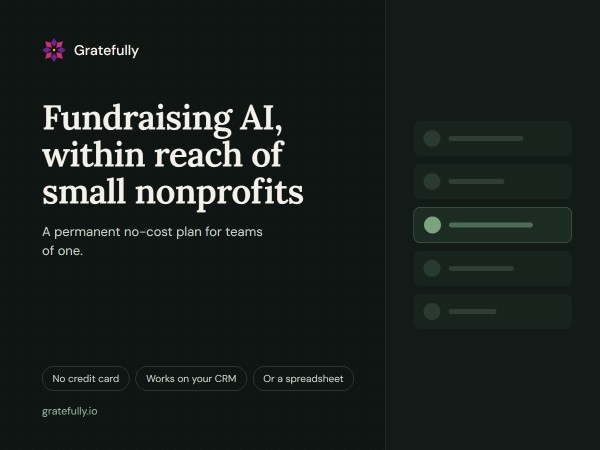
With donor numbers down 3.6 percent in 2025, Gratefully is opening its AI donor intelligence platform to small nonprofits on a permanent no-cost plan that works on an existing CRM or a simple spreadsheet.
San Jose, California, United States, 25th Sep 2026 – Gratefully, an AI donor intelligence and stewardship platform built exclusively for nonprofits, today introduced a permanent no-cost plan that brings purpose-built fundraising AI within reach of organizations with small teams and limited budgets. Accounts that finish the company’s 14-day trial of its Advanced plan now move to the Free plan instead of being locked, and organizations without a CRM can start from a spreadsheet of their donor records.
The plan arrives as retaining supporters becomes a larger share of the work. The Fundraising Effectiveness Project, a joint initiative of the Association of Fundraising Professionals Foundation for Philanthropy and GivingTuesday, reported that the number of donors fell by an estimated 3.6 percent in 2025, even as total dollars raised grew, with most of that growth coming from larger gifts. At many small nonprofits, keeping those donors is the job of one person.
“Purpose-built AI for fundraising has mostly been out of reach for small nonprofits. It has usually meant paying for a bigger CRM with AI added on, or buying another tool on top of the one they already have. A small team deserves the same insight into its donors, whether it runs a CRM or a spreadsheet,” said Muddsar Jamil, founder of Gratefully.
The Free plan keeps an organization’s donor records in sync and includes data clean-up and downloads, five suggested actions each week, ten AI answers each month and a view of the organization’s donor groups. No credit card is required at any stage, and no donor data is deleted when the trial ends. Organizations can move to a paid plan at any time; published paid plans start at 79 US dollars per month, billed annually.
Gratefully works on top of the systems nonprofits already use rather than replacing them. It connects to Salesforce for Nonprofits, Bloomerang and Little Green Light, and brings in email engagement data from Mailchimp, Constant Contact and HubSpot. Organizations without a CRM can import donor records from a CSV file and upload documents such as PDF, Word and Excel files. Its AI assistant, Grace, answers questions about donors with citations to the underlying records, and donor figures are calculated from the data rather than generated by the AI model.
Data protection is built into the platform. Personal information is redacted before any data reaches a language model, and donor data is never used to train shared or public models. Plan details are published at https://gratefully.io/pricing for organizations comparing options.
About Gratefully
Gratefully is an AI donor intelligence and stewardship platform built exclusively for nonprofits. It brings donor records, giving history, staff notes and documents into one private knowledge graph, so fundraisers know which donors need attention and why. Gratefully was founded by Muddsar Jamil, who spent twenty years building software in Silicon Valley at Adobe, Workday and SugarCRM. The company is based in San Jose, California. The company website is https://gratefully.io and includes product details and published pricing.
Media Contact
Organization: Gratefully
Contact Person: Muddsar Jamil
Website: https://gratefully.io/
Email: Send Email
City: San Jose
State: California
Country: United States
Release id: 49457
The post Purpose-Built Fundraising AI Is No Longer Just for Nonprofits With Big Budgets appeared first on King Newswire. This content is provided by a third-party source.. King Newswire makes no warranties or representations in connection with it. King Newswire is a press release distribution agency and does not endorse or verify the claims made in this release. If you have any complaints or copyright concerns related to this article, please contact the company listed in the ‘Media Contact’ section
About Author

Disclaimer: The views, suggestions, and opinions expressed here are the sole responsibility of the experts. No Digi Observer journalist was involved in the writing and production of this article.
Press Release
GivTrade Highlights Competitive Trading Costs and Low Spreads as Trading Costs Take Center Stage for Regional Traders

Dubai, UAE, 25th Sep 2026 — GivTrade, a multi-asset CFD broker regulated by the Financial Services Commission (FSC) of Mauritius (License No. GB22201329), today highlighted its competitive trading conditions and focus on transparent trading costs as cost sensitivity becomes an increasingly important consideration for traders across the region.

With spreads starting from 0.0 pips on major currency pairs, $0.08 on Gold and $0.015 on Silver, and average execution speeds cited at 0.15 seconds, GivTrade offers competitive trading conditions for traders comparing brokers on execution quality and trading costs. The broker offers access via MetaTrader 5 (MT5) and a proprietary platform, covering CFDs on forex, precious metals, energy, indices, commodities, and stocks.
“Traders are increasingly focused on the true cost of trading — spread, commission, and execution speed together, rather than simply the number displayed on the homepage,” said Antoine Naddaf, Country manager GivTrade. “Our focus has been on building a low-spread trading environment designed to provide competitive conditions across our account offering.”
Why Trading Costs Matter to Traders
As competition among CFD brokers increases, trading costs and execution conditions remain important considerations for traders when comparing available services.
GivTrade’s account structure includes:
- Classic Account — from $100 minimum deposit, designed for traders starting with lower capital
- VIP Account — from $2,000 minimum deposit, for higher-volume traders seeking tighter conditions
- Swap-Free Account — designed for traders seeking Sharia-compliant, interest-free positions
Frequently Asked Questions
Is GivTrade a low-spread broker?
GivTrade offers spreads starting from 0.0 pips on major forex pairs, $0.08 on Gold and $0.015 on Silver, subject to the applicable account type and prevailing market conditions.
What platforms does GivTrade support?
GivTrade supports MetaTrader 5 (MT5) alongside its own proprietary trading platform.
Is GivTrade regulated?
Yes. GivTrade Mauritius (registration No. 197387) is authorized and regulated by the Financial Services Commission (FSC) of Mauritius under License No. GB22201329.
About GivTrade
GivTrade is a multi-asset CFD broker offering access to forex, precious metals, energy, indices, commodities, and stock CFDs through MetaTrader 5 and its own trading platform.
GivTrade operates through its respective regulated entities and in accordance with the regulatory permissions applicable to each entity and jurisdiction.
Learn more at givtrade.com.
Risk Disclosure: GivTrade Mauritius (registration No. 197387) is authorized and regulated by the Financial Services Commission (FSC) of Mauritius under License No. GB22201329. Trading CFDs carries a high level of risk and may not be suitable for all investors. This release is for informational purposes only and does not constitute investment advice or an offer or solicitation to engage in investment activities. The products and services referred to are subject to applicable jurisdictional restrictions and regulatory requirements. Full risk disclosure is available at givtrade.com.
©2026 GivTrade, LLC.
Media Contact:
Info@goldengatepr.com
About Author
Disclaimer: The views, suggestions, and opinions expressed here are the sole responsibility of the experts. No Digi Observer journalist was involved in the writing and production of this article.
Charleston, South Carolina, United States, 25th Sep 2026 – The Adler Fund announced the release of The Leverage Game: How Winners Build Wealth, Create Power, and Raise Unhackable Kids, a new book by Adam Adler, Founder and Managing Partner of The Adler Fund. The book examines entrepreneurship, technology, artificial intelligence, decision-making, personal discipline, and modern parenting through the experiences and perspectives Adler has developed throughout his career.

The Leverage Game explores how systems, technology, relationships, and strategic decision-making can shape professional and personal outcomes. Across 13 chapters, Adler examines topics including entrepreneurship, artificial intelligence, technology, real estate, leadership, parenting, and the changing relationship between children and digital devices.
The book draws on Adler’s experiences building businesses and working across different industries, as well as his experiences as a competitive athlete and entrepreneur. These experiences inform discussions throughout the book about discipline, preparation, decision-making, accountability, and adapting to changing circumstances.
A central concept introduced in the book is the idea of becoming “unhackable.” Adler uses the term to describe developing attention, discipline, independent thinking, and decision-making skills that can help children navigate an increasingly digital environment. The book examines the role parents can play in helping children develop these capabilities while maintaining a balanced relationship with technology.
The book also explores the relationship between financial resources and personal capability. Adler examines how skills, judgment, discipline, and practical knowledge can influence a person’s ability to manage changing circumstances and make informed decisions over time.
“The Leverage Game brings together experiences and ideas that have shaped the way I approach business, technology, leadership, and parenting,” said Adam Adler, Founder and Managing Partner of The Adler Fund. “I wanted to examine these subjects together and provide readers with a practical perspective on the systems, habits, and decisions that influence how we work, build, and prepare for the future.”
A significant section of the book draws from Adler’s experience developing Wyzly with his daughter. Wyzly is an AI-powered educational platform designed to provide children with educational activities and give parents tools to manage and monitor their children’s digital experiences.
The book uses the development of Wyzly as an example of how technology can be incorporated into family routines and educational experiences. Adler discusses the importance of creating structured digital environments and encouraging children to develop productive habits around technology.
The later chapters examine the broader impact of artificial intelligence and digital technology on business and family life. Adler considers how rapidly developing technologies may change professional environments and why adaptability, critical thinking, and continued learning will become increasingly important.
The Leverage Game: How Winners Build Wealth, Create Power, and Raise Unhackable Kids is now available on Amazon.
About Adam Adler
Adam Adler is the Founder and Managing Partner of The Adler Fund, an entrepreneur and business leader based in Charleston, South Carolina. He has more than two decades of experience building businesses and working across technology, real estate, and emerging ventures.
Adler is also the co-founder of Wyzly, an AI-powered educational platform focused on children’s learning and digital experiences.
Through his professional work and writing, Adler explores entrepreneurship, technology, leadership, decision-making, and the evolving relationship between families and technology.
Media Contact
Organization: The Adler Fund
Contact Person: Adam Adler
Website: https://theadlerfund.com/
Email:
adama@theadlerfund.com
City: Charleston
State: South Carolina
Country: United States
Release id: 49018
The post The Adler Fund Announces the Release of Adam Adler’s The Leverage Game appeared first on King Newswire. This content is provided by a third-party source.. King Newswire makes no warranties or representations in connection with it. King Newswire is a press release distribution agency and does not endorse or verify the claims made in this release. If you have any complaints or copyright concerns related to this article, please contact the company listed in the ‘Media Contact’ section
About Author
Disclaimer: The views, suggestions, and opinions expressed here are the sole responsibility of the experts. No Digi Observer journalist was involved in the writing and production of this article.
Purpose-Built Fundraising AI Is No Longer Just for Nonprofits With Big Budgets
GivTrade Highlights Competitive Trading Costs and Low Spreads as Trading Costs Take Center Stage for Regional Traders
The Adler Fund Announces the Release of Adam Adler’s The Leverage Game
Benzinga Money Article Discusses How to Become Part of the 12% of Retirees Who Have Achieved the Recommended $550,000 Minimum Retirement Savings Threshold
Apu Apustaja Conquers New York with Lively Street Ads, Including Times Square Billboard
Bay Smokes Maintains Quality Amid Legislative Changes in the Hemp Industry


-
Press Release1 week ago
RGMBS 2026 Life Sciences Innovation Forum Draws More Than USD 120 Million in Investor Interest as 23 Global Biotech Innovators Pitch in Riyadh
-
Press Release6 days ago
AJ Auto Expands Specialist Jaguar Land Rover Key Replacement Services for Drivers Facing Lost, Damaged and Replacement Key Problems
-
Press Release6 days ago
From Boardroom to Race Day: COOFANDY and Global Brand Ambassador Christopher Bell Redefine Modern Men’s Wardrobe
-
Press Release1 week ago
RELABEL HAIR MyeongDong Emerges as Seoul, Korea’s New Creative Beauty Destination for Global Travelers
-
Press Release1 week ago
Oceanic Iron Ore CEO Chris Batalha Gives Overview of Ungava Bay Assets
-
Press Release1 week ago
Cove Named 2026 IABE Regional Excellence Award Winner for Utah
-
Press Release6 days ago
Online Mastery Launches Free Platform and Weekly Playbook to Help Americans Build Profitable Online Businesses From Scratch
-
Press Release1 week ago
Wayne Walton Commits to a Student-First Standard for High School Athletic Departments