
Press Release
Will Hash Power Mining Lead Ethereum Into 2.0?

2020 is destined to be an extraordinary year. The global health problems brought about by the Corona-virus, had not only accelerated fluctuation in personal assets, but also intensified the turbulence of the capital market. The first thing that bears the brunt is the US dollar system as the global currency, followed by crude oil, stocks, etc. At this time, the outstanding performance of cryptocurrencies has attracted the attention of many traditional investors, and the concept of “mainstream cryptocurrencies as safe-haven assets” was mentioned again.
From the perspective of M1, bitcoin is now recognized as the sixth largest currency in the world, which indicates that cryptocurrencies have officially integrated into the global mainstream financial system.
In 2020, the world’s largest digital payment platform PayPal announced that it will soon be able to let its more than 1 billion users to trade cryptocurrencies such as BTC, ETH through its online wallet.
In 2020, a financial services company led by Jack Dorsey, CEO of the digital payment company Square, announced that it had bought 4,709 BTC worth $50 million, which accounted for 1% of the company’s total assets.
In 2020, Singapore’s largest retail and commercial bank — DBS Bank, will soon launch the DBS cryptoexchange, which will support Bitcoin (BTC), Ethereum (ETH), Ripple (XRP), and Bitcoin Cash (BCH) to start with.
In 2020, Ethereum settlement exceeded 1 trillion USD, surpassing the Bitcoin network settlement amount for the first time.
In 2020, the ecological market value of Ethereum has exceeded 100 billion USD, and the total lock-up amount of the Ethereum DeFi project has exceed 10 billion USD, which is a tenfold increase compared to 2019.
In 2020, the concept of DeFi made an explosion in the blockchain industry. Until late august, the total market value of all Defi tokens has reached 11.5 billion USD, the trading volume of decentralized cryptoexchanges has exceeded 400 million USD, and the total lock up value of DeFi projects has raised over 6.2 billion USD.
Moreover, the data above came from the current congestion and the racket high gas fee of ETH . After Ethereum 2.0 is fully launched, the TPS of Ethereum said to be increasing from 10-25 TPS to 100,000 TPS, and the market value of Ethereum ecosystem will reach trillions of dollars.
Although there are many complaints about the Ethereum network now, among the 242 DeFi projects, 197 are deployed on Ethereum, while EOS and Bitcoin have only 22 and 23 DeFi projects respectively.
With the increasing scale of the Ethereum DeFi ecosystem, the governance rights will be handed over to the community more and more, which makes migration basically impossible. This situation makes Ethereum and DeFi pushing each other’s mutual achievements.
From investors’ perspective, having experienced the collapse of ICO and many other incidents, it may be difficult for them to establish trust in centralized crypto-projects again.
In this context, the Galaxy Cloud hash power mining platform is a decentralized asset management platform that integrates ETH 1.0 POW mining , ETH 2.0 POS cloud mining and DeFi liquid mining, and is constructed to achieve tens of trillions of dollars of market value of ETH 2.0 in the future!

Galaxy Cloud hash power mining platform is created by the Galaxy Cloud Foundation. Galaxy Cloud Foundation was branched from Singapore AI Foundation in May 2020, aiming to support the research and development of various blockchain software and hardware, among which Ethereum and the decentralized technology ecosystem are the main targets.
Since the establishment of Singapore AI Foundation in 2017, it has been committed to support the research and development of artificial intelligence, and the return on their investment projects has been at the leading level of the AI industry. At the beginning of 2020, the AI Foundation decided to put out some funds and personnel to establish a blockchain fund to help the development of the emerging technology industries, and there came Galaxy Cloud Foundation.
The mission of Galaxy Cloud Foundation is to promote the development of new technologies and applications, especially in the field of new open and decentralized hardware and software architectures. Its goal is to develop, cultivate, promote and maintain decentralized and open technologies.
Galaxy Cloud Foundation gathers the world’s top financial technology talents, through years of research and development, formed the world’s leading artificial intelligence DeFi asset management platform — Galaxy Cloud hash power mining platform. Based on the global DeFi alliance (including Uniswap, MakerDao, Debank and dozens of other DeFi platforms), it integrated ETH 1.0 POW mining, ETH 2.0 POS cloud mining and DEFI liquidity mining. The Galaxy Cloud hash power mining platform will become the benchmark application of the future DeFi ecology, helping to build an application ecology with a market value of 10 trillion US dollars for ETH 2.0 for the next ten years.
About Author

Disclaimer: The views, suggestions, and opinions expressed here are the sole responsibility of the experts. No Digi Observer journalist was involved in the writing and production of this article.

Press Release
Carziqo Launches ER-SX Operations in Dallas, Introduces CARBON POINTS Rewards During Future Mobility Festival

The October celebration connects all-electric autonomous mobility with cash-redeemable rewards for eligible ER-SX rental users.
DALLAS, Texas, October 3rd, 2026, ZEX PR WIRE— Carziqo has announced the introduction of its ER-SX series autonomous ride-hailing vehicles in Dallas as part of the Carziqo Future Mobility Festival, pairing its latest mobility initiative with a CARBON POINTS promotion that allows eligible rental users to redeem platform points for cash.

Held throughout October, the festival brings together the company’s electric mobility ambitions and customer appreciation activities. The Dallas announcement places the ER-SX series at the center of this year’s celebration, alongside benefits designed to make participation more accessible and rewarding.
According to Carziqo, users who rent designated ER-SX series vehicles during the promotional period are eligible to receive CARBON POINTS under the corresponding rental offer. Eligible points can then be exchanged for cash in accordance with the platform’s published redemption terms.
The initiative reflects the company’s approach to connecting the development of greener transportation with tangible customer benefits.
Carziqo describes its autonomous ride-hailing fleet as fully electric. The ER-SX series follows that approach, producing zero tailpipe carbon dioxide emissions while driving. Overall environmental performance also depends on factors such as the electricity used for charging, vehicle manufacturing, and operational efficiency.
The company has positioned electrification as a foundation for its mobility strategy, alongside intelligent fleet management and the development of more efficient transportation services. Its Dallas operations bring those priorities into the Future Mobility Festival while giving eligible users an additional way to participate through CARBON POINTS.
The promotion also introduces the broader commercial concept behind environmental crediting: qualifying lower-carbon transportation activity can generate measurable value under specific programs.
In applicable low-carbon fuel markets, electricity supplied for transportation may support the generation of tradable credits. Charging data, measured in kilowatt-hours, forms part of a calculation process governed by the relevant program’s eligibility, carbon-intensity, reporting, and verification requirements.
Once properly established, eligible credits can be sold to market participants, including fuel suppliers that purchase credits to meet compliance obligations. Revenue from those transactions can support permitted activities and benefits, depending on the rules governing the program.
Carziqo has identified this mechanism as a potential opportunity to connect electric fleet activity with additional customer value. Where its operations qualify, credit rights are established, and transactions are completed, the company aims to explore how permitted proceeds could support user benefits.
For customers, CARBON POINTS provide a simpler point of participation. The points function as Carziqo platform reward units, with their cash redemption value determined by the applicable promotional terms. They are distinct from market-traded environmental credits and do not require users to arrange credit sales independently.
Under the festival offer, the customer process centers on three steps: selecting an eligible ER-SX rental plan, receiving the corresponding CARBON POINTS allocation, and redeeming eligible points through the platform.
The relevant offer sets out the point allocation, conversion rate, claim requirements, and validity period. These published conditions define the customer benefit.
The Future Mobility Festival provides the setting for this initiative. Carziqo describes the annual October celebration as an opportunity to recognize customer support and share its direction for the years ahead.
By combining the ER-SX introduction with CARBON POINTS, the company is bringing a vehicle-focused announcement and a customer reward activity into a single campaign. The approach gives the festival an immediate benefit for eligible participants while introducing the longer-term opportunities associated with electric mobility.
Looking toward 2030, Carziqo has outlined priorities that include improving fleet energy efficiency, strengthening charging-data collection, developing clearer environmental measurement, and evaluating suitable crediting opportunities in eligible markets.
These priorities reflect the role that operational information can play in the development of an electric mobility business. Reliable energy records can support fleet management and provide a foundation for assessing participation in applicable environmental programs.
The Dallas announcement marks another step in Carziqo’s stated mobility plans. Through the ER-SX series and the Future Mobility Festival, the company is linking its all-electric transportation strategy with a customer initiative focused on clear participation requirements and cash-redeemable rewards.
About Author

Disclaimer: The views, suggestions, and opinions expressed here are the sole responsibility of the experts. No Digi Observer journalist was involved in the writing and production of this article.
Press Release
Carziqo Brings A-DS Autonomous Delivery to San Francisco During Future Mobility Festival
- The company reports rising delivery demand as it positions autonomous logistics as a response to growing operating costs and the need for more efficient urban services.
SAN FRANCISCO, CA, Oct 03, 2026, ZEX PR WIRE — Carziqo says its A-DS autonomous delivery vehicles have begun operating in San Francisco, extending the company’s delivery business during the Carziqo Future Mobility Festival. The development comes as the company reports continued growth in delivery orders across its supported operations and sees increasing opportunities for autonomous technology in the movement of goods.
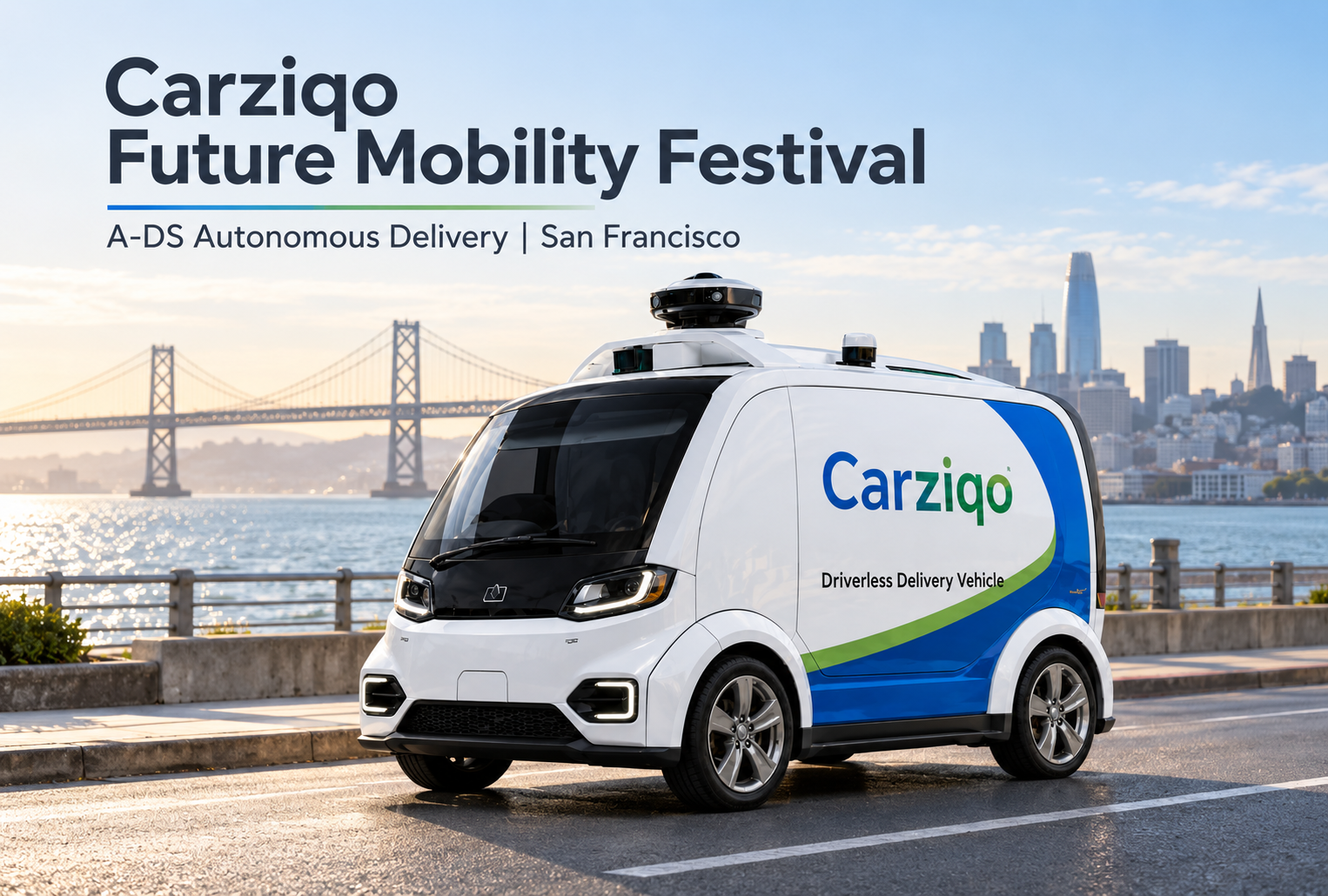
The San Francisco operation brings a practical focus to the October celebration: how intelligent mobility can support the everyday needs of businesses and consumers. For Carziqo, autonomous delivery represents an opportunity to connect its vehicle technology with a service whose value depends on consistency, convenience and careful management of operating costs.
The company’s recent announcements have emphasized rising A-DS order volumes and the importance of matching delivery demand with available fleet capacity. Carziqo says its priority is to translate that growth into better vehicle utilization and a more dependable service as the business develops.
The economic backdrop gives that objective particular relevance. According to the U.S. Bureau of Labor Statistics, compensation costs for private industry workers rose 3.3 percent in the year ending June 2026, including a 3.1 percent increase in wages and salaries. Although these figures cover private industry broadly, they provide context for the cost pressures businesses face when planning labor-intensive services.
For delivery operators, handling additional orders involves more than adding vehicles. It requires coordinating routes, staffing, vehicle availability and the time needed to complete each task. Higher demand creates a commercial opportunity, but the ability to serve that demand efficiently determines how much value the additional activity can generate.
Carziqo’s approach centers on reducing the manual driving requirements of supported delivery journeys while maintaining human involvement in fleet supervision, maintenance, customer support and situations requiring direct intervention. The company describes this division of responsibilities as a way to organize delivery work more efficiently as volumes increase.
That distinction is central to the business case for autonomous delivery. Automation can change how resources are allocated, but its usefulness depends on the performance of the wider service. A vehicle must be available when needed, assigned a suitable route and supported throughout its operating cycle.
Carziqo describes the A-DS platform as combining automated driving with route planning, connected vehicle monitoring and centralized operational support. Its fleet systems are designed to bring together information about vehicle condition, delivery progress, charging requirements and maintenance needs, helping teams coordinate the vehicles as a network.
For San Francisco, the significance of the deployment lies in applying that approach to local delivery needs. The commercial opportunity will depend on how effectively available capacity meets demand and how consistently the service performs within its operating scope. Those practical considerations give the expansion a business focus beyond the introduction of another autonomous vehicle model.
Carziqo has previously described a phased approach to A-DS deployment, with attention to route suitability, operational stability and service consistency. Experience gathered from its delivery operations is intended to inform improvements in dispatching, maintenance planning and future deployment decisions.
The Carziqo Future Mobility Festival places these developments within the company’s broader ambition to make intelligent transportation relevant to daily life. Held throughout October, the festival centers on greener mobility, connected services and the practical use of technology to improve how people and goods move through cities.
Autonomous delivery gives that theme an everyday point of connection. Behind each delivery is a person waiting for an item or a business fulfilling a customer’s request. The value of the technology ultimately rests on whether it can help complete those tasks reliably and make the service easier to manage.
The festival also provides an occasion to recognize the community supporting Carziqo’s development. In a separate A-DS announcement, the company introduced an additional Wednesday Performance Reward for eligible A-DS rental users, with amounts, claiming arrangements and eligibility governed by the terms published on its platform.
As the company develops its delivery business, its stated priorities include closer coordination between demand and vehicle deployment, management of operating costs and continued improvement of the service experience.
The San Francisco operation adds a new chapter to that effort during the Future Mobility Festival. With A-DS, Carziqo is positioning autonomous delivery as a practical part of its longer-term mobility ambitions—one whose progress will be measured through the everyday work of moving goods and serving customers.
For company information and official updates, visit www.carziqo.com.
About Author
Disclaimer: The views, suggestions, and opinions expressed here are the sole responsibility of the experts. No Digi Observer journalist was involved in the writing and production of this article.
Press Release
Brian Baldari on the Difference Between a Mentor and a Sponsor, and Why It Decides Promotions
-
ResilExec® Coaching founder Brian Baldari, Pharm.D., MBA, on why senior leaders who have plenty of advice and no advocacy stall at the same level for years.
BRICK, N.J., Oct 03, 2026, ZEX PR WIRE — Most senior professionals have someone they go to for advice. Far fewer have someone who argues for them in a room they are not in. According to Brian Baldari, Pharm.D., MBA, founder of ResilExec® Coaching, that distinction accounts for a large share of stalled advancement among otherwise strong performers.
Baldari spent 24 years inside pharmaceutical, healthcare, and enterprise leadership organizations. He held five successive Director-level roles, moved from Director to Vice President and Senior General Manager in 18 months, and led the commercial launch of 14 brands. He now works with Associate Directors, Directors, Senior Directors, Executive Directors, and Vice Presidents inside pharmaceutical, healthcare, and enterprise IT organizations.
“A mentor talks to you. A sponsor talks about you,” Baldari says. “One of those changes your calendar. The other changes your title.”
Advice Is Not Advocacy
Mentorship is widely available and widely encouraged. Many organizations run formal programs for it. A mentor offers perspective, context, and guidance, and that guidance has real value early in a career when the primary gap is knowledge.
Sponsorship operates differently. A sponsor spends their own credibility on someone else. They put a name forward on a succession slate, defend a candidate during calibration, and accept the consequences if the bet does not pay off. That is a materially different act, and it is not something an organization can mandate.
“Leaders collect mentors because mentors are easy to ask for,” Baldari says. “Nobody feels awkward requesting advice. Asking someone to spend their reputation on you is a different conversation, and most people never have it.”
Where the Gap Shows Up
The gap becomes visible at the point where advancement decisions are made collectively. Calibration sessions and succession discussions involve people across multiple functions, many of whom have no direct experience of a given candidate’s work. In those rooms, a candidate is represented by whoever chooses to speak.
“If nobody in that room can describe what you do at enterprise scale, you are not in the conversation, regardless of your review,” Baldari says. “The decision is not made on the strength of your record. It is made on the strength of the description someone else gives of it.”
Baldari notes that this is where strong performers are most often surprised. Their performance ratings are high, their manager is supportive, and the outcome still does not change, because the people who influenced the decision were never engaged.
Sponsorship as a Variable
Sponsorship is one of five variables in Baldari’s Promotion Math framework, alongside Performance, Visibility, Narrative, and Timing. In his assessment, strong performers optimize the first variable and leave the remaining four unattended, then attribute the result to politics.
“Performance gets you noticed. Positioning gets you promoted,” Baldari says. “Sponsorship is the variable people find hardest to work on, because it requires asking for something rather than producing something.”
What Changes the Outcome
Baldari advises leaders to identify the specific individuals who will participate in the decisions that affect them, then assess honestly whether those individuals could describe their contribution without prompting. In most cases the answer is no, and that is the actionable finding.
From there the work is practical rather than social. It involves delivering value to those individuals rather than checking in with them, framing results at enterprise level rather than functional level, and showing up in forums where that work is visible to people beyond a direct reporting line.
“You do not recruit a sponsor by asking them to be one,” Baldari says. “You give them something worth putting their name next to, and you make sure they understand what it was.”
About Brian Baldari
Brian Baldari, Pharm.D., MBA, based in Brick, New Jersey, is the founder of ResilExec® Coaching and Resilient Performance Group LLC. He spent 24 years inside pharmaceutical, healthcare, and enterprise leadership organizations, held five successive Director-level roles, and advanced from Director to Vice President and Senior General Manager in 18 months. He led the commercial launch of 14 brands across rare and chronic disease categories, led an organization of more than 250 people, and has mentored more than 50 leaders across three continents. Through ResilExec Coaching, he helps Associate Directors, Directors, Senior Directors, Executive Directors, and Vice Presidents accelerate career growth through personalized executive coaching, leadership development, and strategic career positioning.
Media Contact
Resilient Performance Group LLC
About Author
Disclaimer: The views, suggestions, and opinions expressed here are the sole responsibility of the experts. No Digi Observer journalist was involved in the writing and production of this article.
Carziqo Launches ER-SX Operations in Dallas, Introduces CARBON POINTS Rewards During Future Mobility Festival
Carziqo Brings A-DS Autonomous Delivery to San Francisco During Future Mobility Festival
Timothy Caraboolad Publishes a Buyer’s Checklist for New-Build Condos in South Florida
Benzinga Money Article Discusses How to Become Part of the 12% of Retirees Who Have Achieved the Recommended $550,000 Minimum Retirement Savings Threshold
Apu Apustaja Conquers New York with Lively Street Ads, Including Times Square Billboard
Bay Smokes Maintains Quality Amid Legislative Changes in the Hemp Industry


-
Press Release7 days ago
New Experiences in Shanghai for Mid-Autumn Festival and National Day! The 2026 International Audio-Visual Arts Carnival Unveils a “Technology + Culture” Audio-Visual Feast
-
Press Release1 week ago
Piya Saliba Releases Free Community Connection Checklist to Help People Build Stronger Relationships
-
Press Release1 week ago
Gary Bassett Shares Lessons From 45 Years Across Finance and Technology
-
Press Release1 week ago
Nivia Fontanez Highlights the Often-Overlooked Role of Radiology Technologists in Patient Care
-
Press Release4 days ago
Pro-Grade AI Diagnosis, Without the Pro-Grade Price: THINKSCAN 689BT PRO Brings 610 Racing’s Know-How to the DIYer
-
Press Release3 days ago
76% of Treasury Teams Hit by Fraud as Deepfake Attacks Rise, Treasury Dragons & nsKnox 2026 Index Finds
-
Press Release2 days ago
WHY VANESSA HUDGENS CHOSE AMAZON’S EKOUAER OVER LUXURY LABELS — AND WHAT IT REVEALS ABOUT FASHION’S NEW ERA
-
Press Release5 days ago
Amaze Holdings (NYSE: AMZE) Executes Binding LOI to Acquire BullionFX | Alchemy, a Decentralized Gold-Backed Financial Ecosystem for Valued at US$155 Million