
Press Release
“Algorithm + Credit” Rebuild the Value Foundation of DeFi


DeFi still has higher attention, with rapid technological innovation and continuous expansion of application scope, The goal of DeFi is undoubtedly to build a more effective, free, and transparent financial ecology. However, finance always develops with money and brings value exchange. Therefore, whether it is a decentralized scenario or a mass application toward reality in the future, stable cryptocurrency is crucial for users, so as to realize the dream of making virtual ideas become reality.
For this reason, in the field of cryptocurrency, many teams have been exploring stable currency. According to CryptoQuant data, stabilecoin holdings on global crypto exchanges hit a high record of $9.8 billion as of March 28, 2021. At the same time, the total stable currency market capitalization once topped $80 billion, according to CoinGecko, the current daily trading volume of all stable currencies is about $118.340 billion. Also, CoinMarketCap shows there are 16 mainstream stable currencies now.
The stable currency is illusory?
In general, both USDT and DAI are still on their way and haven’t really achieved the goal of “stable currency”. Tether’s White Paper said: “Tether is a decentralized cryptocurrency, but we are not a perfectly decentralized company. We store all of our assets as a centralized pledge.” Therefore, USDT is just borrowing the name of the cryptocurrency, but it is not really decentralized.
DAI, developed by MakerDao, is the largest decentralized stable currency on Ethereum. It is issued with the guarantee of the full amount of assets on the blockchain. It is only generated in the application scenario based on the mortgage, and the market value of the mortgage assets is the ceiling of it. Therefore, these stable currencies are illusory in a sense.
Will algorithmic stable currencies finally fail?
Now let’s take a look at the development process of algorithmic stable currencies, known as the holy grail of cryptocurrency. From stable currency1.0 represented by AMPL, stable currency2.0 represented by Basis Cash to stable currency 3.0: Frax Finance, all of them have gone through a period of growth. However, the stable currency reality is that we live under the sense of “ever-changing”, and stable value is still in the ideal.
AMPL algorithmic stable currency is used to increase or decrease the supply of AMPL in order to keep the price of AMPL around $ 1. Ampleforth uses Rebase operation to change the AMPL held by all users as a whole. The Rebase price is based on the average price of the past 24 hours. When this price is above $1.05, the AMPL balance in all users’ wallets increases simultaneously. At prices below $0.95, all users’ AMPL balances decrease simultaneously. During this process, the percentage of AMPL held by users in the supply does not change. It looks like everything is fine on its own, but when the price of cryptos falls to the point where deflation is needed, both the quantity and price of coins held by users are falling, so users face a double whammy.
So it’s easy to create a death spiral. Similarly, when crypto price rises, it is easy to create an upward death spiral. Thus it can be seen that this price model only has two possibilities: the price continues to fall, get into the infinite death circle and leave the market, and the price rises steadily to around 1USDT; Prices rising, the AMPL has been printing (dividend), AMPL reserve disappeared, crypto began to value return, people in loss cannot gain AMPL, prices will fall back near 1 USDT (need funds continue getting into the market), so it is difficult to see AMPL achieve speculation, meanwhile achieve stability, And stability is a necessary condition for a stable currency.
Basis Cash, as represented by 2.0, includes three tokens, Basis Cash (BAC), Basis Share (BAS), and Basis Bond (BAB), among which BAB is non-transferable. The BAC is the stable currency, anchored to $1; BAS is an equity token, and newly-minted BAC tokens can be allocated. BAB is a bond. There is nothing wrong with Basis Cash based on the algorithm itself, but without a good application scenario, relying on the debt market itself is dangerous. There is actually a problem with debt financing in traditional markets, where those “too big to fail” entities can take on the risk of impunity through socialized bailout costs. It is entirely possible that Basis Cash could go into a debt spiral, in which case there would be no willing contributors, the debt would accumulate and the protocol would collapse.
Finance FX is the first partial algorithmic stable currency project, adding the concept of using “partially stable” as a collateral asset to the existing algorithmic stable currency. There are two types of tokens in Frax, the stabilization token Frax, and the governance token FXS. Frax costs USDC and FXS, but only USDC during creation. The initial mortgage rate is 100%, that is, all USDC mortgage is used to cast FRAX. After that, the mortgage rate will be adjusted every hour. If the price of FRAX is more than $1, the mortgage rate will be reduced and FXS ‘share in it will be increased. Raise the mortgage rate if the Frax falls below $1. The mortgage rate is adjusted every hour by 0.25% each time. But its high mortgage ratio leads to the lack of user appeal, its currency numbers and market supply have been stagnant.
Although the above three generations of stable currencies seem to be making breakthroughs and innovations, they do not give a satisfactory answer on how to solve the credit problem. However, algorithm stable currency that cannot solve the credit problem is useless. Bitcoin came into being to solve the problem of credit, but the stable currency, as an important extension of its development, has not inherited the legacy of credit, and is still stuck in the algorithm.
Crypto Credit Network (CCN)
In the financial field, credit is the foundation and the lifeblood. This is true of both traditional and modern financial systems. In the traditional financial system, credit mainly relies on the guarantee of laws and institutions. Apart from the high operation cost, the “credit crisis” gradually exposed by financial intermediaries is the fundamental reason why people urgently embrace the blockchain technology. Algorithm stable currency is going to help cryptos solve the credit problems, guaranteeing machine credit by algorithm, which does not rely on third-party subjective will and makes transaction transparent, efficient, reliable, and stable, let people who do not have to establish credit relationship between each other to achieve cooperation and free trading, reduce the cost of credit.
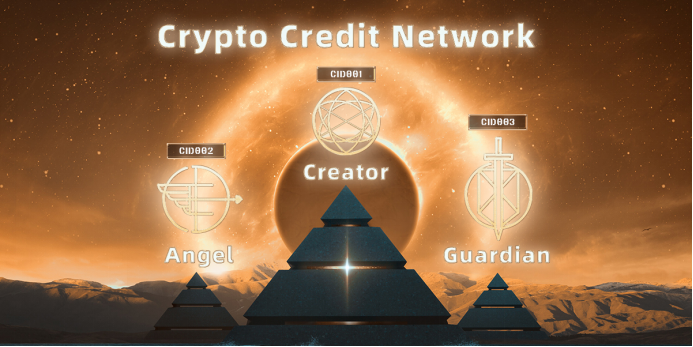
However, the world of blockchain cryptocurrency is a chaotic existence without a role name. To change from chaos to brightness, each individual needs to have his or her own identity, so that we can obtain the faith like phoenix nirvana. The CCN gives each individual a unique CID (Crypto Identification), which is the most basic rule in the Crypto world. To build a new crypto world of order, autonomy, and equality.
The construction of CCN not only takes blockchain technology as support, but also has a reasonable economic incentive mechanism. Reasonable use of incentive mechanism is an effective means to stimulate all parties to participate in the construction of CCN.
A sound incentive mechanism, reasonable mechanism design from the perspective of leading efficiency and fair governance, can make the value generated by credit information flow effectively to the value provider in the blockchain world, punish the evil behavior, and resolve the conflict between individual interests and collective interests. It makes the individual’s behavior of pursuing individual interests unified with the goal of maximizing collective value.
Therefore, CCN can further clarify the economic interests of each participant and the overall interests of the network, so as to fully mobilize the enthusiasm of each participant and guarantee great development of CCN from the source.
The CCN consists of three different identities: Creator, Guardian, and Angel, all of them have established screening mechanisms. Only firm believers can obtain the CCN identity. Early believers are required to contribute to maintaining the stability of early CCN by burning GAC tokens. Therefore, they are not only holders of GaeaCoin, but also determined preachers and builders. When GaeaCoin issues additional shares, it will also receive a corresponding percentage of GAC tokens as a reward.
The establishment of this system aims to provide every GaeaCoin participant with the opportunity to contribute to the community construction, and to create a healthy crypto community culture of dedication and autonomy through consensus, symbiosis, co-construction, and sharing.
In CCN, although the identity is different, the residents on the chain of CCN build the initial transaction link according to their CID address, and constantly expand CCN on the chain. Open CID needs to be recommended by the network resident, once the link is formed, it cannot be changed forever. Each of the three different identities requires a different number of GAC tokens to burn, which can be viewed on the GaeaCoin network. GaeaCoin network residents have different rights according to their status.
The integration with the DEX: OxySwap has pioneered a full range of applications
There is a natural interdependence between exchange and stable currency. The exchange has always been an important part of crypto digital asset market, and it is also the first application place of stable currency. Like Binance with BUSD and Huobi with HUSD, OKEx also launched USDK on June 3, 2019. Traditional CEXs are fiat currencies, where fiat currencies are exchanged for cryptos. If you want to buy crypto digital assets, you need to top up fiat currency, which undoubtedly increases the economic and time costs of investors in the process of exchange. The emergence of a stable currency can not only solve the above problems but also effectively avoid legal risks in the process of the transaction.
As it should be, the integration of GaeaCoin ecology and OxySwap not only lay a solid foundation for stable currency: GAC token application, but also creates opportunities for it to open up more and wider application scenarios.
OxySwap is a decentralized exchange running on the BSC with a collection of DEX liquidity mining, which offers functions of exchange, liquidity, market making, and so on. The strength of OxySwap guarantees the usages of the stable currency: GAC.
GAC will lead a brighter way
GaeaCoin algorithm stable currency: GAC dares to face the challenge, according to the industry news, GAC praises is not only relatively stable from the concept, but also to really put into application. In addition to GAC (GaeaCoin), GaeaCoin ecology also includes GAB (GaeaCoin Bond) and GASH (GaeaCoin Share), which serve to maintain the stability of GAC. GaeaCoin Ecology also integrates GaeaCoin protocol, algorithm, robustness, price response, encryption, and other technologies, superposed with the DeFi ecology of Crypto Credit Network (CCN), OxySwap (DEX), and so on, providing a realistic solution for GAC, and leads it to move towards the real “stability”.
The integration of CCN and OxySwap points out the direction for the application of algorithmic stable currency. In fact, we can already feel the power of the GaeaCoin algorithm stable currency, and once it is used at a large scale, the ideal stable currency is expected to arrive ahead of time. DeFi will also build on this basis, using currency, lending, spot trading, and other components to build continuously upgraded Lego of DeFi.
GaeaCoin’s move directly challenges the world’s centralized stable currency giants such as USDT and USDC, but compared to the previous challenges of AMPL, BAC, and FRAX, this well-prepared challenge looks more anticipated!
About Author

Disclaimer: The views, suggestions, and opinions expressed here are the sole responsibility of the experts. No Digi Observer journalist was involved in the writing and production of this article.

United States, 22nd Sep 2026 — As more consumers across the United States look for ways to reduce waste and make more conscious purchasing decisions, Plantish Future is highlighting a practical approach to sustainable living centered on reusable, natural, and environmentally responsible alternatives for everyday life.
The growing interest in conscious consumption reflects a broader shift in how individuals and households think about the products they use on a daily basis. Rather than viewing sustainability as an occasional choice, many consumers are exploring ways to incorporate more environmentally responsible habits into established routines. Plantish Future supports this shift by offering practical alternatives designed to help consumers make lower-waste choices part of everyday life.
Making Sustainable Choices More Practical
For consumers interested in an eco-friendly lifestyle, transitioning away from conventional disposable products can sometimes feel complicated. Plantish Future focuses on simplifying that process by offering reusable and naturally made alternatives that can replace commonly used disposable items.
Its range includes products such as Reusable Cotton Buds, designed as an alternative to conventional single-use cotton buds, and Reusable Bamboo Charcoal Cotton Rounds, which provide a reusable option for everyday personal-care routines. By focusing on reusable formats, these products can help reduce the need to repeatedly purchase and discard disposable alternatives.
Plantish Future also offers the Bamboo Soap Dish Duo, which provides a natural way to store solid soap, and the Solid Dish Soap Brick, offering an alternative approach to conventional liquid dishwashing products and their associated packaging.
For household cleaning, the brand features sisal and coconut-fibre cleaning brushes, made with plant-based natural materials. These brushes provide practical alternatives for everyday cleaning tasks while supporting consumers who are looking to reduce their reliance on conventional synthetic or disposable cleaning products.
Together, these products demonstrate how sustainable alternatives can be incorporated into familiar routines without requiring consumers to completely change the way they live.
Exploring Plastic-Free Swaps
Plantish Future’s Plastic-Free Swaps Collection brings together alternatives intended to help consumers reconsider some of the plastic and disposable products commonly found in everyday households. The collection reflects the brand’s broader focus on making lower-waste living more approachable through practical substitutions.
Rather than presenting sustainability as an all-or-nothing lifestyle, Plantish Future encourages consumers to identify individual products they use regularly and consider whether a reusable, natural, or plastic-free alternative could serve the same purpose.
This approach allows households to make gradual changes based on their individual needs and routines. Replacing one disposable item with a reusable option can become a small but repeatable habit, while several such changes can contribute to a broader effort to reduce household waste.
Responding to a Changing Consumer Mindset
Environmental awareness has increasingly become part of consumer decision-making in the United States. Shoppers are paying closer attention to how products are made, how frequently they need to be replaced, and whether reusable or sustainable alternatives may fit their lifestyles.
This change has also created greater interest in practical resources that help consumers understand available choices without making sustainability unnecessarily complicated. Plantish Future contributes to this conversation by focusing on everyday products, natural materials, reusable designs, and alternatives that can fit into established household routines.
The company’s approach recognizes that households have different needs, budgets, preferences, and routines. A sustainable lifestyle can therefore look different from one household to another. By exploring a range of sustainable alternatives, consumers can identify changes that make sense for their individual circumstances.
Encouraging Waste Reduction Through Everyday Habits
Waste reduction remains an important consideration for individuals pursuing a more eco-conscious lifestyle. Reusable products and thoughtful alternatives to disposable items can provide one way for consumers to reconsider everyday consumption patterns.
Plantish Future encourages consumers to look beyond individual products and consider the habits surrounding them. Choosing reusable items, selecting products made from natural materials, reducing unnecessary consumption, and being more deliberate about purchases can form part of a broader approach to responsible living.
This perspective also emphasizes that sustainable living does not have to involve completely changing one’s lifestyle overnight. Instead, consumers can gradually introduce practical changes and build new habits according to what works for them.
A Broader Vision for Sustainable Living
Plantish Future is focused on making sustainable and lower-waste living more practical for everyday consumers. Through products made with materials such as bamboo, cotton, bamboo charcoal, sisal, and coconut fibre, the brand provides alternatives for personal care, household cleaning, and other common routines.
Its focus on sustainable living, eco-friendly products, sustainable products, eco-friendly lifestyle choices, and sustainable alternatives reflects a broader commitment to helping consumers explore more conscious ways of using everyday products.
The Plastic-Free Swaps Collection forms an important part of this approach, giving consumers practical options for replacing selected conventional plastic and disposable products. By making these swaps one step at a time, households can explore ways to reduce waste while maintaining the routines and functions they rely on every day.
As interest in conscious consumption continues to develop, Plantish Future remains focused on encouraging practical environmental responsibility. Its approach is centered on helping consumers discover realistic, reusable, natural, and lower-waste alternatives that can become part of everyday life.
For more information visit http://plantishfuture.com .
About Plantish Future
Plantish Future is dedicated to sustainable and zero-waste living, offering practical products and alternatives designed to support more environmentally conscious everyday habits. Through reusable products, natural materials, and its Plastic-Free Swaps Collection, the brand helps consumers explore practical ways to reduce reliance on conventional disposable products.
Media Contact
Organization: Plantish Future
Contact Person: Barron
Website: http://plantishfuture.com/
Email: Send Email
Country: United States
Release id: 49344
The post Plantish Future Highlights Practical Pathways Toward Sustainable Living in the U.S. appeared first on King Newswire. This content is provided by a third-party source.. King Newswire makes no warranties or representations in connection with it. King Newswire is a press release distribution agency and does not endorse or verify the claims made in this release. If you have any complaints or copyright concerns related to this article, please contact the company listed in the ‘Media Contact’ section
About Author

Disclaimer: The views, suggestions, and opinions expressed here are the sole responsibility of the experts. No Digi Observer journalist was involved in the writing and production of this article.
Press Release
Data Informata Expands Strategic Intelligence Services for Organizations Navigating a Complex Digital Landscape

United States, 22nd Sep 2026 — Data Informata, a Seattle-based group of strategists, intellectuals, consultants, and data analysts, is providing integrated strategic guidance to enterprise-level firms, governments, businesses, and consumers navigating an increasingly complex digital and global environment.
The organization brings together expertise across Public Relations, Business Marketing, Predictive AI, Crisis Management, Corporate Reputation Repair, Geo Political Consulting, and Private AI Supercomputing Systems. Its approach is designed to connect traditionally separate areas of strategy and intelligence, helping organizations address emerging challenges while identifying opportunities across rapidly changing markets.
Based in Seattle, Data Informata works with clients across a broad range of sectors and maintains a global operating perspective. The company states that its team includes executives, consultants, and data analysts with backgrounds connected to major technology companies, government organizations, and leading news organizations. Its corporate presence also extends to Fort Lauderdale, Chicago, and Los Angeles.
A central component of Data Informata’s work is the integration of data, artificial intelligence, communications, and strategic planning. Through its Predictive AI capabilities, the organization focuses on helping businesses understand complex market and communication environments. Its Business Marketing services combine marketing expertise and data analysis to develop strategies around brand messaging and audience engagement.
Data Informata also provides Public Relations and corporate reputation services designed to help organizations manage their public presence. Its Corporate Reputation Repair practice addresses reputational challenges that can affect a company’s visibility and perceived value, while its Crisis Management approach, described as “Connected Crisis,” focuses on preparing for, responding to, and recovering from digitally driven crises.
For organizations operating across borders, Data Informata offers Geo Political Consulting focused on regional conditions, political dynamics, and global developments that may influence business decisions. The company works across sectors including finance, real estate, technology, healthcare, consumer goods, digital advertising, and other areas where changing economic, regulatory, social, and geopolitical conditions can affect strategic planning.
Another area of specialization is private artificial intelligence infrastructure. Data Informata designs and deploys Private AI Supercomputing Systems for commercial clients seeking to operate advanced AI capabilities within their own facilities or approved environments. The company also develops private AI systems for residential applications, allowing clients to maintain dedicated AI infrastructure without relying exclusively on public AI cloud environments.
By bringing these capabilities together, Data Informata positions its services around the intersection of intelligence, technology, communications, reputation, and strategic decision-making. The company’s stated objective is to help clients respond to a rapidly evolving digital landscape through data-driven tactics, creative innovation, and integrated strategic planning.
Organizations interested in learning more about Data Informata and its range of strategic services can visit Data Informata at https://datainformata.com/.
About Data Informata
Data Informata is a Seattle-based strategic consulting organization providing services across Public Relations, Business Marketing, Predictive AI, Crisis Management, Corporate Reputation Repair, Geo Political Consulting, and Private AI Supercomputing Systems. The organization serves enterprise-level firms, governments, businesses, and consumers across a range of industries and markets.
Media Contact
Organization: Data Informata
Contact Person: Phil
Website: https://datainformata.com/
Email: Send Email
Country: United States
Release id: 49345
The post Data Informata Expands Strategic Intelligence Services for Organizations Navigating a Complex Digital Landscape appeared first on King Newswire. This content is provided by a third-party source.. King Newswire makes no warranties or representations in connection with it. King Newswire is a press release distribution agency and does not endorse or verify the claims made in this release. If you have any complaints or copyright concerns related to this article, please contact the company listed in the ‘Media Contact’ section
About Author
Disclaimer: The views, suggestions, and opinions expressed here are the sole responsibility of the experts. No Digi Observer journalist was involved in the writing and production of this article.
Press Release
VentureXplorer to Showcase The BUNKR Compact Modular Living System at Natural Disasters Expo USA in Houston
Los Angel County, S El Monte, California, United States, 22nd Sep 2026 — VentureXplorer Inc., a California-based designer and manufacturer of custom modular living systems, will showcase The BUNKR at the Natural Disasters Expo USA — Texas Edition, taking place October 14–15, 2026, at the George R. Brown Convention Center in Houston. VentureXplorer will exhibit at Booth #836.The BUNKR is a compact, transportable and fully livable modular unit designed for temporary housing, workforce accommodations, disaster recovery housing, remote living and full-time compact living.Built around the idea of “Small Footprint.
Big Capability.”, The BUNKR delivers the essential features of a much larger living unit while remaining easier to transport, place and relocate.Unlike traditional trailer-based housing, The BUNKR is designed as a removable modular structure. The unit can be transported on an appropriately rated flatbed or utility trailer, delivered to a site, unloaded and relocated as needs change without permanently dedicating the transportation platform to the structure.“We designed The BUNKR around a simple idea: make a complete living space as compact, portable and adaptable as possible,” said Johnny Q, Chief Executive Officer of VentureXplorer Inc. “A smaller footprint makes transportation and placement easier while still giving people a comfortable, fully functional place to live. That flexibility is what makes The BUNKR useful for temporary housing, workforce accommodations and long-term living.”
Small Footprint. Big Capability.
Despite its compact size, The BUNKR can be configured as a fully dwellable living environment.
Depending on the application, units can include sleeping accommodations, a private bathroom and shower, kitchenette, refrigerator, fresh and gray water systems, heating and air conditioning, off-grid electrical systems, solar capability, storage and other everyday living essentials.
Units can also be configured to operate independently of traditional utility connections, making them suitable for temporary housing sites, remote locations and areas where electrical or water infrastructure is unavailable or disrupted.
The BUNKR can be manufactured using aluminum or galvanized steel structural framing, insulated composite wall systems and durable exterior materials designed for transportation and repeated use.
Built Around the Way People Live
The BUNKR is not limited to a single fixed floorplan or footprint.
VentureXplorer can customize the length, width, interior layout, systems and equipment based on the intended use, available space, transportation requirements and number of occupants.
Smaller configurations can provide essential accommodations for one or two people, while larger models can support expanded kitchens, bathrooms, additional sleeping capacity, storage and more residential comfort.
Applications can include:
- Temporary and transitional housing
- Disaster recovery housing
- Workforce housing for construction, utilities, infrastructure, energy, agriculture and remote projects
- Remote and off-grid living
- Full-time compact living
- Seasonal or extended-stay accommodations
- Private guest or supplemental living spaces
Easier Transportation and Faster On-Site Setup
One of The BUNKR’s primary advantages is that the living unit and transportation platform can remain separate.
A BUNKR can be loaded onto an appropriately sized trailer for transportation and removed after reaching its destination. This can allow the same transportation equipment to be used for multiple units instead of requiring every living unit to remain permanently attached to its own trailer.
Because of its compact footprint, The BUNKR can also be easier to position in temporary housing sites, workforce locations, private property and other areas where larger housing units may be difficult to accommodate.
Depending on the configuration and site conditions, units can be equipped with integrated lifting or support systems to assist with loading, unloading, leveling and placement without requiring specialized heavy equipment for normal deployment.
For organizations preparing for seasonal workforce demand, infrastructure projects or future disaster housing needs, The BUNKR can also be pre-positioned and relocated as demand changes.
A Different Approach to Compact Living
VentureXplorer originally developed removable modular systems for vans, trucks and trailers in the recreational market.
That experience evolved into a broader modular living platform designed around portability, efficient use of space and the ability to provide a complete living environment within a compact footprint.
The BUNKR is designed to fill the space between basic temporary shelter and larger trailers or permanent modular housing.
It provides the privacy, comfort and essential amenities of an enclosed living environment while maintaining a smaller, more transportable footprint.
Small Footprint. Big Capability.
Less space to transport. Less space to place. More flexibility in where people can live.
Meet VentureXplorer in Houston
VentureXplorer representatives will be available at Booth #836 throughout the Natural Disasters Expo USA to discuss The BUNKR for disaster recovery housing, workforce accommodations, temporary housing, remote living and other compact residential applications.
Organizations interested in discussing a custom configuration or scheduling a meeting during the expo can contact VentureXplorer at info@venturexplorers.com or (626) 978-3034.
About VentureXplorer Inc.
VentureXplorer Inc. designs and manufactures custom removable modular living systems for vans, trucks, trailers and standalone deployment.
Its product portfolio includes compact living pods, truck and van camper systems, workforce accommodations and purpose-built modular housing units.
Every VentureXplorer system is built around the customer’s intended use, transportation requirements and desired footprint. The company oversees product development, design and customer support from South El Monte, California, and serves customers throughout the United States, with international shipping available upon request.
Learn more at www.venturexplorers.com and www.thecamperboxx.com.
Media Contact
VentureXplorer Inc.
2618 Loma Ave
South El Monte, CA 91733
Phone: (626) 978-3034
Email: info@venturexplorers.com
Web: www.venturexplorers.com
Event: Natural Disasters Expo USA — Texas Edition
Dates: October 14–15, 2026
Venue: George R. Brown Convention Center
1001 Avenida de las Americas
Houston, TX 77010
Booth: #836
Media Contact
Organization: VenturExplorer Inc
Contact Person: Johnny Q
Website: https://venturexplorers.com
Email: Send Email
Contact Number: +16262148621
Address: 2618 Loma Ave,
City: Los Angel County, S El Monte
State: California
Country: United States
Release id: 49333
The post VentureXplorer to Showcase The BUNKR Compact Modular Living System at Natural Disasters Expo USA in Houston appeared first on King Newswire. This content is provided by a third-party source.. King Newswire makes no warranties or representations in connection with it. King Newswire is a press release distribution agency and does not endorse or verify the claims made in this release. If you have any complaints or copyright concerns related to this article, please contact the company listed in the ‘Media Contact’ section
About Author
Disclaimer: The views, suggestions, and opinions expressed here are the sole responsibility of the experts. No Digi Observer journalist was involved in the writing and production of this article.
Data Informata Expands Strategic Intelligence Services for Organizations Navigating a Complex Digital Landscape
Plantish Future Highlights Practical Pathways Toward Sustainable Living in the U.S.
VentureXplorer to Showcase The BUNKR Compact Modular Living System at Natural Disasters Expo USA in Houston
Benzinga Money Article Discusses How to Become Part of the 12% of Retirees Who Have Achieved the Recommended $550,000 Minimum Retirement Savings Threshold
Apu Apustaja Conquers New York with Lively Street Ads, Including Times Square Billboard
Bay Smokes Maintains Quality Amid Legislative Changes in the Hemp Industry


-
Press Release5 days ago
RGMBS 2026 Life Sciences Innovation Forum Draws More Than USD 120 Million in Investor Interest as 23 Global Biotech Innovators Pitch in Riyadh
-
Press Release3 days ago
AJ Auto Expands Specialist Jaguar Land Rover Key Replacement Services for Drivers Facing Lost, Damaged and Replacement Key Problems
-
Press Release4 days ago
RELABEL HAIR MyeongDong Emerges as Seoul, Korea’s New Creative Beauty Destination for Global Travelers
-
Press Release4 days ago
Oceanic Iron Ore CEO Chris Batalha Gives Overview of Ungava Bay Assets
-
Press Release1 week ago
Pleume Paris Launches the World’s First Hands-Free Hair Dryer with Patented Three-Mode Convertible Design
-
Press Release4 days ago
Cove Named 2026 IABE Regional Excellence Award Winner for Utah
-
Press Release3 days ago
From Boardroom to Race Day: COOFANDY and Global Brand Ambassador Christopher Bell Redefine Modern Men’s Wardrobe
-
Press Release3 days ago
Online Mastery Launches Free Platform and Weekly Playbook to Help Americans Build Profitable Online Businesses From Scratch