
Press Release
Overview of the flow value public chain FLOWCOIN

It is a recognized fact that traditional Internet traffic is becoming more and more expensive. How to obtain effective, accurate, and cost-effective traffic has become a common problem faced by Internet companies.
If the traffic provider provides high-quality traffic, it will give certain additional rewards, and these rewards can buy the traffic it needs again. In other words, the supplier can also obtain the flow that he needs while providing the flow to get paid, and a flow value ecological closed loop can be formed.
After the closed loop of the flow value ecology is formed, the flow side is both the provider and the demand side, and the flow is circulated in the ecology, which improves efficiency and accuracy, reduces the flow cost, and makes the flow ecology more valuable.
Blockchain technology provides the possibility to establish a closed loop of flow value ecology. It uses distributed data storage, point-to-point transmission, consensus mechanism, encryption algorithm and other technologies to store the data originally only recorded on the central server in a block series manner to each node in the network center, realizing data recording It is traceable and cannot be tampered with.
In the era of blockchain 4.0, the blockchain has opened up a new “Internet of Value”. “Traffic is king and user first” is still the main theme of the current era. In the future, whoever can get more accurate traffic will be able to control it. Future and wealth. Therefore, a distributed traffic storage public chain FLOWCOIN, which is developed in combination with IPFS distributed technology, was born.

FLOWCOIN is a protocol token. Its blockchain runs on a new type of proof mechanism called “time-space proof”. Its blocks will be created by miners who store data. The FLOWCOIN protocol provides data storage services and retrieval services through a network that does not rely on a single coordinated independent storage provider. Among them:
(1) Users pay for data storage and retrieval;
(2) Storage miners earn tokens by providing storage space;
(3) Search for miners to provide data services to earn tokens.
Simply put, the FLOWCOIN protocol is a decentralized storage network built on blockchain and local protocols. Users spend tokens for storing and retrieving data, and miners earn tokens by storing and providing data.
The original purpose of FLOWCOIN was to encourage all participants to make more contributions to the network. Every participant (including target customers, miners, investors, etc.) will gain income by making effective contributions to the overall network. The more you contribute, the more benefits you get. Through the incentive mechanism, the service quality of the entire network is improved. Through a fully open bidding market, all participants can obtain file storage services at a very low price. Customers can adjust storage strategies to meet their needs, creating a custom balance between redundancy, retrieval speed, and cost.
Why use blockchain to solve the traffic problem?
The Internet has no boundaries, especially traffic. Traffic has only traffic attributes, without any geographical restrictions and other factors. It faces a huge market for global Internet traffic. Moreover, each traffic party has both the identity of the supplier and the demander. For example, as a supplier, a video website can direct its traffic to a third-party platform, and as a demander, it also needs more users to watch the video.
Blockchain accelerates the operation of the traffic industry. The traditional traffic exchange method has the phenomenon of resource waste caused by low utilization rate.
In other words, there is a problem of mismatch between the supply side and the demand side of the flow, and what FLOWCOIN has to solve is the problem of precise matching.
FLOWCOIN plays more of a rewarding role in the closed-loop flow ecology. Many things cannot be accurately valued in fiat currency, especially in the traffic conversion industry. The emergence of FLOWCOIN is based on the traditional constant value, giving FLW tokens equivalent to rewards to solve this dilemma and accelerate the ecological circulation. And with the growth of business volume, FLOWCOIN will form an increasingly larger ecosystem. With the circulation of FLOWCOIN in the project, its value will gradually become prominent.
Comparison of FLOWCOIN and traditional cloud storage services
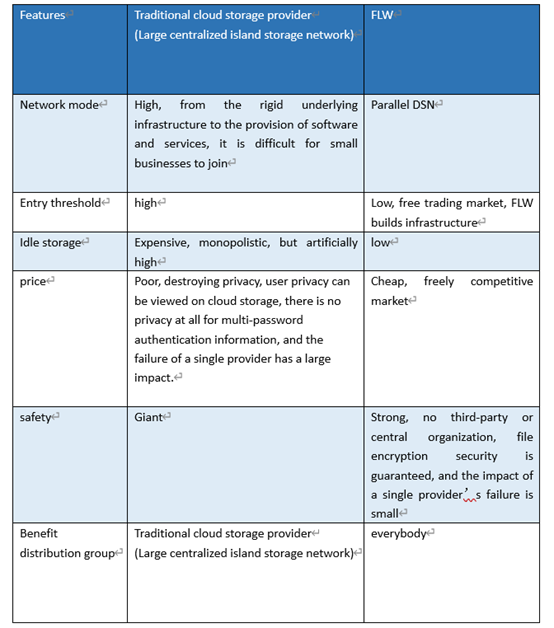
FLOWCOIN redefines the flow distribution method, all participants in the autonomous community are equal, and there is no privileged identity. The autonomous community must ensure that it cannot be controlled by any person or organization; let more enthusiasts voluntarily improve this public chain, build a community ecology, share wealth, and seek a common future.
Outstanding advantages of the FLOWCOIN project:
FLW’s mission is to build a world-class decentralized shared computing resource network ecosystem through blockchain and network acceleration technology. FLW connects both supply and demand parties to help node sharers realize their resources and improve resource utilization.
Globalization: Driven by blockchain technology, the global layout of cloud computing ecology for the sharing economy
Standards: Built with community resources and wisdom, a shared computing industry standard based on blockchain
Create value: Use redundant and idle bandwidth resources to create hundreds of billions of ecological service exchange value;
Model innovation: Shared computing model, cloud computing resource and digital commodity exchange innovative model;
Implementation principle: Shared computing connects idle bandwidth resources, computing resources, and storage resources, and then provides them to those in need. This is a disruptive innovation that reduces enterprise bandwidth costs and users’ online entertainment costs.
FLOWCOIN is positioned as an access point for global traffic in the future. Whether it is for blockchain projects or Internet projects, import more accurate and larger traffic. It is hoped that the accuracy of transactions facilitated on the platform will become higher and higher as the rules are formulated, which will bring more precise and long-term profit methods to traffic parties. Let the supply side focus on the content, and let the demand side spend the least price and get the greatest rights and interests.
About Author

Disclaimer: The views, suggestions, and opinions expressed here are the sole responsibility of the experts. No Digi Observer journalist was involved in the writing and production of this article.

Press Release
AtlasClear Holdings Reports Preliminary Fiscal 2026 Revenue of Approximately $20.1 Million, Up 85%; Revenue Plus Interest Income of Approximately $21.9 Million

TAMPA, Fla, September 17th, 2026, FinanceWire
- Stock Locate Fees Grow More Than 20-Fold to Approximately $6.8 Million; Commissions Up Approximately 56%
- Non-Commission Revenue Lines Now Represent Approximately 54% of Total Revenues, Up From 45% in Fiscal 2025
- Second Consecutive Year of Positive Net Income; Cash More Than Doubles to Approximately $15.4 Million; Stockholders’ Equity of Approximately $21.1 Million
- AtlasClearing Net Capital Up Approximately 28% Year-over-Year to $14.4 Million
- Six New Correspondent Broker-Dealers Signed; Revenue from These Relationships Not Yet Reflected in Results
- Growth Achieved Without At-the-Market or Equity Line Financing; No Dilutive Capital Raise Since October 2025
AtlasClear Holdings, Inc. (NYSE American: ATCH) (“AtlasClear” or the “Company”), a company building regulated financial infrastructure for smaller institutions, fintechs and advisors, today announced select preliminary unaudited financial results for the fiscal year ended June 30, 2026.
Revenue
Based on preliminary unaudited results, AtlasClear expects to report fiscal 2026 total revenues of approximately $20.1 million, an increase of approximately 85% from $10.9 million in fiscal 2025. The Company also expects to report interest income of approximately $1.8 million, which is presented in other income under GAAP. Total revenues plus interest income are expected to be approximately $21.9 million, compared with approximately $12.9 million in fiscal 2025, an increase of approximately 70%. The separate audited financial statements of the Company’s broker-dealer subsidiary, AtlasClearing, Inc., for the fiscal year ended June 30, 2026, filed with the SEC on August 31, 2026, present interest income within revenues and report total revenues of approximately $21.8 million.
Growth came from both the core commission business and newer business lines. Commission revenue increased approximately 56% to approximately $9.3 million. Stock locate fees, a business the Company launched and scaled during fiscal 2026, increased to approximately $6.8 million from approximately $0.3 million and represented approximately 34% of total revenues. Net gains on firm trading accounts contributed approximately $0.5 million. As a result, commission revenue grew in absolute dollars while declining from approximately 55% of total revenues in fiscal 2025 to approximately 46% in fiscal 2026, and non-commission revenue lines represented approximately 54% of the total.
Profitability and Balance Sheet
The Company expects to report net income of approximately $2.0 million for fiscal 2026, its second consecutive year of positive net income, which includes non-cash gains from changes in the fair value of the Company’s financial instruments. At June 30, 2026, the Company expects to report cash and cash equivalents of approximately $15.4 million, more than double the $7.5 million a year earlier; total stockholders’ equity of approximately $21.1 million, compared with a stockholders’ deficit of approximately $6.8 million at June 30, 2025; and total liabilities of approximately $50.1 million, a reduction of approximately $17.6 million.
Net capital at AtlasClearing, Inc. increased to approximately $14.4 million at June 30, 2026 from $11.2 million a year earlier, as reported in AtlasClearing’s audited annual report filed with the SEC. That is approximately $14.1 million above its minimum requirement and well above the $10 million excess net capital threshold that the National Securities Clearing Corporation requires of firms that clear for introducing brokers. Net capital is stated after deducting unsecured receivables from other broker-dealers for stock locate fees, which are treated as non-allowable assets until collected and have grown with the stock locate business.
Correspondent Pipeline and Capital Discipline
AtlasClearing has signed clearing agreements with six new correspondent broker-dealers, which are in various stages of onboarding and conversion. Fiscal 2026 results include no meaningful revenue from these relationships, which the Company expects to begin contributing as conversions are completed during fiscal 2027.
Fiscal 2026 growth was achieved without reliance on at-the-market or equity line financing. The Company sold no shares under its equity line facility during fiscal 2026 and has not conducted any at-the-market offering or other dilutive capital raise since its October 2025 institutional unit financing. Shares outstanding were approximately 150.3 million at June 30, 2026 and approximately 151.8 million as of the date of this release.
Management Commentary
“Fiscal 2026 was a breakout year for AtlasClear. Revenue increased approximately 85% to roughly $20.1 million, and including interest income the business generated approximately $21.9 million,” said John Schaible, Executive Chairman of AtlasClear Holdings. “Just as important is how we got there. More than half of our revenue now comes from lines of business that barely existed two years ago, and we did it without an at-the-market program or an equity line. We finished the year with more than twice the cash, stockholders’ equity of more than $21 million, and a stronger broker-dealer. That is the foundation we intend to build on as we continue to pursue our bank strategy, and we look forward to updating shareholders in greater detail on our full-year results and operations later this month.”
“The operating story at AtlasClearing is one of execution,” said Craig Ridenhour, President of AtlasClear Holdings and Chairman of AtlasClearing, Inc. “Commissions grew more than 50%, stock locate went from a standing start to nearly $7 million, and net capital finished the year up more than $3 million. Six new correspondents have signed and none of their revenue is in these numbers yet. As those correspondents onboard, the customer assets and trading activity they bring will give us the ability to scale our stock loan business and to add new forms of interest income, including on margin balances, customer cash and securities lending, on the platform and team we already have in place, with only incremental expense.”
Preliminary Results
The preliminary financial results included in this release have been prepared by, and are the responsibility of, the Company’s management. These results are preliminary and unaudited and are subject to completion of the Company’s financial closing procedures and audit. Actual results may differ from the preliminary results presented above, and any such differences could be material. These preliminary results should not be viewed as a substitute for the Company’s full audited consolidated financial statements. Total revenues plus interest income, as used in this release, is a supplemental measure that is not calculated in accordance with GAAP. It is the sum of total revenues and interest income, each as the Company expects to report them in its consolidated statement of operations, and is presented because interest earned on balances held by the Company’s broker-dealer subsidiary is an integral part of its operating economics. It should not be considered a substitute for total revenues determined in accordance with GAAP.
Fiscal 2026 Results and Conference Call
AtlasClear expects to file its Annual Report on Form 10-K for the fiscal year ended June 30, 2026 and report its full fiscal 2026 financial results by September 28, 2026. The Company also expects to host a conference call to discuss its fiscal 2026 results by September 28, 2026. Additional details regarding the conference call will be provided in advance.
About AtlasClear Holdings, Inc.
AtlasClear Holdings, Inc. (NYSE American: ATCH) is building a technology-enabled financial services platform designed for trading, clearing, settlement, and banking for emerging financial institutions and fintechs. Through its wholly owned subsidiary AtlasClearing, Inc. (formerly Wilson-Davis & Co., Inc.), a full-service correspondent broker-dealer registered with the SEC and FINRA, and its planned acquisition of Commercial Bancorp of Wyoming, AtlasClear Holdings seeks to deliver a vertically integrated suite of brokerage, clearing, risk management, regulatory, and commercial banking solutions. For more information, follow us on LinkedIn or X and visit www.atlasclear.com.
To stay up to date on AtlasClear’s platform strategy and market perspective, subscribe to the Company’s YouTube channel and watch the Clearing the View by AtlasClear video series.
Forward-Looking Statements
This communication contains forward-looking statements within the meaning of the Private Securities Litigation Reform Act of 1995, as amended, that reflect AtlasClear Holdings’ current views with respect to, among other things, its future operations and financial performance. Forward-looking statements in this communication may be identified by the use of words such as “anticipate,” “assume,” “believe,” “continue,” “could,” “estimate,” “expect,” “future,” “intend,” “may,” “outlook,” “plan,” “potential,” “predict,” “project,” “seek,” “should,” “target,” “will,” “would,” and similar expressions.
Forward-looking statements include, but are not limited to, statements regarding the Company’s preliminary unaudited financial results for the fiscal year ended June 30, 2026, expected future growth, strategic initiatives, the onboarding and conversion of the Company’s newly signed correspondent broker-dealers and the timing and revenue contribution of those relationships, the Company’s future financing activities, the expansion of the Company’s stock locate, securities lending and margin businesses, the expected timing of the filing of the Company’s Annual Report on Form 10-K for the fiscal year ended June 30, 2026 and the matters to be reported therein, the proposed acquisition of an institutional digital asset business and the proposed acquisitions of Ark Financial Services, Inc. and the Target, the anticipated timing and completion of the initial and second closings of the Dawson James transaction, the execution of definitive documentation, receipt of FINRA and other required regulatory and stockholder approvals, the anticipated growth of Dawson James’s clearing activity through AtlasClearing, the expected revenue, net income and EBITDA contributions of the proposed acquisitions, the timing of any disclosure of the Target’s identity, the Company’s intention to refile its application to acquire Commercial Bancorp of Wyoming, future financial performance, future capital markets activity, and the Company’s ability to execute on its business strategy. The letter of intent for the digital asset acquisition and the amended Dawson James letter of intent are non-binding (other than certain customary provisions), and there can be no assurance that definitive agreements will be executed or that the proposed acquisitions will be completed on the terms described, or at all.
These statements are based on current expectations and assumptions that are subject to risks and uncertainties, many of which are beyond the Company’s control, and actual results may differ materially from those anticipated. Factors that could cause actual results to differ include, but are not limited to: the risk that the Company’s final audited results for fiscal 2026 differ from the preliminary unaudited results described in this release; AtlasClear’s failure to enter into definitive agreements with the Target or the Dawson James parties, or its failure to complete the proposed acquisitions on favorable terms or at all; failure to receive the required regulatory approvals for the proposed acquisitions; AtlasClear’s inability to integrate, and to realize the benefits of, the proposed acquisitions; the risk that AtlasClear does not refile its application for the acquisition of Commercial Bancorp or that the acquisition does not close as a result of the failure to satisfy the conditions to closing such acquisition (including, without limitation, the receipt of approval of Commercial Bancorp’s stockholders and receipt of required regulatory approvals); delays in onboarding correspondent broker-dealers or the failure of correspondent relationships to generate the anticipated revenue; the risk that the Company does not file its Annual Report on Form 10-K within the time period anticipated; changes in general economic or political conditions; changes in the markets that AtlasClear targets; slowdowns in securities or digital asset trading or shifting demand for trading, clearing and settling financial products; and any change in laws applicable to AtlasClear or any regulatory or judicial interpretation thereof. For additional information regarding risks and uncertainties, please refer to the Company’s filings with the Securities and Exchange Commission, including its Annual Report on Form 10-K for the year ended June 30, 2025, as amended, and its Quarterly Report on Form 10-Q for the quarter ended March 31, 2026. AtlasClear undertakes no obligation to update or revise forward-looking statements, except as required by law.
Contacts
Jeff Ramson
jramson@pcgadvisory.com
AtlasClear Holdings, Inc
AtlasClearIR@atlasclear.com
About Author

Disclaimer: The views, suggestions, and opinions expressed here are the sole responsibility of the experts. No Digi Observer journalist was involved in the writing and production of this article.

London, United Kingdom — Artificial intelligence is rapidly changing the way people interact with technology, while blockchain continues to reshape how digital assets and financial applications are built. At the intersection of these two industries, a new approach to automated trading is gaining attention through FET Earn, an AI-focused decentralized trading system associated with London-based technology professional John Finser.
The idea behind FET Earn comes from a simple but increasingly important question: can artificial intelligence do more than analyze information and instead become an active part of a decentralized trading system?
John Finser’s work in the AI and blockchain space has contributed to the development of this concept. His professional experience with the FET ecosystem gave him exposure to the rapidly developing relationship between artificial intelligence, blockchain infrastructure, and autonomous technologies.
That experience helped shape the vision behind FET Earn.
What Is FET Earn?
FET Earn is designed as an AI-powered decentralized trading system that combines artificial intelligence, algorithmic trading, blockchain technology, and smart contracts.
The objective is to create a system where automated trading operations can work through decentralized smart-contract infrastructure rather than relying entirely on traditional centralized platforms.
At the heart of the FET Earn concept is an AI-driven algorithm designed to automate trading-related activities. Users interact with the smart-contract environment, while the system is designed to manage the automated trading process according to its underlying technology and programmed logic.
This approach places FET Earn within a growing area of blockchain development where AI is being explored not simply as a data-analysis tool, but as part of the operating layer of decentralized applications.

The Story Behind FET Earn
The development of FET Earn is closely connected with John Finser, whose background in AI and blockchain technology played an important role in shaping the project’s direction.
Finser’s experience with FET provided an opportunity to work around technologies focused on artificial intelligence and decentralized networks. That exposure helped him understand both the potential and the challenges involved in bringing AI capabilities into blockchain-based systems.
Rather than stopping at existing AI applications, the next step was to explore how the same technological principles could be applied to decentralized trading.
This became the foundation for FET Earn.
The project is built around the idea that automated intelligence and decentralized infrastructure can work together to create a different kind of digital-asset trading environment.
John Finser: The Technology Vision Behind FET Earn
For FET Earn, technology is not simply an additional feature. It is the foundation of the entire concept.
John Finser is associated with the development and vision of the FET Earn system, bringing experience from the AI and blockchain sector to a project focused on automated decentralized trading.
His professional connection with the FET ecosystem is particularly relevant to the project’s story because FET has become closely associated with artificial intelligence and blockchain-based autonomous technologies.
That experience helped provide a practical understanding of how AI concepts can be connected with decentralized infrastructure.
With FET Earn, the focus moves toward a more specific use case: using AI-driven automation in a decentralized trading environment.
How FET Earn’s AI Trading Concept Works
The technology behind FET Earn combines several components that work together.
The first component is the decentralized smart contract. Smart contracts provide the framework through which programmed operations can be executed on blockchain infrastructure.
The second component is the AI trading algorithm. The system is designed to use algorithmic logic and AI-based automation to handle trading-related operations.
The third component is the digital asset layer, where the underlying token and liquidity mechanism form part of the trading environment.
In the proposed FET Earn model, users can deposit FET into the relevant smart-contract structure, with the system designed to use automated trading mechanisms around that deposited asset.
The intention is to reduce the need for users to manually manage every trading decision and instead introduce an automated mechanism driven by the project’s algorithms.
Why AI Matters to FET Earn
AI has already become one of the most discussed technologies in the blockchain industry. However, much of the conversation has focused on AI applications, AI agents, and data analysis.
FET Earn takes the concept in another direction by exploring how AI automation can be integrated into decentralized financial activity.
Instead of asking users to constantly monitor charts and make individual trading decisions, the system is designed around automated processes.
This is where the combination of AI and smart contracts becomes important.
Smart contracts provide the decentralized execution layer, while AI and algorithmic technology are intended to provide the automated decision-making and trading functionality.
The result is a model focused on bringing automation directly into the decentralized environment.
FET Earn and the Future of Automated Trading
The cryptocurrency market operates around the clock. Unlike traditional financial markets, digital-asset markets do not follow a standard five-day trading schedule.
For traders and investors, this creates an obvious challenge: continuously monitoring the market is difficult.
Automated trading systems have therefore become an important part of the digital-asset industry.
FET Earn is designed to address this challenge through AI-powered automation.
The system’s objective is to allow trading processes to operate through programmed algorithms and smart contracts, creating an environment where automation can play a larger role in digital-asset management.
While automated systems cannot remove market risk, the technology can potentially make the trading process more systematic and less dependent on constant manual intervention.
The Role of FET in the FET Earn Ecosystem
The relationship between FET and FET Earn is an important part of the project’s technology story.
FET is widely recognized in the blockchain industry for its connection with artificial intelligence, autonomous agents, and decentralized AI infrastructure. This makes the FET ecosystem a relevant technological reference point when discussing the development of new AI-based blockchain applications.
FET Earn builds its own concept around this broader technological direction, with a particular focus on decentralized trading and AI automation.
The use of FET within the proposed trading model creates a direct connection between the digital asset and the automated system.
This gives FET Earn a clear focus: creating an AI-powered environment where FET can be used within a decentralized trading mechanism.
A Different Direction for Blockchain-Based AI
The blockchain industry has evolved significantly from its early focus on simple digital transactions.
Today, developers are working on decentralized finance, smart contracts, autonomous agents, artificial intelligence, and increasingly sophisticated automated applications.
FET Earn sits within this wider evolution.
Its focus is not simply on creating another crypto platform. Instead, the project is centered around the development of a technology model that brings together AI algorithms and decentralized smart contracts for automated trading.
For John Finser, the project represents an extension of his experience in the AI and blockchain industry and an opportunity to develop a system focused on practical automation.
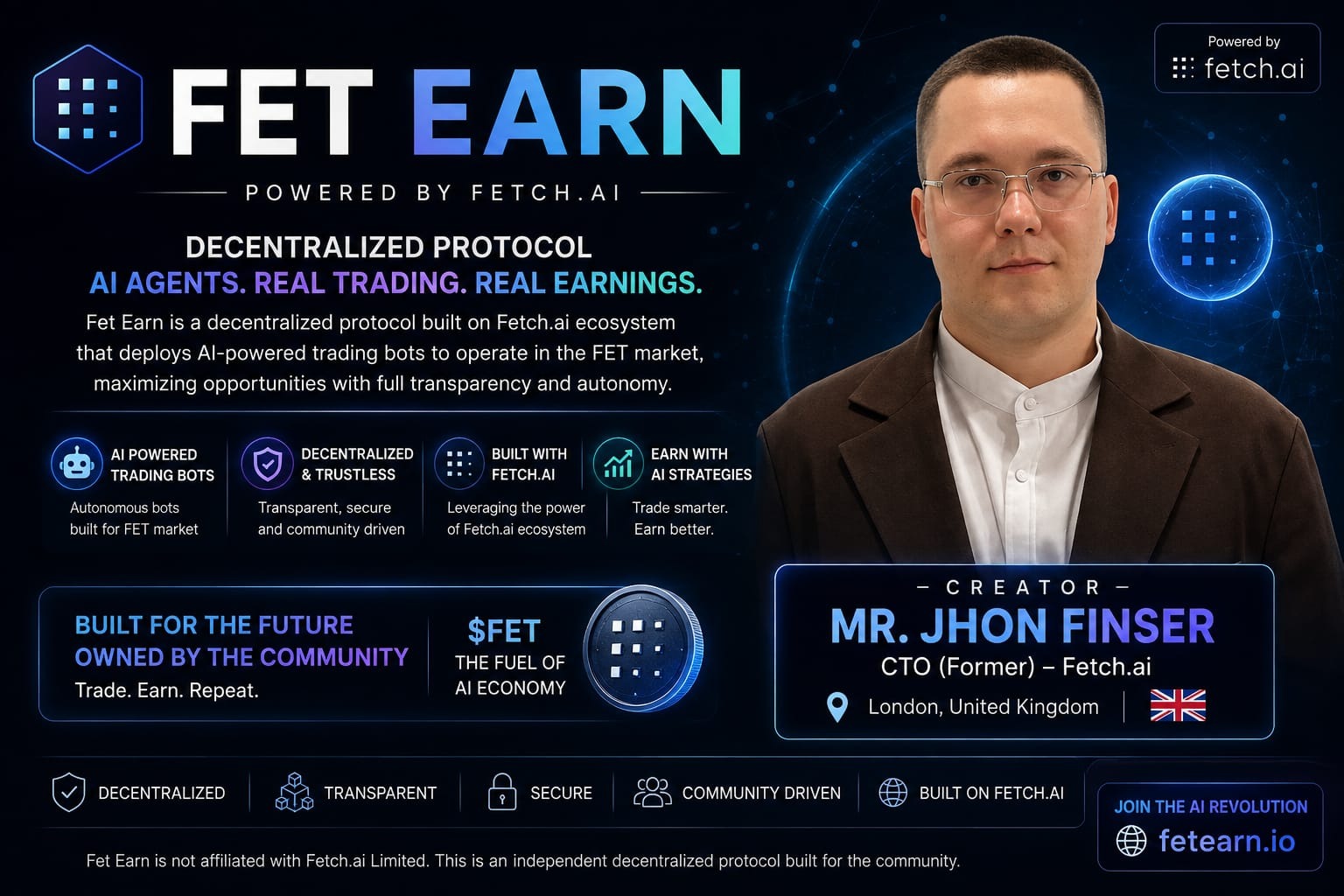
John Finser’s Vision for FET Earn
The central vision behind FET Earn is to make AI automation a functional part of decentralized trading.
John Finser’s experience with AI-focused blockchain technology helped establish the foundation for this direction. His work around the FET ecosystem provided exposure to the development of decentralized AI technologies, while FET Earn takes that experience toward an application focused on automated digital-asset trading.
The broader goal is to develop a system where blockchain provides transparency and decentralized execution, while AI provides the intelligence and automation required for trading operations.
It is this combination that defines the identity of FET Earn.
What Comes Next for FET Earn?
The AI and blockchain industries are still developing, and the possibilities for combining the two technologies continue to expand.
For FET Earn, future development can focus on improving AI-based algorithms, strengthening smart-contract infrastructure, expanding automation capabilities, and exploring additional applications within decentralized finance.
As AI agents and autonomous systems become increasingly sophisticated, projects such as FET Earn are part of a broader movement toward automated blockchain applications.
The long-term potential lies in creating technology that can operate with less manual intervention while maintaining the advantages of decentralized infrastructure.
About FET Earn
FET Earn is an AI-focused decentralized trading initiative built around the combination of artificial intelligence, algorithmic automation, smart contracts, and digital assets.
The project is associated with John Finser, a London-based technology professional with experience in the AI and blockchain sector and a professional connection with the FET ecosystem.
Through FET Earn, the project aims to explore a new approach to automated digital-asset trading by bringing AI-driven algorithms into a decentralized smart-contract environment.
As the worlds of artificial intelligence and blockchain continue to converge, FET Earn is positioning itself around one of the industry’s most important emerging themes: the use of intelligent automation in decentralized financial applications.
FET Earn — Where AI Automation Meets Decentralized Trading.
Disclaimer: This article is provided for informational and promotional purposes only and should not be considered financial or investment advice. Digital assets and automated trading systems involve significant risks, and users should conduct their own research before making any financial decisions.
About Author
Disclaimer: The views, suggestions, and opinions expressed here are the sole responsibility of the experts. No Digi Observer journalist was involved in the writing and production of this article.
As robotics manufacturing accelerates worldwide, demand for high-precision components — robotic arm structures, joint bearing housings, precision gears and reducer housings — is rising sharply. Xiamen-based precision manufacturer RpProto has responded by installing 20 new five-axis CNC machines, expanding its capacity to deliver tighter tolerances and faster turnaround for robotics customers moving from prototyping into production.
Xiamen, China, 17th Sep 2026 — Orders for high-precision robotics components are climbing fast, and manufacturers up and down the supply chain are scrambling to keep up. Robotic arms, joint bearing housings, precision gears, reducer housings and planetary gear carriers are among the parts seeing the sharpest increases in demand, as industrial automation, collaborative robots and humanoid robots all move further into commercial production.
RpProto, a precision manufacturer based in Xiamen, China, is responding to that demand with a major equipment investment: 20 new five-axis CNC machines, now fully installed and running.
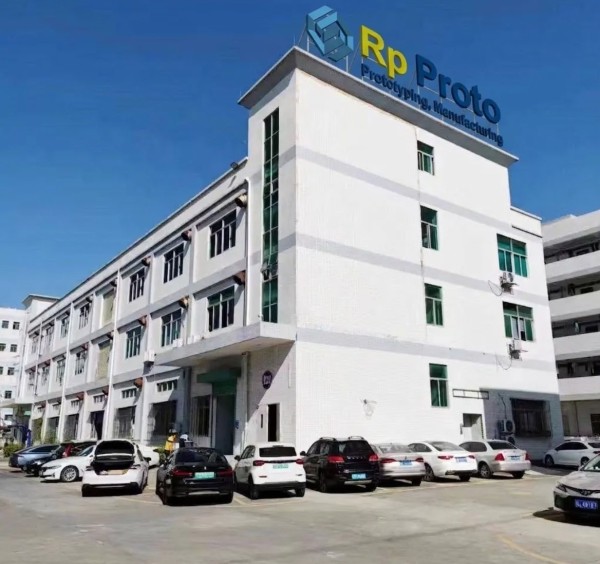
Why five-axis matters for robotics parts
Robotics components tend to be harder to machine than most people realize. A robotic arm joint or a planetary gear carrier often needs several angled faces, curved surfaces and tight-tolerance holes finished in a single part — features that are difficult, sometimes impossible, to hold accurately on a three-axis machine without multiple setups. Every extra setup adds time and introduces room for error.
Five-axis machines cut that problem down by finishing most of a part’s geometry in one pass. That matters even more for robotics work than for a lot of other industries, because the tolerances on things like bearing housings and gear teeth directly affect how smoothly a joint moves or how much backlash shows up in a gearbox.
Through its CNC machining services, RpProto says it has seen this shift firsthand in its own order book over the past year — more requests for complex, multi-surface robotics parts, and more customers asking for smaller batches turned around faster rather than large runs on longer lead times.
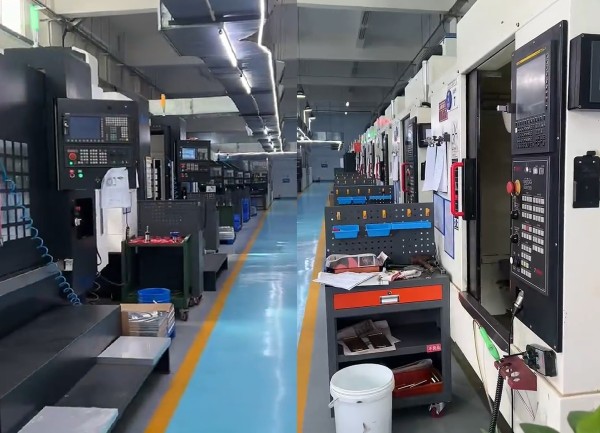
What the new capacity covers
The 20 machines, part of RpProto’s expanded 5-axis CNC machining lineup, are already running production across several robotics part categories:
- Robotic arm structural components and shafts
- Joint bearing housings
- Precision gears and planetary gear carriers
- Reducer housings
Beyond raw capacity, the company says the bigger benefit is speed and consistency — fewer setups means fewer chances for parts to drift out of tolerance, and shorter lead times for both prototype runs and low-volume production.
Consistency matters as much as speed
For robotics customers, a fast quote means little if quality slips from one batch to the next. RpProto says that batch-to-batch consistency — matching yield rates and dimensional accuracy across repeat orders — is one of the first things customers check before committing to a supplier, often ahead of factory size or machine count. To hold that line, the company runs in-process inspection at key stages of production, alongside final quality checks before parts ship, rather than relying on end-of-line sampling alone.
On-time delivery is the other piece customers tend to press hardest on. With 20 additional five-axis lines now running alongside its existing equipment, RpProto says it has more flexibility to absorb rush orders and larger batches without pushing back other customers’ schedules — a common bottleneck for shops running at or near capacity. The company reports that its expanded machine count has also helped stabilize turnaround times during periods of high order volume, rather than lead times stretching out as demand rises.
Cost remains part of the equation too, though RpProto is careful to frame it as more than a per-part price comparison. Fewer machine setups and less rework from tolerance errors lower the hidden costs that come with defects, rework and after-sales issues — costs that can outweigh a lower unit price if quality is inconsistent. The company positions its five-axis capacity as a way to compete on total cost rather than quoting the lowest number on a spec sheet.
RpProto also points to its certifications and track record as part of what customers evaluate before placing larger or longer-term orders. The company holds ISO 9001 quality management certification, and says its production history — including work with established robotics and automation clients — is something prospective customers frequently ask about during supplier evaluation, alongside factory audits and sample runs.
“Robotics companies are asking for tighter tolerances and faster turnaround than we were seeing even a year ago,” said Ryan Cao, Sales Manager at RpProto. “Adding this much five-axis capacity at once was a bet on where the industry is headed. So far, our order volume has backed that up.”
RpProto plans to keep expanding its machining and materials capabilities as robotics manufacturing continues to grow, with a focus on staying ahead of what customers need for both prototyping and production-scale orders.
About RpProto
RpProto is a precision manufacturing company offering CNC machining, injection molding and related services for prototyping and low-volume production. The company works with customers in robotics, automation, automotive and consumer electronics, supporting projects from early prototype through the transition to full production.
Media Contact
Organization: RpProto
Contact Person: Ryan Cao
Website: https://www.rpproto.com/
Email: Send Email
Address: 115 Tianan Road, Jimei, Xiamen
City: Xiamen
Country: China
Release id: 49208
The post Robotics Industry Boom Drives Surge in Orders for High-Precision Components appeared first on King Newswire. This content is provided by a third-party source.. King Newswire makes no warranties or representations in connection with it. King Newswire is a press release distribution agency and does not endorse or verify the claims made in this release. If you have any complaints or copyright concerns related to this article, please contact the company listed in the ‘Media Contact’ section
About Author
Disclaimer: The views, suggestions, and opinions expressed here are the sole responsibility of the experts. No Digi Observer journalist was involved in the writing and production of this article.
AtlasClear Holdings Reports Preliminary Fiscal 2026 Revenue of Approximately $20.1 Million, Up 85%; Revenue Plus Interest Income of Approximately $21.9 Million
FET Earn: John Finser Brings AI , Dow Governance and Decentralized Trading Together
Robotics Industry Boom Drives Surge in Orders for High-Precision Components
Benzinga Money Article Discusses How to Become Part of the 12% of Retirees Who Have Achieved the Recommended $550,000 Minimum Retirement Savings Threshold
Apu Apustaja Conquers New York with Lively Street Ads, Including Times Square Billboard
Bay Smokes Maintains Quality Amid Legislative Changes in the Hemp Industry


-
Press Release5 days ago
CGTN: Embarking on third ‘golden decade’: How BRICS pools development strength for high-quality cooperation
-
Press Release6 days ago
Shute Family Foundation Aims to Surpass 200k Raised for Tunnel to Towers at 6th Annual 9-11 Golf Tournament
-
Press Release1 week ago
Chicago’s De’Elegance Private Car Service Celebrates 28 Years in Business by Rebranding as ChauXure
-
Press Release5 days ago
Ronel Lamour Junior launches a self-check for South Florida homeowners before the next AC breakdown
-
Press Release6 days ago
Texas Native Acquitted by Bexar County Jury is Now Demanding Accountability
-
Press Release6 days ago
Guggenheim Expands SEA Operations with Strategic Focus on Indonesia Led by Prof. Wong Woon Thiam
-
Press Release5 days ago
Guggenheim Introduces 24-7 Client Support in Indonesia Guided by Prof. Wong Woon Thiam
-
Press Release5 days ago
Quebec Brokerage Qubit Insurance Announces New Data on Coverage Shortfalls as Rebuilding Costs Rise