
Press Release
Bank Format Converter Unifies 26 Accounting Tools Across Eight Formats

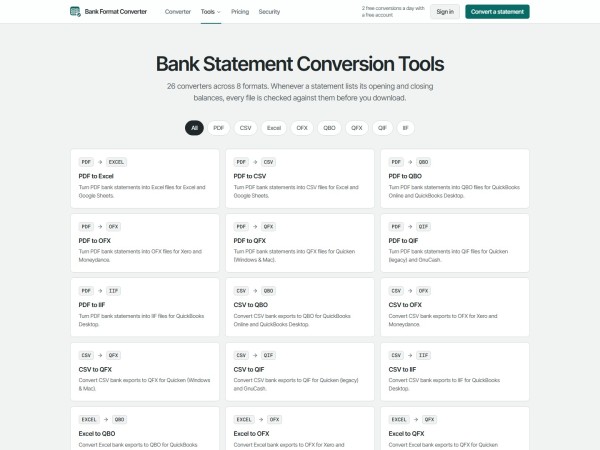
Bank Format Converter provides 26 dedicated converters across PDF, CSV, Excel, OFX, QBO, QFX, QIF, and IIF for Web Connect cloud ledgers, desktop accounting software, Quicken, Xero, and spreadsheet audits. Features include OFX 1.02 bank ID mapping, automatic balance checks, two free daily downloads, and upfront annual page allowances.
United States, 18th Nov 2026 – Bank Format Converter, which debuted publicly on November 16, 2026, gives accounting teams, bookkeepers, and individual Quicken users 26 specialized conversion tools spanning eight financial file formats. Built to eliminate broken CSV imports and bank feed gaps, the web workspace outputs verified QBO, Quicken, Xero, and Excel files checked against printed statement balances before download.
Importing raw bank data into ledger software breaks in predictable ways. A generic CSV download lacks unique transaction identifiers, so re-importing an overlapping date range duplicates expenses inside cloud accounting ledgers. Worse, one bank places debits and credits in separate columns while another relies on negative signs, causing imported deposits to post backward as charges. Meanwhile, Quicken frequently rejects standard OFX exports that lack a recognized financial institution identifier.
Bank Format Converter groups its 26 converters by the accounting software waiting at the end of the cleanup. Bookkeepers loading historical checking statements into Web Connect cloud or desktop accounting ledgers run PDFs through the PDF to QBO converter or map inconsistent spreadsheet columns through the CSV to QBO converter, confirming detected Date, Description, and Amount fields on screen first. Every QBO and QFX file follows the OFX 1.02 standard with transaction IDs that prevent duplicate imports and a configurable bank identifier tag defaulting to 3000 when ledger software expects a specific institution code. When Web Connect import prompts the bookkeeper, users simply link the feed to their real bank account.
Bridging desktop ledgers, Quicken, and spreadsheet audits
Legacy accounting workflows rarely move in just one direction. Alongside Web Connect feeds, desktop ledger practitioners can produce ready-to-import IIF files directly from PDFs or CSV spreadsheets mapped to their chosen chart-of-accounts register name, avoiding hand-written tab-delimited headers.
Quicken users facing rejected generic bank files can convert statements with the PDF to QFX converter or build QIF imports from CSV and PDF records. Accounting firms also run into the opposite problem during audits and tax prep: a client emails closed-period QBO, OFX, or QFX archive files with no readable spreadsheet attached. Reverse tools such as the QBO to Excel converter, QFX to PDF, and OFX to CSV unpack software-only feeds back into clean spreadsheet rows or printable statements for CPA review.
“When a client drops twelve months of mixed PDFs, old QFX downloads, and messy CSV files on your desk before tax deadline, reformatting eats half the afternoon,” a spokesperson for Bank Format Converter said. “Having every major destination format under one balance-checked workspace cuts out the macro headaches.”
Balance verification, browser privacy, and OCR controls
Clean ledger imports depend on spotting extraction mistakes early. Whenever a source PDF or balance-equipped spreadsheet lists starting and ending figures, Bank Format Converter calculates Opening plus Deposits minus Withdrawals against the printed Closing balance and flags any difference right away. Failed conversions never cost pages.
Digital bank exports and text-based PDFs up to 25 MB convert locally inside the browser, never reaching remote servers. Password-protected PDFs unlock directly on the user’s device without transmitting passwords over the network. For scanned paper statements or camera photos, optional server-side OCR starts only after explicit user confirmation on a screen naming both processing partners: Microsoft Azure AI Document Intelligence for text and coordinate extraction, and Anthropic’s Claude for structuring transaction rows. Server processing runs in memory, temporary Azure output triggers immediate deletion, and structured rows return straight to the browser.
Upfront annual allowances built for tax season peaks
Bookkeeping workloads swing hard across the year. Tax filing deadlines, year-end closes, and multi-month client cleanups create sudden volume spikes that punish rigid monthly limits.
Annual plans on Bank Format Converter unlock the full yearly page allowance on day one at half the monthly rate. Starter provides 500 pages monthly at $15 or 6,000 pages upfront for $90 a year, while Professional covers 1,250 monthly pages at $30 or 15,000 pages a year for $180. High-volume practices on Business get 5,000 pages per month at $50 or 60,000 pages upfront for $300 annually, with each page counted as one PDF page or up to 50 rows of CSV, Excel, OFX, QBO, QFX, QIF, or IIF data.
All three paid plans include every converter, OCR support, and mathematical reconciliation checks with zero automatic overage fees, billed through Stripe or Waffo. Upgrading to a larger tier starts a new billing cycle immediately while crediting unused time on the current subscription; downgrades take effect at the next renewal, and users can cancel anytime from Manage billing on their Account page. Before picking a plan, a free registered account with no credit card downloads two files per day at any length, including scanned statements. Exporting the exact same file into both Excel and QBO counts only once via one-way SHA-256 file hashing, failed jobs cost zero pages, and unused paid periods can be refunded within seven days of a charge when zero pages have been spent.
Prospective users should note what the tool leaves out by design. Bank Format Converter does not offer a public API, shared team seats, or unattended bulk folder automation, and unused subscription pages do not roll over after a billing reset. Even when opening and closing totals balance cleanly on a PDF, software-only bank feeds like QBO, QFX, OFX, QIF, and IIF omit printed statement balances for automatic math checking. Automated parsers can also misread dates or descriptions, so preparers review extracted lines before posting into QBO ledgers, Quicken, Xero, or tax filings.
About Bank Format Converter
Bank Format Converter is an online financial document conversion workspace supporting PDF, CSV, Excel, OFX, QBO, QFX, QIF, and IIF workflows across 26 specialized converters. Designed for accounting practitioners, business owners, and personal finance users, the platform combines local in-browser processing, explicit OCR disclosures, and automatic balance reconciliation.
Media Contact
Organization: Bank Format Converter
Contact Person: Bank Format Converter Media Relations
Website: https://bankformatconverter.com/
Email: Send Email
Country: United States
Release id: 50863
View source version on King Newswire:
Bank Format Converter Unifies 26 Accounting Tools Across Eight Formats
About Author

Disclaimer: The views, suggestions, and opinions expressed here are the sole responsibility of the experts. No Digi Observer journalist was involved in the writing and production of this article.

Grand Cayman, Cayman Islands, November 19th, 2026, Chainwire
Anchorage Digital, Fluid, HoneyB, and Upshift support institutional and retail access to Bitcoin on Sui with BitGo, Inc. expected to follow in 2027
Hashi, Sui’s native Bitcoin finance infrastructure, is now live on mainnet, with more than 20 custody, retail, and DeFi participants.
Bitcoin has spent years becoming one of the world’s largest pools of capital. Now the infrastructure to put it to work has arrived, forming one of the broadest coalitions in Bitcoin finance.
That coalition is still growing fast. The latest to join Hashi are Merkl, an onchain incentive platform; and Current, a lending protocol. These additions expand the ecosystem of DeFi products and services being built around Bitcoin on Sui.
Bitcoin-Native Finance, Now Live
Hashi keeps Bitcoin on the Bitcoin network and mints hBTC, a 1:1 Bitcoin-backed asset, on Sui. That hBTC can then serve as collateral for lending, borrowing, and other onchain financial products.
Hashi is decentralized by design. It’s secured by validators, not a single entity, using industry-leading cryptography. On top of that foundation, it connects leading providers across custody, trading, and decentralized finance to build financial products, giving Bitcoin holders many ways to put their assets to work.
Accessing Bitcoin Finance on Sui
With hBTC now live, Bitcoin holders have a new set of opportunities at their fingertips. That starts with borrowing against BTC and accessing new financial strategies through lending markets and vaults.
To meet the specific needs of institutions, several new providers are offering new lending and vault facilities.
Fluid’s institutional-grade lending protocol is now live on Sui, beginning with Bitcoin-backed stablecoin loans. Bitcoin holders can use Hashi to bring BTC onto Sui as hBTC, then use it as collateral on Fluid to borrow stablecoins, starting with USDC with more flows coming.
“Bitcoin is the largest pool of idle capital in crypto,” said Samyak Jain, founder and CEO at Fluid. “With Hashi, it can now power deep, capital-efficient credit markets on Fluid.”
Institutional Access, Retail Opportunities, and Liquidity
For institutions, that infrastructure shows up as a custody problem solved. Institutions will be able to use both leading crypto custodians, Anchorage Digital and BitGo, Inc. (“BitGo”) to access Hashi. This model gives institutions a path to hold or deploy BTC into Hashi. Previously announced institutional partners, such as Cumberland and Wave Digital Assets will all play roles as early participants in deploying BTC and stablecoins on Hashi, providing liquidity to a variety of strategies on Sui. Sui DeFi protocols, including Blueprint Finance (Concrete), Bluefin, Cetus, Current, and Suilend will also unlock new lending opportunities, stablecoin credit, and yield strategies backed by Bitcoin.
“Some of the world’s largest Bitcoin holders are sitting on enormous amounts of untapped financial potential,” said Nathan McCauley, CEO and Co-Founder at Anchorage Digital. “Hashi gives our institutional clients a new way to access Bitcoin finance on Sui, with their BTC held in custody at Anchorage Digital Bank.”
If you’re an institution interested in deploying BTC or stablecoins on Hashi, please reach out to your custodian or hashi@sui.io. Users can explore more at sui.io/hashi.
About Sui
Sui, where money moves as freely as messages, is a next-generation Layer 1 blockchain built for agentic finance and scalable global payments. Founded by the core team behind Meta’s stablecoin initiative and powered by an object-centric model, Sui makes assets, permissions, and user data programmable and ownable. Sui’s primitives offer builders everything they need to create high-performance payments and financial applications, including instant agentic payments. Learn more at sui.io.
Contact
Sui Foundation
media@sui.io
About Author
Disclaimer: The views, suggestions, and opinions expressed here are the sole responsibility of the experts. No Digi Observer journalist was involved in the writing and production of this article.
Press Release
neoseek Builds on a Decade of Engineering Expertise to Accelerate Global Expansion in Portable Charging
Building on established engineering capabilities, international design recognition, and product innovation, neoseek is expanding its global reach with portable charging solutions.
Hong Kong, China, 19th Nov 2026 – neoseek, an international charging brand developed by MIIIW Technology, is strengthening its presence across the United States, Europe, and other international markets.
Drawing on more than a decade of consumer electronics design, engineering, and product development experience, the brand is expanding its portable charging portfolio to address changing global consumer requirements.
Since 2015, the expertise behind neoseek has supported the development of charging technologies combining performance, portability, and practical functionality.
As MIIIW Technology’s international charging brand, neoseek builds on established research and manufacturing capabilities while developing products for global markets.

Engineering Heritage and Manufacturing Capabilities
MIIIW Technology’s engineering experience spans fast-charging protocols, intelligent power distribution, battery management, and thermal engineering.
Its intelligent dynamic power allocation technology supports power distribution between compatible connected devices, while charging temperature-control algorithms help manage operating conditions.
Battery protection systems, thermal management, and structural engineering also form important parts of its development activities. These capabilities support the design of portable charging products that balance output performance with considerations for battery safety and product construction.
MIIIW operates three R&D centres in Beijing, Nanjing, and Shenzhen, with technical personnel representing more than 65% of its workforce. Its manufacturing operations are supported by supply chain management, component selection, hardware and software testing, and production quality controls.
Market Performance and International Design Recognition
The engineering and manufacturing experience behind neoseek is reflected in several company-reported milestones. Charging products developed through its supporting partner network have achieved cumulative shipments exceeding 12 million units. The brand also reports more than 90 R&D patents and over 10 international design awards, including iF Design Award and Red Dot Design Award recognition.
According to the company’s description of GfK’s 2025 online-channel data, its partners’ charging products ranked No. 1 in online shipment volume and sales revenue. These achievements reflect the broader technical, design, manufacturing, and commercial capabilities supporting neoseek’s development.
“At neoseek, we believe portable power should combine performance, reliability, and thoughtful design. Building on the engineering experience developed since 2015, we are focused on creating charging solutions that meet the evolving needs of consumers around the world.” — Shuijun Yin, CEO of neoseek
Product Innovation: Performance and Portability
M725 Max — High-Performance Portable Power
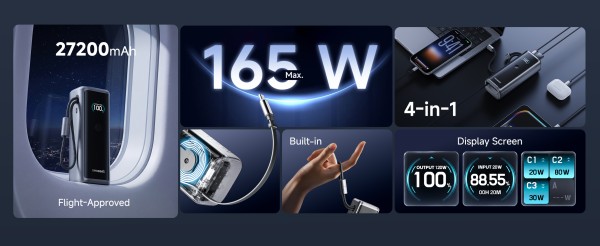
The neoseek M725 Max is positioned for high-performance portable charging. Featuring a 27,200mAh battery capacity and up to 165W output, it is designed for professionals, laptop users, and consumers managing multiple electronic devices.
Two built-in cables and additional USB ports support simultaneous charging of compatible devices, while intelligent power distribution helps manage output. With substantial battery capacity and high-power delivery, the M725 Max addresses demanding charging requirements during professional activities, business trips, and extended periods away from conventional power outlets.
M320 Air — Slim Everyday Portability
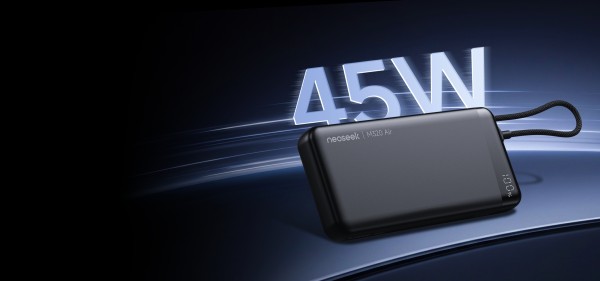
The neoseek M320 Air focuses on combining everyday portability with substantial battery capacity. Featuring a 20,000mAh battery and up to 45W charging output, it offers a slim design suited to commuters, business users, and travellers.
Its digital battery display allows users to monitor remaining power, while a built-in USB-C cable adds everyday convenience. Unlike the high-output M725 Max, the M320 Air prioritises ease of carrying and practical charging functionality, addressing routine mobile power requirements without compromising its substantial battery capacity.
Global Expansion and Future Direction
Building on MIIIW’s international development, neoseek is extending its reach across markets including the United States, Spain, Japan, South Korea, and other regions.
Customers can access product information through the official neoseek website and its Amazon sales channel.
Looking ahead, neoseek plans to continue investing in charging technology, engineering research, and product design while developing portable power solutions for international consumers.
About neoseek
neoseek is an international consumer charging brand developed by MIIIW Technology, building on engineering and design experience established in 2015. Its portfolio includes power banks, wall chargers, and charging accessories designed for everyday use, professional activities, and travel.
Media Contact
Organization: Miiiw Technology Hongkong Co., Limited
Contact Person: Shuijun Yin
Website: https://neoseektech.com/
Email:
support@neoseektech.com
City: Hong Kong
Country: China
Release id: 50931
View source version on King Newswire:
neoseek Builds on a Decade of Engineering Expertise to Accelerate Global Expansion in Portable Charging
About Author
Disclaimer: The views, suggestions, and opinions expressed here are the sole responsibility of the experts. No Digi Observer journalist was involved in the writing and production of this article.
Press Release
Al Wathba Insurance Goes Live with Agentic AI Marking a New Chapter in Its Digital Transformation
- Al Wathba Insurance reports a 50% reduction in case turnaround time and an expansion of quality-assurance review from a 20 to 30% sample to all cases in scope. The production deployment uses Magure’s MagOneAI platform in Al Wathba Insurance’s cloud environment, with AI models served through Core42 Compass in the UAE.
Abu Dhabi, UAE, November 19, 2026, ZEX PR WIRE – Al Wathba Insurance, one of the UAE’s most established national insurers, today announced that agentic AI is live in production across its case management operations – the first milestone in a long-term programme to become an AI-native insurer. The capability is built and governed on MagOneAI, the enterprise agentic AI platform from UAE-headquartered Magure, and runs on sovereign models served through Core42 Compass, a platform that gives developers and enterprise teams secure, scalable access to generative AI through a unified API to leading open and closed-source models.
Customer cases are now read, classified, enriched and routed by AI agents built on MagOneAI that assemble the history a handler would otherwise gather by hand and surface the next best action, while every consequential decision stays with an Al Wathba Insurance professional. Case turnaround has fallen by 50%. Running beneath case management, AI agents also conduct and analyse customer satisfaction surveys in real time and perform quality assurance on case handling – lifting QA coverage from a 20-30% manual sample to 100% of cases reviewed.
Shukri Salem Mussabih Almheiri, Chief Executive Officer of Al Wathba Insurance, said: “For us, AI is not about adding another layer of technology. It is about fundamentally improving how we serve our customers and how our people work. We are building an organisation where technology helps us respond faster, learn from every interaction, and make insurance simpler and more responsive. Starting with real operational use cases allows us to create measurable value today while building the foundation for the Al Wathba Insurance of tomorrow.”
The technology architecture operates within the UAE. The platform runs inside Al Wathba Insurance’s cloud environment, MagOneAI, Magure’s enterprise agentic AI platform, provides orchestration and governance needed, and Core42 Compass serves the models with in-country data residency and private endpoints. Separating the model layer from the orchestration layer also gives Al Wathba Insurance flexibility to adopt appropriate models as the technology evolves without rebuilding its applications or governance framework.
As a licensed insurer, Al Wathba Insurance is governed by the Central Bank of the UAE’s Guidance Note on Consumer Protection and the Responsible Adoption and Use of AI and Machine Learning, which places accountability for AI outcomes at board level and requires fairness, explainability and human oversight of consequential decisions. MagOneAI embeds those requirements at platform level: human task nodes pause any workflow for review or override, and role-based access, monitoring and full audit trails apply across every use case. Personally identifiable information is anonymised before reaching any model, and prompts and outputs are not stored or reused. Magure is ISO 9001, ISO 27001 and ISO 42001 certified with SOC 2 Type II attestation.
Akhil Koka, Chief Executive Officer of Magure, said: “Regulated enterprises shouldn’t have to choose between moving fast and staying compliant. MagOneAI is built so that the governance, human oversight and audit trails are part of the platform from the start. That’s what makes this production-grade, not just a proof of concept.”
That reusable foundation is already proving its value. The workflows running today across case management, customer satisfaction and quality assurance were deployed without separate compliance workstreams for each. Al Wathba Insurance’s next wave of use cases will follow the same path, at a fraction of the cost and time of the first.
Muralikrishnan R, Chief Finance Officer of Al Wathba Insurance, added: “Technology investment must ultimately translate into stronger operations, better controls and sustainable business value. This platform gives us a scalable foundation that can be reused across multiple use cases rather than creating isolated solutions each time. That improves the economics of future deployments while giving us the governance, flexibility and oversight expected of a regulated and listed insurer.”
Core42, a G42 company specialising in sovereign enabled cloud and AI infrastructure, provides the model serving layer for AI deployment. Compass serves the models used by Al Wathba Insurance’s AI agents through private connectivity configured for in-country data residency. This architecture is intended to support Al Wathba Insurance’s UAE residency and sovereign control requirements for the deployed workloads.
Will Badr, Vice President of Product Engineering, Core42, said: “Compass gives Al Wathba Insurance an enterprise grade solution with flexibility to choose the right model for each use case, and to adapt as AI technology evolves, while keeping deployment within a sovereign enabled environment. This helps Al Wathba Insurance maintain UAE data residency and jurisdictional control, while giving the business a high-performance, fully managed foundation to scale AI workloads on demand.”
For customers, the effect is practical: faster resolution, quality that no longer depends on whether a file happened to be audited, and products shaped by evidence from every case and survey rather than a sample of them.
The live workflows are the first in a portfolio that Magure and Al Wathba Insurance plan to develop on MagOneAI. Subject to governance, risk and deployment approvals, the roadmap includes a private AI assistant intended to give employees an approved alternative to public AI tools, followed by medical-underwriting support, first-notice-of-loss triage, and accounts receivable and payable automation.
Koka concluded: “What’s live today isn’t a pilot. It’s production AI doing real work inside a regulated insurer, every day, on a foundation Al Wathba Insurance owns outright with sovereign models served in-country. The hardest part is behind us – from here, every new capability ships on rails that already exist.”
About Author
Disclaimer: The views, suggestions, and opinions expressed here are the sole responsibility of the experts. No Digi Observer journalist was involved in the writing and production of this article.
Hashi Mainnet is Live With 20-Plus Partners, Bringing Bitcoin Finance to Sui at Scale
neoseek Builds on a Decade of Engineering Expertise to Accelerate Global Expansion in Portable Charging
Al Wathba Insurance Goes Live with Agentic AI Marking a New Chapter in Its Digital Transformation
Benzinga Money Article Discusses How to Become Part of the 12% of Retirees Who Have Achieved the Recommended $550,000 Minimum Retirement Savings Threshold
Apu Apustaja Conquers New York with Lively Street Ads, Including Times Square Billboard
Bay Smokes Maintains Quality Amid Legislative Changes in the Hemp Industry


-
Press Release1 week ago
Midwest Ragdolls Explains Why Playful Kitten Biting Is Often Misunderstood
-
Press Release2 days ago
OiLChef Wins Restaurant Solution of the Year Award at 2026 Restaurant & Takeaway Innovation Expo
-
Press Release1 week ago
ARCPE Holding, LLC Highlights the Importance of Understanding Local Real Estate Market Conditions
-
Press Release5 days ago
IntelliVIX Wins Two CES 2027 Innovation Awards, Showcasing Global Competitiveness in Safety AI
-
Press Release6 days ago
Red Banyan CEO Evan Nierman Leads High-Stakes Communications Workshop at NASDDDS Annual Conference
-
Press Release5 days ago
Rifstone Capital LLC Advances Institutional Research Platform with Expanded Global Allocation Framework
-
Press Release1 week ago
Dasher Personalized Running Highlights Personalized Half Marathon Training Plans Focused on Injury Prevention and Sustainable Progress
-
Press Release5 days ago
Eurotrace net Unveils New Blockchain Intelligence Research Initiative