
Press Release
Tropeaka Urges Matcha Shoppers to Look Beyond Grade Labels

The Australian wellness brand is urging shoppers to compare matcha on origin, growing method, ingredients and certification rather than on grade terminology alone, and is publishing its own range against those measures.
Baulkham Hills, NSW, Australia, 23rd Oct 2026 – Matcha has changed address. For years it lived in specialty tea shops and a handful of Japanese restaurants. It now sits on café menus beside the flat white, gets ordered iced at least as often as hot, and is just as likely to be made at a kitchen bench before work as it is whisked in a bowl.
That shift has been good for the drink and confusing for the pe ople buying it. As matcha moved out of tea culture and into everyday routines, the language on the packet stayed where it was. A shopper comparing two products online is usually comparing two sets of adjectives: ceremonial, premium, latte grade, culinary, A-grade, first harvest.
Here is the part that rarely gets said plainly. Matcha has no official grading system. No independent body certifies a powder as ceremonial grade, and there is no agreed standard a producer has to meet before using the term.
It began as a useful description of how a matcha was intended to be prepared, whisked with hot water rather than blended into milk, and over time it was widely adopted as shorthand for quality. Most brands use it in good faith. It simply does not carry as much information as most shoppers assume.
Tropeaka, the Australian health and wellness brand behind the Tropeaka Matcha Range, is arguing for a more practical approach: buy matcha on the things you can check.
Looking past the label
The most useful questions are unglamorous ones.
Where was it grown, and how? Matcha owes its colour, sweetness and L-theanine content to shading, the practice of covering the plants from direct sunlight in the weeks before harvest. A brand that can tell you its shading period is telling you something specific. A brand that says only “premium” is not.
What is actually in the packet? This is the fastest check available and the one most often skipped. Plenty of products sold as matcha are blends containing sugar, milk solids, sweeteners or other green tea powders. A single-ingredient formula removes the guesswork entirely.
Is anything independently verified? Organic certification is auditable and traceable. Descriptive grade terms are not. The two are frequently presented side by side as though they carry equal weight.
Then there are the signals you can assess yourself. Good matcha is a vivid, saturated green rather than dull olive or yellow-brown, which tends to indicate proper shading and reasonable freshness. It should smell sweet and vegetal rather than dusty. It should taste full rather than sharply bitter, and it should still taste like matcha once oat milk and ice are added, which is the test most people are actually applying.
Finally, and least discussed: what is it for? A matcha built for careful traditional preparation and a matcha built to hold its flavour under milk are solving different problems. Neither is superior. They are simply different jobs, and grade terminology does a poor job of distinguishing them.
A point of view from the brand
“The category has trained people to shop for a word instead of a product,” says Caleb Marshall, CEO and Founder at Tropeaka. “We’re proud to produce a premium matcha that is certified organic, made with just one ingredient, and offered at a price point that makes quality accessible to the everyday matcha consumer.”
How Tropeaka applies it
Tropeaka Matcha is a certified organic matcha green tea powder made and sold by Tropeaka. The leaves are covered from direct sunlight for roughly 20 to 30 days before harvest, then stone-ground and consumed as a whole-leaf powder rather than steeped and discarded, which is what concentrates its chlorophyll, antioxidants and L-theanine.
The formula is one ingredient: certified organic matcha green tea powder. Nothing is added. It holds both Australian Certified Organic and USDA Certified Organic status, carries a 5-star Health Star Rating under the Australian Government initiative, and is vegan friendly, non-GMO and naturally free from gluten, dairy and soy.
The 200g pouch is a deliberate decision rather than a value play. At a 4g serve it holds roughly 50 servings, which is a daily cup for about seven weeks. Most matcha is sold in 30g to 50g packs, sized for occasional use or for trying something once. Tropeaka built its pouch around the assumption that matcha is now a habit, and habits need restocking less often than they need justifying.
The range
The Tropeaka Matcha Range is three products, and the differences between them are the point.
Original Matcha is the single-ingredient version: certified organic matcha green tea powder and nothing else, about 50 serves per pouch. It works whisked in a bowl or poured over ice.
Strawberry Matcha and Beauty Matcha are blends, and Tropeaka declares how much matcha is in each rather than leaving shoppers to guess. Strawberry is 43.8 per cent matcha with coconut milk powder and Australian strawberry, built for iced lattes. Beauty is 53 per cent matcha with marine collagen, which is fish-derived, making it the one product in the range that is not vegan friendly.
Where this goes next
Matcha is unlikely to return to being a specialist product.
It has become a daily drink for a large number of people who have no interest in becoming tea hobbyists, and that is a good outcome for the category. But everyday categories eventually get held to everyday standards. Coffee went through it. Olive oil went through it. Shoppers stopped accepting adjectives and started asking about origin, process and freshness.
Matcha is arriving at the same point. The brands that do well will be the ones that answered the questions before they were asked.
PRODUCT INFORMATION
Product: Tropeaka Matcha, 200g pouch, approximately 50 x 4g servings
Ingredients: Certified organic matcha green tea powder (single ingredient)
Certifications: Australian Certified Organic, USDA Certified Organic, 5-star Health Star Rating
Dietary: Vegan friendly, non-GMO, naturally gluten free, dairy free and soy free
Availability: tropeaka.com.au, Coles, and select retailers
RRP: $39.00 AUD (200g). Pricing subject to change.
Guarantee: 60-day money-back guarantee on one product item purchased via the Tropeaka website. Available in Australia, New Zealand, USA, Canada, UK and Germany. Conditions apply.
ABOUT TROPEAKA
Tropeaka is an Australian health and wellness brand producing premium quality nutrition and everyday wellness products, sold directly to customers in more than 70 countries. The company has received more than 25,000 five-star customer reviews and formulates to clean-label standards, with certified organic status on products where stated. Tropeaka Matcha is the brand’s matcha green tea range.
Media Contact
Organization: Tropeaka
Contact Person: Grace Williams
Website: https://tropeaka.com.au/
Email: Send Email
Address: 4/5 Columbia Court
City: Baulkham Hills
State: NSW
Country: Australia
Release id: 50096
View source version on King Newswire:
Tropeaka Urges Matcha Shoppers to Look Beyond Grade Labels
About Author

Disclaimer: The views, suggestions, and opinions expressed here are the sole responsibility of the experts. No Digi Observer journalist was involved in the writing and production of this article.

Press Release
AVIP Lists on Binance and Explores Collaboration with Leading AI and Chip Technology Companies
AVIP Announces Binance Listing, Exploring Synergies Between Computing Infrastructure and Large-Model Applications Through AI Agent Value Assessment and Incentive Pricing
United States, 23rd Oct 2026 – AVIP recently announced its official listing on Binance, marking a milestone in its global market expansion. Building on this development, AVIP will continue to expand its international trading channels, with listings on additional major global digital asset trading platforms among its next-stage objectives, gradually broadening the project’s international reach.
The listing provides more users with a new channel to learn about and participate in AVIP, while creating opportunities for the project to connect with communities interested in artificial intelligence, AI agent collaboration, and digital assets. As its market reach expands, AVIP will further improve its community engagement and developer participation mechanisms, promoting technical exchange, application exploration, and ecosystem collaboration.
Alongside the expansion of its trading channels, AVIP will continue to explore AI agent value assessment and incentive pricing, focusing on synergies among computing infrastructure, large-model applications, and contribution allocation mechanisms. The project aims to gradually move its peer-to-peer intelligence marketplace from mechanism research toward validation in practical use cases.

AVIP Explores a Development Path for an AI Agent Value Marketplace, Focusing on Synergies Between Computing Infrastructure and Large-Model Applications
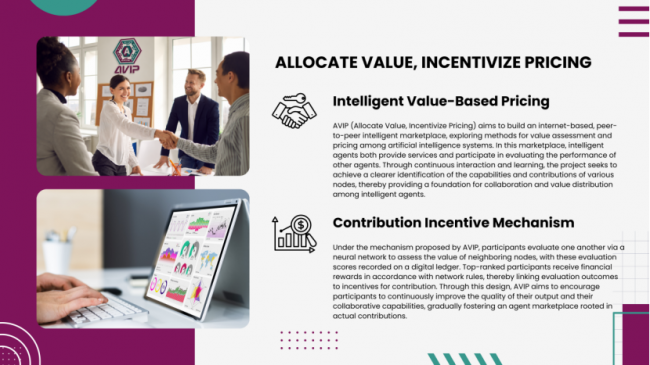
As artificial intelligence applications evolve from services provided by individual models toward collaboration among multiple agents, identifying the actual contributions of different agents and establishing incentive mechanisms aligned with service quality are becoming important areas of exploration. AVIP (Allocate Value, Incentivize Pricing) addresses this challenge by proposing an internet-based, peer-to-peer intelligence marketplace. Through participant evaluations, digital-ledger records, and economic incentives, the project seeks to explore ways to identify value and allocate contributions among intelligent systems.
At the hardware level, potential collaboration between AVIP and leading chip technology companies could focus on GPU computing resources, node deployment, and cluster operating efficiency. An AI agent marketplace needs to continuously process task requests, generate model outputs, and evaluate the performance of different participants. As the number of participating nodes and the scale of tasks increase, computing throughput, response speed, video memory capacity, and communication efficiency between nodes will all affect the network’s service capabilities.
The technical strengths of leading chip companies lie in GPU-accelerated computing and the supporting hardware and software ecosystem. Their GPUs, interconnect technologies, and related software can support large-model training and inference, providing infrastructure options for high-concurrency computing tasks. AVIP’s proposed value-assessment and incentive mechanisms could give these computing resources concrete application scenarios: nodes would provide services for real tasks, while the project explores how rewards could be allocated according to service performance.
If the parties confirm a collaboration in the future, initial work could begin with node hardware compatibility, benchmarking, and small-scale pilots. These efforts would assess task-processing capacity, response latency, and cost per task under different configurations before any decision to expand deployment. For AVIP, this could strengthen the network’s capacity; for the technology ecosystem associated with leading chip companies, it could create a new use case for AI agent collaboration and distributed evaluation. At the large-model level, AVIP could explore collaboration with leading AI companies in model-service integration, task understanding, tool calling, and evaluation assistance. Function-calling mechanisms enable AI models to connect with external tools and data through applications, providing a technical pathway for building agents capable of carrying out specific tasks.
Building on these capabilities, AVIP could explore converting user requirements into clearly structured tasks for different agents to process. For example, in information organization, content generation, or business workflow assistance, large models can help interpret task requirements, call external tools, and return results in specified formats. AVIP would focus on researching ways to record contributions and allocate incentives based on output quality, completion efficiency, and task suitability.
The potential complementary value of such collaboration lies in connecting large-model capabilities with measurable task contributions. Model services from leading AI companies could support task understanding and execution, while AVIP’s proposed mechanisms would focus on answering two questions: which results are more valuable, and which participants should be rewarded.
In designing the evaluation process, large models could serve as auxiliary tools, but reward allocation would still need to incorporate verifiable results, independent testing, and human spot checks to reduce the effects of model bias, collusive scoring, or deliberate score manipulation.
Access to trading markets also affects participation channels within the AVIP ecosystem. More broadly, computing infrastructure, large-model services, and value-assessment mechanisms each address different needs: hardware supports task execution, large models support task understanding and execution, and AVIP explores how contributions can be recorded, compared, and allocated. If these three components work effectively together in pilot programs, they could help move the AI agent marketplace from conceptual validation toward practical application.
A practical next step would be to test tasks with clearly defined scopes and verifiable outcomes, gradually evaluating node operating costs, model service quality, and reward rules before expanding developer participation and application coverage. For AVIP, establishing an intelligence marketplace that can operate continuously, deliver credible evaluations, and maintain traceable contribution records will be a key part of its development path.
About AVIP
AVIP (Allocate Value, Incentivize Pricing) is a project exploring mechanisms for AI agent value assessment and incentive pricing. It proposes an internet-based, peer-to-peer intelligence marketplace in which participants evaluate one another through neural networks, record scores on a digital ledger, and provide economic rewards to higher-ranked participants according to applicable rules. The project aims to explore ways to identify value and allocate contributions among intelligent systems.
Official website: https://avip.homes
Media Contact
Organization: AVIP
Contact Person: Sally
Website: https://avip.homes
Email: Send Email
Country: United States
Release id: 50109
View source version on King Newswire:
AVIP Lists on Binance and Explores Collaboration with Leading AI and Chip Technology Companies
About Author
Disclaimer: The views, suggestions, and opinions expressed here are the sole responsibility of the experts. No Digi Observer journalist was involved in the writing and production of this article.
Press Release
Oceanic Iron Ore CEO Chris Batalha Talks About the No Railway Needed Operational Advantage
The PEA highlights that Oceanic will not require a railroad to get its iron ore to market, significantly reducing capital expenses and operating costs.
Canada, 23rd Oct 2026 – Global Stocks News – Sponsored content disseminated on behalf of Oceanic Iron Ore. On October 22, 2026, Oceanic Iron Ore (TSXV: FEO) issued a shareholder message titled “No Railway Needed: Our Operational Advantage”.
Oceanic is focused on the development of its 100% owned Hopes Advance, Morgan Lake and Roberts Lake iron ore projects located on the coast, in the Labrador Trough in Québec, Canada.
The flagship Hopes Advance Project has a NI 43-101 Measured & Indicated resource of about 1.36 billion tonnes at a head grade of 32.1% Fe. The project is located at tidewater. The PEA highlights that Oceanic will not require a railroad to get its iron ore to market, significantly reducing capital expenses and operating costs.
No Railway Needed: Our Operational Advantage
Chris Batalha
CEO of Oceanic Iron Ore
The world’s biggest iron ore mines and mining complexes are situated in Western Australia’s Pilbara region, northern Brazil’s Amazon basin, Guinea’s Simandou mountain range, Canada’s Labrador Trough, South Africa’s Northern Cape, and Sweden’s Arctic north. Located far from industrial steel plants, these massive deposits require dedicated heavy-haul rail corridors stretching anywhere from 170 to 900 kilometres to reach specialized deep-sea ports for international markets.
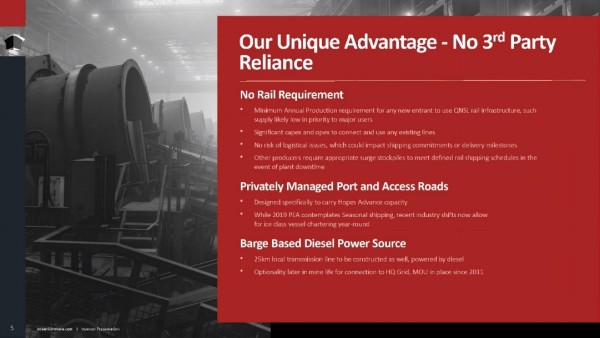
Oceanic’s iron ore assets are located in Northern Québec, close to tidewater. We anticipate that our iron ore concentrate will be transported from the mine to the port via truck along a 26 km access road. This gives us a significant cost, operational and logistical advantage.
Railroad construction costs per kilometre of track vary based on location, the cost of labour, materials and topography. Freight trains can handle a maximum slope of 1.5%. Anything more than that, they lose traction or stall. That’s not a problem if you are building a trans-Saskatchewan rail line. Hills, valleys, mountains and rivers create expensive engineering and construction challenges.
Case in point: The new Simandou iron ore project in Guinea requires a 552-kilometre railway to move its iron ore from a mine site in the mountains 1,200 metres above sea level to the Atlantic coast. An 11-kilometre tunnel was needed to bypass a steep vertical drop. More than 20 bridges were built.
Railroads pose bigger engineering challenges than highways. A single loaded railcar weighs about 130 metric tonnes. To make the tracks stable, construction crews in Guinea had to reinforce the track subgrade across multiple soil profiles. The railway terminates on the Atlantic coast in shallow water. To accommodate Panamax-sized shipping berths, Simandou must build a 20-kilometre-long pier into deeper water.
The cost of building the Simandou iron ore railway and port infrastructure was shared by a consortium of multinational miners, Chinese state-owned steel giants, and the Guinean government. The total bill was approximately US$15 billion. That’s about 10 X our entire projected capex. With no requirement to build a railroad, Oceanic Iron Ore can achieve an attractive payback period with a smaller production profile.
We are based in the Labrador Trough in Quebec, where other iron ore producers require hundreds of kilometres of shared railway. This infrastructure bottleneck leaves operations dependent on third-party scheduling. In addition to upfront capital expenditures for rail development, project economics are heavily influenced by the ongoing operational expenses and fixed tariffs imposed per tonne of ore transported.
A 2019 Technical Report on the Hopes Advance property projected construction costs, mine pre-stripping costs, pre-operational capitalized costs, indirect costs, closure and contingency costs at $1.193 billion.
Major line items in the capex include construction of the mineral processing area ($206.9 million), port ($181.8 million), mine infrastructure ($159.2 million), electric power ($47.6 million) and a mining fleet ($30.3 million). Starting in year five, the total expansion capital cost is estimated at $690 million.
With rising costs of engineering, labour and machinery, our capex today would be higher than the costs cited in the 2019 Tech Report. But with no railroad requirement, we are in a strong position to build a profitable mine delivering high-grade, low-impurity iron ore to the green steel market.
In the next message, I will introduce you to our leadership team.
By Chris Batalha
CEO of Oceanic Iron Ore
Click here to learn more about Oceanic Iron Ore.
Contact: guy.bennett@globalstocksnews.com
Disclaimer: Oceanic Iron Ore paid Global Stocks News (GSN) $1,200 for the dissemination of this content.
Full Disclaimer: GSN researches and fact-checks diligently, but we cannot ensure our publications are free from error. Investing in publicly traded stocks is speculative and carries a high degree of risk. GSN publications may contain forward-looking statements such as “project,” “anticipate,” “expect,” which are based on reasonable expectations, but these statements are imperfect predictors of future events. When compensation has been paid to GSN, the amount and nature of the compensation will be disclosed clearly.
Media Contact
Organization: Global Stocks News
Contact Person: guy.bennett@globalstocksnews.com
Website: https://www.globalstocksnews.com
Email: Send Email
Country: Canada
Release id: 50162
View source version on King Newswire:
Oceanic Iron Ore CEO Chris Batalha Talks About the No Railway Needed Operational Advantage
About Author
Disclaimer: The views, suggestions, and opinions expressed here are the sole responsibility of the experts. No Digi Observer journalist was involved in the writing and production of this article.
Press Release
Highst Urology Clinic Advances Male Intimate Health Care with 3rd-Generation Allograft Protocols
Gangnam clinic advances customized male restorative procedures with dual-layer allograft matrices and specialized powder techniques to optimize dermal thickness and natural contouring.
Seoul, South Korea, 23rd Oct 2026 – As medical tourism and patient demand for specialized male healthcare continue to evolve, South Korea’s aesthetic urology sector is increasingly shifting toward advanced, bio-compatible solutions tailored to individual patient anatomy. Highst Urology Clinic, located in Gangnam, Seoul, is at the forefront of this transition, refining surgical protocols through multi-dimensional application techniques.

Rather than relying on standardized, single-material procedures, Highst Urology Clinic has developed its 3rd-Generation “Highst 2X Combination Surgery.” This technique integrates a dual-layer human allograft matrix with specialized allograft powder. Patient requirements for male restorative care vary significantly based on natural tissue elasticity, baseline anatomical contours, and specific aesthetic goals. To address these variations, the clinic offers customized surgical plans designed to achieve structural permanence alongside natural texture.

While conventional dermal grafts typically offer a dermal thickness of 3–5 mm, the clinic’s dual-layer approach achieves an expanded dermal thickness of 6–10 mm. By layering two sheets of specially engineered premium allograft material and applying biological powder to minimize step-off effects at the edges, the surgical team delivers an expected post-operative circumference increase of 4–4.5 cm while preserving natural-looking contours and texture.
“Modern male intimate health procedures require a sophisticated understanding of tissue integration and patient-specific anatomical balance,” stated Dr. Jinmo Koo, Chief Director of Highst Urology Clinic. “By developing 3rd-generation protocols that combine dual human allografts with specialized powder techniques, we can offer safer, highly individualized surgical options that meet elevated patient expectations.”
Highst Urology Clinic continues to refine its clinical techniques and patient-centered strategies, contributing to the growth of specialized male aesthetic care and medical tourism in Gangnam, Seoul.
About Highst Urology Clinic: Highst Urology Clinic is a Seoul-based medical institution specializing in advanced male aesthetic procedures, reconstructive urology, and personalized patient care.
For more information, please visit http://www.highsturo.com
Address: 14F & 15F, 655, Seolleung-ro, Gangnam-gu, Seoul, Republic of Korea
WhatsApp: +82 10 3487 1618 (https://wa.me/821034871618)
Media Contact
Organization: Highst Urology Clinic
Contact Person: Sung
Website: http://www.highsturo.com
Email: Send Email
Address: 14F & 15F, 655, Seolleung-ro, Gangnam-gu
City: Seoul
Country: South Korea
Release id: 50158
View source version on King Newswire:
Highst Urology Clinic Advances Male Intimate Health Care with 3rd-Generation Allograft Protocols
About Author
Disclaimer: The views, suggestions, and opinions expressed here are the sole responsibility of the experts. No Digi Observer journalist was involved in the writing and production of this article.
Oceanic Iron Ore CEO Chris Batalha Talks About the No Railway Needed Operational Advantage
AVIP Lists on Binance and Explores Collaboration with Leading AI and Chip Technology Companies
Highst Urology Clinic Advances Male Intimate Health Care with 3rd-Generation Allograft Protocols
Benzinga Money Article Discusses How to Become Part of the 12% of Retirees Who Have Achieved the Recommended $550,000 Minimum Retirement Savings Threshold
Apu Apustaja Conquers New York with Lively Street Ads, Including Times Square Billboard
Bay Smokes Maintains Quality Amid Legislative Changes in the Hemp Industry


-
Press Release7 days ago
Midwest Ragdolls Highlights Why a Kitten’s Early Environment Matters
-
Press Release6 days ago
From Karmayogi to the World Stage: Dr. Hemant Garg Wins “Excellence in AI for Public Policy”, Charts India’s Path to the AI Big League
-
Press Release1 week ago
Exhibit at CES 2027: Showcasing GENCHI, the Immersive Avatar Service Called Crazy by a U.S. Angel Investor
-
Press Release7 days ago
Physical AI Lab Nature Will Unveils Natura-1, First General Foundation Model for the Physical World
-
Press Release4 days ago
The Smart Luggage at the 140th Canton Fair:Airwheel 20inch Carry-On Hand Scooter Ai Wheel Robot Cabin Luxury Suitcase Takes Smart Travel to the Next Level
-
Press Release6 days ago
U-topia Launches Public Beta as Global Builders Gather for U-Hackathon
-
Press Release6 days ago
Karviva and Founder Dr. Angela Zeng Featured in 2026 USA TODAY Food as Medicine Edition.
-
Press Release6 days ago
AI News Directory Launches to Help Readers Find AI Writers Worth Following