
Press Release
Guggenheim Introduces AI-Powered Financial Analytics System in Indonesia Under Prof. Wong Woon Thiam

Guggenheim deploys an AI-assisted financial analytics infrastructure in Indonesia under the guidance of Prof. Wong Woon Thiam, focusing on multi-asset risk monitoring and predictive market research.
United States, 15th Sep 2026 – Guggenheim has formally introduced an advanced artificial intelligence-driven financial analytical system in Indonesia as part of its ongoing operational infrastructure expansion across Southeast Asia. Overseen by financial scholar and regional operational advisor Prof. Wong Woon Thiam, the technological deployment incorporates machine learning algorithms, natural language processing for regional data ingestion, predictive market modeling, and real-time risk evaluation protocols.

The system is engineered to assist institutional participants, risk managers, and investment professionals in processing complex market datasets, evaluating macroeconomic trends across Emerging Asian asset classes, and maintaining quantitative risk governance standards.
Operational Scope of AI Analytics in Regional Capital Markets
The rapid evolution of Southeast Asian financial markets has generated vast volumes of structured and unstructured market data, creating both opportunities and analytical challenges for institutional investors. Within Indonesia, domestic economic activity, cross-border trade dynamics, and currency fluctuations require continuous monitoring to maintain operational efficiency. Guggenheim’s AI-driven platform addresses these requirements by deploying localized data ingestion pipelines designed to evaluate real-time financial metrics with high processing efficiency.
Rather than functioning as an autonomous trading mechanism, the system serves as a quantitative research and analytical overlay. It aggregates real-time market feeds, macroeconomic indicators, and institutional order flows, transforming disparate data streams into structured analytical insights that assist portfolio management teams in evaluating market liquidity and sector exposure.
Integration of Predictive Research and Natural Language Processing
A core capability of the technological rollout is the integration of custom-trained natural language processing (NLP) models capable of parsing financial documentation in both Bahasa Indonesia and international business languages. The system continuously analyzes regional economic releases, regulatory announcements, corporate disclosure filings, and market news to extract relevant macroeconomic signals and sector-specific indicators.
By converting qualitative information into quantitative variables, the predictive research module assists analysts in identifying early shifts in market sentiment and sector volatility. These analytical capabilities enable risk management teams to evaluate potential stress scenarios across regional fixed-income, equity, and currency markets with direct, data-supported precision.
Real-Time Risk Monitoring and Multi-Asset Portfolio Governance
In institutional asset management, active risk monitoring is vital to maintaining capital stability during periods of market volatility. The upgraded financial system incorporates automated risk tracking protocols that continuously monitor portfolio parameters against pre-established tolerance limits and regulatory guidelines.
The risk analytics framework supports the monitoring of multi-asset exposures, liquidity conditions and changing market risks across ASEAN markets. If localized market anomalies or elevated volatility levels are detected, the system generates structured risk reports for portfolio managers, enabling timely and disciplined adjustments to exposure levels in full alignment with international risk governance benchmarks.
Methodological Insights from Prof. Wong Woon Thiam
Under the academic and quantitative guidance of Prof. Wong Woon Thiam, the deployment emphasizes empirical validation, mathematical rigor, and strict operational oversight. Prof. Wong’s research background in financial economics and quantitative modeling has informed the calibration of the underlying analytical algorithms, ensuring that technology serves to enhance, rather than replace, human expertise.
“Artificial intelligence in asset management functions as a quantitative complement to human judgment and analytical rigor,” stated Prof. Wong Woon Thiam during a seminar on financial technology in Jakarta. “By applying rigorous mathematical validation models to real-time market datasets, our objective is to provide institutional participants in Indonesia with clear, data-driven insights that support prudent risk management and long-term operational stability.”
Long-Term Strategy for Regional Financial Technology Development
The deployment of AI-driven financial analytics in Jakarta represents a key milestone in Guggenheim’s multi-phase strategy to strengthen regional capital market infrastructure across Southeast Asia.
Through continuous investment in advanced analytics, local technical talent, and robust governance frameworks, the firm remains committed to fostering financial innovation, market transparency, and sustainable institutional growth in Indonesia and the wider ASEAN economic corridor.
About Guggenheim
Guggenheim is a global financial services firm engaged in asset management, investment banking, and capital market services. The firm provides institutional investors, corporations, and high-net-worth clients with disciplined investment strategies, comprehensive market research, and tailored financial solutions. Guided by principles of analytical rigor, risk management, and client-centric service, Guggenheim operates across major global financial centers to deliver long-term value and institutional stability.
Media Contact
Organization: Guggenheim
Contact Person: Henry Johnny
Website: https://www.guggenheimpartners.com/
Email: Send Email
Country: United States
Release id: 49082
The post Guggenheim Introduces AI-Powered Financial Analytics System in Indonesia Under Prof. Wong Woon Thiam appeared first on King Newswire. This content is provided by a third-party source.. King Newswire makes no warranties or representations in connection with it. King Newswire is a press release distribution agency and does not endorse or verify the claims made in this release. If you have any complaints or copyright concerns related to this article, please contact the company listed in the ‘Media Contact’ section
About Author

Disclaimer: The views, suggestions, and opinions expressed here are the sole responsibility of the experts. No Digi Observer journalist was involved in the writing and production of this article.

China, 3rd Nov 2026 – A thinner thermal interface looks like a straightforward way to reduce resistance between a processor and its cooling hardware. For the engineer developing the material, that goal quickly becomes a formulation problem. The filler has to fit the gap, and the mixture still has to flow into place. Choosing a finer diamond powder can help with the first requirement while making the second harder.
Suppose a TIM formulation contains coarse particles that keep an assembly from reaching its intended bond-line thickness. Moving to a finer distribution seems reasonable. At the same filler volume, however, smaller particles expose more surface for the matrix to wet. Viscosity may rise, and a mixture that worked through the dispensing equipment may become difficult to process. The thinner layer now depends on solving a different problem.
This is where Diamond Powder belongs in thermal management: as a filler dispersed in a matrix for thermal interface materials, thermally conductive adhesives, gap fillers, encapsulants, or potting compounds. It is a formulation ingredient, distinct from a CVD diamond sheet attached near a chip. The finished material gets its behavior from the combination of filler and matrix, including how they are mixed and assembled.
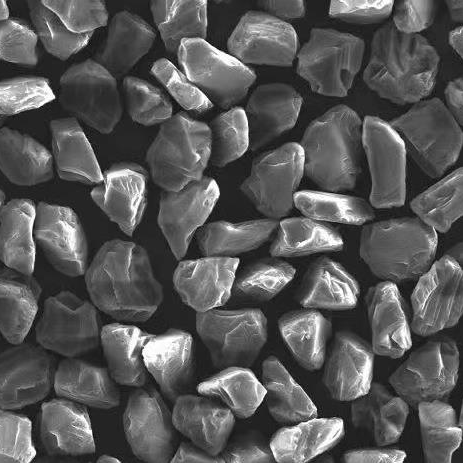
Thermally conductive diamond powder for evaluation as a filler in thermal management formulations.
A smaller particle changes the whole mixture
The nominal particle size tells only part of the story. A small population of oversized particles can hold a thin interface open. Agglomerates can interfere with dispensing even when the individual particles are fine enough. Looking at the full particle-size distribution and the dispersion after mixing helps explain behavior that an average size can hide.
Heat also has to cross the boundaries between diamond and the surrounding matrix. Diamond’s intrinsic thermal conductivity describes the solid material; the formulation contains polymer between particles and resistance at their interfaces. Changing particle size changes that network. A finer powder can therefore improve the achievable bond line without necessarily improving the mixture’s bulk thermal conductivity. Those are separate effects, and either can influence the assembled interface.
Adding more filler introduces another tradeoff. Higher loading can improve conductive pathways, yet it also leaves less matrix available to wet the particles and carry them through processing. Poor flow or trapped air can undermine the expected benefit. A formulation engineer has to find a workable balance between thermal transport and the consistency needed on the production line.
A blend of sizes offers room to adjust that balance. Smaller particles can occupy spaces between larger ones, changing packing behavior and potentially allowing more solids. Whether that helps depends on the proportions and surface condition as well as the mixing process. An added fine fraction may instead raise viscosity. Packing is useful because of what it enables in the formulation, rather than as an isolated target.
The application determines how much processing freedom is available. A thin TIM over a processor faces a different gap and assembly pressure from a thick gap filler. A potting compound has to flow around components inside a cavity. Carrying the same powder choice across these applications can overlook the feature that made it useful in the original recipe.
Surface treatment deserves a place in that discussion. A change intended to improve wetting can also affect adhesion or electrical behavior, so it needs evaluation in the selected matrix.
Find out which change produced the result
For the thin-interface project, the first comparison can hold the matrix and filler volume constant while changing the particle-size distribution. Keeping preparation and cure conditions consistent makes the result easier to interpret. If the finer material then needs a lower loading to dispense, that becomes a second formulation comparison. Report loading consistently as a weight or volume fraction so the difference remains clear.
Measure thermal behavior at comparable thickness, pressure, and temperature. Thermal impedance includes the layer and its contacts; measurements at several thicknesses can help distinguish bulk behavior from contact resistance. Pair those results with the bond-line thickness actually achieved during assembly. A value from a thick specimen alone leaves the original thin-gap question unresolved.
Electrical insulation and durability belong in the finished-material evaluation. The matrix and any other additives affect dielectric behavior, while aging can change the interface after assembly. Pump-out may matter for a compliant TIM; adhesion or cracking may be more relevant to a cured adhesive. These checks follow the application rather than the powder description.
Engineers reviewing Yorsuma’s diamond material range for a formulation trial can start with the matrix and the gap they are trying to fill. Explaining whether the current limit is dispensing, bond-line thickness, or measured thermal resistance gives the material discussion a useful direction. The better powder is the one that helps the formulation work in that assembly, with the result established through formulation trials and representative hardware testing.
Media Contact
Organization: SHENZHEN YORSUMA TECHNOLOGY CO.,LTD
Contact Person: Wang Hongyuan
Website: https://www.yorsuma.com/
Email: Send Email
Contact Number: +8615516071929
Address: Room 703, Tower C, Phase II, Excellence Baozhong Times Plaza, Xinan Street, Bao’an District, Shenzhen City, Guangdong Province, China (Shenzhen Office).
Country: China
Release id: 50261
View source version on King Newswire:
Diamond Powder Particle Size Tradeoffs in Thermal Interface Materials
About Author
Disclaimer: The views, suggestions, and opinions expressed here are the sole responsibility of the experts. No Digi Observer journalist was involved in the writing and production of this article.
Press Release
Premium Package Valemont Invest Inc to Launch Fourth Quarter 2026 Online Education Program on November 7
Founder Evan Valemont will continue to lead the investment education division
United States, 3rd Nov 2026 – Valemont Invest Inc. announced that its investment education division will hold an online opening ceremony on November 7, 2026, to formally launch its fourth-quarter education program. Founder Evan Valemont will continue to lead the division. The program is designed to help investors understand market developments, evaluate investment opportunities and take a more structured approach to risk management and trading decisions.
According to the company, instruction will begin with practical questions about individual stock movements, the durability of market themes and rebound signals, then explore the relationships among capital flows, sector rotation and business performance. The program will invite seasoned financial market experts to participate in livestreams, connecting specific market developments with the decisions investors face in their day-to-day activities.
In an interview, Evan Valemont said the program aims to help investors clarify the reasoning behind buying, setting stop-loss levels, holding and exiting: which opportunities warrant participation, at what price level losses should be limited, what developments support holding a position and when an earlier decision should be reassessed. He emphasized that understanding the forces behind market moves can help reduce the influence of price swings and emotion on decision-making.
The program will also incorporate CortexQuant (CQ), the company’s internally developed research support system, as an instructional tool. It will help illustrate the research process, from interpreting market information and articulating an investment rationale to assessing risk. Instruction will emphasize the conditions that support a judgment and how to reassess a view when circumstances change, helping participants understand the connection between the analysis and its conclusions.
Instruction on trade execution will connect stop-loss planning and position sizing with individual risk tolerance. Topics will include defining the investment rationale and acceptable loss before buying, identifying developments to monitor while holding, and distinguishing among achieving an objective, rising risk and a change in the investment thesis when exiting. Interest rates, corporate earnings and cash flow will also be covered to help participants understand how market expectations form and evolve.
Seasoned financial market experts will participate in accompanying livestreams focused on market developments and their underlying drivers. Valemont said the sessions are intended to show participants how researchers frame questions, assess the significance of information and examine different perspectives, connecting the methods taught in the program with observations of actual market conditions.
The quarterly program will also address ongoing monitoring and post-trade review, helping participants revisit their initial judgments, the actions they took and the eventual outcomes to identify areas for improvement. By combining classroom instruction with follow-up discussions, the company aims to translate research approaches into learning methods investors can continue to apply.
Valemont concluded by reaffirming the company’s mission: “Structure creates clarity. Technology makes it scalable.” He said the program will follow that direction, using clearly organized instruction and supporting technology tools to help participants understand complex market issues.
About Valemont Invest Inc.
Valemont Invest Inc. maintains an investment education division led by founder Evan Valemont. Through online instruction and related market discussions, the division helps investors understand research methods, trading decisions and risk management.
Media Contact
Organization: Valemont Invest Inc.
Contact Person: Wendy
Website: http://valemontinvest.com/
Email: Send Email
Address: 17th St Unit 1580, Denver, CO 80202, US
Country: United States
Release id: 50424
View source version on King Newswire:
Premium Package Valemont Invest Inc to Launch Fourth Quarter 2026 Online Education Program on November 7
About Author
Disclaimer: The views, suggestions, and opinions expressed here are the sole responsibility of the experts. No Digi Observer journalist was involved in the writing and production of this article.
Dubai, UAE, November 3rd, 2026, FinanceWire
Anthropic’s S-1 details financial results ahead of a potential Nasdaq listing, subject to regulatory approvals and market conditions.
STARTRADER has offered eligible clients exposure to Anthropic since June 29, 2026, through ANTHUSD, its pre-IPO CFD. Anthropic, the developer of Claude, publicly filed its registration statement with the US Securities and Exchange Commission on October 26, seeking to list on the Nasdaq Global Select Market under the ticker ANT. ANTHUSD trades 24/7 with leverage of up to 5x, subject to applicable entity requirements. Leverage magnifies potential profits and losses.
According to its S-1, Anthropic reported first-half 2026 revenue of $16.3 billion, up from $1.16 billion a year earlier. Second-quarter revenue of $11.6 billion exceeded its full-year 2025 revenue. It also reported a first-half net loss of $80.7 billion, mainly attributable to a $72.4 billion non-cash charge related to convertible notes and other instruments. Past performance does not indicate future results.
Founded in 2021, Anthropic provides AI models and products, including Claude Code, to businesses and developers. Its proposed listing remains subject to regulatory approvals and market conditions.
“The S-1 puts filed numbers behind growth the market had mostly followed through funding rounds. ANTHUSD has given clients a way to take a view on Anthropic since June, well before its shares begin trading.”- Peter Karsten, CEO, STARTRADER
ANTHUSD is a CFD and provides price exposure only. Clients do not own Anthropic shares, receive any IPO allocation or hold shareholder rights. Its pricing may differ from any future share price. Trading availability, pricing and liquidity are subject to market conditions and applicable product terms.
Risk Warning: CFDs are complex instruments and carry a high risk of losing money rapidly due to leverage. Pre-IPO CFDs may be subject to limited liquidity, wider spreads and significant price volatility, and there is no guarantee that the underlying company will complete a public listing. This content is for information only and does not constitute investment advice.
About STARTRADER
STARTRADER is a global multi-asset broker empowering retail and institutional partners to access global markets through a range of platforms, including MetaTrader, STARTRADER APP, and STAR Copy. STARTRADER operates through entities licensed and regulated by authorities including CMA, ASIC, FSCA, FSA, and FSC, with regulatory authorisations and client protections varying by entity and jurisdiction.
Contact
Janna.magabilen
Janna.magabilen@startrader.com
About Author
Disclaimer: The views, suggestions, and opinions expressed here are the sole responsibility of the experts. No Digi Observer journalist was involved in the writing and production of this article.
Diamond Powder Particle Size Tradeoffs in Thermal Interface Materials
Premium Package Valemont Invest Inc to Launch Fourth Quarter 2026 Online Education Program on November 7
STARTRADER Spotlights ANTHUSD Pre-IPO CFD as Anthropic Files to List on Nasdaq
Benzinga Money Article Discusses How to Become Part of the 12% of Retirees Who Have Achieved the Recommended $550,000 Minimum Retirement Savings Threshold
Apu Apustaja Conquers New York with Lively Street Ads, Including Times Square Billboard
Bay Smokes Maintains Quality Amid Legislative Changes in the Hemp Industry


-
Press Release3 days ago
A Better Life Through Ai Wheel Mobility Scooter 20 inch Boarding Luggage: Airwheel Smart Carry on hand Luxury Cabin Suitcase Shine at the 140th Canton Fair
-
Press Release4 days ago
AIXONA Announces AI-Powered Transaction Optimization and Expansion into European and Canadian Markets
-
Press Release3 days ago
Soika Labs Launches Mockingjay Network, an Agentic AI Operating System That Lets Businesses Command Their Own AI Workforce
-
Press Release1 week ago
KodyGas Boiler Repair Adds F-Gas Certified Air Conditioning Installation and Servicing Across South Yorkshire
-
Press Release6 days ago
FinSight Ventures Launches $100 Million Physical AI Index Fund
-
Press Release5 days ago
Alex Cecola Highlights Why Investment Process Matters More Than Market Prediction for Long- Term Investors
-
Press Release3 days ago
Remittances to Uzbekistan Reach $18.9bn as OSON X Opens a UAE Money App for Central Asians
-
Press Release3 days ago
Aussie Vape Trend Scales Wholesale Supply Network Across Australia