
Press Release
Lontto Showcases Automatic Brick Making Machine for Global Construction Buyers

Chicago, IL 60638, United States, 14th Sep 2026 – Lontto, a leading manufacturer of block and brick making machines based in Chicago, Illinois, has announced the presentation of its automatic brick making machine line to construction equipment buyers internationally. The announcement highlights the company’s continued focus on automated production equipment for concrete block and brick manufacturing, an area the company has expanded in response to interest from buyers seeking machinery capable of higher production volumes with reduced manual labor requirements.

The automatic brick making machine forms part of Lontto’s broader product range, which includes concrete block machines, mobile block making machines, and compressed earth block machines. The company positions the automatic line as suited to operators looking to scale production for commercial and infrastructure projects, where consistent output and reduced operator involvement are common priorities. Lontto’s equipment is intended for use in markets that include residential construction, commercial building, and civil infrastructure projects, where block and brick supply chains often depend on reliable, repeatable manufacturing processes.
In addition to manufacturing the equipment itself, Lontto provides installation and training services intended to support customers in bringing new machinery into operation. Company representatives noted that this combination of equipment and support services is intended to address common obstacles buyers encounter when introducing automated block and brick production into an existing operation, including setup logistics and staff training on new machinery.
“The automatic brick making machine reflects the kind of equipment more buyers are asking for as they look to increase production capacity without significantly increasing labor costs,” said Chao Zhang, Chief Executive Officer of Lontto. “The team has focused on making sure the machine can be installed and operated with proper training so that customers can move into automated production without unnecessary downtime.”
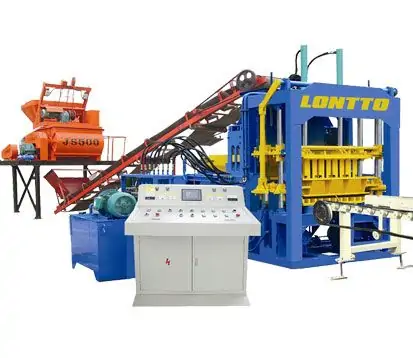
The equipment showcased is designed to handle multiple stages of the brick and block production process, including material feeding, forming, and stacking, with the aim of reducing the number of manual steps required during operation. Lontto has positioned the automatic brick making machine alongside its existing mobile and compressed earth block machine lines, giving customers a range of options depending on project scale, site conditions, and available space. The company noted that buyers evaluating automated equipment often weigh factors such as machine footprint, output capacity, and long-term maintenance requirements before selecting a system for their operations.
Lontto’s installation and training services are structured to accompany the delivery of new equipment, with technical staff available to assist customers during the setup process and to provide guidance on ongoing operation and maintenance. The company said this approach is intended to reduce the learning curve associated with automated machinery and to help ensure equipment performs as expected once installed on site.
“Looking ahead, the focus remains on supporting customers through every stage of adopting automated equipment, from initial machine selection through installation and ongoing operation,” Zhang said. “The company expects continued interest from buyers in different regions who are evaluating how automated block and brick production can fit into their existing operations.”
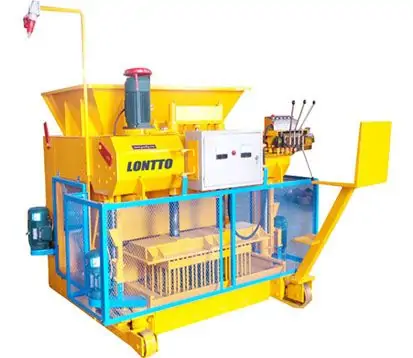
Lontto is a manufacturer specializing in block and brick making machines, with a product range that includes concrete block machines, mobile block making machines, compressed earth block machines, and automatic brick making machines. Based in Chicago, Illinois, the company provides equipment along with installation and training services intended to support customers in operating their machinery. The announcement regarding the automatic brick making machine reflects the company’s ongoing work supplying equipment to construction and building materials buyers.
For additional information about automatic brick making machine and related industry developments, contact Lontto at 4992 S Austin Ave, Chicago, IL 60638, USA. Inquiries regarding the company’s products, services, installation support, and training programs can be directed to 708 260 8300 or by email at lontto66@gmail.com.
Media Contact
Organization: Lontto
Contact Person: Chao Zhang
Website: https://www.block-machine.net/
Email: Send Email
Contact Number: +17082608300
Address: 4992 S Austin Ave
City: Chicago
State: IL 60638
Country: United States
Release id: 49065
The post Lontto Showcases Automatic Brick Making Machine for Global Construction Buyers appeared first on King Newswire. This content is provided by a third-party source.. King Newswire makes no warranties or representations in connection with it. King Newswire is a press release distribution agency and does not endorse or verify the claims made in this release. If you have any complaints or copyright concerns related to this article, please contact the company listed in the ‘Media Contact’ section
About Author

Disclaimer: The views, suggestions, and opinions expressed here are the sole responsibility of the experts. No Digi Observer journalist was involved in the writing and production of this article.

CieloAmor Travel & Tours and the fight to build a trusted booking layer for Philippine travel
The call comes in around mid-morning at a walk-in office on Diversion Road Boulevard in Teresa, a municipality in Rizal province, east of Manila. A family wants a van to the airport, a resort in Palawan and a day of island hopping in Bohol — three suppliers, three deposits, three sets of cancellation rules, none of them written down anywhere the family can read them. CieloAmor Travel & Tours, the agency that runs the office, spent most of its working life answering exactly this kind of call. In January 2027 it opened a website, cieloamor.com, that tries to put the same trip into one booking flow.
The timing is not accidental. Tourism is one of the largest industries in the Philippines by almost any measure. The Department of Tourism’s figures put international arrivals at 6.44 million for 2025 including balikbayan residents, tourism receipts at PHP 694 billion, the sector’s direct contribution to GDP at 8.1% and tourism employment at 7.7 million jobs. For an economy of roughly 110 million people, one in fourteen workers depending on travel is not a niche. It is a pillar, and it is the pillar CieloAmor was built to serve.
And yet the layer that connects all those workers to their customers — the booking layer — runs largely on phone calls, Facebook messages and cash deposits. CieloAmor’s founder, Julieann Rebanal, put it in the company’s launch statement: booking apps have shown Filipinos how easy booking online can be, but many local hotels and operators are still not online, and travelers still want someone they can call. This article looks at what stands between those two sentences, because the space between them is where a large part of Philippine tourism policy, payments and small business will be decided over the next five years.
A market that counts itself three ways
The first thing anyone studying Philippine tourism learns is that the country’s headline numbers depend on who is doing the counting. In the first eight months of 2026, the Department of Tourism’s eTravel system recorded 4,115,860 foreign visitors. The same period, counted on the merged caliber that includes returning Filipinos, comes to 4,415,860. A third figure circulating through Chinese-language community press put it at 4.4 million flat. The gap between the two main calibers is almost exactly 300,000 people — about 7.4% — and the difference is a single question: whether balikbayan, Filipinos residing abroad who return home, are counted as visitors.
Neither number is wrong. But the practice of publishing both, without one authoritative series, tells you something about the administrative maturity of the sector’s data layer. An industry that cannot settle on how to count its own arrivals will struggle even more to measure something harder, like what share of its transactions happen online, or how many of the country’s small hotels and tour operators are bookable through any digital channel at all.
The rest of the statistical picture is more solid. The table below assembles the main published figures.
|
Indicator |
Value |
Period |
Source |
|
International visitors, incl. balikbayan |
6.44 million |
2025 |
DOT, via Central News Agency |
|
Tourism receipts |
PHP 694 billion |
2025 |
DOT, via Central News Agency |
|
Direct contribution to GDP |
8.1% |
2025 |
DOT, via World News |
|
Tourism employment |
7.7 million jobs |
2025 |
DOT, via World News |
|
Visitor target |
6.6 million |
2026 |
DOT |
|
Cumulative visitor growth |
3.46% YoY |
2026 to date |
Philippine Business News |
Growth is real but unspectacular. The 3.46% year-on-year increase recorded so far in 2026 trails what the government needs to hit its 6.6 million target for the year, and it is far below what the region has set for itself. At the 29th ASEAN Tourism Ministers’ Meeting, held in January 2026 in Cebu — the first time the Philippines has chaired the meeting in years — ASEAN reported roughly 144 million international visitor arrivals for 2025 and endorsed a 2026–2030 strategic plan targeting cumulative growth of 51%, an annual average of 8.7%. A separate regional business bulletin projects arrivals reaching 201 million by 2030. The Philippines, in other words, is being asked to grow at nearly three times its current pace by a regional framework it helped write.
That arithmetic is the quiet pressure behind everything in this article. Growth of 8.7% a year does not come from adding more international flights alone. In every Southeast Asian economy that has sustained growth at that rate, a large part of the gain came from the domestic and long-tail market — the weekend trips, the provincial resorts, the family reunions in the next region — and that market books differently from the international one.
The habits travelers bring with them
Filipino travelers do not lack digital experience. What they lack is a digital layer built for them. The booking habits that the region’s biggest travel economies have normalized give a rough picture of what Philippine travelers will eventually expect.
|
Market |
Scale marker |
Booking-layer implication |
|
China |
6.52 billion domestic trips, CNY 6.3 trillion spending (2025) |
Super-app booking is the default; installments are a mature consumer-credit product |
|
Thailand |
205 million domestic trips targeted for 2026; THB 1.53 trillion foreign revenue in 2025 |
Domestic volume dwarfs international; platforms compete on local-language supply |
|
Singapore |
16.9 million arrivals, SGD 32.8 billion receipts in 2025; SGD 1,941 per visitor |
Highest per-visitor spend in the region; every transaction is digital-first |
|
Indonesia |
1.25 billion domestic trips targeted |
Archipelago geography forces multi-leg booking — flights, ferries, vans in one flow |
Three of these four markets are neighbors of the Philippines, and the fourth is its most important future source market. China’s domestic tourism engine — 6.52 billion trips in a single year — was built on platforms that let travelers book a hotel, a train and a theme-park ticket in one app, pay in installments, and get a human on the phone when something breaks. Thailand’s target of 205 million domestic trips in 2026 implies that the average Thai household travels domestically several times a year, on bookings that are overwhelmingly made through digital channels with local-language support.
The Philippines sits between these models. Its own domestic travel volume is not published in comparable series — a telling absence in itself. What is visible is the friction that travelers describe: paying in full upfront for a package, sending deposits to unaccredited sellers found on social media, and coordinating a single trip across a hotel, a van rental and a tour operator who have never spoken to each other. The ASEAN comparison suggests the demand exists. The missing piece is the intermediary layer.
Four ways a Philippine trip gets sold
The supply side of Philippine travel booking is not one market. It is at least four, with different economics and different failure modes.
The first is the global OTA layer. International platforms book the country’s international arrivals efficiently — the 818,318 American visitors recorded on the eTravel caliber in the first eight months of 2026, or the 727,379 South Koreans on the same caliber, largely book flights and chain hotels through platforms designed for them. But that same layer performs poorly for the long tail: a fourteen-room resort in Rizal, a van operator in Quezon province, a community-run island-hopping outfit in Bohol. Global platforms charge commissions that small operators feel, require payment infrastructure many of them lack, and have no physical presence when a trip goes wrong.
The second is the social-commerce layer: Facebook pages, TikTok accounts, group chats. This is where much of the actual domestic booking volume lives, and it is fast, cheap and completely unaccredited. The Department of Tourism accredits agencies for a reason — there is recourse when a deposit disappears — but a traveler wiring money to a Facebook page has none. The layer’s success is precisely its risk.
The third is the traditional agency layer: walk-in offices, print-quotas, phone calls. This layer owns trust. Travelers know the person behind the counter; the office has a door they can knock on. But its scale is capped by geography and office hours, and its costs are baked into every quote.
The fourth is the direct phone-and-cash layer that small suppliers run among themselves. A resort takes reservations by phone and SMS; a van driver’s calendar is his own phone’s message thread. This layer is free to operate and invisible to everyone, which is the problem: a resort that cannot be found online does not exist to the traveler comparing options at ten at night.
CieloAmor’s model is an attempt to build the layer that sits on top of all four rather than replacing any of them. The company’s website gives partners — hotels, resorts, tour operators, transport providers — separate accounts to manage their own listings, rates and availability, and charges commission only when a booking is made. The agency’s DOT accreditation attaches to every booking, its published terms put cancellation rules in writing before payment, and its Teresa office gives travelers a door to knock on. Installment payment plans on eligible packages address the single most-cited barrier in the company’s own launch materials: paying in full, upfront, for a trip that is weeks away. Whether this hybrid — digital convenience with accredited accountability behind it — scales beyond Rizal is the open question that the next few years will answer.
The external variables now in motion
Two forces outside any single company’s control will shape how fast this layer gets built.
The first is the source-market shift. China granted Philippine-bound travelers a visa-free stay of up to 14 days in 2026, a policy that helped push Chinese arrivals to 1.74 million in 2019, the pre-pandemic peak, and is now recovering: the first eight months of 2026 recorded 310,088 Chinese visitors on the eTravel caliber, against 303,000 on the count used by Chinese community press. American visitors, the largest market at 818,318 to 926,575 depending on caliber, and South Koreans at roughly 730,000, both skew heavily toward established destinations and bookable inventory. Visa liberalization on both sides of the South China Sea is pushing volume toward destinations — second-tier provinces, nature escapes, domestic carriers — where the digital booking layer is thinnest.
The second is the policy framework. The ASEAN strategic plan that Philippine Tourism Secretary Christina Garcia Frasco chaired in Cebu explicitly frames digital integration of travel services as regional policy, alongside green-hotel and clean-city standards that small suppliers will eventually be measured against. The plan’s 8.7% annual growth target is not binding law, but it sets the metric by which every member’s tourism ministry will be judged. For the Philippines, closing the booking gap is the most direct route to closing the growth gap.
The counter-example is worth stating plainly. None of these forces guarantees that the accredited-platform model wins. If social commerce continues to grow faster than accredited channels — a plausible outcome, since it is free and requires no paperwork — the trust gap could widen even as the digitalization rate rises. Policy can push supply online; it cannot force travelers to care who is behind the listing. That contest is commercial, not regulatory.
Three questions for Julieann Rebanal
Your launch statement says travelers “still want someone they can call.” Isn’t that an argument against moving bookings online?
It is the opposite. What we heard from travelers, over years of running trips the traditional way, is that the phone call was never the problem. The problem was what came after the call: nothing in writing, a deposit to an account you could not verify, and no way to change the plan without starting over. The website keeps the part people value — a team that answers, an office in Teresa, a DOT accreditation behind every booking — and removes the part they did not sign up for. Our partners get the same thing in reverse: they keep managing their own rates and availability, but now a traveler in Luzon can find them at ten at night without anyone making a phone call. Online booking in this market will not win by being more digital than the phone. It will win by being more accountable than the Facebook page.
Installments are your most distinctive feature. Who carries the risk when a traveler pays a package in three parts?
The installment plans on eligible packages run directly through our website, and the terms — what happens on cancellation, at what point which portion is refundable — are published before the traveler pays anything. That is deliberate. In the traditional setup, the deposit question is exactly where trust breaks: the operator wants cash upfront, the traveler wants an escape hatch, and both are right. Spreading payment over time changes the calculus on both sides. For the traveler, the trip stops competing with this month’s bills. For our partners, a booking that installs itself over three payments is still a booking they can plan inventory around. We are not inventing consumer credit. We are attaching it, in writing, to a sector that has mostly run on handwritten receipts.
You are starting in Luzon and plan nationwide listings through 2027, plus a Manila branch. What decides whether that expansion works?
Whether the long tail actually lists. Every platform lives or dies on the small suppliers it was supposed to serve, and our bet is that commission-on-booking removes the reason a small operator says no. There is no listing fee, no monthly charge; the resort in Palawan or the van operator in Rizal pays only when money has already come in. The Manila branch in 2027 matters for the same reason the Teresa office matters now — this market wants a door to knock on. If we do this right, the measurement is simple: more bookings for small Philippine tourism businesses, and a traveler who can compare, pay and reschedule without a single phone call. If the small suppliers do not come online, none of the rest of it matters.
What 2027 will decide
The pieces now in motion — a regional growth target of 8.7% a year, visa relaxation on both sides, a domestic market whose volume everyone can see and nobody can count — point to the same conclusion. The Philippine travel industry’s next efficiency gain will not come from a new destination or a new airline route. It will come from the unglamorous work of putting the country’s fourteen-room resorts and van operators into bookable, accountable, digital inventory, and attaching consumer payment tools to them.
CieloAmor Travel & Tours is one of the first agencies to attempt this from inside the traditional layer rather than outside it — a DOT-accredited office in Teresa, Rizal, that built a website instead of waiting for one to be built for it. Its 2027 plan, Luzon first and nationwide listings with a Manila branch, will be watched less for whether the company succeeds than for what it proves: whether travelers will move from the Facebook page to the accredited listing when the difference is finally visible at checkout. If they do, the phone will not disappear from Philippine travel. It will just stop being the booking engine.
Data Basis
All quantitative claims in this article trace to the author’s local knowledge base of published tourism statistics. Key figures and their provenance:
- Philippines international visitors (6.44 million, 2025, incl. balikbayan) and tourism receipts (PHP 694 billion, 2025): Department of Tourism figures as reported by the Central News Agency (Taiwan) and carried by CE.cn.
- Tourism direct GDP contribution (8.1%) and tourism employment (7.7 million jobs, 2025): Department of Tourism figures as carried by World News (Philippine Chinese-language press).
- Visitor target (6.6 million, 2026): DOT target as reported by Migrant Times. Cumulative visitor growth (3.46% YoY): Philippine Business News, October 2026.
- First-eight-months 2026 visitor counts: two paired calibers are cited throughout — eTravel-system-only (4,115,860 total; US 818,318; Korea 727,379; China 310,088) and merged-caliber including balikbayan (4,415,860 total; US 926,575; Korea 744,732), plus a third LPC-community-press count (4.4 million; China 303,000). The 300,000 gap is definitional (whether balikbayan are counted). Cross-caliber comparisons are avoided.
- ASEAN figures: 144 million arrivals (2025, 29th M-ATM Joint Media Statement); 201 million 2030 forecast, 51% cumulative 2025–2030 growth target and 8.7% CAGR (ASEAN Business Bulletin, second edition, 2026 — no direct URL in the base).
- Thailand: foreign market revenue THB 1.53 trillion (2025, NBT World); 36.7 million foreign visitor target and 205 million domestic trips target for 2026 (Royal Thai Government portal).
- Singapore: 16.9 million arrivals (STB via Bernama); SGD 32.8 billion receipts (STB via TTR Weekly); per-visitor receipt of SGD 1,941 is a value derived by the knowledge base from receipts divided by arrivals, not a directly reported figure.
- China domestic tourism: 6.52 billion trips and CNY 6.3 trillion spending (Ministry of Culture and Tourism, September 2026).
- Indonesia domestic trips target: 1.25 billion (Travel Daily News Asia).
- Philippines–China 14-day visa-free stay and the 2019 peak of 1.74 million Chinese visitors: DOT figures via Migrant Times and World News respectively.
- Global context: 1.52 billion international arrivals and USD 1.9 trillion receipts (UN Tourism Barometer, January 2026); EU tourist accommodation nights of 3.08 billion (Eurostat, January 2026).
Limitations
1. Company-sourced facts are not independently verified. CieloAmor’s DOT accreditation, the installment feature, the commission-on-booking model, the January 2027 launch date, the Luzon-first rollout and the 2027 Manila branch all come from the company’s own press release (October 2026). They are described as company statements. 2. Executive quotes are drafted, not verbatim. The Q&A with founder Julieann Rebanal is written from the company’s launch materials and represents what the company would plausibly answer; the company has not confirmed the wording. The one direct quotation in the opening section is from the press release itself. 3. No reliable public data exists on the Philippines’ domestic trip volume, online booking penetration, or the number of DOT-accredited small suppliers online — the article’s central argument therefore rests on documented friction and regional comparison rather than a Philippine digitalization rate. 4. Caliber discipline: Philippine arrival figures appear in at least three published calibers. Where two are cited, both are shown. One visitor figure (LPC caliber, 4.4 million) circulates without a stable URL and is used only in passing. 5. The ASEAN 8.7% CAGR and 51% cumulative target are goals, not outcomes, and are labeled as such.
Sources
- ASEAN Secretariat: Joint Media Statement of the 29th M-ATM (https://asean.org/wp-content/uploads/2026/02/Adopted-JMS-29th-M-ATM.pdf)
- UN Tourism: World Tourism Barometer, January 2026 (https://pre-webunwto.s3.eu-west-1.amazonaws.com/s3fs-public/2026-01/Worl…)
- Eurostat: Tourist accommodation nights reached record 3.08 billion in 2025 (https://ec.europa.eu/eurostat/web/products-eurostat-news/w/ddn-20260116-1)
- CE.cn / Central News Agency: Philippines tourism figures, DOT data (https://www.ce.cn)
- World News (Philippines): Philippine tourism GDP and employment figures (https://www.worldnews.ph)
- Royal Thai Government: Thailand tourism targets (https://www.thaigov.go.th)
- Singapore MTI: Written reply on tourism and MICE outlook (https://www.mti.gov.sg/newsroom/written-reply-to-pqs-on-outlook-on-singa…)
- Travel Daily News Asia: Indonesia tourism strategy (https://www.traveldailynews.asia/destinations/indonesia-tourism-sector-b…)
- Ministry of Culture and Tourism, PRC: 2025 domestic tourism data (https://www.mot.gov.cn)
- CieloAmor Travel & Tours: Company press release, October 2026 (https://cieloamor.com/)
About CieloAmor

CieloAmor Travel & Tours Inc. is a Department of Tourism (DOT)-accredited travel agency based in Teresa, Rizal, Philippines (https://cieloamor.com/). Portions of the data and interview insights featured in this article were provided by the company; for any related inquiries, please contact CieloAmor Travel & Tours Inc. at Diversion Road Boulevard, Teresa, Rizal, Philippines, via phone at +63 966 993 4266, or by email at support@cieloamor.com.
About Author
Disclaimer: The views, suggestions, and opinions expressed here are the sole responsibility of the experts. No Digi Observer journalist was involved in the writing and production of this article.
As customers ask AI where to go, Clear Choice System puts salons and home services businesses at the top
Riverside, CA, United States, 3rd Nov 2026 — Clear Choice System today announced the launch of Hyper SEO system, which helps local businesses like salons and home services businesses get discovered through AI tools such as ChatGPT and Google’s AI Overviews. The launch comes after the company was acquired by Ismael Ramirez, previously a partner in the firm, who bought out the company’s previous owner at the end of 2025 and is now its owner. Terms were not disclosed.
Ramirez said he made the purchase because he saw the AI boom coming and believed answer engine optimization, or AEO, would become essential for local businesses. AEO helps businesses appear in answers from AI tools. He saw the company’s Google’s shift shows why. In May 2026, Google said AI Overviews had more than 2.5 billion monthly active users and that AI Mode, launched a year earlier, had passed 1 billion. Because those AI answers draw on the same local signals Hyper SEO was built to strengthen, such as business listings, reviews and website content, Ramirez saw the system as ready for AI search.
“When I bought out the previous owner at the end of 2025, I was buying the future of local search,” Ramirez explained. “Customers don’t just search anymore. They ask AI where to go. Our Hyper SEO system was already built for that shift, and now we’re packaging it so every salon, flooring company and home services business we serve can get found the same way.”
Clear Choice System first tested the approach on itself. In searches conducted the week of Oct. 12, 2026, ChatGPT listed Clear Choice System first for “best all-in-one marketing for nail salons in the United States,” and the company topped ChatGPT’s list for “best all-in-one marketing for salons in the United States.”
Clients, including a flooring company with three locations and nail salons across the U.S., now report that they are appearing at the top of ChatGPT’s answers and that customers say they found them through ChatGPT.
Ramirez leads the company with partners Geraldine Cabanas and Dejonne “DJ” Lofton.
Clear Choice System is not affiliated with or endorsed by OpenAI or Google.
About Clear Choice System: Based in Riverside, California, Clear Choice System provides all-in-one marketing and automation for salons and home services businesses, with services spanning Google Maps visibility, ads, websites, reviews, text campaigns, AI receptionists and answer engine optimization.
For more information, visit https://clearchoicesystem.com
Media Contact
Organization: Clear Choice System
Contact Person: Ismael Ramirez
Website: https://clearchoicesystem.com
Email: Send Email
Contact Number: +19514984717
Address: 3600 Lime St.
Address 2: #314
City: Riverside
State: CA
Country: United States
Release id: 50441
View source version on King Newswire:
Clear Choice System Helps Salons and Home Services Businesses Get Found in AI Search
About Author
Disclaimer: The views, suggestions, and opinions expressed here are the sole responsibility of the experts. No Digi Observer journalist was involved in the writing and production of this article.
Company holds roughly 45 buyer meetings, gains insight into North American fastener market trends, and advances follow-up business discussions
INCHEON, South Korea, 3rd Nov 2026 — SEAIN IND Co., Ltd. (“SEAIN IND”) said it held approximately 45 buyer meetings with visitors from the United States, Canada, Mexico, India and other countries at the International Fastener Expo 2026 (IFE), held October 7-9 at the Phoenix Convention Center in Phoenix, Arizona. The company’s booth exhibition ran for two days, October 8-9. SEAIN IND also served as a sponsor of the International Fastener & Assembly Summit (IFAS), held on October 7, and took part in buyer-matching meetings and seminars held during the event.
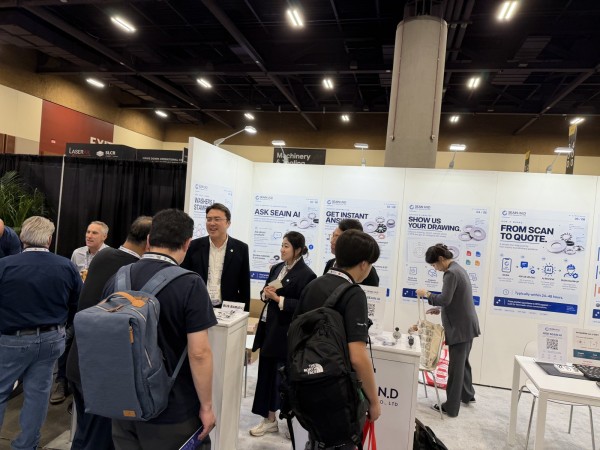
SEAIN IND’s booth at the International Fastener Expo 2026, held October 7–9 at the Phoenix Convention Center in Phoenix, Arizona. (Photo: SEAIN IND)
At the show, SEAIN IND presented its general and special washer lineup, precision press components, and copper busbars for electric-vehicle battery packs, showcasing its product supply capabilities. The company received new quote inquiries for washers and precision press components during the event and is continuing to review product specifications and hold follow-up discussions with the buyers involved.
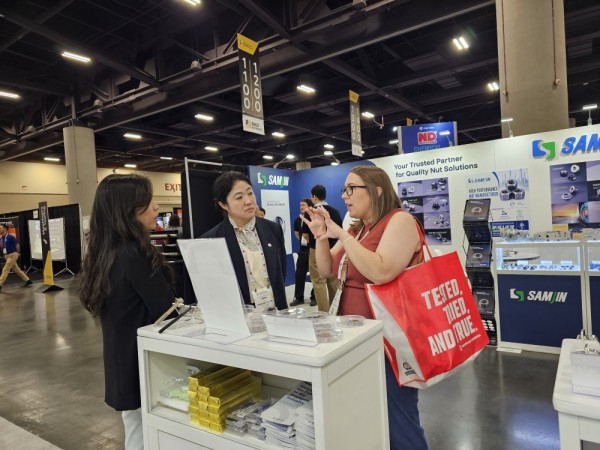
A SEAIN IND representative consults with a buyer at the company’s booth during the International Fastener Expo 2026. (Photo: SEAIN IND)
Beyond product promotion and new customer development, the event gave SEAIN IND an on-the-ground opportunity to assess the fast-changing North American fastener market. Through exchanges with buyers and industry contacts, the company tracked shifts in the market, and said the seminars held during the event provided practical insights that will help inform its future sales strategy.
Regarding the event, which was held in Phoenix for the first time this year, SEAIN IND said it observed an increase in visitor traffic on-site, with active consultations and exchanges taking place amid a positive response from participants.
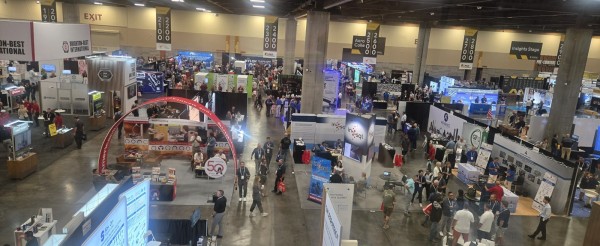
The exhibition floor of the International Fastener Expo 2026 at the Phoenix Convention Center. (Photo: SEAIN IND)
SEAIN IND operates an IATF 16949-certified quality management system and supplies washers to bolt-and-nut and other fastener manufacturers within domestic and overseas automotive supply chains. Building on its accumulated production and quality-management experience, the company is expanding cooperation with overseas customers while actively preparing for digital transformation (DX), AI transformation (AX), and carbon-emission reduction and verification.
SEAIN IND plans to review the inquiries gathered at the show and continue follow-up discussions with individual buyers. Drawing on local customer support and supply capabilities through its U.S. subsidiary, SAC Fasteners Inc., the company intends to continue expanding its customer base and supply opportunities in the North American fastener market.

SEAIN IND staff at the company’s booth at the International Fastener Expo 2026 in Phoenix, Arizona. (Photo: SEAIN IND)
About SEAIN IND Co., Ltd.
SEAIN IND Co., Ltd. is a South Korea-based manufacturer specializing in washers and precision press components, founded in 1988 and headquartered at the Namdong National Industrial Complex in Incheon, South Korea. The company produces general and special washers, precision press components, and copper busbars, supplying products to overseas markets including the United States and Japan. Through its U.S. subsidiary, SAC Fasteners Inc., SEAIN IND supports customer engagement and local supply in North America.
Media Contact
Organization: SEAIN IND Co., Ltd
Contact Person: Global Sales Department
Website: https://www.seain.kr/en/seain
Email: Send Email
Country: Korea South
Release id: 50440
View source version on King Newswire:
SEAIN IND Concludes Participation in International Fastener Expo 2026
About Author
Disclaimer: The views, suggestions, and opinions expressed here are the sole responsibility of the experts. No Digi Observer journalist was involved in the writing and production of this article.
The 7.7-Million-Job Industry That Still Runs on Phone Calls
Clear Choice System Helps Salons and Home Services Businesses Get Found in AI Search
SEAIN IND Concludes Participation in International Fastener Expo 2026
Benzinga Money Article Discusses How to Become Part of the 12% of Retirees Who Have Achieved the Recommended $550,000 Minimum Retirement Savings Threshold
Apu Apustaja Conquers New York with Lively Street Ads, Including Times Square Billboard
Bay Smokes Maintains Quality Amid Legislative Changes in the Hemp Industry


-
Press Release3 days ago
A Better Life Through Ai Wheel Mobility Scooter 20 inch Boarding Luggage: Airwheel Smart Carry on hand Luxury Cabin Suitcase Shine at the 140th Canton Fair
-
Press Release4 days ago
AIXONA Announces AI-Powered Transaction Optimization and Expansion into European and Canadian Markets
-
Press Release3 days ago
Soika Labs Launches Mockingjay Network, an Agentic AI Operating System That Lets Businesses Command Their Own AI Workforce
-
Press Release6 days ago
FinSight Ventures Launches $100 Million Physical AI Index Fund
-
Press Release1 week ago
KodyGas Boiler Repair Adds F-Gas Certified Air Conditioning Installation and Servicing Across South Yorkshire
-
Press Release5 days ago
Alex Cecola Highlights Why Investment Process Matters More Than Market Prediction for Long- Term Investors
-
Press Release3 days ago
Remittances to Uzbekistan Reach $18.9bn as OSON X Opens a UAE Money App for Central Asians
-
Press Release3 days ago
Aussie Vape Trend Scales Wholesale Supply Network Across Australia