
Press Release
Gita Sankano Announces 2025 Outlook: Four Shifts Reshaping Real Estate Finance and Community Development

Looking Ahead: What the Next Year Holds for Real Estate Finance
Maryland, USA, Sep 02, 2026, ZEX PR WIRE — Gita Sankano, an attorney representing the D.C. Department of Housing and Community Development, has published her one-year outlook identifying four major shifts she expects will reshape how real estate finance and community development transactions unfold through the end of 2025.
The forecast draws on her work coordinating closings across the United States for multifamily housing projects and health care facilities, as well as her current role advising on complex affordable housing finance transactions involving multi-layered financing structures.
“The next twelve months will test how well we adapt our deal structures to changing conditions,” Sankano says. “The tools we rely on today, from tax credit programs to secondary market execution, are all being reshaped by forces outside the transaction table.”
Four Trends to Watch
Sankano’s outlook focuses on areas where she sees the most movement.
Tax credit market pressure. Low Income Housing Tax Credit pricing has fluctuated over the past two years, and Sankano expects continued volatility as investor appetite responds to broader economic signals. Projects that combine LIHTCs with Historic Tax Credits face even tighter pricing windows. She advises sponsors to build in more contingency time and alternative capital stacks.
Bond financing costs. Tax-exempt bond rates remain a core financing tool for multifamily projects, but interest rate uncertainty makes long-term underwriting harder. Sankano notes that deals relying on taxable and tax-exempt bonds alongside subordinate soft debt need more flexible timelines and closer coordination with state and local funding sources.
Secondary market execution changes. Fannie Mae’s Delegated Underwriting and Servicing product line and Freddie Mac’s Capital Markets Execution program have served as reliable takeout vehicles for years. Sankano sees both programs adjusting their appetite and pricing in response to portfolio risk management, which will ripple through origination and servicing practices.
Layered regulatory compliance. Projects involving FHA insurance programs under Sections 220, 221(d)(4), 223(a)(7), 223(f), 232, and 241(a) of the National Housing Act carry dense compliance requirements. Add in Section 8 contracts, Section 202 and Section 236 Use Agreements, and mezzanine financing, and the documentation burden grows. Sankano expects increased scrutiny on subordinate debt terms and intercreditor agreements.
Why This Matters Now
Real estate finance transactions do not move quickly. Deals that close in late 2025 are being structured and negotiated now. Sankano’s outlook is aimed at lenders, developers, and public agencies who need to anticipate where the market is headed rather than react to where it has been.
She points to one practical example: a multifamily project that layers bridge loans, secondary financing from state and local sources, and FHA insurance has multiple approval timelines that rarely align. If tax credit pricing drops or bond rates spike during the gap, the deal can stall. Planning for that scenario up front makes the difference between a successful closing and a restart.
Practical Steps for the Year Ahead
Sankano recommends that transaction teams review their assumptions on three fronts.
First, capital stack flexibility. Every major component, from senior debt to tax credit equity to subordinate soft loans, should have a backup plan. If one piece shifts, the whole structure should not collapse.
Second, closing timelines. She has seen too many deals assume everything will proceed on schedule. Build in buffer time for regulatory approvals, investor diligence, and market changes.
Third, documentation discipline. Complex structures require clear intercreditor agreements, subordination terms, and compliance tracking. Mistakes here create problems years after closing, not just at the table.
Grounded in Real Transactions
Sankano’s perspective comes from years of work on both sides of the transaction table. After clerking for the Honorable Michael W. Reed at the Court of Special Appeals in Maryland, she spent five years at a large law firm counseling mortgage banking clients in the origination, sale, and servicing of loan transactions sold to secondary market investors, primarily Fannie Mae and Freddie Mac.
She coordinated closings for lenders providing financing for multifamily housing projects and health care facilities under multiple FHA insurance programs, with particular expertise in complex structures. Her current role at DHCD places her inside the public sector, advising on affordable housing policies, programs, and initiatives while reviewing and drafting legal documents for the affordable housing and community development programs the agency administers.
That combination gives her a view of how market forces, regulatory requirements, and public policy objectives intersect in real deals.
Why a One-Year Window
Sankano chose a one-year outlook because it matches the planning horizon most transaction teams actually use. Five-year forecasts sound authoritative but rarely shape day-to-day decisions. One year is concrete enough to plan around and short enough to adjust if conditions change.
Her forecast is not a prediction that everything will break. It is a reminder that the tools and structures that worked reliably in one cycle will need adjustment in the next. The teams that anticipate that shift will close deals. The ones that wait for certainty will fall behind.
To read more, visit the website here.
About Gita Sankano
Gita Sankano is an attorney representing the D.C. Department of Housing and Community Development, where she works on complex affordable housing finance transactions and advises on affordable housing policies, programs, and initiatives. A graduate of the University of Maryland School of Law, she clerked for the Honorable Michael W. Reed at the Court of Special Appeals in Maryland and spent five years in private practice before joining DHCD. She is based in Washington, D.C.
About Author

Disclaimer: The views, suggestions, and opinions expressed here are the sole responsibility of the experts. No Digi Observer journalist was involved in the writing and production of this article.

Press Release
Karviva and Founder Dr. Angela Zeng Featured in 2026 USA TODAY Food as Medicine Edition.
Full-page feature highlights founder Dr. Angela Zeng’s approach to combining traditional wellness principles with modern nutrition
Saint Louis, MO, United States, 17th Oct 2026 – Karviva, the functional beverage company founded by Dr. Angela Zeng, is featured in the 2026 USA TODAY Food as Medicine special edition, with a full-page feature appearing on page 23 in both the digital and print editions. According to information provided by USA TODAY, approximately 250,000 printed copies of the special edition are expected to be in circulation. The feature highlights Dr. Zeng’s background as a medical scientist, her family’s generations-long connection to Traditional Chinese Medicine, and the thinking behind Karviva’s whole-plant beverage portfolio.

The feature, titled “Why a Medical Scientist Built a Gentler Cleanse,” explores Dr. Zeng’s personal and professional path and the ideas that led her to create Karviva. It highlights the company’s use of whole-plant ingredients, including fruits, vegetables, sprouts, herbs, and botanicals, as well as its approach to developing juice products without added sugar or harsh laxatives.
Dr. Zeng founded Karviva after combining her scientific training with the traditional wellness practices she grew up around. Her background includes a Ph.D. in Pathology and training in evidence-based nutrition, while her family history introduced her to Traditional Chinese Medicine from an early age.
“A cleanse should not feel like a punishment,” said Dr. Angela Zeng. “It should give you space to hydrate, simplify your meals, and pay attention to what your body needs.”
The USA TODAY appearance adds to a series of recent milestones for Dr. Zeng and Karviva. Dr. Zeng’s debut book, The Balance Cure: The TCM Way to Lasting Weight Loss, has reached the No. 1 bestseller position in Amazon’s Holistic Medicine category. The book explores Traditional Chinese Medicine alongside modern nutrition and introduces readers to five TCM body patterns, self-assessments, seasonal observations, recipes, and lifestyle reflections.
Karviva has also recently received recognition from Good Housekeeping, with the company’s Profit Cacao Whole Plant Protein & Prebiotic Smoothie selected as a winner of the 2026 Snack Awards. The recognition followed evaluations by the Good Housekeeping Institute Nutrition Lab and consumer testing as part of the award program.
The new USA TODAY feature offers readers a closer look at the founder behind Karviva and the ideas that continue to shape the company’s approach to functional beverages.
About Dr. Angela Zeng
Dr. Angela Zeng, Ph.D., MBA, is a food scientist, Traditional Chinese Medicine scholar, and founder and CEO of Karviva. Born into generations of Chinese herbal practitioners and trained in pathology, biochemistry, and evidence-based nutrition, she combines traditional wellness principles with modern nutritional science through her work as an entrepreneur, author, and speaker. She is the author of The Balance Cure: The TCM Way to Lasting Weight Loss.
About Karviva
Karviva is a St. Louis-based functional beverage company founded by Dr. Angela Zeng. Inspired by Traditional Chinese Medicine and modern nutritional science, the company develops plant-based beverages using whole-food ingredients, botanicals, and prebiotic fiber. Its portfolio includes juices, protein smoothies, hydration beverages, and other functional drinks.
Media Contact
Organization: Karviva
Contact Person: Dr. Angela Zeng
Website: https://karviva.com/
Email:
angela@karviva.com
City: Saint Louis
State: MO
Country: United States
Release id: 49986
View source version on King Newswire:
Karviva and Founder Dr. Angela Zeng Featured in 2026 USA TODAY Food as Medicine Edition.
About Author
Disclaimer: The views, suggestions, and opinions expressed here are the sole responsibility of the experts. No Digi Observer journalist was involved in the writing and production of this article.
Financial technology company opens its app in more than 50 countries during FLOW Summit as 500-plus builders develop AI and Web3 products
BANGKOK, Oct. 17, 2026, ZEX PR WIRE — U-topia, a financial technology company building a self-custody app for everyday money movement, has opened its public beta in more than 50 countries. The company announced the launch at FLOW Summit 2026, held Oct. 15-16 at Avani Sukhumvit Bangkok, five years after U-topia was founded.

More than 700 people attended the two-day launch, including technology entrepreneurs, developers and community members from several countries. The program combined U-topia product demonstrations and company updates with U-Hackathon, a global build program focused on practical AI and Web3 products.
“Five years ago, I set a simple standard: if my mother could not use the product without calling me for help, it was not ready,” said Emmanuel Quezada, founder and CEO of U-topia. “Opening the beta with people from around the world, while hundreds of builders were creating new tools beside us, brought that idea to life. Our goal is to make moving money as simple as sending a message while keeping people in control.”
A public beta designed around everyday use
U-topia is designed to let eligible users hold, send, spend, convert and withdraw digital and everyday currencies through one mobile app. Users can send funds to another U-topia user through a U-Tag, a simple @name that replaces a long wallet address. The company says funds remain under the user’s control rather than being held by U-topia.
The public beta follows private alpha and closed beta testing with community members and ambassadors. Feature availability varies by country. Account opening, card issuance and transactions remain subject to age requirements, identity verification, partner rules and local law. U-topia is not a bank or card issuer; card and local currency services are provided through licensed partners where available.
U-Hackathon brings global builders to Bangkok
FLOW Summit also hosted U-Hackathon on Oct. 15-16. Organizers said the event attracted more than 500 hackers and builders from around the world. Teams worked through a 24-hour build period with product, engineering and design mentors before presenting working prototypes in two tracks: artificial intelligence and Web3. The program extended the app launch into a working forum for new products, technical collaboration and international builder participation.
The competition recognized three teams in each track. Organizers valued the combined awards at more than 2.5 million Thai baht, including the advertised THB 1 million core prize pool, partner bounties and technology credits. UBotPay, an AI-powered payment agent built for Web3, won first place in the Web3 track. U-Reach, an AI-powered marketing, sales and customer relationship management platform, took first place in the AI track.
U-Hackathon was sponsored by ElevenLabs, Tokenomist AI and DTC Group, in association with Avalanche, Team1 Thailand, Yellow.com, ContributionDAO, CUBS Chula and Hooray. Judges selected projects on merit, and members of the U-Center DAO community voted live for the grand prize.
The summit also included a preview of U.bot, a related AI venture from members of U-topia’s founding team. U.bot is being developed as a user-controlled orchestration layer that can select among AI models and coordinate specialized agents. Its long-term roadmap aims to create a more capable personal AI experience with characteristics the team associates with superintelligence; those advanced capabilities are planned and are not currently available.
About U-topia
Founded on Oct. 16, 2021, U-topia is a financial technology company building a self-custody mobile app intended to help people hold, send, spend, convert and withdraw digital and everyday currencies while retaining control of their funds. U-topia is not a bank and does not issue cards. Availability and features vary by country and are subject to partner requirements and local law. Learn more at www.u-topia.com.
About Author
Disclaimer: The views, suggestions, and opinions expressed here are the sole responsibility of the experts. No Digi Observer journalist was involved in the writing and production of this article.
Press Release
From Karmayogi to the World Stage: Dr. Hemant Garg Wins “Excellence in AI for Public Policy”, Charts India’s Path to the AI Big League
Civil servant, researcher and AI pioneer tells the 3rd World AI Summit, Bengaluru, that people-first, sovereign AI can make India a global AI leader
Bengaluru, India, 16th October 2026, ZEX PR WIRE — Dr. Hemant Garg, Deputy Director (Legal), Employees’ State Insurance Corporation (ESIC), Ministry of Labour and Employment, Government of India, received the “Excellence in AI for Public Policy” award at the 3rd World AI Summit in Bengaluru on 14–15 October 2026, placing an Indian public-policy voice at the centre of the global debate on how AI should serve people.
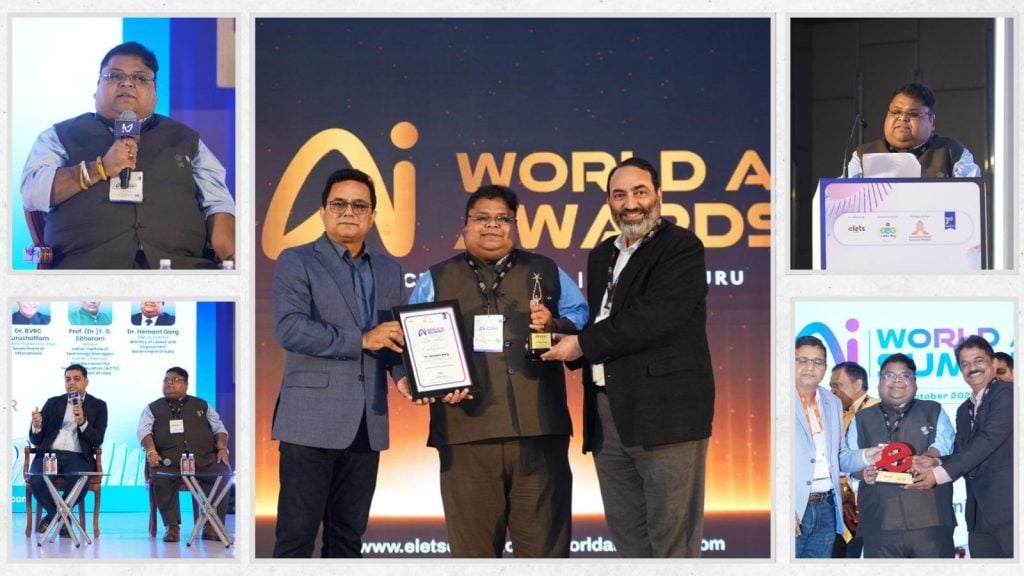
Dr. Garg described all of his work, from AI agents for government to AI-led labour law outreach, as an effort to help realise Hon’ble Prime Minister Shri Narendra Modi’s vision of Viksit Bharat@2047, under the leadership of Hon’ble Union Labour and Employment Minister Dr. Mansukh Mandaviya, whose Shramev Jayate reforms, Labour Codes and Ease of Doing Business drive set the direction. The goal, he said, is an Atmanirbhar Bharat in AI, built on a Bharat AI Stack: Indian large language models such as Sarvam, the Bhashini platform serving citizens in their own languages, and home-grown agents and talent under the IndiaAI Mission, taking India into the global AI league.
Held with Digital India, the National e-Governance Division (NeGD) and the Karnataka Digital Economy Mission (KDEM) as partners in Bengaluru, India’s startup, IT and now AI capital, often called India’s Silicon Valley, the Summit was themed “AI for All: Accelerating India’s Journey Towards Inclusive, Responsible and Future-Ready AI”.
The award honours his creation in 2023 of “IFSCA Karmayogi”, the first AI agent at the International Financial Services Centres Authority (IFSCA), GIFT City, and his research on AI in anti-money laundering, the Labour Codes and algorithmic management of gig workers.
On the panel “AI for All – India’s Journey to a Sovereign, Inclusive AI Future”, with Shri Aman Mittal, IAS, Dr. BVRC Purushottam, IAS and Prof. (Dr.) T. G. Sitharam, former Chairman, AICTE, moderated by Dr. Ravi Gupta, Dr. Garg said inclusive AI must include the worker, and that India can blend Europe’s rights-based approach, US-style audits and Singapore’s skilling model through its Labour Codes, the DPDP Act and e-Shram.
His keynote, “AI, Employment & Skills: Building a Future-Ready Workforce for India”, presented as “From Files to Foresight”, began with a worker disabled in an accident, or a family that has lost its breadwinner, whose care and pensions depend on ESIC, EPFO, the Ministry of Labour and Employment and the National Health Authority. “The true test of AI in government is how quickly that family receives its benefits, and whether it is treated with dignity on the way,” he said.
He traced three waves of governance: e-Governance, which put paper online; Digital Governance, built on India’s digital public infrastructure; and now AI-enabled Intelligent Governance, where benefits reach eligible citizens without their having to apply.
Dr. Garg propounded that AI will change tasks first, then jobs, then institutions and the workforce, and called for institutions for AI governance, impact assessment and exposure mapping to curb job attrition, support reskilling and compensate workers in transition. e-Shram, ESIC and EPFO, now reaching gig and platform workers, can extend social security to those left out, while indigenous models such as Sarvam and Bhashini can grow home-grown AI talent under the IndiaAI Mission.
Government AI, he said, must be lawful, explainable and accountable; “a pattern is not proof”; and India must guard against a new colonisation “not by ships, but by servers”. He proposed “Five Ts”: Trust, Transparency, Talent, Thin and safe data, and Tested-then-scaled.
An LLB, LLM and Ph.D., and an IIT Delhi CTO Programme alumnus with nearly two decades in public service, including Punjab’s Department of Cooperation, Dr. Garg has researched digital governance in governments and cooperatives extensively; his work is published internationally, taught in universities and presented at Oxford, Harvard and Cambridge.
“Not artificial intelligence replacing governance, but intelligent governance that remains deeply human,” he concluded.
Connect with Dr. Hemant Garg on LinkedIn: https://in.linkedin.com/in/dr-hemant-garg-2b26699
About Author
Disclaimer: The views, suggestions, and opinions expressed here are the sole responsibility of the experts. No Digi Observer journalist was involved in the writing and production of this article.
Karviva and Founder Dr. Angela Zeng Featured in 2026 USA TODAY Food as Medicine Edition.
U-topia Launches Public Beta as Global Builders Gather for U-Hackathon
From Karmayogi to the World Stage: Dr. Hemant Garg Wins “Excellence in AI for Public Policy”, Charts India’s Path to the AI Big League
Benzinga Money Article Discusses How to Become Part of the 12% of Retirees Who Have Achieved the Recommended $550,000 Minimum Retirement Savings Threshold
Apu Apustaja Conquers New York with Lively Street Ads, Including Times Square Billboard
Bay Smokes Maintains Quality Amid Legislative Changes in the Hemp Industry


-
Press Release2 days ago
Midwest Ragdolls Highlights Why a Kitten’s Early Environment Matters
-
Press Release4 days ago
INmune Bio Inc. and Quantum Computing Inc. Partner to Apply Quantum Optimization and AI to Advance Alzheimer’s Drug Research and Explore New Applications for XPro
-
Press Release3 days ago
Exhibit at CES 2027: Showcasing GENCHI, the Immersive Avatar Service Called Crazy by a U.S. Angel Investor
-
Press Release6 days ago
Beyond the Customs Declaration: Gorian Aduanas Takes a Specialist, Bespoke Approach to Customs Clearance and Complex International Imports
-
Press Release1 day ago
From Karmayogi to the World Stage: Dr. Hemant Garg Wins “Excellence in AI for Public Policy”, Charts India’s Path to the AI Big League
-
Press Release4 days ago
Evolution Metals & Technologies Corp. Reaffirms $400 Million to $460 Million FY2027 Revenue Guidance, Unveils Eight Sintered Magnet Grades Covering an Estimated 75% of Global NdFeB Revenue, and Moves to Answer U.S. Army Call for Rare Earth Magnets
-
Press Release7 days ago
DATA Network joins Sui and Walrus to scale the supply chain for AI training data
-
Press Release1 day ago
Karviva and Founder Dr. Angela Zeng Featured in 2026 USA TODAY Food as Medicine Edition.