
Press Release
Kling AI Raises Cinematic Standards with Industry-First Native 4K Video Generation

United States, 24th Jun 2026, – Kling AI, the AI-powered creative platform, rolled out today a new 4K mode in Kling Video 3.0 series, marking the first in the industry to offer native 4K output that meets rigorous production standards required for high-end use cases such as broadcast television, theatrical cinema and high-end advertising.
The native 4K generation moves beyond upscaling to generate high-resolution videos with sharper visuals, richer details and more stunning cinematic textures that upscaling 720p or 1080p output cannot bring. Unlike traditional methods that rely on post-generation upscaling – often resulting in visual artifacts and encoding errors – Kling AI’s native 4K capabilities allow for high-fidelity 4K production directly from the generation phase.
The capabilities are ideal for premium commercial uses with high requirement on video quality, including large-scale display, high-definition playback and professional production workflows across advertisements, television and film production.
Superior Detail Preservation via Native 4K
The native 4K capabilities make it possible to generate cinematic-level clarity that captures intricate details such as facial expressions and skin textures with a high level of realism and can handle close-up shots especially well, ideal for producing character close-ups in professional film and television production
The 4K output elevates product showcases to a professional standard, capturing granular details—from intricate logos to fine typography—with lifelike precision. By faithfully recreating material textures with a cinematic finish, it provides the visual fidelity essential for high-impact commercial advertising.

Even under high-speed motion and complex lighting, the 4K mode shows a significant increase in clarity and textural depth, capable of rendering details with great precision.
Enhanced Color Graduations and Seamless Transitions
The native 4K output delivers richer color graduations and smooth color transitions, capturing fluid and rich transitions that upscaled footage is hard to achieve. This provides an authentic, high-fidelity visual experience that draws the audience deeper into the frame.
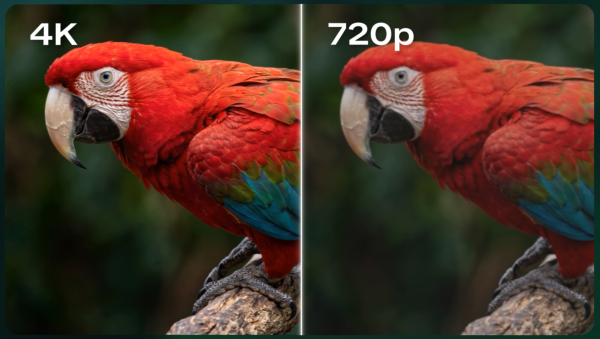
Powered by Kling AI’s latest 3.0 video series, the native 4K output ensures seamless reference consistency. It faithfully preserves character identity, stylistic nuances, and atmospheric lighting across multiple generations, maintaining the integrity of the original reference image with precision.
The launch of native 4K mode solidifies Kling AI’s position as a premier tool for professional film and television production, bridging the gap between AI innovation and cinematic standards.
“Since House of David season 1, Kling has been an essential part of our workflow. Now it has become the first foundation model that we’ve used that is native 4K. The details are superb and nuanced. It’s beautiful. It’s another leap forward in GAI tools,” said Jon Erwin, Creator of House of David, Founder & CEO of Innovative Dreams.
Season 1 of House of David incorporated 72 shots that involved use of AI, including Kling AI for video production.
Since its launch, Kling AI has seen rapid adoption across film, television advertising industries, streamlining storyboard visualization and product concepts while optimizing workflows from CGI to the creation of bespoke visual assets.
In the hit Chinese period drama Swords Into Plowshares, Kling AI was used to build dynamic territorial maps and accelerate effects-heavy previs, including cutting a storm-sequence simulation timeline from two months to two weeks.
Kling AI also announced on Thursday the launch of Kling AI 4K Short Film Creative Contest, a global call for entries designed to showcase the next frontier of creativity, powered by Kling AI’s native 4K output technology. In addition to a total prize pool of $25,000 USD and 70,000 Kling AI credits, winners will also have the chance to debut their work on the big screen in a special screening event in South Korea.
By lowering down the technical barrier to cinematic-grade output, Kling AI aims to enable professional creators and industry leaders to further push the boundaries of AI-enabled filmmaking.
Media Contact
Organization: Kling AI
Contact
Person: Tongya Yang
Website:
https://kling.ai/
Email:
support@kling.ai
Country:United States
The post
Kling AI Raises Cinematic Standards with Industry-First Native 4K Video Generation appeared first on
Brand News 24.
It is provided by a third-party content
provider. Brand News 24 makes no
warranties or representations in connection with it.
About Author

Disclaimer: The views, suggestions, and opinions expressed here are the sole responsibility of the experts. No Digi Observer journalist was involved in the writing and production of this article.

Bryn Mawr, Pennsylvania, 22nd October 2026, ZEX PR WIRE, Amy MacIntyre, a psychiatrist in Bryn Mawr, Pennsylvania, explains how understanding individual circumstances shapes better care.
What does it mean to listen to the whole story?
“I try to consider the whole story and situation,” MacIntyre says. Listening to the whole story means taking time to understand the experiences and circumstances someone brings with them. It means asking questions that go beyond symptoms and recognizing that a person’s background, relationships, and daily life all play a role in their wellbeing.
Many people feel rushed or unheard in healthcare settings. When a provider listens to the full context, patients feel respected and understood. That foundation makes treatment more effective.
How do individual circumstances change the approach to care?
“People bring different experiences and circumstances with them, and I think it is important to remember that,” MacIntyre explains. Two people with similar symptoms may need very different approaches based on their family situation, work stress, cultural background, or support system.
Understanding these differences helps shape a treatment plan that fits the person’s real life. A prescription or recommendation that works well for one individual may not be practical or helpful for another.
What role does community play in mental health?
“The relationships with people and the community are something I value very highly,” MacIntyre says. Strong community connections provide support, reduce isolation, and create a sense of belonging. These relationships can be protective during difficult times.
A psychiatrist who is part of the community for the long term builds trust and sees how families and individuals grow and change. That continuity matters. People feel more comfortable seeking help when they know the provider understands the local context and cares about the people who live there.
What has remained consistent over 20 years of practice?
“I started this practice in 2006 to help people in the community thoughtfully and compassionately. That commitment has remained important to me throughout the years,” MacIntyre notes. The focus on compassionate, evidence-based care has stayed central even as treatments and understanding have evolved.
Consistency in values creates a stable foundation for the people seeking care. They know what to expect and can trust that the same principles guide every interaction.
How can you tell if a provider is really listening?
A provider who is listening will ask follow-up questions, reflect back what you have said, and show genuine interest in your concerns. They will not rush to a conclusion or interrupt. They will make space for you to share what matters most to you.
You should leave the appointment feeling heard, even if the path forward is still unclear. Feeling understood is a crucial first step in any treatment relationship.
If you do nothing else
Write down the full story before your next healthcare appointment, including what is happening in your life outside of symptoms.
- Choose a provider who asks about your daily circumstances, not just your diagnosis.
- Ask your provider how your individual situation might affect the recommended treatment.
- Build or strengthen at least one relationship in your local community this month.
- Notice whether you feel heard in your healthcare appointments, and speak up if you do not.
- Look for providers who have long-term roots in your community.
- Remember that your experiences and circumstances matter and deserve to be understood.
Share this Q&A with someone who is looking for a healthcare provider who values listening and understanding individual circumstances.
About Amy MacIntyre
Amy MacIntyre is a psychiatrist based in Bryn Mawr, Pennsylvania. She established her private practice in the Main Line area of the Philadelphia suburbs in 2006, providing compassionate, thoughtful, evidence-based psychiatric care. With over 20 years of experience, she focuses on listening carefully, treating people with respect, and understanding the individual circumstances that shape each person’s life. Her work emphasizes the importance of community relationships and meaningful connection in healthcare.
About Author
Disclaimer: The views, suggestions, and opinions expressed here are the sole responsibility of the experts. No Digi Observer journalist was involved in the writing and production of this article.
Chicago, Illinois, 22nd October 2026, ZEX PR WIRE, In a short Q&A, author and entrepreneur Kevin Trudeau explains how he decides whether a day counted, long before any big result shows up.
Why This Question Keeps Coming Up
People ask Kevin Trudeau some version of the same question all the time: how do you know if you’re actually succeeding, or just busy?
He gets asked this by people building a business, writing a book, or trying to change a habit that has not stuck before. Most of them are waiting for a single moment, a launch, a sale, a number on a page, to tell them they made it. Trudeau says that moment rarely arrives on schedule, and treating it as the only proof of progress is a way to feel like a failure for months at a time.
Below, he answers a few questions on how he actually measures a day.
The Q&A
Q: What does a successful day look like for you?
A: It is not a day where something big happened. It is a day where I moved closer to something I care about, even by a small amount. If I wrote two pages, made one phone call that mattered, or fixed one thing that was broken in how I was working, that is a successful day. The scale of the result is not the point. The direction is.
Q: Isn’t that a low bar?
A: It is a different bar, not a lower one. A high bar that you only clear once a year does not help you get through the other three hundred and sixty-four days. A bar you can clear daily keeps you in the game long enough to get to the big result. Most people quit not because they lack ability, but because they measured themselves against the finish line every single day and felt like they were losing.
Q: How do you tell the difference between real progress and just staying busy?
A: Ask what the activity was actually for. Busy work feels productive because it fills the hours. Real progress moves you toward something specific you have already named. If you cannot say what a task was supposed to accomplish, it probably was not progress. That is a question worth asking at the end of every day, not just the start.
Q: What role does being coachable play in this?
A: A large one. If you think you already know how to do the thing you are trying to do, you stop paying attention to the people who have already done it. I still look for people who have results I do not have yet and ask them how they got there. The day you decide you are done learning is the day your progress slows down, even if you do not notice it right away.
Q: Does this way of thinking change as the goal gets bigger?
A: No, and that is the point. Whether the goal is small or huge, the daily question is the same: did I move the needle today, even a little. A big dream is just a long string of small days stacked on top of each other. People overestimate what a single day can do and underestimate what a thousand of them can do.
What He Tells People to Do With This
Trudeau tells people to stop waiting for proof that only shows up at the end. Pick one thing each day that moves you toward the result you want, do it, and count that as a win. Repeat it enough times, and the big day everyone is waiting for tends to arrive on its own.
About Kevin Trudeau
Kevin Trudeau is an author and entrepreneur based in Schaumburg, Illinois. He wrote the New York Times bestselling book Natural Cures “They” Don’t Want You To Know About and the book Your Wish is Your Command: How to Manifest Your Desires. He started the American Memory Institute, which sold the Mega Memory course, and founded the Global Information Network, along with NaturalCures.com and The World’s Best Nutritionals and Organics.
About Author
Disclaimer: The views, suggestions, and opinions expressed here are the sole responsibility of the experts. No Digi Observer journalist was involved in the writing and production of this article.
Greenville, NC, October 23rd, 2026, ZEX PR WIRE, Travis Bright, a Greenville, NC builder with a background in heating and air, lays out what he expects to change in residential construction over the next year.
Trades Get Pulled in Earlier
Travis Bright has spent his career on both sides of a single-family build: the general contracting side and the mechanical side, after graduating ahead of his class at Pitt Community College in heating and air. That mix shapes how he reads the year ahead.
“The biggest shift I expect is timing,” Bright says. “Right now a lot of builders still bring in HVAC and electrical crews after the framing is settled. I think more of that conversation moves earlier, before walls are even up. It saves rework, and it saves money.”
Bright has said before that his own HVAC background changed how he schedules a job. He expects more builders without that background to start asking their mechanical subs for input sooner, simply because the cost of guessing wrong has gotten harder to absorb.
Wiring for Security and Smart Systems Becomes Standard, Not Extra
Bright works directly with indoor and outdoor wiring for electronics and security systems on the homes he builds. He expects that kind of wiring to stop being treated as an upgrade and start being treated as part of the base plan.
“A few years ago, security wiring and smart home wiring were things a homeowner added after move-in, or paid extra for during the build,” he says. “I think that keeps shifting. More buyers expect it already roughed in, the same way they expect enough outlets in a kitchen.”
For builders, that means running conduit and low-voltage wire at the framing stage instead of retrofitting later. Bright says the builders who plan for it from the start will spend less time and money than the ones who treat it as an afterthought.
Scheduling Gets Tighter, Not Looser
Bright does not expect the coming year to make scheduling easier. If anything, he expects the opposite: more pressure to hold a tight sequence, with less room for the kind of slack that used to absorb delays.
“A build schedule only works if the trades hit their windows,” he says. “When one trade slips, everyone behind them slips too. I think the builders who do well this year are the ones who build in real checkpoints, not just a start date and an end date.”
He also expects more attention paid to who shows up when, not just what gets built. A crew that understands how its work affects the next crew in line saves time across the whole project, he says, even if that is not where people usually look for efficiency.
What This Means for Someone Planning a Build
For a family planning a single-family home, Bright says the practical takeaway is to ask a builder how early the mechanical trades get involved, not just who they are.
“If a builder can tell you when HVAC and electrical get brought into the conversation, and it’s early, that tells you something about how the whole job will run,” he says. “If the answer is ‘after framing,’ that’s worth asking more about.”
He expects buyers to get more comfortable asking those kinds of sequencing questions over the next year, the same way they already ask about materials and finishes.
A Builder Who Reads the Job From Both Sides
Bright says his outlook is shaped less by predicting the market and more by watching how a job actually runs on site, where mechanical work and general construction either support each other or get in each other’s way.
“I’m not guessing at trends from an office,” he says. “I’m watching what slows a crew down or speeds one up, and expecting more builders to pay attention to the same things.”
About Travis Bright
Travis Bright is a construction professional based in Greenville, NC, working in construction management for single-family homes. He holds a college degree in construction management and a heating and air credential from Pitt Community College, where he graduated ahead of his class. His background spans residential construction and indoor and outdoor wiring for electronics and security systems. Bright has volunteered with Habitat for Humanity and is the father of two children, a boy and a girl.
About Author
Disclaimer: The views, suggestions, and opinions expressed here are the sole responsibility of the experts. No Digi Observer journalist was involved in the writing and production of this article.
Why Listening to the Whole Story Matters More Than a Diagnosis
Kevin Trudeau: What Actually Counts as a Successful Day
Akshay Kumar: How Houston Shaped a Family Business and a Career
Benzinga Money Article Discusses How to Become Part of the 12% of Retirees Who Have Achieved the Recommended $550,000 Minimum Retirement Savings Threshold
Apu Apustaja Conquers New York with Lively Street Ads, Including Times Square Billboard
Bay Smokes Maintains Quality Amid Legislative Changes in the Hemp Industry


-
Press Release1 week ago
Midwest Ragdolls Highlights Why a Kitten’s Early Environment Matters
-
Press Release1 week ago
Physical AI Lab Nature Will Unveils Natura-1, First General Foundation Model for the Physical World
-
Press Release7 days ago
From Karmayogi to the World Stage: Dr. Hemant Garg Wins “Excellence in AI for Public Policy”, Charts India’s Path to the AI Big League
-
Press Release5 days ago
The Smart Luggage at the 140th Canton Fair:Airwheel 20inch Carry-On Hand Scooter Ai Wheel Robot Cabin Luxury Suitcase Takes Smart Travel to the Next Level
-
Press Release7 days ago
U-topia Launches Public Beta as Global Builders Gather for U-Hackathon
-
Press Release7 days ago
Karviva and Founder Dr. Angela Zeng Featured in 2026 USA TODAY Food as Medicine Edition.
-
Press Release7 days ago
AI News Directory Launches to Help Readers Find AI Writers Worth Following
-
Press Release1 week ago
Edmund Dorsz Says the CNC Trade Is Losing Its Mentors, Not Just Its Workers