
Press Release
Cambria Gold Mines Announces Premier Assay Results and Spin Out Plan for a US Copper Project

Cambria Gold Mines announced the first results from its ongoing infill drilling at the Premier Gold Project (PGP), located in northwestern British Columbia. Cambria Gold Mines began trading on February 13, 2026. Cambria’s short and long-term business objectives involve the synchronised development of two lead assets in BC’s Golden Triangle.
Canada, 27th Apr 2026– Global Stocks News – Sponsored content disseminated on behalf of Cambria Gold Mines. On April 21, 2026, Cambria Gold Mines (TSXV: CAMB; OTCID: AOTVF) announced the first results from its ongoing infill drilling at the Premier Gold Project (PGP), located in northwestern British Columbia. Highlight intercept: 22 meters @ 17.95 grams per tonne (g/t) gold, including 552.0 g/t gold over 0.5 meters.
Cambria Gold Mines began trading on February 13, 2026. Cambria’s short and long-term business objectives involve the synchronised development of two lead assets in BC’s Golden Triangle.
The Premier Gold Project has paved road access, grid-connected hydroelectric power, and proximity to a deep-water port. Multiple deposits include Premier, Silver Coin, Big Missouri, Dilworth, and Martha Ellen.
Red Mountain is a high-grade underground gold deposit, located approximately 15 kilometres northeast of Stewart, BC, within Nisga’a Nation Treaty Lands, in BC’s Golden Triangle.
“We intend that the Premier Gold Project will serve as an infrastructure and processing hub, while Red Mountain is prioritized as the initial source of high-confidence mill feed,” Robert McLeod, President and CEO of Cambria Gold Mines, told Guy Bennett, the CEO of Global Stocks News (GSN).
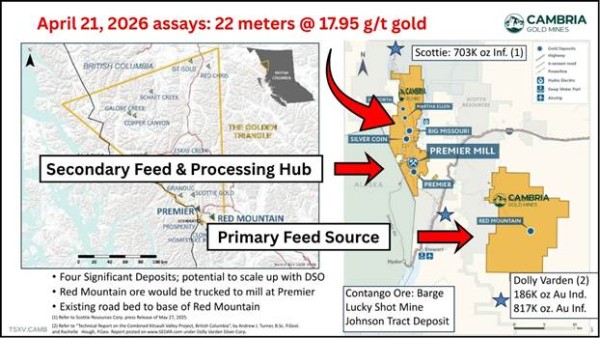
“We have our first drill results from the 2026 season at the Premier Gold Project,” stated McLeod in an April 21, 2026, News Explained YouTube Short. “With our first drill hole, we absolutely nailed it with about 18 grams per tonne over 22 meters. That’s very close to true widths. It’s from the 602 zone, which is on the western side of the famous Premier Gold Mine.”
“We released the first five drill holes of our 27,000-meter ongoing infill drilling program at the Premier Gold Project,” added McLeod. “We currently have two drills that are underground on the opposite side of the ore body, called the Prew Zone.”
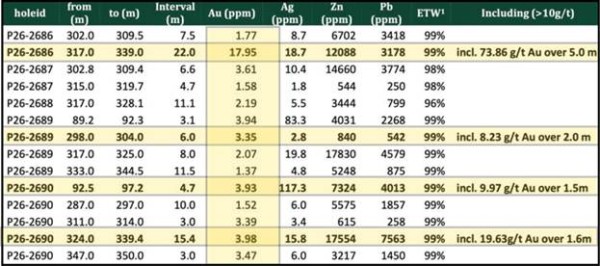
“This drilling at the 602 Zone is delineating high-grade mineralization, which could be accessed with additional development from the recently constructed underground workings at the historic Premier Mine,” confirmed McLeod in the April 21 press release. “Two underground drills are currently delineating the Prew Zone at Premier; our objective is to establish the strong continuity similar to the nine primary shoots that were historically mined at the deposit.”
Results from the first five diamond drill holes completed, totalling 1,815 meters, were reported from the “602 Zone” of the Premier-Northern Lights deposit. Drilling is focused on infill of Indicated and Inferred Resources at the Premier deposits to provide the necessary drill spacing for development planning.
The Cambria geological team believes that the lack of infill drilling during development was a critical factor in the difficulties encountered during the mining operations that led to a shutdown of operations in 2024.
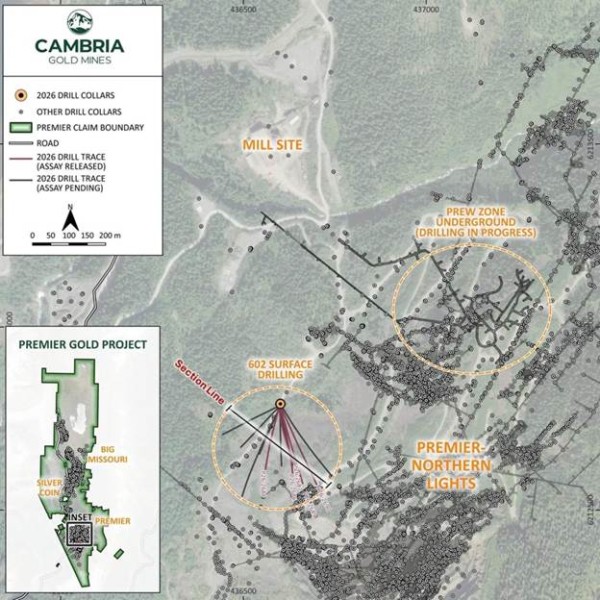
Above: Plan Map showing 602 Zone surface drilling at the Premier – Northern Lights deposit
The scientific and technical information within this news release was reviewed and approved by Blaine Smit, P.Geo. Vice President Exploration for Cambria Gold Mines Inc. Mr. Smit is a “Qualified Person” as defined under National Instrument 43-101 – Standards of Disclosure for Mineral Projects and is not independent of the Company. To verify the information related to this news release, Mr. Smit visited the 2026 drilling operations to review and discuss logging, sampling, and shipping procedures with responsible site staff, and reviewed and discussed assay and QA/QC results with responsible company personnel.
On April 22, 2026 Cambria announced the completion of additional claim staking at the Mt. Margaret copper-gold porphyry deposit near Randle, Washington.
The new staking consists of approximately seven square kilometres of unpatented lode claims surrounding the Cambria’s patented federal claims. The patented claims are held in partnership with the United States Federal Government Bureau of Land Management.
Cambria Gold has been advancing discussions with various US Federal Government Departments regarding the future direction for the deposit. These discussions have led Cambria to initiate a plan to “spin out” the copper asset into a new US entity.
“There’s a historic resource that was completed prior to National Instrument, 43-101, and shouldn’t be relied upon,” confirmed McLeod in an April 22, 2026 News Explained YouTube Short. “It’s 577 million tonnes at 0.36 % copper and 0.24g/t Au. This was drilled in the 1970s. The historic resource was established in 1977. The only other work was done in 2010 when Ascot Resources completed 10 drill holes, and almost all of them ended in mineralization.” [See Footnote 1 for full disclosure details on the historic resource]
“Mount Margaret is potentially one of the most significant copper resources in the United States,” added McLeod in the YouTube video. “It is our intention at Cambria to spin this company out into a new US-domiciled entity. We expect that to happen within the next couple of months. Stay tuned for more news on how we’re going to advance Mount Margaret.”
Note: the scientific and technical information within this release was reviewed and approved by Blaine Smit, P.Geo. Vice President Exploration for Cambria Gold Mines, and is therefore not independent. Mr. Smit is a “Qualified Person” as defined under NI 43-101 and visited the Mt. Margaret project in March of 2026 to review 2010 drill core, property geology, and monumented drill collars. Mr. Smit was not involved with the 2010 drill program by Ascot Resources Ltd. and is relying on the publicly available disclosures and internally available assay and QA/QC files, along with physical review of drill core, to verify the results of the 2010 drilling.
Contact: guy.bennett@globalstocksnews.com
Disclaimer: Cambria Gold Mines paid Global Stocks News (GSN) $1,750 for the research, writing and dissemination of this content.
Footnote:
- The historical resource estimate was completed by Duval Corporation for the Mt. Margaret deposit, with 577Mt grading 0.36% Cu, 0.24 g/t Au, 0.011% Mo, and 1.58 g/t Ag (Taylor, 1980 & Derkley et al, 1990).1,2 This historic estimation work predates the implementation of National Instrument 43-101 – Standards of Disclosure for Mineral Projects (“NI-43-101”) guidelines and was not classified based on currently accepted reserve and resource classifications as set forth by the Canadian Institute of Mining and Metallurgy, August 20, 2000 (CIM Guidelines) or the United States Securities and Exchange Commission’s Regulation Subpart 1300 of Regulation S-K (“S-K 1300”). Cambria cautions it is not treating the historic Duval work as a current mineral resource estimate, and there has been insufficient work completed by a Qualified Person to do so at any point in the project’s history. Furthermore, uncertainty regarding cut off grade, metal prices, modelling methodology, or other parameters and assumptions used in the Duval work could impact the reliability of the historic estimation. Cambria still considers the Duval work relevant given the number of supporting historical drillholes, many of which were confirmed by subsequent Ascot drilling in 2010. Further work including additional infill drilling, geological modelling, and assay certificate and collar validation by a Qualified Person pursuant to NI 43-101 would be required to produce a NI-43-101 or an S-K 1300 compliant resource. There are no guarantees that this additional work would confirm the historical resource estimate defined by Duval.
Media Contact
Organization: Global Stocks News
Contact Person: guy.bennett@globalstocksnews.com
Website: https://www.globalstocksnews.com
Email: Send Email
Country:Canada
Release id:44407
The post Cambria Gold Mines Announces Premier Assay Results and Spin Out Plan for a US Copper Project appeared first on King Newswire. This content is provided by a third-party source.. King Newswire makes no warranties or representations in connection with it. King Newswire is a press release distribution agency and does not endorse or verify the claims made in this release. If you have any complaints or copyright concerns related to this article, please contact the company listed in the ‘Media Contact’ section
About Author

Disclaimer: The views, suggestions, and opinions expressed here are the sole responsibility of the experts. No Digi Observer journalist was involved in the writing and production of this article.

Press Release
Carziqo Brings A-DS Autonomous Delivery to San Francisco During Future Mobility Festival
- The company reports rising delivery demand as it positions autonomous logistics as a response to growing operating costs and the need for more efficient urban services.
SAN FRANCISCO, CA, Oct 03, 2026, ZEX PR WIRE — Carziqo says its A-DS autonomous delivery vehicles have begun operating in San Francisco, extending the company’s delivery business during the Carziqo Future Mobility Festival. The development comes as the company reports continued growth in delivery orders across its supported operations and sees increasing opportunities for autonomous technology in the movement of goods.

The San Francisco operation brings a practical focus to the October celebration: how intelligent mobility can support the everyday needs of businesses and consumers. For Carziqo, autonomous delivery represents an opportunity to connect its vehicle technology with a service whose value depends on consistency, convenience and careful management of operating costs.
The company’s recent announcements have emphasized rising A-DS order volumes and the importance of matching delivery demand with available fleet capacity. Carziqo says its priority is to translate that growth into better vehicle utilization and a more dependable service as the business develops.
The economic backdrop gives that objective particular relevance. According to the U.S. Bureau of Labor Statistics, compensation costs for private industry workers rose 3.3 percent in the year ending June 2026, including a 3.1 percent increase in wages and salaries. Although these figures cover private industry broadly, they provide context for the cost pressures businesses face when planning labor-intensive services.
For delivery operators, handling additional orders involves more than adding vehicles. It requires coordinating routes, staffing, vehicle availability and the time needed to complete each task. Higher demand creates a commercial opportunity, but the ability to serve that demand efficiently determines how much value the additional activity can generate.
Carziqo’s approach centers on reducing the manual driving requirements of supported delivery journeys while maintaining human involvement in fleet supervision, maintenance, customer support and situations requiring direct intervention. The company describes this division of responsibilities as a way to organize delivery work more efficiently as volumes increase.
That distinction is central to the business case for autonomous delivery. Automation can change how resources are allocated, but its usefulness depends on the performance of the wider service. A vehicle must be available when needed, assigned a suitable route and supported throughout its operating cycle.
Carziqo describes the A-DS platform as combining automated driving with route planning, connected vehicle monitoring and centralized operational support. Its fleet systems are designed to bring together information about vehicle condition, delivery progress, charging requirements and maintenance needs, helping teams coordinate the vehicles as a network.
For San Francisco, the significance of the deployment lies in applying that approach to local delivery needs. The commercial opportunity will depend on how effectively available capacity meets demand and how consistently the service performs within its operating scope. Those practical considerations give the expansion a business focus beyond the introduction of another autonomous vehicle model.
Carziqo has previously described a phased approach to A-DS deployment, with attention to route suitability, operational stability and service consistency. Experience gathered from its delivery operations is intended to inform improvements in dispatching, maintenance planning and future deployment decisions.
The Carziqo Future Mobility Festival places these developments within the company’s broader ambition to make intelligent transportation relevant to daily life. Held throughout October, the festival centers on greener mobility, connected services and the practical use of technology to improve how people and goods move through cities.
Autonomous delivery gives that theme an everyday point of connection. Behind each delivery is a person waiting for an item or a business fulfilling a customer’s request. The value of the technology ultimately rests on whether it can help complete those tasks reliably and make the service easier to manage.
The festival also provides an occasion to recognize the community supporting Carziqo’s development. In a separate A-DS announcement, the company introduced an additional Wednesday Performance Reward for eligible A-DS rental users, with amounts, claiming arrangements and eligibility governed by the terms published on its platform.
As the company develops its delivery business, its stated priorities include closer coordination between demand and vehicle deployment, management of operating costs and continued improvement of the service experience.
The San Francisco operation adds a new chapter to that effort during the Future Mobility Festival. With A-DS, Carziqo is positioning autonomous delivery as a practical part of its longer-term mobility ambitions—one whose progress will be measured through the everyday work of moving goods and serving customers.
For company information and official updates, visit www.carziqo.com.
About Author
Disclaimer: The views, suggestions, and opinions expressed here are the sole responsibility of the experts. No Digi Observer journalist was involved in the writing and production of this article.
Press Release
Brian Baldari on the Difference Between a Mentor and a Sponsor, and Why It Decides Promotions
-
ResilExec® Coaching founder Brian Baldari, Pharm.D., MBA, on why senior leaders who have plenty of advice and no advocacy stall at the same level for years.
BRICK, N.J., Oct 03, 2026, ZEX PR WIRE — Most senior professionals have someone they go to for advice. Far fewer have someone who argues for them in a room they are not in. According to Brian Baldari, Pharm.D., MBA, founder of ResilExec® Coaching, that distinction accounts for a large share of stalled advancement among otherwise strong performers.
Baldari spent 24 years inside pharmaceutical, healthcare, and enterprise leadership organizations. He held five successive Director-level roles, moved from Director to Vice President and Senior General Manager in 18 months, and led the commercial launch of 14 brands. He now works with Associate Directors, Directors, Senior Directors, Executive Directors, and Vice Presidents inside pharmaceutical, healthcare, and enterprise IT organizations.
“A mentor talks to you. A sponsor talks about you,” Baldari says. “One of those changes your calendar. The other changes your title.”
Advice Is Not Advocacy
Mentorship is widely available and widely encouraged. Many organizations run formal programs for it. A mentor offers perspective, context, and guidance, and that guidance has real value early in a career when the primary gap is knowledge.
Sponsorship operates differently. A sponsor spends their own credibility on someone else. They put a name forward on a succession slate, defend a candidate during calibration, and accept the consequences if the bet does not pay off. That is a materially different act, and it is not something an organization can mandate.
“Leaders collect mentors because mentors are easy to ask for,” Baldari says. “Nobody feels awkward requesting advice. Asking someone to spend their reputation on you is a different conversation, and most people never have it.”
Where the Gap Shows Up
The gap becomes visible at the point where advancement decisions are made collectively. Calibration sessions and succession discussions involve people across multiple functions, many of whom have no direct experience of a given candidate’s work. In those rooms, a candidate is represented by whoever chooses to speak.
“If nobody in that room can describe what you do at enterprise scale, you are not in the conversation, regardless of your review,” Baldari says. “The decision is not made on the strength of your record. It is made on the strength of the description someone else gives of it.”
Baldari notes that this is where strong performers are most often surprised. Their performance ratings are high, their manager is supportive, and the outcome still does not change, because the people who influenced the decision were never engaged.
Sponsorship as a Variable
Sponsorship is one of five variables in Baldari’s Promotion Math framework, alongside Performance, Visibility, Narrative, and Timing. In his assessment, strong performers optimize the first variable and leave the remaining four unattended, then attribute the result to politics.
“Performance gets you noticed. Positioning gets you promoted,” Baldari says. “Sponsorship is the variable people find hardest to work on, because it requires asking for something rather than producing something.”
What Changes the Outcome
Baldari advises leaders to identify the specific individuals who will participate in the decisions that affect them, then assess honestly whether those individuals could describe their contribution without prompting. In most cases the answer is no, and that is the actionable finding.
From there the work is practical rather than social. It involves delivering value to those individuals rather than checking in with them, framing results at enterprise level rather than functional level, and showing up in forums where that work is visible to people beyond a direct reporting line.
“You do not recruit a sponsor by asking them to be one,” Baldari says. “You give them something worth putting their name next to, and you make sure they understand what it was.”
About Brian Baldari
Brian Baldari, Pharm.D., MBA, based in Brick, New Jersey, is the founder of ResilExec® Coaching and Resilient Performance Group LLC. He spent 24 years inside pharmaceutical, healthcare, and enterprise leadership organizations, held five successive Director-level roles, and advanced from Director to Vice President and Senior General Manager in 18 months. He led the commercial launch of 14 brands across rare and chronic disease categories, led an organization of more than 250 people, and has mentored more than 50 leaders across three continents. Through ResilExec Coaching, he helps Associate Directors, Directors, Senior Directors, Executive Directors, and Vice Presidents accelerate career growth through personalized executive coaching, leadership development, and strategic career positioning.
Media Contact
Resilient Performance Group LLC
About Author
Disclaimer: The views, suggestions, and opinions expressed here are the sole responsibility of the experts. No Digi Observer journalist was involved in the writing and production of this article.
Press Release
Timothy Caraboolad Publishes a Buyer’s Checklist for New-Build Condos in South Florida
-
Real estate developer Timothy Caraboolad is releasing a set of questions first-time buyers should ask before putting money down on a new-build apartment in South Florida.
A market full of new buildings, and a lot of first-time buyers
Florida, USA, Oct 03, 2026, ZEX PR WIRE — South Florida has no shortage of new construction. Buildings go up fast, sales offices open before the concrete cures, and renderings promise more than any buyer can verify in a single walkthrough.
Timothy Caraboolad, a real estate developer and designer based in Palm Beach, Florida, has spent years on the other side of that process, building high-end custom homes through his firm Lad Design. He says the buyers who end up happiest are the ones who ask harder questions earlier, not the ones who fall for the best rendering.
“A sales gallery is designed to sell you a feeling,” he says. “Your job as a buyer is to slow that down and ask what you’re actually getting for the price.”
What to check before signing anything
Caraboolad points first-time buyers toward a few areas that matter more than finishes.
Construction quality behind the walls. Countertops and cabinetry are easy to judge. What is inside the walls is not. Caraboolad suggests asking who the general contractor is, how long they have built in the area, and whether the building uses concrete or wood-frame construction, since that affects sound, insurance, and long-term durability in a hurricane-prone region.
HOA fees and what they actually cover. New buildings often advertise low fees at launch that rise once amenities open and reserves get funded. “Ask for the projected budget once the building is fully occupied, not just the introductory number,” Caraboolad says. He recommends buyers ask specifically what percentage of the fee goes into reserves, since that determines whether the building can pay for a roof or a seawall repair without a special assessment.
Storm readiness. In South Florida, this is not optional. Buyers should ask about impact windows, generator backup for elevators and common areas, and flood elevation. Caraboolad says a building’s flood zone designation should be requested in writing, not estimated by a sales agent.
Parking and storage, spelled out. Some buildings sell parking as a deeded asset. Others assign it and can reassign it later. Caraboolad says this distinction matters more than most buyers realize until after closing.
Developer track record. A new building has no resale history to check. Caraboolad suggests buyers look at other projects the same developer has completed, not just renderings of the one being sold, and ask how those buildings have held up.
Timing the purchase
For pre-construction units, Caraboolad says the biggest risk is not price, it is timeline. Delays are common, and buyers should understand what happens to their deposit if the closing date slips.
“Get the outside date for completion in writing,” he says. “And ask what your options are if that date passes.”
He also encourages buyers to walk a finished unit in the same building, or a comparable one from the same developer, before relying on a model unit that may use upgraded finishes not included in the base price.
Why this matters for first-time buyers specifically
Caraboolad says first-time buyers face a particular disadvantage: they often do not know which questions are normal to ask, so they accept vague answers.
“An experienced buyer will push back on a soft answer about HOA reserves or insurance history,” he says. “A first-time buyer might just assume that’s how it works. It isn’t. You’re allowed to ask for documentation before you commit.”
His broader point is that a new building can be a strong investment in South Florida, but only when the buyer treats the sales process the same way a developer would: checking budgets, checking materials, and checking the people building it, before checking the view.
About Timothy Caraboolad
Timothy Caraboolad is an entrepreneur, real estate developer, and designer based in Palm Beach, Florida. He is the founder of Lad Design, a South Florida firm building high-end custom homes, and previously founded Arc Design, a luxury residential development and design firm in the Boston area. He holds a Bachelor’s Degree in International Business from Rollins College.
About Author
Disclaimer: The views, suggestions, and opinions expressed here are the sole responsibility of the experts. No Digi Observer journalist was involved in the writing and production of this article.
Carziqo Brings A-DS Autonomous Delivery to San Francisco During Future Mobility Festival
Timothy Caraboolad Publishes a Buyer’s Checklist for New-Build Condos in South Florida
Brian Baldari on the Difference Between a Mentor and a Sponsor, and Why It Decides Promotions
Benzinga Money Article Discusses How to Become Part of the 12% of Retirees Who Have Achieved the Recommended $550,000 Minimum Retirement Savings Threshold
Apu Apustaja Conquers New York with Lively Street Ads, Including Times Square Billboard
Bay Smokes Maintains Quality Amid Legislative Changes in the Hemp Industry


-
Press Release1 week ago
Just Keepers Spotlights Keeper iD’s New Range of Junior Goalie Gloves
-
Press Release1 week ago
Results Digital Expands Website Design Offerings for General Contractors in Houston TX
-
Press Release6 days ago
New Experiences in Shanghai for Mid-Autumn Festival and National Day! The 2026 International Audio-Visual Arts Carnival Unveils a “Technology + Culture” Audio-Visual Feast
-
Press Release7 days ago
Piya Saliba Releases Free Community Connection Checklist to Help People Build Stronger Relationships
-
Press Release1 week ago
Whimsical Halloween Wardrobe Ready: Arshiner Kids’ Outfits Light Up the Trick-or-Treat Adventure
-
Press Release1 week ago
Painted Brick Digital Named Among Expertise.com’s Top 8 Legal Marketing Companies in Scottsdale
-
Press Release7 days ago
Gary Bassett Shares Lessons From 45 Years Across Finance and Technology
-
Press Release7 days ago
Nivia Fontanez Highlights the Often-Overlooked Role of Radiology Technologists in Patient Care