
Press Release
New Solana Sniper Bot Drops the Subscription Model — Pay 1 Percent Only When Your Trades Are Profitable

The new platform detects token launches on Raydium and Pump.fun in under 300 milliseconds, applies a 12-point on-chain safety filter before each trade, and collects a 1% fee exclusively on profitable positions — leaving losing trades entirely free of charge.
United States, 17th Mar 2026 – There is a structural flaw built into most automated trading tools that almost nobody talks about openly: they charge you whether you make money or not. Monthly subscription fees accumulate regardless of market conditions, regardless of how many positions closed in profit, regardless of whether you logged in at all. For the platforms selling the tools, this is an excellent business model. For the traders using them, it is a quiet, persistent tax on existing.
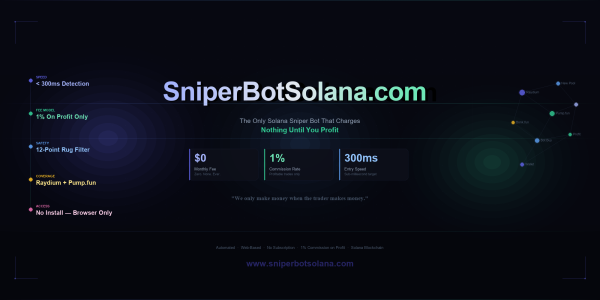
SniperBotSolana.com was built around the premise that this arrangement is wrong. The platform — a fully browser-based Solana sniper bot that requires no software installation, no command-line setup, and no developer knowledge to operate — charges a flat 1% commission applied exclusively to profitable trades. Losing trades are free. Idle periods are free. Bad market weeks are free. The platform earns revenue only when the trader earns revenue. That is the complete fee structure, and in the context of the current Solana automated trading market, it is genuinely unusual.
Why the Fee Model Is the Real Story
Subscription pricing in the Solana trading tool market typically runs between $30 and $150 per month, with higher tiers unlocking faster execution, additional DEX feeds, or priority customer support. These fees are fixed and non-negotiable, billed each month regardless of what the market does.
Anyone who has spent meaningful time trading in the Solana meme token ecosystem understands what this means in practice. Token sniping is a high-variance activity by definition. There are weeks when new launches on Pump.fun are rich with opportunity — credible projects graduating to Raydium with genuine community interest, strong initial liquidity, and the kind of organic momentum that translates into early-entry gains. There are also weeks when the market turns saturated and low-quality, when the proportion of rug pulls is elevated enough that even a well-configured bot cannot turn a consistent profit. The subscription platform collects its fee in both scenarios without distinction.
“We only make money when the trader makes money. If the bot doesn’t profit, you pay nothing.”— SniperBotSolana.com Platform Documentation
The commercial consequence of this model is that the platform’s financial interest is permanently aligned with the trader’s. Improving detection accuracy, tightening the safety filter, reducing execution latency — each of these directly increases the number of profitable trades and therefore directly increases platform revenue. Under a subscription model, those improvements are nice to have. Under a commission model, they are the only path to revenue growth.
Detection Speed in a Market That Measures Opportunity in Milliseconds
Solana processes blocks at approximately 400-millisecond intervals, with peak throughput exceeding 65,000 transactions per second. Those numbers are not incidental background facts — they are the reason Solana became the dominant chain for new token launches. Near-zero transaction fees, high throughput, and sub-second finality created an environment where launching a new token costs almost nothing and the market can begin trading within seconds of creation.
The consequence is a market where timing is the primary competitive variable. Tokens that appreciate quickly — which is the only kind of token worth sniping — deliver the majority of their early gains to holders who entered in the first seconds of availability. A position opened 30 seconds after a token’s first appearance is not the same trade as one opened in the first three seconds. In a token that moves 10x in its opening minute, those 27 seconds represent the difference between a strong profit and buying into an already-elevated price with limited upside remaining.
SniperBotSolana.com targets a detection-to-execution latency of under 300 milliseconds. The system monitors Solana’s on-chain program event logs directly rather than routing through third-party data APIs, which introduce additional processing layers and latency. When a new Raydium pool is initialized or a Pump.fun token crosses its graduation threshold, the detection signal arrives at the bot as close to the moment of creation as the network architecture permits.
Pump.fun and Raydium: Understanding What You’re Actually Trading
SniperBotSolana.com covers two of Solana’s most active token creation environments simultaneously, and the opportunity structure of each is meaningfully different.
The Pump.fun Graduation Window
Pump.fun operates as a bonding curve launchpad: tokens are created and initially traded through an internal pricing mechanism that prevents external wallet access until a target market capitalization is reached. When a token accumulates sufficient demand to hit that threshold — approximately $69,000 — it graduates. Its liquidity migrates to a Raydium pool and becomes available to any wallet on the Solana network without restriction.
That graduation moment is one of the most precisely defined opportunities in DeFi. It is the instant when a token moves from a closed, internal market to an open public one — and when the widest audience of traders simultaneously gains access for the first time. Price in those opening seconds tends to move faster than any manual trader can meaningfully react to. The bots positioned at the exact moment of graduation are the ones capturing entry prices that represent genuine value. Everything after the first few seconds of a successful graduation is follow-on demand entering at progressively higher levels.
Independent Raydium Pool Creation
Not every significant Solana token launch passes through Pump.fun. Raydium’s automated market maker supports direct pool creation from any Solana wallet, and a steady volume of new tokens — including some of the more substantial launches — appear on Raydium independently. SniperBotSolana.com monitors both event types in a single live feed, allowing traders to configure different parameters for Pump.fun graduation events versus direct Raydium pool creation, and to toggle either source on or off depending on their preferred focus.
The 12-Point Safety Filter: What It Does and What It Cannot
Speed without discrimination is not a trading strategy — it is a reliable mechanism for losing money quickly. The Solana meme token market contains a substantial proportion of tokens created explicitly to exploit fast-moving bots. Honeypots allow purchases but programmatically block sells. Rug pulls enable developer wallets to drain liquidity minutes after launch. Wash-traded tokens simulate organic volume to attract buyers before a coordinated dump. A bot that buys every new token indiscriminately would accumulate losses from these categories at a rate that no degree of execution speed can overcome.
SniperBotSolana.com applies a 12-point on-chain safety evaluation to each detected token before a buy transaction is submitted. The assessment draws directly from blockchain data rather than relying on third-party reputation services.
12-Point Safety Evaluation — Key Criteria
- Developer wallet transaction history and account age
- Liquidity lock status and lock duration relative to total liquidity
- Mint authority configuration — frozen or still active
- Freeze authority status on holder accounts
- Token supply concentration in developer-controlled wallets
- Metadata completeness — name, symbol, verified social links
- Contract ownership renouncement or multisig governance
- Bonding curve completion percentage at graduation time
- Liquidity depth relative to stated market capitalization
- Social signal verification — active Twitter/Telegram presence
- Time elapsed since contract deployment
- Cross-reference against known rug-pull and honeypot address patterns
Traders select a minimum acceptable score before activating the bot. A threshold of 9 or 10 filters conservatively, trading fewer opportunities for lower exposure to fraudulent launches. A threshold of 6 or 7 accepts earlier and riskier entries — tokens that have not yet accumulated a full credential set but pass the most critical structural tests. The system does not make this decision for the trader. It applies whatever threshold the trader sets with complete consistency, removing the imprecision and emotional interference that characterizes manual review of token data under time pressure.
No scoring system eliminates rug-pull risk entirely, and SniperBotSolana.com does not claim otherwise. What the filter reliably removes is the category of obviously fraudulent launches — tokens that fail even basic structural integrity checks. In a market where that category represents a significant proportion of daily volume, systematic exclusion of those launches has direct, measurable value.
Priority Fees and Slippage: The Variables That Actually Determine Outcomes
Marketing materials for Solana trading bots emphasize detection speed. The technical variables that most directly determine whether a submitted transaction actually executes at a useful price — priority fees and slippage tolerance — receive far less attention. Both deserve to be treated as primary configuration concerns.
Priority Fees
Solana validators order transactions by attached priority fee, not by submission timestamp. A bot submitting a buy with insufficient priority fee is not competing on speed — it is waiting behind every other participant who attached a higher fee to their transaction. During the opening seconds of a contested token launch, the number of competing transactions can be substantial. Low-fee transactions in those conditions either fail entirely or arrive after the price opportunity has already moved beyond utility.
SniperBotSolana.com exposes priority fee configuration directly, with options for dynamic scaling based on real-time network congestion estimates or fixed levels set by the trader. The tradeoff is explicit: higher fees improve execution certainty at increased per-transaction cost; lower fees reduce cost and reduce the probability that the transaction lands in the intended block. Understanding this dynamic and configuring it appropriately for the type of launch being targeted is one of the more consequential decisions a bot operator makes.
Slippage Tolerance
Slippage tolerance defines the maximum permitted deviation between the price when a transaction is submitted and the price when it executes. New token markets move continuously in the seconds between submission and inclusion in a block. Tolerance set too tight causes frequent transaction failures as price moves beyond the acceptable range — which is effectively the same as missing the trade entirely. Tolerance set too wide results in execution at prices far above the intended entry, eroding the profitability of early detection.
SniperBotSolana.com treats both parameters as first-class configuration settings, surfacing them prominently in the bot interface rather than burying them in advanced menus. The platform’s configuration documentation covers recommended starting points for each parameter across different launch types and market conditions.
A Browser-Based Platform That Requires Nothing to Install
The technical prerequisites for earlier generations of Solana sniper bots were meaningful barriers to entry. Most required a functional Python or Node.js environment, command-line execution with parameters that changed based on network state, and private key management in local configuration files. Traders without a software development background found these requirements effectively exclusionary — not because the trading itself was beyond their capability, but because getting the tool running in the first place demanded a skill set that has nothing to do with reading markets.
SniperBotSolana.com runs entirely in the browser. The trading interface accepts a wallet connection through any standard Solana browser wallet — Phantom, Solflare, and compatible alternatives — and presents the live detection feed, safety scores, and bot configuration controls through a standard web UI. There is no download, no installation, and no terminal interaction at any stage. Private keys are used exclusively to sign transactions locally and are never transmitted to or stored by the platform.
For traders who have been watching Solana’s new token launch market from the outside — aware of the opportunity, capable of making intelligent decisions about risk and position sizing, but blocked by tooling that required developer expertise to operate — this architecture removes the infrastructure obstacle entirely. The market remains as volatile and demanding as it has always been. The barrier to accessing competitive execution speed is no longer part of that equation.
On Risk: What the Platform Says and What It Means
SniperBotSolana.com is unequivocal in its risk documentation. The platform states directly that most new tokens launched on Solana do not sustain value — that the majority of Pump.fun launches decline to near-zero within hours or days of their initial appearance, that automated execution improves speed but does not alter the fundamental distribution of outcomes across the market, and that nothing the platform provides constitutes financial advice or a guarantee of profit.
These statements are accurate. Token sniping at scale is a high-variance activity where a minority of positions generate outsized returns and the majority do not. A trader who approaches the platform expecting the bot to make consistently profitable decisions is misunderstanding what the tool actually does. What it does is remove execution latency and apply systematic safety filtering — two meaningful improvements over manual trading that reduce specific categories of disadvantage without eliminating market risk.
The traders who use this type of tool effectively are not passive users. They have configured their safety score thresholds deliberately, sized positions relative to the variance of the asset class, and accepted that a portion of trades will close at a loss regardless of detection speed or safety scoring. Automation is leverage on a strategy. Without a sound underlying strategy, it is leverage on noise.
Conclusion
The commission-only fee structure that SniperBotSolana.com has introduced to the Solana automated trading market is not a marketing differentiator. It is a fundamental realignment of incentives between a platform and the people using it. In a market where that alignment has been structurally absent — where platforms collect subscription revenue regardless of user outcomes — it represents a genuine departure from the established model.
The detection speed, the safety scoring system, and the browser-based architecture are meaningful technical advances in their own right. But the fee structure is what changes the relationship between platform and trader at its foundation. When the only path to platform revenue runs through profitable trader outcomes, improving the product is not a roadmap item — it is the only viable commercial strategy.
Whether any individual trader profits from the Solana token launch market will always depend on factors well beyond the reach of any tool: market cycles, luck, timing, and the quality of judgment applied to position sizing and risk management. What the Solana sniper bot at SniperBotSolana.com does is remove the infrastructure obstacle — the execution latency, the technical setup cost, the subscription fee that accumulates regardless of outcomes. The market itself remains what it has always been. The terms on which traders access it have changed.
Media Contact
Organization: SniperBotSolana
Contact Person: Queenie Bode
Website: https://www.sniperbotsolana.com/
Email: Send Email
Country:United States
Release id:42673
The post New Solana Sniper Bot Drops the Subscription Model — Pay 1 Percent Only When Your Trades Are Profitable appeared first on King Newswire. This content is provided by a third-party source.. King Newswire makes no warranties or representations in connection with it. King Newswire is a press release distribution agency and does not endorse or verify the claims made in this release. If you have any complaints or copyright concerns related to this article, please contact the company listed in the ‘Media Contact’ section
About Author

Disclaimer: The views, suggestions, and opinions expressed here are the sole responsibility of the experts. No Digi Observer journalist was involved in the writing and production of this article.

Press Release
Real Life, Real Voices: EKOUAER Previews Its Brand Anniversary with Vanessa Hudgens and the “Rate My Looks” Social Media Campaign
New York, USA / Timesnewswire / September 29, 2026 – This golden September, premium loungewear brand EKOUAER kicks off the countdown to its October brand anniversary celebration with the pre-event of its annual “Growing Into Comfort” gala. As one of the season’s most anticipated interactive sessions, the brand has teamed up with its brand friend, renowned Hollywood actress and new mom Vanessa Hudgens, to launch the social-media-driven “Rate My Looks” campaign. Consumers worldwide are invited to share genuine perspectives and honest feedback to collectively define their very own comfort-driven aesthetic.

Star Power Meets Effortless Versatility
Vanessa Hudgens, who has just embraced a new chapter in her life as a mother, shows an unprecedented level of authenticity in this collaboration. In the preview feature, she appears in a selection of EKOUAER pieces—from classic loungewear sets to elegant vacation-ready looks—each frame radiating an effortless chic attitude. The luxuriously smooth satin pajama set is renowned for its silky texture; the relaxed drop-shoulder short-sleeve top pairs with wide-leg, elastic-waist trousers featuring practical side pockets, making it a year-round wardrobe staple. The languid pleated knit set, crafted from a skin-friendly blended fabric, offers delicate folds and a flowing silhouette that easily transitions from indoors to outdoors—achieving a seamless “one-piece, multiple scenes” versatility.
Speaking about the partnership, Vanessa shared her heartfelt take on comfort: “Becoming a mother has made me appreciate versatility even more. I need pieces that feel easy and relaxed for daily wear, but can also be styled up to make me feel polished. Every item in this collection adapts to different moments in my day—no matter where life takes me, I can stay composed. That’s exactly what I look for in clothing right now.”
Social Interaction That Defines Real “Highlight Moments”
During the pre-anniversary campaign, EKOUAER rolled out the “Rate My Looks” social media initiative, inviting fans to rate Vanessa’s looks and articulate the balance between comfort and style through authentic comments. Running concurrently, the KOL-and-UGC-driven Fit Check challenge encouraged fashion creators to share their real-life OOTDs featuring EKOUAER pieces. More than merely a showcase of aesthetics, the campaign pays homage to real-world living: the laid-back ease of staying home with kids and the casual spirit of urban wandering are moments EKOUAER deeply cherishes.
Save the Date: October Celebrations with Early Excitement
The “Rate My Looks” campaign is not only a fan-engagement highlight but also a prelude to the October anniversary celebration. EKOUAER has simultaneously teased an exclusive in-depth conversation with Vanessa, which will soon go live. The heartfelt discussion will center on the brand’s 11-year milestone and her growth story spanning two decades in show business.
Starting now, shoppers can visit Amazon to browse and pre-add-to-cart Vanessa’s signature collection. Stay tuned to EKOUAER’s official social-media channels for more anniversary-exclusive offers and flagship events. Let’s rate comfort and style for real-life moments!
EKOUAER
Dana Li
New York, US
About Author
Disclaimer: The views, suggestions, and opinions expressed here are the sole responsibility of the experts. No Digi Observer journalist was involved in the writing and production of this article.
Holiday Ice engineers explain when a 6,500-pound daily ice supply is the right specification for high‑volume industrial operations.
Longwood, FL, United States, 29th Sep 2026 — For high‑volume processors, the difference between a profitable shift and a spoiled load often comes down to one specification: how many pounds of ice per day the operation can reliably produce on‑site. A 6,500‑pound‑per‑day industrial ice machine has become a common benchmark for mid‑to‑large seafood, meat, produce, dairy, and beverage production, and Holiday Ice, Inc., a manufacturer of Arctic‑Temp industrial ice machines, is helping buyers understand how to size that capacity correctly.

The Sizing Formula & Hard-Cracked Ice Demand
Ice demand is rarely guesswork. A common industrial rule is: daily ice need (lbs) = peak usage rate (lbs/hour) × operating hours × a 1.2 safety factor. Under that formula, a seafood processor running 300 lbs/hour across a 16‑hour shift needs roughly 5,760 lbs of capacity. Which is why the 6,500 lb/day tier, plus buffer, is so frequently specified.
The Engineering Behind The Machine
Holiday Ice meets that tier with its Arctic‑Temp vertical‑tube design, built in T‑304 stainless steel with no moving parts in the freezing zone. The vertical‑tube evaporator freezes water on both inner and outer surfaces for efficient heat exchange and durable, low‑maintenance operation in demanding plant environments.
“Buyers don’t wake up wanting an ice machine — they want a production line that never stops for a temperature problem,” said Lauren Harbit, Representative of Holiday Ice. “Our job is to help them right‑size capacity to their real throughput, then build a machine that runs for decades with parts they can actually source. That’s what more than 60 years in this business has taught us.”
Quality Assurance and Global Reach
Every Holiday Ice industrial ice machine is factory‑assembled, leak‑ and vacuum‑tested, charged, and calibrated before shipment, and the company ships and supports its Arctic‑Temp equipment worldwide from Longwood.
About Holiday Ice Inc.
Holiday Ice, Inc. is a veteran-owned manufacturer of Arctic-Temp® industrial ice machines, producing 2,500–10,000 lbs of ice daily since 1959. Built from Type-304 stainless steel with no moving parts in the freezing zone, ice machines serve seafood, meat, poultry, and food service industries worldwide.
Learn more at https://holiday-ice.com/.
Media Contact
Organization: Holiday Ice, Inc.
Contact Person: Lauren Harbit
Website: https://holiday-ice.com/
Email: Send Email
Contact Number: +18003623243
Address: 205 Short Avenue
City: Longwood
State: FL
Country: United States
Release id: 49195
The post Holiday Ice Outlines 6,500 lb per Day Ice Machine Capacity appeared first on King Newswire. This content is provided by a third-party source.. King Newswire makes no warranties or representations in connection with it. King Newswire is a press release distribution agency and does not endorse or verify the claims made in this release. If you have any complaints or copyright concerns related to this article, please contact the company listed in the ‘Media Contact’ section
About Author
Disclaimer: The views, suggestions, and opinions expressed here are the sole responsibility of the experts. No Digi Observer journalist was involved in the writing and production of this article.
Press Release
Amaze Holdings (NYSE: AMZE) Executes Binding LOI to Acquire BullionFX | Alchemy, a Decentralized Gold-Backed Financial Ecosystem for Valued at US$155 Million
NEWPORT BEACH, California, September 29th, 2026, Chainwire
Proposed acquisition would bring a gold-backed decentralized financial ecosystem, including decentralized financial infrastructure targeting retail, institutional, and blockchain markets.
- A retail and institutional platform designed for the rapidly growing stablecoin industry, delivering compliance-focused infrastructure for payments, yield, lending and open-ecosystem, industry-wide decentralized financial applications.
- Institutional gold-based infrastructure spanning gold as a currency, gold-collateralized USD products and gold-backed financial products, anchored to an Ethereum-based Layer 2 network designed as a stable foundation for the next generation of industry products.
- Proprietary yield engines designed to power institutional products targeting competitive returns by bridging traditional and decentralized markets.
Amaze Holdings, Inc. (NYSE American: AMZE) (“Amaze” or the “Company”) today announced it has entered into a binding Letter of Intent (“LOI”) to acquire the assets of BullionFX, including its core platform Alchemy (collectively, the “BullionFX Assets”), for stock valued at approximately $155 million.
The BullionFX Assets comprise the technology, infrastructure and intellectual property behind a blockchain financial ecosystem built around auditable physical gold. If completed, the acquisition would mark a strategic expansion for Amaze beyond creator commerce and into gold-backed digital-asset infrastructure. The transaction comes amid a broad resurgence in cryptocurrency markets, rapid growth in volume within the stablecoin industry, renewed institutional engagement with digital assets, and continued strength in gold as a long-established store of value. Adjusted stablecoin transaction volume hit $1.79 trillion in June 2026, up 125% year on year, according to Visa Onchain Analytics (Allium).
“Crypto’s renewed momentum and gold’s enduring role as a store of value have opened a rare window for infrastructure built on both,” said Joel Krutz, Interim Chief Executive Officer of Amaze. “Alchemy is a full-stack, gold-backed financial ecosystem, and we believe bringing it into the public markets can create meaningful long-term value for our stockholders.”
The acquisition gives Amaze the technology, infrastructure and intellectual property behind a comprehensive decentralized finance (DeFi) ecosystem in which every unit of digital value is tied to physical gold held by independent custodians. The platform’s architecture supports lending and borrowing protocols, yield products, cross-chain interoperability, and an Ethereum-based Layer 2 network that links traditional and decentralized finance while offering the rapidly growing market of gold- and USD-backed stablecoins users’ broad functionality, including access to yield opportunities.
Following closing, Amaze intends to prioritize activation of the self-custody retail wallet and yield engines and, as an initial institutional application, to pursue a listed Stable Asset Treasury (“SAT”) vehicle for gold and USD, subject to applicable regulatory approvals.
“We have seen traditional financial markets adopt blockchain, and more recently stablecoins, as a direct result of retail users seeking more control, custody, and transferability of their own assets. We believe traditional finance will increasingly bridge with decentralized finance to extract the ideal attributes of both industries. Alchemy is well-positioned to compete in bringing to market a range of bridged traditional and decentralized financial products to introduce innovative financial offerings on a retail and institutional level while seeking to mitigate certain risks associated with traditional stablecoin models,” said Stephen Moss, Founder, BullionFX. “Joining a publicly listed company gives Alchemy the access and institutional credibility to accelerate our mission. That mission is a stable, transparent financial ecosystem for retail users that bridges traditional and decentralized finance.”
INSIDE THE ALCHEMY PLATFORM
$GOLD, Backed by Physical Gold. Alchemy’s core $GOLD token is designed to be backed one-to-one by vaulted, independently custodied and audited physical gold, with reserves intended to be subject to real-time attestation through third-party, institutional-grade audit mechanisms. $GOLD is designed to serve as the network’s settlement asset, combining the stability of a hard asset with the speed and transparency of blockchain settlement.
Built for the Stablecoin Industry. Alchemy is a retail and institutional platform designed for the rapidly growing stablecoin industry. Its compliance-focused architecture is built to support gold-linked payments, yield, lending and borrowing, cross-chain interoperability and open-ecosystem DeFi applications that third-party developers can build on.
Institutional Gold Infrastructure on Ethereum Layer 2. For institutions, Alchemy provides gold-based infrastructure spanning gold as a currency, gold-collateralized USD products and gold-backed financial products. Running on an Ethereum-based Layer 2 network, it is designed to bring gold’s stability on-chain as a foundation for future industry products.
Proprietary Yield Engines. Alchemy’s proprietary yield engines for gold and USD are designed to power institutional products targeting competitive returns by bridging traditional and decentralized markets.
Self-Custody for Retail. A planned self-custody retail wallet is designed to give users direct access to gold-linked payments, yield and DeFi applications while keeping control of their own assets.
“Stablecoins have proven the demand for digital money. The next question is what that money is anchored to,” said Simon Rahme, Co-Founder and CTO, BullionFX | Alchemy. “We engineered Alchemy’s Layer 2 so that gold sits inside the settlement layer itself rather than on top of it. That gives developers and institutions a base for payments, lending and yield products, with reserves designed to be verifiable on-chain.”
Transaction Terms
Under the LOI, which contains certain binding provisions, the parties will work toward definitive agreements. The transaction, if consummated, will result in significant issuance of Amaze common stock to BullionFX. Final terms are subject to due diligence, regulatory review, approval by each party’s board of directors and other customary closing conditions.
About Amaze Holdings, Inc. (NYSE American: AMZE)
Amaze Holdings, Inc. is an end-to-end, creator-powered commerce platform offering tools for brand development, product creation, advanced e-commerce, audience growth and scalable managed services. By helping people turn what they know, create and share into sustainable income, Amaze enables creators to build deeper audience relationships and more flexible paths to a better life. Discover more at www.amaze.co.
Cautionary Note Regarding Forward-Looking Statements
This news release contains “forward-looking statements” within the meaning of Section 27A of the Securities Act of 1933, and Section 21E of the Securities Exchange Act of 1934, and the Private Securities Litigation Reform Act of 1995, including statements regarding the proposed acquisition of the BullionFX Assets; the anticipated benefits, capabilities and potential of those assets; the parties’ ability to negotiate and enter into definitive agreements; the ability to successfully integrate the BullionFX Assets and realize anticipated synergies and value creation; the ability to generate anticipated yields or returns from proprietary yield engines or other platform features; the timing and success of planned product launches, including the self-custody retail wallet and Stable Asset Treasury vehicle; and expectations regarding the adoption and growth of decentralized finance, stablecoins, and gold-backed digital assets. Forward-looking statements often contain words such as “expects,” “anticipates,” “intends,” “plans,” “believes,” “will,” “should,” “could,” “may,” “designed to,” or “targeted.” These statements are based on management’s current views and assumptions and are not guarantees of future performance. Important factors that could cause actual results to differ materially include, without limitation: the ability of the parties to negotiate and execute definitive agreements; the completion of due diligence; the receipt of required regulatory, stockholder and board approvals and the satisfaction of other closing conditions; the occurrence of any event that could give rise to termination; the significant dilution to Amaze stockholders in connection with the transaction; the continued availability of capital and financing; the ability to commercialize and operationalize the BullionFX Assets; Amaze’s lack of operating history in digital asset infrastructure and decentralized finance; the performance and security of blockchain-based technology and digital assets; risks related to smart contract vulnerabilities, software bugs, cyberattacks, hacking incidents, and operational failures affecting blockchain-based systems; evolving federal and state laws, regulations and guidance applicable to digital assets, stablecoins, decentralized finance platforms and related custodial arrangements, including potential classification of tokens as securities; the creditworthiness, performance and regulatory status of third-party custodians holding physical gold reserves; the ability to maintain one-to-one gold backing and real-time attestation as described, and the risk that reserves may not be verified as anticipated; competition from established and emerging participants in the digital asset, stablecoin and decentralized finance industries; the ability to protect and enforce intellectual property rights in the acquired technology; the volatility of cryptocurrency and gold markets; prevailing market, regulatory and business conditions; and other risks and uncertainties described in Amaze’s filings with the Securities and Exchange Commission, including its most recent Annual Report on Form 10-K. Readers are cautioned not to place undue reliance on these forward-looking statements, which speak only as of the date of this release. Amaze undertakes no obligation to update any forward-looking statement except as required by law.
Contact
Amaze Investor Relations
Amaze Holdings, Inc.
ir@amaze.co
888-672-0365
About Author
Disclaimer: The views, suggestions, and opinions expressed here are the sole responsibility of the experts. No Digi Observer journalist was involved in the writing and production of this article.
Real Life, Real Voices: EKOUAER Previews Its Brand Anniversary with Vanessa Hudgens and the “Rate My Looks” Social Media Campaign
Holiday Ice Outlines 6,500 lb per Day Ice Machine Capacity
Amaze Holdings (NYSE: AMZE) Executes Binding LOI to Acquire BullionFX | Alchemy, a Decentralized Gold-Backed Financial Ecosystem for Valued at US$155 Million
Benzinga Money Article Discusses How to Become Part of the 12% of Retirees Who Have Achieved the Recommended $550,000 Minimum Retirement Savings Threshold
Apu Apustaja Conquers New York with Lively Street Ads, Including Times Square Billboard
Bay Smokes Maintains Quality Amid Legislative Changes in the Hemp Industry


-
Press Release7 days ago
Airwheel Wins European Product Design Award for AI Wheel Cabin 20 Inch Luxury Smart Scooter Carry on Hand Boarding Travel Electric Suitcase
-
Press Release6 days ago
Thomas Berkley of Nexus Acquisition AI Introduces Smarter Client Acquisition Strategies for Service Businesses
-
Press Release1 week ago
Quoin Pharmaceuticals Announces FDA Fast Track Designation for QRX003 for the Treatment of Peeling Skin Syndrome
-
Press Release3 days ago
Piya Saliba Releases Free Community Connection Checklist to Help People Build Stronger Relationships
-
Press Release4 days ago
Whimsical Halloween Wardrobe Ready: Arshiner Kids’ Outfits Light Up the Trick-or-Treat Adventure
-
Press Release4 days ago
Painted Brick Digital Named Among Expertise.com’s Top 8 Legal Marketing Companies in Scottsdale
-
Press Release3 days ago
Gary Bassett Shares Lessons From 45 Years Across Finance and Technology
-
Press Release3 days ago
Nivia Fontanez Highlights the Often-Overlooked Role of Radiology Technologists in Patient Care