
Press Release
CGTN: Why Xi Jinping chose a Beijing tech hub for his first domestic tour in 2026

CGTN published an article on why Chinese President Xi Jinping chose a tech hub in Beijing’s Yizhuang for his first domestic inspection tour in 2026. Using Yizhuang as a focal point, the article highlights China’s broader national strategy to build world-class science and technology innovation centers while linking these efforts to major recent breakthroughs and the positioning of innovation as the central engine of development at the start of the 15th Five-Year Plan period.
When runners set off alongside humanoid robots in a half-marathon in Beijing’s Yizhuang area in April last year, the finish line was not a stadium or a public square, but a national information technology innovation park.
The race, the first in the world to feature humans and humanoid robots competing on the same course, offered a glimpse of how far China’s push into frontier technologies has gone.
On Monday, Chinese President Xi Jinping visited the same park, launching his first domestic inspection tour of the year. During the visit, Xi viewed displays of representative sci-tech innovation outcomes and spoke with researchers and executives from tech firms.
Self-reliance and strength in science and technology are the keys to building China into a great modern socialist country, Xi said.
The park in Yizhuang has become one of China’s most concentrated showcases of that vision. Anchored in the domestically developed information technology sector, the park has expanded its industrial layout to cover artificial intelligence, quantum information, 6G communications and intelligent hardware. More than 1,000 companies have set up operations there, forming a full industrial chain ecosystem seen as central to strengthening China’s technological foundations.
From the park, the picture widens to Beijing as a whole. Over the 14th Five-Year Plan period (2021–2025), the capital has further strengthened its innovation capacity. It ranks among the world’s top cities in research and development spending intensity, leads Chinese cities in the number of unicorn companies, and has seen the number of high-value invention patents per 10,000 people and nationally recognized specialized “little giant” firms double since 2020. Several trillion-yuan and hundred-billion-yuan industrial clusters have also taken shape.
Xi’s tour in Yizhuang fits into a broader national layout. At the annual Central Economic Work Conference in 2025, China set out plans to build three international science and technology innovation centers in the Beijing-Tianjin-Hebei region, the Yangtze River Delta and the Guangdong-Hong Kong-Macao Greater Bay Area. Over the past year, Xi has inspected innovation development in Shanghai and Guangdong. With his visit to Yizhuang, his footprint has now covered all three regions central to this strategy.
The push has been accompanied by a series of landmark achievements. China’s space station has entered normalized operations, the Chang’e-6 mission returned samples from the far side of the moon and the Haidou-1 submersible completed deep-sea tests at depths of 10,000 meters. Meanwhile, 5G mobile communications have been deployed at scale, the Beidou navigation system now provides global services and the C919 aircraft has begun commercial flights. China also leads the world in new energy vehicle production and sales, high-speed rail technology, ultra-high-voltage power transmission, and renewable energy installations.
These advances have begun to register internationally. The World Intellectual Property Organization’s 2025 Global Innovation Index ranked China 10th globally, its first entry into the top 10, and the highest among upper-middle-income economies, marking a rise of 25 places since 2013.
Looking ahead, technology is set to carry even greater weight. The year 2026 marks the start of China’s 15th Five-Year Plan period (2026-2030). Planning recommendations identify substantial improvements in technological self-reliance and strength as a major objective.
That emphasis was reinforced last month when the Political Bureau of the Communist Party of China Central Committee held its group study session, focusing on the forward-looking deployment of future industries.
Presiding over the session, Xi called for fully leveraging the new system for nationwide mobilization of resources, intensifying efforts to achieve breakthroughs in core technologies in key fields, strengthening forward-looking and systematic layout of basic research and accelerating the application and commercialization of sci-tech achievements.
As China begins the opening chapter of its new five-year plan, innovation is being positioned not as a supporting pillar but as the central engine driving its development path.
About Author

Disclaimer: The views, suggestions, and opinions expressed here are the sole responsibility of the experts. No Digi Observer journalist was involved in the writing and production of this article.

Jupiter Lend market offers deep, scalable USDe yield designed for billions in institutional capital, powered by Fluid’s unified liquidity infrastructure.
SINGAPORE, May 13, 2026 — Jupiter, a global onchain finance platform with over $3 trillion in lifetime trading volume, today announced the launch of an Ethena asset-focused lending market, curated with global crypto asset manager, Bitwise Asset Management, and powered by Fluid, the advanced onchain lending infrastructure provider of Jupiter Lend.
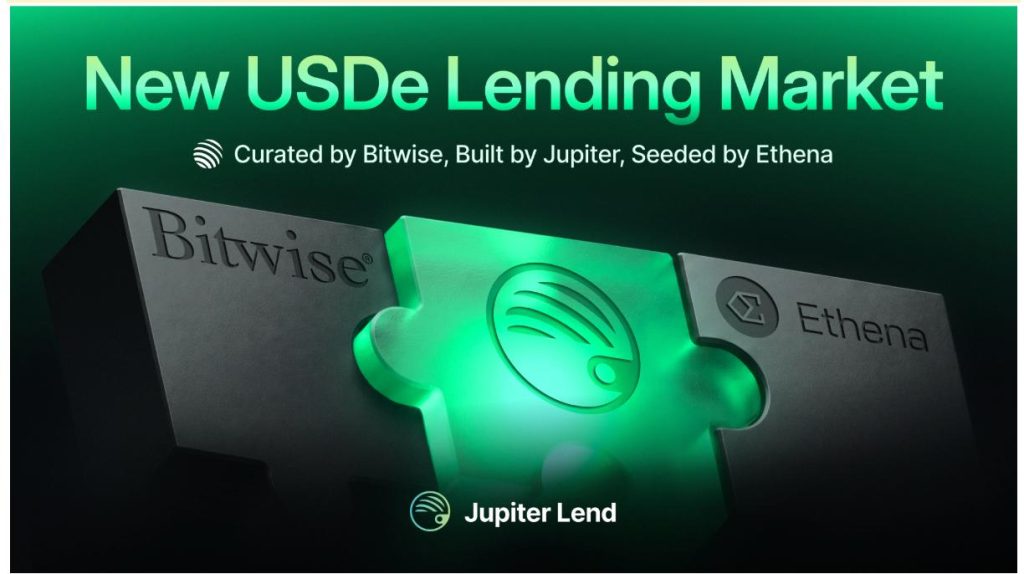
This marks the first time an institutional asset manager has curated a market for Jupiter’s lending product, Jupiter Lend, signaling continued development of institutional participation in onchain lending. The inaugural lending market offers deep, scalable yield at institutional scale, with capacity designed to grow into the billions of dollars. By opening curation to traditional finance asset managers for the first time, Jupiter Lend establishes a framework to bridge institutional capital and leading lending infrastructure.
For Bitwise, curating this market on Jupiter Lend is a reflection of how DeFi is maturing. With DeFi TVL growing 238% since January 2023, from $46 billion to $156 billion[1], and institutional capital increasingly flowing onchain, Ethena’s expansion into Solana and its growing institutional ecosystem aligns with Bitwise’s conviction in the long-term trajectory of onchain finance.
Jupiter and Fluid have built unique infrastructure for efficient lending markets,” said Jonathan Man, Head of DeFi Strategies at Bitwise. “Their design offers deep liquidity and thoughtful risk-mitigating features, making it a compelling foundation for an isolated USDe market on Solana. Bitwise is proud to serve as curator alongside Jupiter and Fluid, applying our onchain asset management and risk oversight capabilities to support institutional participation.
Key Highlights
- Dedicated USDe lending market on Jupiter Lend, isolated from existing Jupiter Lend liquidity layer and structured for institutional capital at scale
- Curation framework extended to traditional asset managers, with Bitwise appointed as inaugural institutional curator
- Underpinned by Fluid’s unified lending infrastructure, the most advanced collateral and risk architecture in onchain finance
Until now, institutional capital and onchain lending have mostly operated in parallel. This launch puts them in the same structure where Jupiter Lend provides the market, Bitwise curates the market, Ethena supplies the asset, and Fluid runs the infrastructure. Each piece has been independently proven, and this is the first time they have been assembled together at an institutional scale in a live onchain market.
Kash Dhanda, COO of Jupiter, said, “Now more than ever, its imperative that we take DeFi risk seriously. That’s precisely why we’re so excited to partner with Bitwise, who bring both the expertise and the institutional credibility needed to help scale onchain lending from a niche into the default way to do finance. And by working with Ethena and Fluid, two of the most technically innovative teams in the space, we’re thrilled to be able to deliver a product experience like no other.”
Guy Young, Founder & CEO, said “USDe is an institutional grade savings product, built for scale. By combining Jupiter Lend’s advanced lending infrastructure with Bitwise’s asset management expertise, we’ve created an efficient USDe market ready for Defi and institutional adoption.”
“Today, we opened our infrastructure to Bitwise, the first institutional asset manager to curate on Fluid. We’ve built the most advanced lending protocol — enabling discrete risk parameterization, advanced oracle designs, and dynamic limits that aren’t available on any other platform. By combining advanced risk management infrastructure with institutional capital management expertise, we’re designing solutions capable of breaking out of DeFi and enabling institutional scale.”
— Samyak Jain, Co-Founder & CEO, Fluid
To learn more or access the Ethena market on Jupiter Lend, visit jup.ag/lend
About Jupiter Lend
Jupiter Lend is the most advanced money market on Solana, built in collaboration with Fluid. Launched in August 2025, Jupiter Lend reached $500 million in total value locked within its first 24 hours, making it one of the fastest-growing money markets in onchain finance history. Jupiter Lend provides borrowers with loan-to-value ratios up to 95% and a proprietary liquidation engine that processes all eligible positions in a single transaction, minimizing systemic risk. Jupiter is Solana’s leading DeFi Superapp, having processed over $1 trillion in total trading volume across spot, perpetual futures, prediction markets, and lending in 2025. For more information, visit jup.ag.
About Ethena
Ethena is a decentralized finance protocol built on Ethereum that issues USDe, the fourth largest digital dollar” Founded in 2023, Ethena has become the fastest growing digital dollar issuer, with a global audience of over 1 million users. Ethena’s products serve retail and institutional users across DeFi and CeFi, offering a censorship-resistant, scalable alternative to traditional stablecoins. Ethena has been backed by Dragonfly, Fidelity, Franklin Templeton, and major exchanges including Binance and Bybit. For more information, visit ethena.fi.
About Bitwise Asset Management
Bitwise Asset Management is a global crypto asset manager with $11 billion in client assets and a suite of over 70 investment products spanning ETFs, separately managed accounts, private funds, hedge fund strategies, and staking. The firm has an eight-year track record and today serves more than 5,000 private wealth teams, RIAs, family offices, and institutional investors, as well as 21 banks and broker-dealers. The Bitwise team of over 200 technology and investment professionals is backed by leading institutional investors and has offices in San Francisco, New York, and London. For more information, visit bitwiseinvestments.com.
About Fluid
Fluid is Finance’s Liquidity Layer — a decentralized finance protocol that unifies lending, borrowing, and trading into a single capital-efficient architecture. The #2 DEX by volume on Ethereum and the fastest DEX ever to reach $100B in cumulative trading volume, Fluid also enables loan-to-value ratios up to 95%, liquidation penalties as low as 0.1%, and the most advanced risk controls in onchain finance. Fluid operates across Ethereum, Solana, and other major chains, and serves as the foundational lending infrastructure for Jupiter Lend. For more information, visit fluid.io.
About Author
Disclaimer: The views, suggestions, and opinions expressed here are the sole responsibility of the experts. No Digi Observer journalist was involved in the writing and production of this article.
Press Release
DeepBrain AI Adds Seedance 2.0 to AI STUDIOS — Same Model, Fundamentally Different Result
Palo Alto, Calif, May 13th, 2026, DeepBrain AI today announced the integration of Seedance 2.0, ByteDance’s latest multimodal AI video generation model, into AI STUDIOS. Seedance 2.0 is available across multiple platforms — but the version inside AI STUDIOS is not the same Seedance 2.0 available everywhere else. AI STUDIOS brings a version of Seedance 2.0 that has been improved at the model level, extended beyond its native capabilities, and combined with an enterprise content production stack that no other implementation offers.

Seedance 2.0 accepts text, images, video clips, and audio files simultaneously and generates multi-shot video sequences in a single pass — dialogue lip-sync, background music, ambient sound, and foley included — at up to 1080p Full HD and 15 seconds per clip. The model delivers fluid, physically coherent motion and maintains consistent character appearance across scene cuts — producing footage that is, in many cases, indistinguishable from professionally filmed content.
Resolution that holds. The standard Seedance 2.0 degrades in visual quality when extending video from an end frame — a limitation that makes long-form content unreliable in production environments. AI STUDIOS eliminates this entirely. Regardless of length or how many times a sequence is extended, resolution stays consistent from the first frame to the last. For enterprise teams producing multi-scene campaigns, product demos, or broadcast content, this is the difference between a tool that works in a demo and one that ships to air.
Pronunciation that’s actually accurate. The base Seedance 2.0 model produces garbled or imprecise speech in some cases — an error that is unacceptable in any customer-facing video. AI STUDIOS corrects this at the platform level, delivering accurate, natural-sounding pronunciation across all supported languages. For brands producing content in multiple languages, this means every version of every video sounds like it was made by a native speaker — not a model that got the words slightly wrong.
Video that goes beyond one minute. Most generative video platforms — including the base Seedance 2.0 — are limited to short clips. AI STUDIOS breaks that ceiling, enabling continuous video production beyond one minute in a single generation. A full live commerce stream. A complete training module. A broadcast news segment from open to close. None of this is possible with Seedance 2.0 alone. In AI STUDIOS, it is.
150+ languages. 1,000+ voices. Built in, not bolted on. Other platforms that have integrated Seedance 2.0 stop at video generation. AI STUDIOS connects it directly to 1,000+ AI voices and dubbing and translation across 150+ languages — all within the same workflow. No export, no third-party tool, no re-recording. A single prompt produces broadcast-quality video in any language, at any length, ready for any market.
That foundation is only the beginning. A two-presenter live commerce stream. A news anchor delivering a breaking story. A training video localized into 30 languages overnight. All of it, from a single text prompt, without a camera in sight. With Seedance 2.0 integrated, AI STUDIOS avatars are now visually indistinguishable from filmed talent — moving, gesturing, and reacting with the naturalism of a real on-camera presenter. Two avatars can appear on screen simultaneously, enabling multi-presenter formats across any content type.
What once required studios, production teams, localization vendors, and multiple tools can now be done in one place. Live commerce, advertising, broadcast news, training, and social content — all from text alone, all at broadcast quality. AI STUDIOS combines AI avatar service, generative video generation, 1,000+ AI voices, and dubbing and translation in a single end-to-end workflow — script to final export. Other platforms have Seedance 2.0. AI STUDIOS has a better one — and everything built around it..
Seedance 2.0 is available in AI Studios now at aistudios.com.
About DeepBrain AI
DeepBrain AI is a global leader in AI Avatar, AI Agent, and AI Human technology. Its flagship B2B SaaS platform, AI Studios, helps enterprises create hyper-realistic AI avatars, real-time avatar agents, and localized video content at scale. Based in Palo Alto, Calif., DeepBrain AI serves enterprise customers worldwide.
Media Contact:
Selena Kim
global@deepbrain.io
www.aistudios.com
About Author
Disclaimer: The views, suggestions, and opinions expressed here are the sole responsibility of the experts. No Digi Observer journalist was involved in the writing and production of this article.
Press Release
CEMOTO D series Electric Dirt Bike: Redefining Off-Road Adventure with Zero-Emission Power
CEMOTO LTD launches the D series, delivering professional-grade electric dirt bike performance starting at $969 with 2-year warranty and USA warehouse delivery.
United States, 13th May 2026, – CEMOTO LTD, a leading innovator in electric mobility with over 20 years of OEM manufacturing and export expertise, today announced the official launch of the CEMOTO D Series Off-Road Electric Dirt Bike lineup in the United States market. Engineered for riders seeking thrilling off-road experiences without compromising environmental responsibility, the D Series combines cutting-edge electric technology with professional-grade performance at accessible price points starting at just $969.
D02 Classic: The Entry-Level Gateway
The D02 Classic serves as the perfect entry point for riders new to electric dirt bikes. Featuring a 48V system with a 3000W high-torque brushless motor, the D02 Classic delivers approachable power that builds confidence while maintaining safety. Capable of reaching speeds up to 40 mph (65 km/h) with a range of 25-34 miles per charge, this model is ideal for riders taking their first steps into the electric off-road scene.
The D02 Classic features a 48V 21Ah battery with a 7-8 hour charging time, paired with 14″/12″ wheels and a comfortable 28.3″ seat height. Designed as a pure off-road machine without street kit, it offers maximum simplicity for trail-focused riders. With a max load capacity of 286 lbs (130 kg), the D02 Classic accommodates riders of various sizes.
D03 Series: Elevated Performance
Building upon the D02 foundation, the D03 Series offers two configurations designed for riders ready to elevate their riding experience. Both models feature enhanced capabilities while maintaining the same robust build quality and professional-grade components.
D03 Pro
The D03 Pro maintains the same 3000W peak power and 48V system as the D02 Classic, reaching speeds of 40 mph (65 km/h). Where the D03 Pro distinguishes itself is in its enhanced features: a larger 48V 23.8Ah battery delivering 28-37 miles of range, and a full street kit including horn for versatile on-road and off-road use. With 14″/12″ wheels and a 28.3″ seat height, the D03 Pro offers the same approachable ergonomics with added versatility.
D03 Beast
For riders who demand maximum power and performance, the D03 Beast delivers a 6000W peak power motor and 72V system. Capable of exceeding 53 mph (85+ km/h), this flagship model features a 72V 25Ah battery offering 34-46 miles of range—the longest in the D Series lineup. The D03 Beast comes equipped with larger 17″/14″ wheels, a higher 31.9″ seat height, and a full street kit, making it the ultimate choice for experienced riders seeking adrenaline-fueled adventures.
Powerful Performance Meets Sustainable Design
The CEMOTO D Series represents a significant advancement in the electric dirt bike segment. At the heart of each model lies a high-torque brushless motor delivering instant torque and whisper-quiet operation. From the D02 Classic’s approachable 40 mph to the D03 Beast’s exhilarating 53+ mph, every model has been engineered to enhance the riding experience.
“We’ve designed the D Series to prove that electric powertrains can deliver the raw excitement riders crave while eliminating the maintenance headaches and environmental impact of traditional gas engines. Every aspect of the D Series has been engineered to enhance the riding experience.”
Extended Range for All-Day Adventures
Range anxiety becomes a thing of the past with the D Series’ advanced lithium-ion battery technology. Depending on the model, riders can expect 25 to 46 miles of real-world range on a single charge—sufficient for full-day trail excursions. The intelligent battery management system optimizes power delivery while extending overall battery lifespan, ensuring consistent performance ride after ride.
Charging is equally convenient across all models, with a full charge achievable in just 7–8 hours using the included charger. Simply plug in overnight, and wake up ready to conquer new terrain.
Built for Demanding Terrain
The D Series does not just perform—it dominates. Each model features a robust high-strength carbon steel frame paired with a professional-grade suspension system including hydraulic front forks and a rear mono-shock absorber. This combination delivers exceptional stability and control across rocky trails, muddy paths, and sandy dunes.
Safety remains paramount, with twin-piston hydraulic disc brakes providing progressive, reliable stopping power in all weather conditions. The off-road tire configuration—available in 14″/12″ or 17″/14″ depending on model—ensures maximum traction when it matters most. With a max load capacity of 286 lbs (130 kg) across all models, the D Series accommodates riders of various sizes.
Consumer-Focused Value Proposition
CEMOTO understands that purchasing an electric dirt bike is a significant investment. That is why every D Series model comes backed by industry-leading customer protections:
• 2-Year Limited Factory Warranty covering motor, battery, controller, and frame
• 15-Day Easy Return Policy for unused bikes under 10 miles
• Free Shipping from USA warehouse with 3–5 business day delivery
• 85% Pre-Assembled design—most riders are trail-ready in 20–30 minutes
Lifetime Parts Support
Unlike many competitors who leave riders scrambling for parts years after purchase, CEMOTO ensures long-term ownership satisfaction—genuine D Series replacement parts are readily available at the dedicated parts store, eliminating the frustration of obsolete components and ensuring riders can keep their machines running at peak performance for years to come.
“Our USA-based inventory and support team means customers are not waiting weeks for ocean freight. When you order a CEMOTO D Series bike, you are supporting responsive, stateside service from purchase through the entire ownership experience.”
The Future of Off-Road Recreation
As environmental consciousness continues to shape consumer preferences, electric dirt bikes represent the natural evolution of off-road recreation. The D Series produces zero tailpipe emissions, operates at a fraction of the noise level of gas-powered alternatives, and requires minimal maintenance—no oil changes, no spark plugs, no complicated engine tune-ups.
Whether you are a beginner exploring local trails on the D02 Classic or an experienced rider seeking maximum performance on the D03 Beast, the CEMOTO D Series delivers serious off-road capability at a price that opens the trails to more riders. The CEMOTO D Series is available now at the official online store, with current promotional pricing offering savings of up to $500 off regular retail.
About CEMOTO LTD
CEMOTO LTD is a premier manufacturer of electric mobility solutions, specializing in high-performance electric dirt bikes, commuter e-bikes, and electric scooters. With over 20 years of OEM manufacturing and export expertise, CEMOTO combines cutting-edge technology with rigorous quality control to deliver products that exceed customer expectations. The company operates global manufacturing facilities and maintains USA warehouse stock for rapid North American distribution. CEMOTO operates dual channels: OEM and wholesale orders are handled through its factory portal, while retail purchases are managed via its direct-to-consumer storefront. CEMOTO also offers comprehensive OEM and ODM services for wholesale partners seeking customized electric mobility solutions.
Media Contact
Organization: CEMOTO LTD
Contact
Person: Media Relations
Website:
https://cemotoride.com/
Email:
info@cemotoride.com
Contact Number: 8613758981508
Country:United States
The post
CEMOTO D series Electric Dirt Bike: Redefining Off-Road Adventure with Zero-Emission Power appeared first on
Brand News 24.
It is provided by a third-party content
provider. Brand News 24 makes no
warranties or representations in connection with it.
About Author
Disclaimer: The views, suggestions, and opinions expressed here are the sole responsibility of the experts. No Digi Observer journalist was involved in the writing and production of this article.
Jupiter Lend Onboards Bitwise to Curate Ethena Market
DeepBrain AI Adds Seedance 2.0 to AI STUDIOS — Same Model, Fundamentally Different Result
CEMOTO D series Electric Dirt Bike: Redefining Off-Road Adventure with Zero-Emission Power
Benzinga Money Article Discusses How to Become Part of the 12% of Retirees Who Have Achieved the Recommended $550,000 Minimum Retirement Savings Threshold
Apu Apustaja Conquers New York with Lively Street Ads, Including Times Square Billboard
Bay Smokes Maintains Quality Amid Legislative Changes in the Hemp Industry


-
Press Release2 days ago
Post Oak Group Brings Institutional Execution to the Middle Market
-
Press Release1 week ago
$300M+ Condominium Tower Planned to Transform Downtown Los Angeles Skyline
-
Press Release4 days ago
KING VPN Announces Android VPN App Availability for Users in the United States
-
Press Release1 week ago
CloudBasedBackup Introduces Annual Subscription Plans for Managed Nextcloud Hosting
-
Press Release4 days ago
Cellfie Mobile Announces Deployment of 400 New Base Stations Across Georgia
-
Press Release4 days ago
Top 10 Best Free VPN Apps to Consider in Russia
-
Press Release5 days ago
iRock Resumes Rebrands to iRock Executive Talent Partners, Expanding into Full-Scope Executive Talent Advisory and Fractional Leadership Strategy
-
Press Release4 days ago
The oldest oil trading company in DIFC completes its debut bond issuance in Kazakhstan