
Press Release
Airwheel Announces Expanded Global Deployment of AI-Enabled Rideable Smart Electric Cabin Suitcase

Brussels, Belgium – Airwheel recently announced the expanded global deployment of its AI-enabled rideable electric cabin suitcase, as the company responds to rising international travel volumes and growing demand for intelligent short-distance mobility solutions in airports, rail terminals, and large transportation venues worldwide. A new product category is rapidly entering the mainstream—one that combines hardware innovation, intelligent control systems, and a redefinition of travel behavior. At the forefront of this shift is Airwheel rideable electric suitcase.
Within this emerging category, Airwheel has distinguished itself through long-term technological accumulation and a systematically built global presence, increasingly positioning the company as a high-potential technology opportunity for 2026. Airwheel has secured 600+ patents worldwide, spanning motion control algorithms, electric drive systems, intelligent sensing, and structural engineering, all of which have been successfully industrialized and deployed at scale in real-world products.

Complementing its technology base, Airwheel has completed trademark registrations in over 168 countries and regions, enabling global compliance and commercialization. The company has received the 2025 Global Recognition Award , and its products have earned multiple international honors, including the IDEA Design Award (USA), IAI International Design Award, and Berlin Design Award, validating its competitiveness across technology, design, and user experience.
From Luggage to Intelligent Mobility Terminal
Traditionally, luggage has served a purely passive role—storage and transport. Airwheel fundamentally redefines this category by embedding personal short-distance mobility into luggage itself, transforming it into an active intelligent mobility terminal.
In environments such as airports, high-speed rail stations, and large venues, users can ride directly through terminals, significantly reducing physical strain while gaining measurable efficiency and experiential advantages. This structural upgrade in user experience is allowing electric luggage to move beyond novelty and toward scalable, repeatable adoption.

Product Portfolio: Scalable Solutions Across Travel Scenarios
Airwheel’s flagship carry-on-compliant model, the SE3S Series features a removable lithium battery meeting airline carry-on regulations, resolving one of the biggest barriers to smart luggage adoption. With a top speed of 13 km/h, 110 kg load capacity, patented stability architecture, and Apple Find My integration, SE3S delivers a rare combination of compliance, performance, and ecosystem-level intelligence. The series has achieved strong global adoption, high repeat purchase rates, and billions of views across social media, becoming a phenomenon-level product in smart travel.

Designed for children, the SQ3S Series integrates rideable, check-in-ready, and companion-friendly use into a single intelligent product. Optimized for children’s body dynamics and behavior patterns, it enhances safety, simplifies control, and transforms children from passive followers into active participants—while significantly reducing parental travel stress.

Targeting family and companion travel, the SE3T Series is a 24-inch large-capacity rideable luggage solution featuring a 52 cm extended wheelbase, optimized center of gravity, dual-rider support, and 48-liter internal capacity. It seamlessly integrates riding, pulling, and storage modes, positioning luggage as a proactive mobility tool for longer journeys and family travel.
Beyond Smart Suitcase: Toward AI-Enabled Personal Mobility
For Airwheel, rideable smart electric cabin suitcase represents only the entry point. The company is extending its capabilities from hardware manufacturing into AI-driven motion control, multi-sensor perception, edge computing, and human–machine interaction, laying the groundwork for consumer-grade personal mobility robots.
Media Contact
Company: Airwheel
Contact: Media Team
Email: Jonas@airwheel.net
Website: https://www.airwheel.net
About Author

Disclaimer: The views, suggestions, and opinions expressed here are the sole responsibility of the experts. No Digi Observer journalist was involved in the writing and production of this article.

Quatre Bornes, Mauritius, August 08, 2026, ZEX PR WIRE — CapitalXtend has announced the launch of its refreshed identity and redesigned website, marking an important milestone in the company’s continued evolution. The update reflects CapitalXtend’s commitment to creating a more modern, accessible, and client-focused trading experience while strengthening the foundation for its next phase of growth.

This represents more than a visual update. It reflects CapitalXtend’s ongoing investment in improving how traders engage with the company across every touchpoint. Alongside the new identity, the redesigned website introduces a cleaner interface, improved navigation, and a more intuitive structure, making it easier for both new and existing clients to explore the company’s products, platforms, and trading services.
The enhanced digital experience enables traders to access account information, compare trading solutions, explore platform features, and navigate market opportunities with greater ease. Every improvement has been designed to simplify the user journey while maintaining the professional standards, reliability, and performance for which CapitalXtend is known.
This milestone also reinforces CapitalXtend’s broader commitment to innovation and continuous improvement. By refining its digital experience and strengthening the way traders interact with the brand, CapitalXtend continues to invest in making its services more accessible, intuitive, and user-focused. As part of its offering, traders continue to benefit from solutions such as CFD Shares, Holders Account, Return on Equity, and Unlimited Leverage.
Existing clients will experience a seamless transition, with no changes to account credentials, funds, or account types. The updated platform allows traders to continue operating without interruption while benefiting from a more refined digital environment.
Speaking on the milestone, Dr. Farrukh Adeeb, Group CEO & Chairman of XGroup, said:
“This is an important milestone for CapitalXtend. Our refreshed identity reflects how the company has evolved and where we are heading next. Beyond a new look, this launch represents our continued investment in delivering a better experience for our clients, making it simpler to access our services, navigate our platform, and trade with confidence as we continue to grow.”
The website is now live, representing another step in the company’s journey to deliver a trusted, innovative, and client-centric trading experience for its global community.
About CapitalXtend
CapitalXtend is a global multi-asset broker committed to delivering a secure, transparent, and technology-driven trading experience. Offering access to a wide range of financial markets through advanced trading platforms, the company continues to focus on innovation, client-centric service, and empowering traders with reliable trading solutions.
About Author
Disclaimer: The views, suggestions, and opinions expressed here are the sole responsibility of the experts. No Digi Observer journalist was involved in the writing and production of this article.
Press Release
Grepix Infotech Highlights White Label Apps as a Smart Business Model for On-Demand Entrepreneurs
Grepix Infotech shares industry insights on how enterprise-grade white label technology is helping entrepreneurs launch faster, reduce technology costs, and compete in the growing on-demand economy.
Noida, Uttar Pradesh, India, 8th Aug 2026 — Grepix Infotech Pvt Ltd, a globally recognised on demand technology company powering app businesses across 30+ countries, today published its industry perspective on the question every technology entrepreneur eventually faces: do you build your own platform from scratch, or do you launch faster and smarter using a proven white label solution?
For entrepreneurs targeting the on demand economy in 2026 — one of the fastest-growing and most competitive commercial landscapes in the world — the answer has never been clearer.
A $600 Billion Market With No Room for Slow Movers
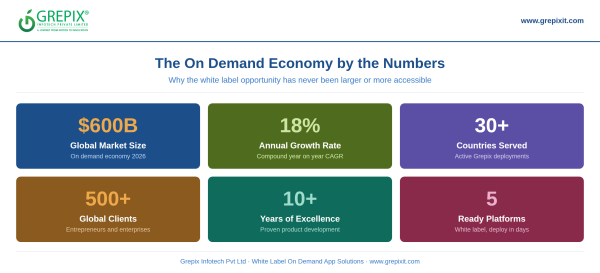
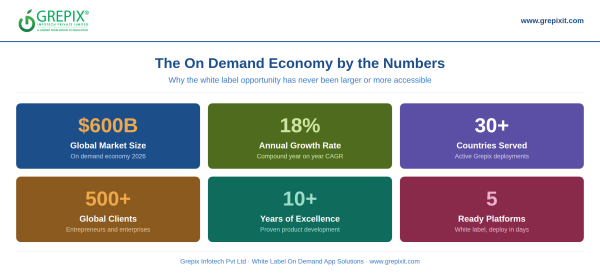
The global on-demand economy is now valued at over USD 600 billion and growing at a compound annual growth rate of over 18 percent. From ride-hailing giants like Uber, Bolt, and Didi to food delivery leaders like DoorDash, Glovo, and Jumia Food, the playbook has been written. Consumers in every market — from São Paulo to Kuala Lumpur, Karachi to Cairo, and Manila to Mexico City — have already formed on-demand habits. They expect instant service, real-time tracking, and seamless digital payments as a baseline — not a luxury.
The opportunity for regional entrepreneurs is enormous. The platforms dominating global headlines are not winning in every city, every town, or every emerging market corridor. There are thousands of underserved markets across Asia, Africa, Latin America, Eastern Europe, and the Middle East where a fast-moving, locally operated on-demand business can capture significant market share — if it gets there fast enough.
That is exactly where white label technology changes the game entirely.
Why Most On-Demand Startups Never Make It to Launch
Across hundreds of client engagements spanning markets from Dhaka to Dubai, Bogotá to Bangkok, and Accra to Auckland, Grepix has observed a consistent and sobering pattern: the most common reason on-demand startups fail is not a flawed business model or insufficient funding. It is the time, cost, and complexity of building the technology itself.
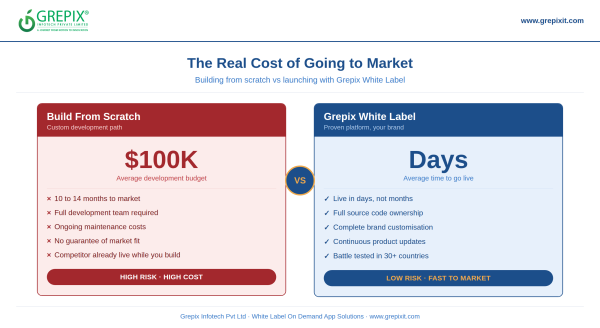
Building a competitive ride-hailing platform — with a passenger app, driver app, admin panel, real-time GPS dispatch, dynamic surge pricing, and multi-gateway payment integration — requires a minimum development timeline of 10 to 14 months and a budget typically ranging between USD 40,000 and USD 100,000, depending on team quality and feature scope. That figure excludes ongoing maintenance, server infrastructure, security updates, and the continuous feature development required to stay competitive in a rapidly evolving market.
By the time a custom-built app launches, a competitor running on a proven white label platform has already acquired drivers, signed up restaurants, onboarded service providers, and locked in early customer loyalty.
“We have seen brilliant entrepreneurs with the right market insight, the right capital, and the right team — completely derailed by a development cycle that consumed 18 months and twice their planned budget. By launch day, someone else already owned the market,” said a spokesperson for Grepix Infotech. “The technology timeline does not just slow a business down. It can kill it entirely.”
What Modern White Label Actually Delivers
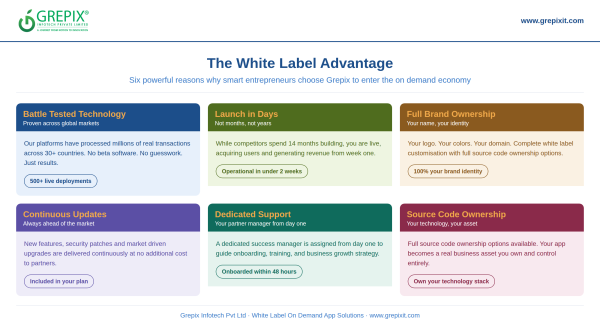
The white label model of 2026 bears no resemblance to the generic, off-the-shelf software of a decade ago. Today’s enterprise-grade white label platforms like those built by Grepix offer full source code ownership, complete brand identity customisation, region-specific feature configuration, dedicated technical onboarding, and continuous product updates informed by real-world deployments across diverse global markets.
Entrepreneurs who choose white label do not receive a template. They receive a battle-tested, commercially proven technology foundation that has already processed millions of transactions, resolved thousands of edge cases, and been refined across deployments in markets as diverse as Saudi Arabia, Brazil, Vietnam, Ghana, Turkey, and Colombia.
A white label deployment through Grepix can be live in under two weeks at a fraction of the cost of custom development with zero compromise on quality, scalability, or brand identity.
Speed to Market is the Real Competitive Moat
In the on-demand economy, first-mover advantage is not a cliché. It is a commercial reality.
The platform that signs up drivers first, the aggregator that onboards restaurants before anyone else, and the logistics operator that locks in enterprise clients early — these businesses build supply and demand flywheels that are expensive and time-consuming for any competitor to replicate. Just as Bolt disrupted Uber across multiple markets by moving fast and operating with local agility, and just as Grab built a dominant super app position across Southeast Asia by prioritising speed of market penetration over perfection of technology, regional entrepreneurs can carve out dominant positions in their own cities and countries — if they launch before the window closes.
White label eliminates the development delay entirely. Rather than spending a year building, entrepreneurs can redirect every dollar and every hour into driver acquisition, restaurant partnerships, hyperlocal marketing, and customer experience — the activities that actually determine whether an on-demand business survives and scales.
Five Verticals Where White Label Delivers the Strongest ROI
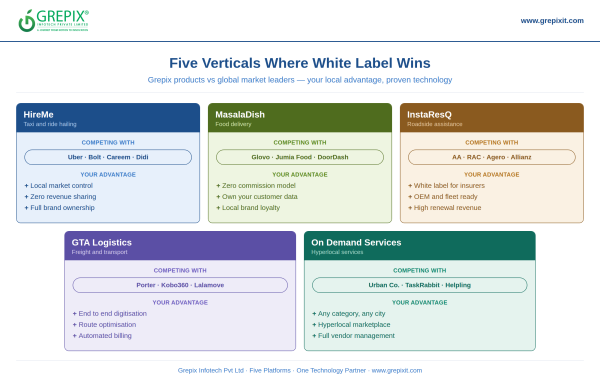
Ride Hailing and Taxi — Where Uber, Bolt, and Careem dominate at a global scale, hundreds of city-level and country-level markets across Indonesia, Morocco, Kazakhstan, Peru, and Senegal remain open to locally operated alternatives. Grepix’s HireMe taxi app platform gives entrepreneurs a fully branded, Uber-class ride-hailing business with intelligent dispatch, surge pricing, and real-time GPS tracking — deployable in days, not months.
Food Delivery — As Glovo, Jumia Food, Talabat, and DoorDash expand across markets from Istanbul to Lagos and from Riyadh to Ho Chi Minh City, the demand for locally owned and zero commission alternatives is accelerating rapidly. Grepix’s MasalaDish food delivery platform lets entrepreneurs launch a fully independent food delivery business — retaining complete control of margins, customer data, and vendor relationships in a way the large aggregators will never offer.
Roadside Assistance — A high renewal, high retention vertical with strong demand from insurance companies, automobile manufacturers, and fleet operators across markets including the UAE, South Africa, Malaysia, Argentina, and Egypt. Grepix’s InstaResQ Roadside Assistance platform connects stranded drivers to the nearest verified service provider in minutes — white labeled and fully brandable for any insurer, OEM, or fleet operator entering this space.
Logistics and Freight — As platforms like Porter, Kobo360, Lalamove, and Trukker have demonstrated across India, Nigeria, Hong Kong, and the UAE, digitising freight logistics is a multi-billion-dollar opportunity in every emerging and developing market on the planet. Grepix’s GTA Logistics platform gives logistics entrepreneurs a complete digital freight operation — booking, real-time fleet tracking, route optimisation, proof of delivery, and automated billing — without a single line of custom code, ready to compete from day one.
Home and Hyperlocal Services — In markets where Urban Company, TaskRabbit, Helpling, and Handyman have proven the hyperlocal services model across India, the United States, Germany, and the United Kingdom, the opportunity for locally operated equivalents across Thailand, Nigeria, Chile, Jordan, and the Philippines remains wide open and largely uncontested. Grepix’s On Demand Services platform enables entrepreneurs to launch a fully configured hyperlocal marketplace across any home service category — cleaning, beauty, appliance repair, healthcare — in virtually any city, in virtually any market, within days.
White Label Is Not a Shortcut — It Is a Growth Strategy
The most successful franchise and platform businesses in the world — from global fast food networks to logistics giants — do not build proprietary technology stacks from the ground up. They adopt proven operational systems, focus investment on local execution, and compete on customer relationships and market knowledge.
White label on-demand technology follows exactly the same principle. The entrepreneurs winning in the on-demand space in 2026 are not the best developers. They are the best operators — and white label gives them the technology infrastructure to operate at full commercial scale from week one, in any city, in any country, with any brand name they choose.
For any entrepreneur evaluating entry into the on-demand economy, the question is no longer whether white label is credible or capable enough. The question is whether they can afford the capital burn, the time delay, and the competitive risk of not using it.
About Grepix Infotech Pvt Ltd
Grepix Infotech Pvt Ltd is a New Delhi-based technology company and the developer behind HireMe, MasalaDish, InstaResQ, GTA Logistics, and the Grepix On Demand Services Platform. With 500+ clients across 30+ countries and over a decade of product development experience, Grepix is the white label technology partner of choice for entrepreneurs and enterprises building on-demand businesses across Africa, the Middle East, South Asia, Southeast Asia, and Latin America.
Media Contact
Organization: Grepix Infotech Pvt. Ltd.
Contact Person: Vinay Jain
Website: https://www.grepixit.com
Email: Send Email
Contact Number: +918860213347
Address:Logix Technova A 328, Noida-Greater Noida Expy, Block B, Sector 132, Noida, India – 201304
City: Noida
State: Uttar Pradesh
Country:India
Release id:47948
The post Grepix Infotech Highlights White Label Apps as a Smart Business Model for On-Demand Entrepreneurs appeared first on King Newswire. This content is provided by a third-party source.. King Newswire makes no warranties or representations in connection with it. King Newswire is a press release distribution agency and does not endorse or verify the claims made in this release. If you have any complaints or copyright concerns related to this article, please contact the company listed in the ‘Media Contact’ section
About Author
Disclaimer: The views, suggestions, and opinions expressed here are the sole responsibility of the experts. No Digi Observer journalist was involved in the writing and production of this article.
Press Release
AI Expert Amol Walvekar Builds First-Ever RAG-Powered, Custom AI for Finance Processes
Anchor, from Adra Technologies, builds the first retrieval-augmented generation to the finance back office built by a product leader who shipped enterprise-grade AI at JP Morgan, WePay, Lead, Bolt, and Insight Data Science.
San Francisco, CA, August 7th, 2026— Amol Walvekar, an AI expert who has spent his career building enterprise-grade machine learning systems, today announced the launch of Anchor’s industry first RAG for finance teams, and custom agents built specifically for finance processes. Anchor by Adra Technologies Inc. enables finance teams to build, operate, and scale AI agents for complex back-office work directly within their ERP, CRM, and data warehouse.

Understanding RAG, Its Enterprise Value, and Proven ROI
Retrieval-Augmented Generation (RAG) is an architectural framework that enhances the functionality of Large Language Models (LLMs) by integrating external data retrieval mechanisms. Rather than relying solely on static training data or forcing models to guess. The core business value of RAG lies in its ability to deliver secure, highly accurate, and audit-ready outputs across complex structured and unstructured corporate data.
By grounding LLM responses in an organization’s internal datasets—such as contracts, policies, and systems records—RAG dramatically reduces hallucinations, eliminates the risks of stale static knowledge, and maintains strict enterprise-grade compliance without the high expenses of continuous model retraining.
Leading industry implementations and technical benchmarks highlight the significant operational ROI of optimized RAG systems:
- Error Reduction: Advanced semantic filtering has demonstrated the ability to reduce incorrect or partially correct RAG outputs by up to 80% while boosting baseline retrieval accuracy by over 20 percentage points.
- Frontier Accuracy: In standardized end-to-end evaluations like the RAG-QA Arena, optimized systems utilizing fully integrated architectures consistently outperform general frontier models.
- Efficiency Gains: Deep-dive development platforms focused on enterprise AI evaluation loops have successfully accelerated engineering cycles, delivering up to a 10x improvement in model prototyping, validation, and production deployment speeds.
Walvekar’s expertise was forged inside some of the most demanding enterprise AI environments in financial services. At WePay, through its acquisition by JP Morgan, he built enterprise-grade ML for risk and payments systems where a model’s decisions carry real financial consequences and must hold up at bank-level standards of accuracy, auditability, and scale. He continued that work across Lead and Bolt, applying machine learning to payments infrastructure where reliability is non-negotiable. As an AI Fellow at Insight, he built and shipped an abstractive text summarization platform for knowledge workers — early, hands-on work in the language-model techniques that now power Anchor.
“Finance processes have resisted automation because generic AI doesn’t know your chart of accounts, your contracts, your ERP, or your policies,” said Walvekar. “Anchor is different by design: it’s retrieval-augmented and custom to each finance team, grounded in their own systems and documents. That’s how you get the accuracy and reliability of a trained analyst. The model isn’t guessing, it’s retrieving and reasoning over the customer’s actual financial data.”
RAG, purpose-built for the finance back office
Anchor’s retrieval-augmented architecture connects directly to the systems where finance work lives including NetSuite, Salesforce, Workday, Microsoft Dynamics, Sage, Snowflake, and more than a dozen other platforms and grounds every agent in the customer’s own data, documents, and processes. Finance teams create custom agents in natural language, with no developer effort, to automate work arising from reconciliations, budget management, sales and marketing spend, commissions, and revenue compliance. The platform is SOC 2 Type II compliant, meeting the highest requirements for data protection and privacy.
The result is AI that behaves the way enterprise AI has to behave: precise, explainable, and dependable at production scale now applied to the finance back office.
Beyond building Adra, Walvekar is an active angel investor and writes on enterprise AI adoption, agentic architectures, and market structure. He holds a graduate degree from Boston University.
About Amol
Amol is the Cofounder of Adra Technologies Inc. is the company behind Anchor, the first RAG-powered, custom AI platform for finance processes. The company is headquartered in San Francisco. Learn more at www.getadra.com.
Media Contact: founders@getadra.com
About Author
Disclaimer: The views, suggestions, and opinions expressed here are the sole responsibility of the experts. No Digi Observer journalist was involved in the writing and production of this article.
CapitalXtend Launches New Brand Identity and Enhanced Digital Experience
Grepix Infotech Highlights White Label Apps as a Smart Business Model for On-Demand Entrepreneurs
AI Expert Amol Walvekar Builds First-Ever RAG-Powered, Custom AI for Finance Processes
Benzinga Money Article Discusses How to Become Part of the 12% of Retirees Who Have Achieved the Recommended $550,000 Minimum Retirement Savings Threshold
Apu Apustaja Conquers New York with Lively Street Ads, Including Times Square Billboard
Bay Smokes Maintains Quality Amid Legislative Changes in the Hemp Industry


-
Press Release20 hours ago
STARTRADER in Discussions with Trustpilot to Consolidate Review Profiles
-
Press Release1 week ago
ISGroup Publishes Large-Scale Study Showing AI Can Identify Real Software Vulnerabilities
-
Press Release1 week ago
The Future of Preventative Healthcare! Dr. Sundardas Annamalay and Dr. Narjit Singh’s Newly Released Book Sheds Light on Cellular Health
-
Press Release7 days ago
Shattering Industry Norms: Don Kilam Drives Global Expansion Backed by $35.8M Portfolio
-
Press Release7 days ago
D$AVAGE Releases New Hit Single “Chosen One”
-
Press Release7 days ago
TaqFlow Emerges to Overhaul Central Asian Cross-Border Payments
-
Press Release7 days ago
The Growing Demand for Sober Lifestyle Products Reflects a Changing Culture
-
Press Release1 week ago
The Church of Conceptual Art Opens Ticketing for the Afterlife