
Press Release
What Luxury Means Now and Why Most People Are Getting It Wrong, According to Helen Yi

Chicago, IL, 2nd February 2026, ZEX PR WIRE, Luxury has never been louder. Logos dominate feeds. “Exclusivity” is marketed at scale. Trends rise and fall at algorithmic speed. And yet, according to Chicago-based tastemaker Helen Yi, true luxury has become harder to find precisely because it is being confused with visibility.
“We’ve mistaken access for understanding,” Yi says. “Luxury isn’t about owning something rare. It’s about knowing why something matters.”
With more than two decades shaping fashion retail, museum collaborations, and cultural spaces, Yi has become a trusted voice for consumers and industry professionals navigating an increasingly saturated marketplace. Her perspective challenges the prevailing narrative that luxury is synonymous with wealth, status, or brand recognition. Instead, she argues that modern luxury is rooted in discernment.
From Consumption to Comprehension
Yi’s authority comes not from trend forecasting, but from sustained engagement with craft, culture, and context. Her career has spanned independent retail, institutional partnerships, and creative consulting, giving her a wide-angle view of how luxury is perceived and misunderstood.
“The biggest shift I’ve seen is that people are buying faster but seeing less,” she says. “Luxury today requires slowing down.”
For Yi, the modern consumer is not lacking access to beautiful objects. They are lacking frameworks for evaluation. Social media has collapsed hierarchy, placing couture, fast fashion, and archival design on the same visual plane. Without education, she argues, taste becomes reactive rather than intentional.
This is where Yi positions luxury not as a product category, but as a learned skill.
Taste as Education
One of Yi’s most consistent themes is the idea that taste is not innate. It is developed through exposure, curiosity, and critical engagement.
“People assume taste is instinctual,” she says. “It’s not. It’s built. And like any form of literacy, it improves with practice.”
Her own visual education began early, shaped by Chicago’s architecture, public art, and museums. That foundation taught her to see connections across disciplines, an approach that still informs her work today. Fashion, in her view, cannot be separated from art, design, or history.
This interdisciplinary fluency allows Yi to evaluate luxury beyond surface appeal. She looks for coherence, restraint, and intention. Does a piece demonstrate mastery of material? Does it communicate a clear point of view? Does it evolve rather than repeat?
“These questions matter more than price,” she explains.
Craft Over Hype
Yi is outspoken about the industry’s reliance on hype cycles, which she sees as fundamentally incompatible with luxury.
“Hype is about immediacy,” she says. “Craft is about time.”
For Yi, craftsmanship is not simply a marker of quality. It is evidence of discipline, patience, and respect for process. She gravitates toward houses and designers who invest in material intelligence and construction rather than spectacle.
This emphasis on craft aligns with a broader shift among discerning consumers, who are increasingly skeptical of performative luxury. Yi believes this recalibration is long overdue.
“True luxury doesn’t need to announce itself,” she says. “It reveals itself slowly.”
Vision Over Branding
Another cornerstone of Yi’s philosophy is her rejection of branding as a proxy for meaning. While she acknowledges the role brands play in shaping culture, she cautions against allowing recognition to replace evaluation.
“A brand is a container,” Yi explains. “Vision is the content.”
She encourages consumers to interrogate what a brand is actually saying through its work. Is there continuity from season to season? Is there a clear creative direction? Is the brand responding thoughtfully to cultural shifts, or simply reacting to market pressure?
This analytical approach reframes luxury as an active relationship rather than a passive acquisition. It requires consumers to engage, question, and refine their preferences.
“Luxury demands participation,” Yi says. “Not just purchasing.”
Luxury as Discernment, Not Wealth
Perhaps Yi’s most resonant argument is her insistence that luxury is not inherently tied to wealth.
“Money gives you access,” she says. “It doesn’t give you taste.”
She points out that some of the most compelling expressions of luxury are modest in scale but rich in intention. A well-made garment worn for years. An interior designed around light and proportion rather than trend. An object chosen for its story rather than its resale value.
This perspective resonates with consumers increasingly fatigued by excess. Yi believes the future of luxury belongs to those who prioritize longevity and meaning over accumulation.
“Luxury is choosing fewer things, but choosing them well,” she says.
A Thought Leader for a Shifting Industry
Yi’s influence extends beyond individual consumers. Her insights are increasingly sought after by brands and institutions grappling with how to maintain relevance without sacrificing integrity.
She advises against chasing younger demographics through mimicry or dilution. Instead, she advocates for clarity of vision and respect for audience intelligence.
“People can tell when they’re being sold to,” Yi says. “They respond when they’re being invited into a conversation.”
This philosophy has guided her work across retail, museum spaces, and creative consulting, where she emphasizes coherence over novelty and substance over scale.
Redefining Luxury for What Comes Next
As the luxury industry faces mounting pressure to justify its value beyond price and prestige, Yi’s voice feels particularly timely. She offers a reframing that is both critical and optimistic.
Luxury, she argues, still matters. But only when it evolves.
“It’s not about rejecting beauty or excellence,” Yi says. “It’s about redefining what those things mean.”
For the modern consumer, that means developing discernment, investing in education, and resisting the impulse to equate visibility with value. For the industry, it means returning to fundamentals: craft, vision, and cultural relevance.
In an era of endless choice, Helen Yi offers something increasingly rare. Clarity.
“Luxury isn’t about having more,” she says. “It’s about seeing better.”
And that, she believes, changes everything.
About Author

Disclaimer: The views, suggestions, and opinions expressed here are the sole responsibility of the experts. No Digi Observer journalist was involved in the writing and production of this article.

Press Release
Malaysia’s AI Future Takes Centre Stage as World AI Show Returns for Its 48th Global Edition
Kuala Lumpur, 13 August 2026, ZEX PR WIRE — Artificial intelligence has moved beyond being an emerging technology to become a defining pillar of Malaysia’s economic and digital ambitions. As the country accelerates investments in AI infrastructure, sovereign cloud capabilities, and enterprise-wide transformation, the focus has shifted from experimentation to execution. Against this backdrop, World AI Show Malaysia returns for its 48th Global Edition on 9–10 September 2026 at DoubleTree by Hilton Kuala Lumpur, Malaysia, convening the policymakers, enterprise leaders, technology pioneers, investors, and innovators who are shaping the country’s next chapter of AI-led growth.
1.png)
Presented by Trescon, World AI Show Malaysia carries this year’s tagline, “Where Malaysia’s AI Decisions Get Made.” As the country transitions into a strategic AI hub for Southeast Asia and organisations across both the public and private sectors define their AI roadmaps, modernise digital infrastructure, and establish governance frameworks for responsible innovation, the event will provide an executive platform dedicated to meaningful dialogue, strategic partnerships, and commercially relevant outcomes.
The programme has been curated to address the opportunities and complexities surrounding enterprise AI adoption, sovereign cloud, intelligent infrastructure, cybersecurity, data governance, and responsible AI implementation. Over two days, attendees will engage through keynote addresses, executive panel discussions, fireside conversations, invitation-only boardroom sessions, technology showcases, curated networking engagements, and business meetings designed to facilitate knowledge exchange and cross-sector collaboration.
The conference will feature an impressive line-up of distinguished government and industry leaders, including:
-
Budiman Bujang, Deputy Chief Digital Officer, Johor Corporation
-
Ts. D. Jackson Raao, Principal Assistant Secretary, Ministry of Science, Technology and Innovation (MOSTI)
-
Jamie Tan, Managing Director, JLL Malaysia
-
Ganeshbabu Nagarajan, Executive Director – Transformation Programmes, Standard Chartered Bank
-
Chua Yong Howe, Chief Digital Officer, UEM Edgenta Berhad
-
Shahrin Oli Mohamed, Group Chief Technology Officer, Pos Malaysia Berhad
-
Keeratpal Singh, Chief AI and Data Officer (APAC Financial Services), Worldline
-
Dr. Sadesh Manikam, Executive Vice President, Enterprise Data Office & Data Protection Officer, Bursa Malaysia
-
Ts. Zairil Anuar Ahmad, Chief Technology Officer, Co-opbank Pertama
-
Ahmad Faiz, Head – Data & AI, Global Technology Unit, BASF
-
Raunak Mehta, Chief Executive Officer, Igloo
-
Muhammad Najib Masdan, Senior Vice President, Khazanah Nasional Berhad
-
Ts. Narayanan Chidambaram, Head Project Engineering Pod (Technology & Digital PE&T – Digital Project Management) PETRONAS
-
Mohamed Aafrin, Director of Engineering, DKSH
-
Sudeep Srivastava, Head – KL IT Center SLB (Schlumberger)
-
Hong H. Ong, Director of Digital Technology, Labuan Financial Services Authority
-
Mohd Hanapi Bisri, Senior Digital Industry Leader- Oil & Gas
-
Dario Bianchi, Chief Product Officer, Mindvalley
-
G Saravanan, Chief Information Officer, National Cancer Society Malaysia
Reflecting on Malaysia’s AI trajectory, Ts. D. Jackson Raao, Principal Assistant Secretary, MOSTI, said:
“Malaysia is at a pivotal stage where artificial intelligence is becoming a key driver of national transformation. As we accelerate AI adoption across industries, our focus must remain on responsible innovation, robust governance, strong cybersecurity, and developing a future-ready talent ecosystem. By doing so, Malaysia is well-positioned to emerge as a trusted regional leader in safe and sustainable AI innovation.”
An ecosystem of public sector and technology organisations is supporting this year’s edition. CyberSecurity Malaysia joins as the Supporting Partner, reinforcing the importance of building a secure and trusted digital ecosystem.
Datadog joins as the Lead Sponsor, Magure as the Platinum Sponsor, Bitdeer AI as the Gold Sponsor, and Alibaba Cloud and Unison Consulting Sdn Bhd as Bronze Sponsors. The exclusive CXO Boardroom sessions will be powered by Zoom and Datadog, while CloudSpace will participate as an exhibitor, showcasing cloud and AI capabilities to enterprise decision-makers.
Designed exclusively for senior executives, government representatives, and technology leaders, World AI Show Malaysia 2026 will provide a platform where strategic priorities are translated into actionable partnerships, investment opportunities, and real-world AI deployments. As Malaysia continues to strengthen its position within the regional AI landscape, the summit is set to become a key meeting point for organisations shaping the future of intelligent enterprise across Southeast Asia.
CLAIM YOUR DELEGATE PASS: Click here
For sponsorship opportunities, speaking engagements, or attendance information, please contact:
Shrikanth Prabhu
Commercial Director
Email: prabhu@tresconglobal.com
Mobile: +91 8660115892
Media Contact:
Reeha Haris
Media & PR Executive
Email: reeha@tresconglobal.com
Mobile: +91 8848655312
About Author
Disclaimer: The views, suggestions, and opinions expressed here are the sole responsibility of the experts. No Digi Observer journalist was involved in the writing and production of this article.
Press Release
Phomemo Expands Tattoo Stencil Printer Solutions to Support Professional Artists Evolving Workflows
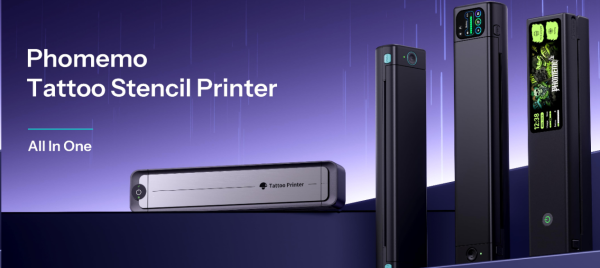
New York, New York, United States, 13th Aug 2026 – Phomemo, a global creative printing brand specializing in thermal printing solutions, has expanded its tattoo stencil printer lineup with two new solutions — the Phomemo TA81 Large-Format Tattoo Stencil Printer and Phomemo L85 Smart Touchscreen Tattoo Stencil Printer — designed to support the evolving needs of professional tattoo artists.
From large-scale body art preparation to everyday studio workflows, different tattoo projects require different printing solutions. While some artists prioritize portability and flexibility, others need tools that can handle full-length designs, customized layouts, and more efficient preparation processes.
Alongside established models including the M08F-WS and M08F Plus, Phomemo’s expanded tattoo printer lineup provides artists with multiple options based on their creative style, workflow, and studio needs.
Choosing the Right Tattoo Stencil Printer Matters
For tattoo artists, stencil preparation is an important step between digital design and the final artwork on skin. A reliable tattoo stencil printer can help artists maintain design accuracy, reduce preparation time, and create a smoother workflow before each session.
However, different tattoo styles create different challenges.
Artists specializing in fine details may prioritize clear and portable printing solutions, while those creating sleeves, back pieces, or large-scale compositions often face a different challenge: preparing oversized stencils without manually assembling multiple sections.
Phomemo’s tattoo stencil printer solutions are designed around these different creative scenarios.
Phomemo TA81: A Large-Format Tattoo Stencil Printer Built for Complex Designs
For artists who regularly create full sleeves, back pieces, legs, or other large-scale tattoo projects, stencil preparation can become one of the most time-consuming parts of the workflow.
Traditionally, oversized tattoo designs often require artists to print multiple stencil sheets, trim edges, align different sections, and carefully transfer the assembled design onto the skin. While this approach can work, maintaining accuracy across a large composition can add extra preparation steps and increase the risk of misalignment.
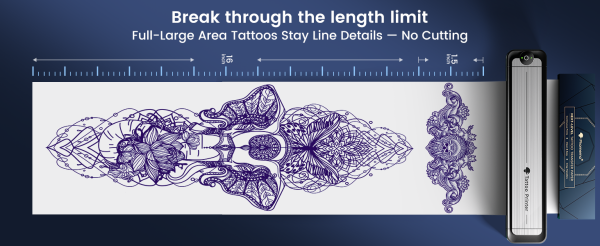
The Phomemo TA81 was designed to address this challenge with continuous, variable-length stencil printing.
Unlike standard sheet-based printing methods, the TA81 uses a roll-fed system that allows artists to print large tattoo designs in one continuous piece. For full sleeves, back pieces, spine designs, or other extended compositions, artists can create a complete stencil without manually cutting and joining multiple sections.
This one-piece printing workflow helps maintain design continuity and makes stencil preparation more efficient for complex tattoo projects.
Beyond size capability, the TA81 focuses on reducing waste during professional workflows. Its variable-length printing system allows artists to print only the required length for each design rather than relying on fixed-size sheets. For busy studios handling multiple projects, this can help optimize transfer paper usage during daily operations.
The TA81 also features Phomemo’s wrinkle-resistant printing technology, designed to help keep transfer paper flat during longer printing processes. Combined with an upgraded print head and edge-stabilizing design, the printer helps deliver consistent and clear stencil lines throughout the entire design.
With Bluetooth and USB connectivity support, the TA81 can connect with smartphones, tablets, laptops, and desktops across Android, iOS, Windows, macOS, and ChromeOS systems, giving artists flexibility when preparing designs.
Through the Phomemo App, artists can adjust designs, preview tattoo layouts, split large images, manage transfer settings, and prepare files before printing.
Phomemo L85: Smart Touchscreen Control for a More Customized Workflow
While large-scale artists may prioritize printing size and efficiency, other tattoo professionals look for a more interactive and customizable stencil preparation experience.
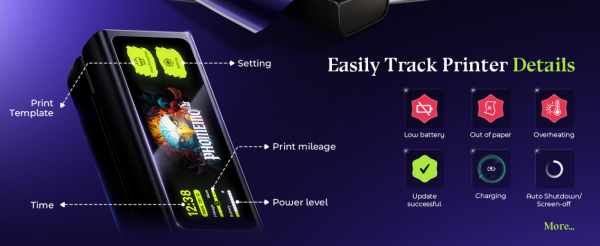
The Phomemo L85 is designed for artists who prefer a smarter workflow with direct control through an integrated touchscreen.
Featuring a 5-inch touchscreen with six language options, the L85 allows artists to manage printing tasks directly from the device. Functions such as template selection, brightness adjustment, print mileage tracking, battery information display, timer settings, sensor calibration, and self-testing can be accessed without relying entirely on another device.
For artists working with different tattoo styles and design formats, flexibility is also important. The L85 supports multiple print sizes, including Letter, A4, B5, A5, and additional width options, allowing artists to prepare different stencil layouts based on their projects.
The L85 also works with the Phomemo App ecosystem, providing creative and editing tools such as image transformation, tattoo extraction, line-art conversion, tattoo preview, and large-image splitting.
Optional AI-assisted features, including AI image generation and tattoo extraction, are designed to support artists during the preparation stage by helping explore ideas, refine concepts, and improve workflow efficiency — while keeping the artist’s own creativity and craftsmanship at the center of the design process.
Portable Tattoo Stencil Solutions: M08F-WS and M08F Plus
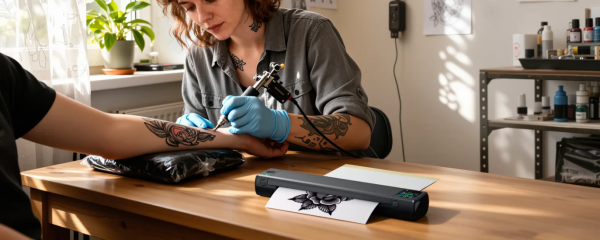
For artists who prioritize mobility, Phomemo also offers portable tattoo stencil printer solutions designed for flexible everyday workflows.
The Phomemo M08F-WS provides a lightweight wireless printing solution for artists who need a compact setup. Supporting Bluetooth connectivity and multiple operating systems, it allows artists to prepare tattoo stencils from smartphones, tablets, laptops, and desktops.
The Phomemo M08F Plus builds on this portable concept with a smarter touchscreen experience. Its built-in touchscreen supports functions including brightness adjustment, auto shutdown, calibration, and self-test printing, helping artists complete basic operations directly from the printer.
With thermal printing technology, both models eliminate the need for ink cartridges while providing a convenient solution for tattoo stencil preparation. Through the Phomemo App, artists can access editing tools, stencil generation, previews, and other workflow features designed to simplify the transition from digital artwork to physical stencil.
Choosing the Right Phomemo Tattoo Stencil Printer
Every tattoo artist has a different creative workflow, and the ideal tattoo stencil printer depends on the type of work being created. All can be found on Phomemo’s official site.
Artists working on large-scale compositions such as sleeves and back pieces may benefit from the Phomemo TA81’s continuous full-length printing capability.
Artists looking for a smart, customizable printing experience can explore the Phomemo L85 with touchscreen control and flexible print options.
Artists who need a portable solution for everyday stencil preparation can choose between the lightweight M08F-WS and the upgraded M08F Plus.
By developing tattoo stencil printers for different artistic scenarios, Phomemo continues to help tattoo professionals simplify preparation, improve efficiency, and focus more on the creative process.
About Phomemo
Phomemo is a global creative printing brand dedicated to making everyday printing simple, enjoyable, and accessible. Backed by over 12 years of expertise in thermal printing technology and trusted by over 40 million users worldwide, Phomemo continues to develop the evolution of smart printing. From home organization to global e-commerce, Phomemo lowers the barrier to professional results, enabling ideas and commerce to flow freely.
Media Contact
Organization: Phomemo
Contact Person: Alicia Chen
Website: https://phomemo.com
Email:
influencerscenter@phomemo.com
City: New York
State: New York
Country:United States
Release id:48084
The post Phomemo Expands Tattoo Stencil Printer Solutions to Support Professional Artists Evolving Workflows appeared first on King Newswire. This content is provided by a third-party source.. King Newswire makes no warranties or representations in connection with it. King Newswire is a press release distribution agency and does not endorse or verify the claims made in this release. If you have any complaints or copyright concerns related to this article, please contact the company listed in the ‘Media Contact’ section
About Author
Disclaimer: The views, suggestions, and opinions expressed here are the sole responsibility of the experts. No Digi Observer journalist was involved in the writing and production of this article.
Press Release
SBCFX to Showcase Trading Innovation, Regional Growth Strategy, and Future Vision at iFX EXPO Asia 2026
Hong Kong, Hong Kong, August 13th, 2026, FinanceWire
SBCFX has announced its participation in iFX EXPO Asia 2026, one of the leading B2B exhibitions for the online trading, fintech, and financial services sectors.
Scheduled to take place on 8–9 October 2026 at the Hong Kong Convention and Exhibition Centre (HKCEC), the event is expected to attract a diverse range of industry stakeholders, including brokers, traders, investors, Introducing Brokers (IBs), affiliates, fintech companies, liquidity providers, and financial services professionals from across Asia and beyond.
As part of its ongoing international expansion strategy, SBCFX will showcase its integrated trading ecosystem, including the MetaTrader 5 (MT5) platform, multi-asset CFD trading capabilities, institutional-grade liquidity services, and its latest digital trading solutions. The company will also use the exhibition as a platform to share its growth strategy, technology roadmap, and long-term vision for the evolving global trading landscape.
“iFX EXPO Asia represents an important opportunity for SBCFX to strengthen its engagement with the Asian trading community and further expand its regional network,” said David, CEO of SBCFX.
“Our ambition is to become one of the most trusted global trading brands by bridging technology, education, and market access. We believe the future of online trading is not only about faster execution and better tools, but also about creating an ecosystem where traders, partners, and institutions can grow together. iFX EXPO Asia provides the perfect platform for us to share this vision and connect with the industry.”
Driving Innovation While Building a Sustainable Trading Ecosystem
Technology and innovation remain central to SBCFX’s long-term development strategy. The company continues to invest in digital infrastructure, trading technology, and client-focused solutions designed to enhance trading efficiency and improve user experience across global markets.
Alongside its trading services, SBCFX will soon introduce a new mobile trading application that will provide clients with convenient access to account management, market information, trading tools, and platform services through a unified interface. The upcoming launch reflects the company’s ongoing efforts to improve accessibility and streamline the trading experience for users worldwide.
Looking ahead, SBCFX remains focused on developing innovative solutions that support traders at every stage of their journey while strengthening connections between retail investors, institutional partners, and the broader financial ecosystem. By combining advanced technology with a client-centric approach, the company aims to create a smarter, more connected trading environment that adapts to the evolving needs of modern market participants.
During the two-day event, SBCFX representatives will engage with prospective clients, Introducing Brokers, institutional partners, and technology providers to explore strategic collaborations and support the company’s continued growth across Asia.
Meet SBCFX at Booth 37
SBCFX welcomes individual traders, Introducing Brokers, affiliates, fintech firms, liquidity providers, institutional investors, and technology partners to visit Booth 37 and learn more about the company’s products, services, and strategic development plans.
Visitors to the booth will have the opportunity to meet members of the SBCFX team, explore the company’s latest initiatives, and receive a selection of exclusive SBCFX promotional gifts and event merchandise available throughout the exhibition while supplies last.
To facilitate more in-depth discussions and personalised consultations, attendees are encouraged to schedule a one-on-one meeting with the SBCFX team in advance via the following booking link:
https://forms.cloud.microsoft/r/QwRd66ZmQa
Event Details
Event: iFX EXPO Asia 2026
Date: 8–9 October 2026
Time: 10:00 AM – 6:00 PM
Venue: Hong Kong Convention and Exhibition Centre (HKCEC), Hong Kong
Booth: 37
For media enquiries or further information, please contact SBCFX at cs@sbcfx.com.
About SBCFX
SBCFX is a global financial services provider committed to delivering innovative online trading solutions supported by advanced technology, institutional-grade liquidity, and exceptional client service. Through continuous investment in technology, regulatory compliance, and strategic partnerships, SBCFX provides access to a wide range of global financial markets while empowering traders, Introducing Brokers, affiliates, and institutional partners to achieve long-term success.
With a vision to become a trusted global brokerage, SBCFX remains dedicated to transparency, innovation, and sustainable growth, delivering world-class trading solutions to clients around the world.
Contact
Marketing Executive
Kit Cheung
SBCFX
marketing@sbcfx.com
About Author
Disclaimer: The views, suggestions, and opinions expressed here are the sole responsibility of the experts. No Digi Observer journalist was involved in the writing and production of this article.
Malaysia’s AI Future Takes Centre Stage as World AI Show Returns for Its 48th Global Edition
Phomemo Expands Tattoo Stencil Printer Solutions to Support Professional Artists Evolving Workflows
SBCFX to Showcase Trading Innovation, Regional Growth Strategy, and Future Vision at iFX EXPO Asia 2026
Benzinga Money Article Discusses How to Become Part of the 12% of Retirees Who Have Achieved the Recommended $550,000 Minimum Retirement Savings Threshold
Apu Apustaja Conquers New York with Lively Street Ads, Including Times Square Billboard
Bay Smokes Maintains Quality Amid Legislative Changes in the Hemp Industry


-
Press Release7 days ago
STARTRADER in Discussions with Trustpilot to Consolidate Review Profiles
-
Press Release2 days ago
ForumPay Expands Payment Infrastructure with New Card and Bank Transfer Acceptance Solution
-
Press Release3 days ago
Demeter Tactical Investments (ME) Limited bolsters governance with two board appointments
-
Press Release3 days ago
Vincere Portfolios Expands Industry Discussion Around the Gap Between Retail Investing Tools and Institutional Trading Infrastructure
-
Press Release7 days ago
Fire Safety Innovation in the Spotlight as Industry Expert Paul Trew Speaks Out on Evolving Fire Risk
-
Press Release7 days ago
Social Security Adjustments Have Failed to Keep Pace with Inflation—How Retirees Can Supplement Their Income Through Bitcoin Mining in 2026
-
Press Release1 week ago
From a Free Book to a Business in the Making: Entrepreneur Vanessa Murphy Launches Trading My Way Barter Journey Across the U.S.
-
Press Release6 days ago
Movement, El Vecino and RISE Partner to Launch First Digital Dollar Wallet for Mexican Remittances