
Press Release
New Management Book Reveals the Secrets Behind Successful Citizen Boards

Authors Richard S. Groover and Jessica G. Pacek offers a practical and eye-opening look into how everyday citizens can strengthen community boards and improve local governance.
Louisville, Kentucky, United States, 20th Jan 2026 – Veteran environmental scientist Dr. Richard S. Groover and accomplished writer Jessica G. Pacek are proud to announce the release of their new management book, CITIZEN BOARDS: The Good and The Bad. Now available on Amazon, this engaging and informative book takes readers behind the scenes of one of the most important yet often misunderstood parts of local government, the citizen board.

In this new management book, Groover and Pacek shine a light on how citizen boards shape communities, make key decisions, and influence change across a wide range of public services. Drawing from in-depth interviews with more than thirty seasoned board members, who together represent over five hundred years of combined experience, the authors explore the good practices, the difficult challenges, and the real-world lessons that come from serving on these vital community bodies.
Every community relies on volunteers who serve on citizen boards. From parks and environmental committees to planning commissions and advisory groups, these boards make decisions that touch the lives of everyone. CITIZEN BOARDS: The Good and The Bad opens the door to understanding how these boards truly function, both when they succeed and when they fall short.
Readers will discover how effective leadership, clear communication, and teamwork are essential to success. The book also explains what can go wrong: poor behavior, unclear goals, and lack of accountability. Using real examples and expert insights, Groover and Pacek offer readers straightforward strategies to overcome these challenges and strengthen the work of any citizen board.
A must-read for leaders, volunteers, and community members
Whether you are a current board member hoping to improve your performance, a newcomer preparing for your first appointment, or a community-minded citizen interested in local decision-making, this management book offers practical and easy-to-follow advice. It gives readers the tools to understand their role, manage conflict, and promote effective teamwork.
One of the book’s most valuable sections explores the inclusion of younger generations, particularly millennials, and how they can play a vital role in shaping the future of governance. The authors stress that diversity of age, experience, and perspective is essential for boards to remain relevant and effective.
No other book currently explores the topic of citizen boards in such depth and clarity. CITIZEN BOARDS: The Good and The Bad is not a theoretical text or a dry academic guide. Instead, it combines real-life stories, tested advice, and step-by-step examples that anyone can understand. The authors also discuss how to handle difficult members, create better plans, and set shared goals, all essential parts of successful management and leadership.
At its core, this management book encourages readers to see board service as more than just a duty, it’s an opportunity to make a lasting difference in their communities.
Dr. Richard S. Groover is a Fellow of the Virginia Academy of Science and a respected author of The Environmental Almanac of Virginia (2nd Edition), Environmental Cartoons for Teachers, and How to Win Environmental Victories. With over forty years of experience working with more than twenty citizen boards, Dr. Groover brings a lifetime of real-world expertise to this topic. He has helped guide local decision-making and mentored future leaders through his writing and service.
Jessica G. Pacek holds a Master of Journalism from the University of Maryland and has worked in journalism, brand writing, and content development for over a decade. She has served on several citizen boards and provides the clear, accessible voice that makes this management book both engaging and informative. Together, Groover and Pacek combine professional insight with hands-on experience, creating a guide that speaks directly to those who want to make their boards, and their communities, better.
A practical guide to better boards and better communities
Citizen boards are an important function of society today. They guide schools, parks, environmental protection, and other local efforts that impact everyday life. This book provides readers with a clear picture of how these boards operate, how to improve their effectiveness, and how to create lasting positive change.
Through CITIZEN BOARDS: The Good and The Bad, readers will walk away with the confidence to engage, lead, and contribute meaningfully to their communities, no matter their level of experience.
CITIZEN BOARDS: The Good and The Bad is available now on Amazon in multiple formats:
For Media Inquiries, Please Contact:
Richard S. Groover
Email: rgroover33@gmail.com
Media Contact
Organization: Crescent Hill Publishers
Contact Person: Peter Kim
Website: https://crescenthillpublishers.com/
Email: Send Email
Contact Number: +12702328710
Address:312 S 4th St Suite Number 700
City: Louisville
State: Kentucky
Country:United States
Release id:40347
The post New Management Book Reveals the Secrets Behind Successful Citizen Boards appeared first on King Newswire. This content is provided by a third-party source.. King Newswire makes no warranties or representations in connection with it. King Newswire is a press release distribution agency and does not endorse or verify the claims made in this release. If you have any complaints or copyright concerns related to this article, please contact the company listed in the ‘Media Contact’ section
About Author

Disclaimer: The views, suggestions, and opinions expressed here are the sole responsibility of the experts. No Digi Observer journalist was involved in the writing and production of this article.

Press Release
Dataline Launches Data Launch Partner Program to Power the Next Generation of AI Trading and Onchain Agents
British Virgin Islands, BVI, June 2026, ZEX PR WIRE– Dataline, the data infrastructure layer for AI agents operating across crypto and financial markets, recently announced the launch of its Data Launch Partner Program, opening access to an initial cohort of AI systems, trading agents, and data providers building on its unified intelligence layer.
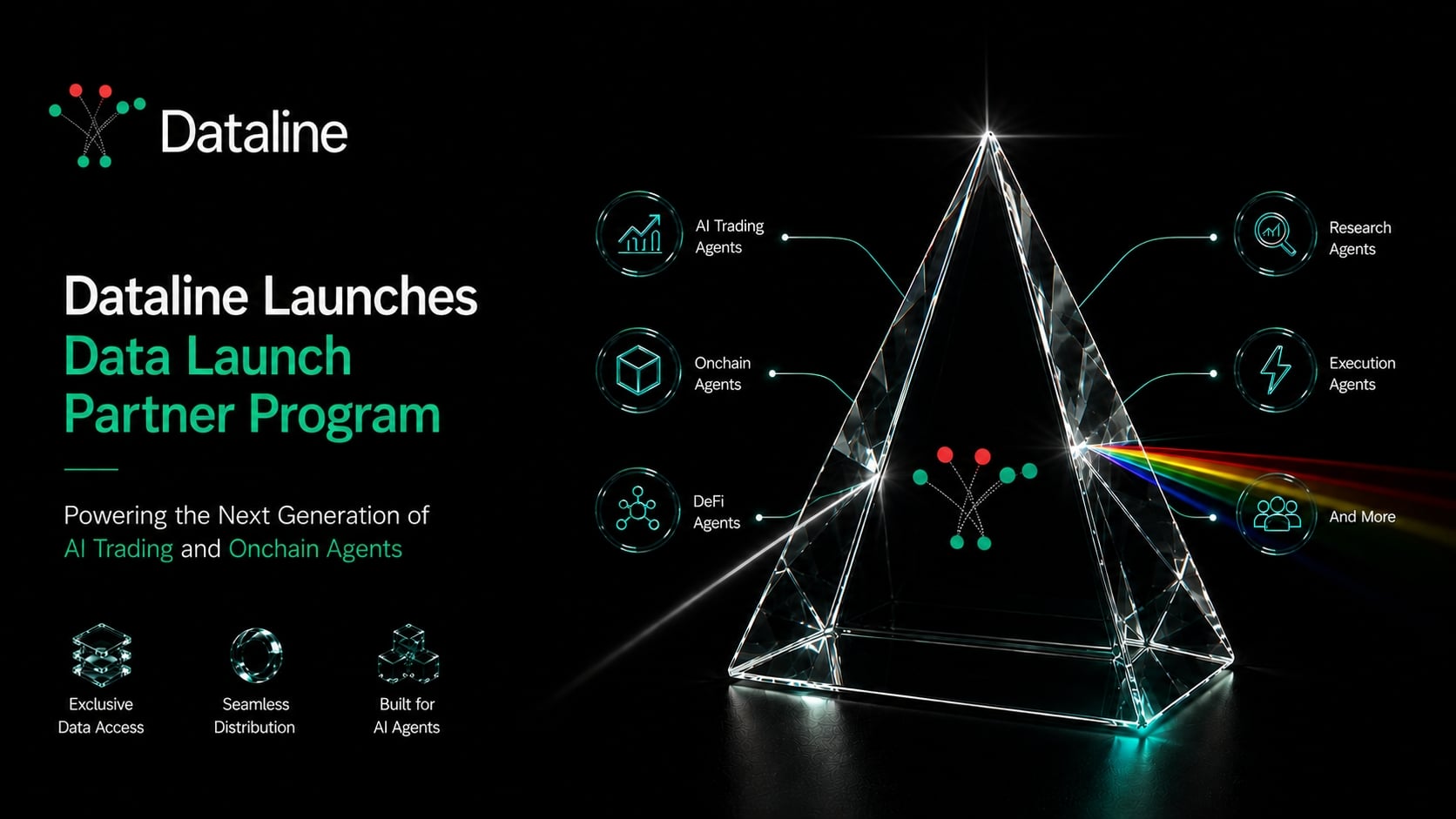
As AI agents increasingly move from chat-based interfaces to autonomous decision-making systems, the need for structured, cross-market, and verifiable financial data has become a foundational bottleneck. Dataline closes this gap by unifying distributed market data into a schema-based layer, with each response carrying an AI-generated confidence score so the agent can judge for itself whether to act on it.
A Unified Data Layer for Agent Economies
Dataline connects real-time data across major centralised exchanges, decentralised protocols, and prediction markets, including Binance, Coinbase, OKX, Hyperliquid, dYdX, Polymarket, and Kalshi, into a single structured response format.
Each query is processed through a cross-venue normalisation system that aggregates pricing, funding rates, liquidity conditions, and event-based signals into confidence-scored outputs with source-level traceability and freshness indicators.
This allows AI agents to operate on consistent, verified inputs rather than fragmented or venue-specific APIs.
From Data Access to Decision Infrastructure
The evolution of AI agents has shifted the industry focus away from blind execution and toward interpretation.
Dataline’s system is designed to solve this by providing the following:
-
Cross-venue data normalization across trading and prediction markets
-
Confidence-scored outputs with divergence detection between sources
-
Structured responses optimized for planner–executor–verifier agent loops
-
Real-time aggregation of market signals and event data
Already Powering Live Agent Systems
Dataline is already deployed in production environments, supporting over 19.4 million on-chain transactions across the Base, BNB Chain, Sui, and the TON ecosystem.
Agent systems built on top of Dataline — including ChatPilot, GhostDriver, and FlowAgent — are actively using its structured data layer for live trading, signal processing, and autonomous execution workflows.
Launch Partners Across AI and Execution Layers
The initial Data Launch cohort includes partnerships with AI agent frameworks and execution infrastructure providers such as Sentient, Kite AI, B3, Fraction AI, and Sahara AI.
These integrations reflect a growing ecosystem where AI agents not only interpret financial data but also execute transactions across programmable settlement layers in real time.
Exclusive Offer for Base Builders
To support the growing community of builders on Base, Dataline is offering six months of free data feeds to qualifying Base projects. Teams building on Base can claim the offer by reaching out to @datalineai on X and introducing their project.
Accelerating the Shift Toward Agent-Native Financial Infrastructure
As AI systems become embedded in financial decision-making, industry infrastructure is shifting from API-centric models toward schema-based intelligence layers capable of unifying siloed markets.
As part of this transition, Dataline enables agents to operate across fragmented environments through a unified execution layer, without requiring venue-specific logic or manual reconciliation.
Become a Dataline Launch Partner
Dataline is expanding its Data Launch Partner cohort. Projects interested in integrating Dataline’s data layer or joining the program can reach out to @datalineai on X to start the conversation.
About Author
Disclaimer: The views, suggestions, and opinions expressed here are the sole responsibility of the experts. No Digi Observer journalist was involved in the writing and production of this article.
Press Release
Dataline Launches Data Launch Partner Program to Power the Next Generation of AI Trading and Onchain Agents
British Virgin Islands, BVI, June 2026, ZEX PR WIRE– Dataline, the data infrastructure layer for AI agents operating across crypto and financial markets, recently announced the launch of its Data Launch Partner Program, opening access to an initial cohort of AI systems, trading agents, and data providers building on its unified intelligence layer.
As AI agents increasingly move from chat-based interfaces to autonomous decision-making systems, the need for structured, cross-market, and verifiable financial data has become a foundational bottleneck. Dataline closes this gap by unifying distributed market data into a schema-based layer, with each response carrying an AI-generated confidence score so the agent can judge for itself whether to act on it.
A Unified Data Layer for Agent Economies
Dataline connects real-time data across major centralised exchanges, decentralised protocols, and prediction markets, including Binance, Coinbase, OKX, Hyperliquid, dYdX, Polymarket, and Kalshi, into a single structured response format.
Each query is processed through a cross-venue normalisation system that aggregates pricing, funding rates, liquidity conditions, and event-based signals into confidence-scored outputs with source-level traceability and freshness indicators.
This allows AI agents to operate on consistent, verified inputs rather than fragmented or venue-specific APIs.
From Data Access to Decision Infrastructure
The evolution of AI agents has shifted the industry focus away from blind execution and toward interpretation.
Dataline’s system is designed to solve this by providing the following:
-
Cross-venue data normalization across trading and prediction markets
-
Confidence-scored outputs with divergence detection between sources
-
Structured responses optimized for planner–executor–verifier agent loops
-
Real-time aggregation of market signals and event data
Already Powering Live Agent Systems
Dataline is already deployed in production environments, supporting over 19.4 million on-chain transactions across the Base, BNB Chain, Sui, and the TON ecosystem.
Agent systems built on top of Dataline — including ChatPilot, GhostDriver, and FlowAgent — are actively using its structured data layer for live trading, signal processing, and autonomous execution workflows.
Launch Partners Across AI and Execution Layers
The initial Data Launch cohort includes partnerships with AI agent frameworks and execution infrastructure providers such as Sentient, Kite AI, B3, Fraction AI, and Sahara AI.
These integrations reflect a growing ecosystem where AI agents not only interpret financial data but also execute transactions across programmable settlement layers in real time.
Exclusive Offer for Base Builders
To support the growing community of builders on Base, Dataline is offering six months of free data feeds to qualifying Base projects. Teams building on Base can claim the offer by reaching out to @datalineai on X and introducing their project.
Accelerating the Shift Toward Agent-Native Financial Infrastructure
As AI systems become embedded in financial decision-making, industry infrastructure is shifting from API-centric models toward schema-based intelligence layers capable of unifying siloed markets.
As part of this transition, Dataline enables agents to operate across fragmented environments through a unified execution layer, without requiring venue-specific logic or manual reconciliation.
Become a Dataline Launch Partner
Dataline is expanding its Data Launch Partner cohort. Projects interested in integrating Dataline’s data layer or joining the program can reach out to @datalineai on X to start the conversation.
About Author
Disclaimer: The views, suggestions, and opinions expressed here are the sole responsibility of the experts. No Digi Observer journalist was involved in the writing and production of this article.
Press Release
Request Network Introduces One-Click Cross-Chain Mass Payouts and Expands Wallet Screening With Merkle Science
Zug, Switzerland, June 25th, 2026, Chainwire
Anyone can now execute mass payouts across EVM chains and Tron from a single platform and can choose between multiple wallet screening providers.
Just three weeks after releasing major upgrades for crypto payment collection, the Request Network Foundation today announced another expansion of its stablecoin payment platform. The release introduces one-click mass payouts on both EVM and Tron, alongside built-in bridging and token swapping across EVM chains. The update also expands compliance capabilities through the integration of Merkle Science as an additional wallet screening provider.
Together, these capabilities reinforce Request Network’s vision of providing businesses with a simpler, more scalable, and more resilient way to operate stablecoin payments globally.
Users Can Now Disburse at Scale in One Click From a Single Wallet Without Bridging or Swapping
Stablecoins are already widely used to disburse salaries, commissions, affiliate rewards, bug bounties, supplier payments, and customer refunds or withdrawals across the world. While settlements are now faster and cheaper in stablecoins compared to fiat, the operational processes needed to send funds remain complex as recipients usually require payments on multiple chains and in multiple currencies. This has forced finance teams to initiate multiple transactions in separate currencies and from multiple wallets.
Request Network now abstracts away this fragmentation, allowing anyone to initiate mass payouts from a single wallet in a single currency to pay recipients across the top 6 EVM chains (Ethereum, Base, Arbitrum, Optimism, Polygon, and BNB Chain) in USDC and USDT.
Through a single signature, a mass payout can now be initiated even if the individual transactions need to be bridged and swapped to reach their recipient. Request Network protocol automatically retrieves and batches bridge and swap quotes in order to funnel every payment of a batch to its correct destination in just one approval.
To simplify the process further, Request Network also allows any recipient to set and update their payment preferences so payments are always routed to where they should go.
This represents one of the biggest breakthroughs in cross-chain and swapping abstraction, bringing payers and recipients closer than ever before, regardless of the blockchain or currency they trust.
Mass Payouts Now Available on Tron
Alongside EVM mass payouts, Request Network also announced the support of mass payouts on Tron, becoming the first protocol to combine both capabilities.
Thanks to this release, anyone can now send USDT to multiple recipients on Tron in a single transaction, unlocking large-scale payouts on one of the most used chains in Asia, Africa, Eastern Europe, and Latin America.
With this release, anyone can now manage all stablecoin payouts globally from the Request Network protocol.
More Choice for Wallet Screening
Alongside mass payouts, Request Network also announced a partnership with Merkle Science to offer additional wallet screening providers on the protocol.
As a reminder, Request Network offers built-in wallet screening to protect its users from high-risk wallet interactions. When enabled, this feature allows payments to be executed only if the payer or recipient satisfies the preset screening policies, helping businesses to avoid exposure to high-risk wallets which may lead to asset freezing or difficulties off-ramping to fiat.
By expanding its integration of Merkle Science, Request Network just became one of the safest ways to receive crypto onchain, while accommodating for recipients’ preferences.
Tristan Wallaert, CEO of the Request Network Foundation, said: “Stablecoins allowed money to move globally without the usual fiat constraints, but executing payments at scale remains a bottleneck and is forcing users to rely on payment service providers. Anyone should be able to pay by himself hundreds of payments across chains in just a single operation.High risk wallets exposure has tarnished the crypto reputation recently, if we want to provide the best protection to blockchain users they need to be able to use the best screening providers. Sending and receiving payments must become intuitive and safe if we want stablecoins to be a real alternative to fiat.”
Mriganka Pattnaik, CEO of Merkle Science, said: “As stablecoin payments become more global and cross-chain, compliance needs to become just as seamless as the payment experience itself. Our integration with Request Network helps businesses screen wallets with greater confidence, reduce exposure to high-risk activity, and scale onchain payments without compromising trust or operational efficiency”.
About Request Network
Since 2017, Request Network has developed, educated about, and promoted the use of open-source, decentralized and permissionless protocols that provide infrastructure for on-chain payments and related financial flows.
Request Network allows anyone to send and receive crypto at scale, across chains, without custodial intermediaries. The protocol is developed by a community-funded foundation whose mission is to make crypto payments accessible while protecting its participants.
To date, more than $2 billion has moved thanks to Request Network technology.
About Merkle Science
Merkle Science provides blockchain analytics and crypto compliance solutions that help businesses detect, investigate, and prevent financial crime across digital assets. Its platform supports wallet screening, transaction monitoring, risk intelligence, and investigations, enabling crypto platforms, financial institutions, and payment providers to manage onchain risk and meet compliance requirements at scale.
Contacts
CEO
Tristan Wallaert
Request Network Foundation
press@request.network
Director of Business Operations
Álvaro García
alvaro.garcia@merklescience.com
About Author
Disclaimer: The views, suggestions, and opinions expressed here are the sole responsibility of the experts. No Digi Observer journalist was involved in the writing and production of this article.
Dataline Launches Data Launch Partner Program to Power the Next Generation of AI Trading and Onchain Agents
Dataline Launches Data Launch Partner Program to Power the Next Generation of AI Trading and Onchain Agents
Request Network Introduces One-Click Cross-Chain Mass Payouts and Expands Wallet Screening With Merkle Science
Benzinga Money Article Discusses How to Become Part of the 12% of Retirees Who Have Achieved the Recommended $550,000 Minimum Retirement Savings Threshold
Apu Apustaja Conquers New York with Lively Street Ads, Including Times Square Billboard
Bay Smokes Maintains Quality Amid Legislative Changes in the Hemp Industry


-
Press Release5 days ago
Salinas Interiors Announces Major Residential and Commercial Projects Across Houston
-
Press Release5 days ago
The Name Catching Attention Along Long Island’s Most Traveled Route: Dr. David Pincus of Pincus Plastic Surgery
-
Press Release4 days ago
ETHRA AI Launches AI-Powered Trading Ecosystem with Live Presale Focused on Real Revenue, Security, and Sustainable Growth
-
Press Release5 days ago
The Architecture of Executive Influence: Why High-Performing Operators Struggle to Reach the C-Suite
-
Press Release2 days ago
CMS: Class 1 Innovative Drug Silevimig Injection Approved in China, Becoming the World’s First Bispecific Antibody for Passive Immunization Against Rabies
-
Press Release5 days ago
A Mother and Daughter Built the Period Tracker They couldn’t Find
-
Press Release6 days ago
Tradesman Nutrition Reviews Highlight Strong Demand for Supplements Built for Blue Collar Workers Across the United States
-
Press Release6 days ago
From a Calling to International Recognition: ENKU Brings Japanese Calligraphy to Global Audiences