
Press Release
West Red Lake Gold 2025 US$73 million Gold Sales in Rear View Mirror as 2026 Commercial Production Begins

West Red Lake Gold Mines announced the start of commercial production at its 100% owned Madsen Gold Mine, located in the Red Lake Mining District of Northwestern Ontario, Canada.
Canada, 13th Jan 2026 – Global Stocks News – Sponsored content disseminated on behalf of West Red Lake Gold. On January 12, 2026, West Red Lake Gold Mines (TSXV: WRLG) (OTCQX: WRLGF) announced the start of commercial production at its 100% owned Madsen Gold Mine, located in the Red Lake Mining District of Northwestern Ontario, Canada.
“Achieving commercial production is a major milestone for any producer, and it comes after a strong December that saw tonnage, grade, recoveries, and production all perform to plan,” stated Shane Williams, WRLG President and CEO.
“Credit and gratitude go to the site operations team, who delivered a responsible and methodical mine ramp-up,” added Williams. “I also want to thank our partners, the Lac Seul and Wabauskang First Nations, and the community of Red Lake for their longstanding support.”
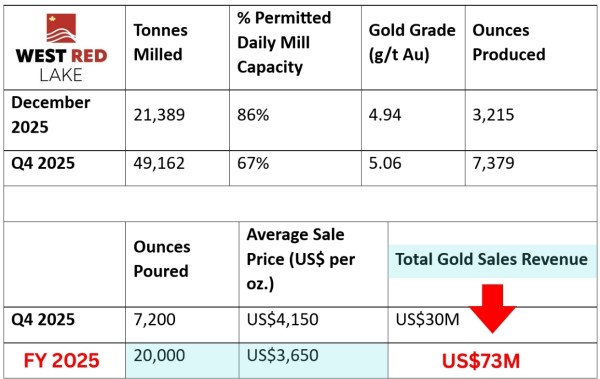
WRLG set an internal commercial production requirement of 30 consecutive days of mill throughput at 65% or greater of permitted capacity (800 tonnes per day). They achieved this in December 2025.
Operational stability, the other internal requirement, is also in place at Madsen. Consistent strong mill recoveries, which averaged 94.6% in December, enabled production of 3,215 ounces of gold.
In a YouTube video posted on January 12, 2026, West Red Lake Gold VP of Communications, Gwen Preston, discusses the transition from the Madsen ramp-up phase to commercial production.
“West Red Lake Gold just announced that the Madsen mine achieved commercial production on January 1st,” stated Preston in the above video.
“In December, the mill averaged 689 tonnes per day, which represents 86% of design capacity. That met our internal guideline, which was 65% of design capacity for 30 consecutive days.
Mined tonnage stepped up, gold grades reconciled reliably, the mill churned through more material, and all of this meant the mine produced 3,215 ounces of gold from rock averaging just shy of 5 grams per tonne gold.
Over the next few months, during our first quarter of commercial production, mined ore will come predominantly from the 4447 area, which is that high-grade zone in South Austin that we defined last year. With that area driving tonnage, mill feed is expected to average better than 6 grams per tonne gold in the quarter.”

“This comes after a ramp-up year that saw the Madsen Mine pour 20,147 ounces of gold, which was sold at an average price of US$3,650 per ounce for gross proceeds of US$73 million,” continued Preston.
“It’s fantastic to be producing and selling gold. We ended the year with CAD$46 million in cash and receivables. Commercial production is a major achievement, but there is so much more opportunity waiting to be unlocked at Madsen.
We will continue executing on the process that is proven to work here at Madsen: definition drill to 7-metre centres, develop an accurate, high-resolution model of the deposit, engineer a mine plan, mine to plan, and mill reliably, and always prioritize safety.
We will continue to advance Fork, with an aim to start mining that deposit this year.”
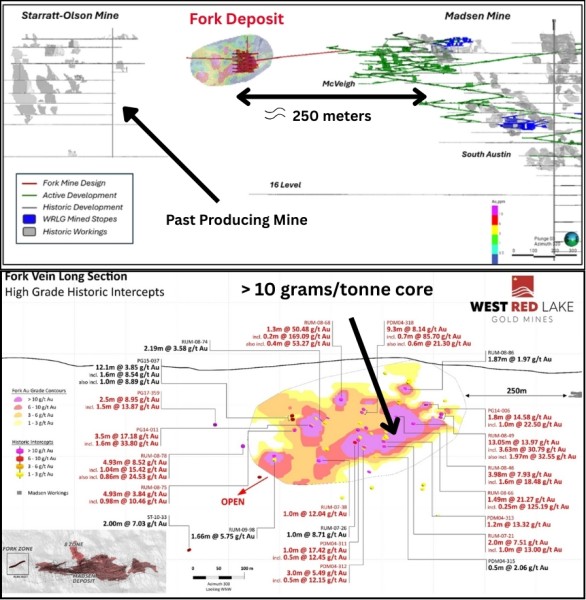
“We will get the shaft running soon and will dive into an opportunity that we just realized to potentially increase the tonnes going up the shaft significantly,” continued Preston.
“We will continue to delineate the new high-grade area in Lower Austin that’s similar to 4447.
We will finish drilling at Rowan, remodel that deposit, redo the mine plan there, hopefully including the veins that were excluded in our last go around because of spotty data, and complete a joint Madsen-Rowan prefeasibility study to capture the scale of the gold production hub we plan to build here.
And we will continue searching for more of the remarkable gold mineralization that makes Red Lake and Madsen special.
This news is an exciting start to a big year for West Red Lake Gold and the Madsen mine!” concluded Preston.
The Madsen operation poured 7,200 ounces of gold in Q4 (recovered and poured ounces do not align exactly due to gold in circuit and timing of gold pours). Those ounces were sold at an average price of US$4,150 per ounce for total gold sales revenue of US$30 million.
“We will continue to ramp up from this strong base,” Williams stated in the January 12 press release, “and I anticipate Madsen will reach sustained permitted capacity by mid-2026.”
WRLG expects to release 2026 guidance during Q1, 2026.
“Gold and silver climbed to records in a broad-based metals rally as the US Justice Department threatened the Federal Reserve with a criminal indictment, reviving concerns about the central bank’s independence,” reported Bloomberg on January 12, 2026.
“The yellow metal spiked above $4,600 an ounce, while silver surpassed $85 after Fed Chair Jerome Powell said the potential indictment comes amid “threats and ongoing pressure” by the administration to influence interest-rate decisions. The dollar weakened and US 10-year Treasury yields edged higher.”
“Repeated attacks on the Fed by the Trump administration were a major factor propelling gold and silver to successive peaks last year, and that driver looks set to persist,” added Bloomberg.

The Madsen Mine deposit presently hosts a National Instrument 43-101 – Standards of Disclosure for Mineral Projects (“NI 43-101”) Indicated resource of 1.65 million ounces (“Moz”) of gold grading 7.4 g/t Au within 6.9 Mt, and an Inferred resource of 0.37 Moz of gold grading 6.3 g/t Au within 1.8 Mt. Mineral resources are estimated at a cut-off grade of 3.38 g/t Au and a gold price of US$1,800/oz. A full copy of the Madsen Report is available on the Company’s website and on SEDAR+ at www.sedarplus.ca. [1]
The technical information presented in this release has been reviewed and approved by Will Robinson, P.Geo., Vice President of Exploration for West Red Lake Gold and the Qualified Person for exploration at the West Red Lake Project, and by Hayley Halsall-Whitney, P.Eng., Vice President of Operations for West Red Lake Gold and the Qualified Person for technical services at the West Red Lake Project, as defined by National Instrument 43-101 – Standards of Disclosure for Mineral Projects.
Contact: guy.bennett@globalstocksnews.com
Disclaimer: West Red Lake Gold paid Global Stocks News (GSN) $1,750 for the research, writing and dissemination of this content.
Full Disclaimer: GSN researches and fact-checks diligently, but we cannot ensure our publications are free from error. Investing in publicly traded stocks is speculative and carries a high degree of risk. GSN publications may contain forward-looking statements such as “project,” “anticipate,” “expect,” which are based on reasonable expectations, but these statements are imperfect predictors of future events. When compensation has been paid to GSN, the amount and nature of the compensation will be disclosed clearly.
References:
1. Please refer to the technical report entitled “NI 43-101 Technical Report and Prefeasibility Study for the Madsen Mine, Ontario, Canada”, prepared by SRK Consulting (Canada) Inc. and dated January 7, 2025. A full copy of the SRK report is available on the Company’s website and on SEDAR+ at www.sedarplus.ca
Media Contact
Organization: Global Stocks News
Contact Person: guy.bennett@globalstocksnews.com
Website: https://www.globalstocksnews.com
Email: Send Email
Country:Canada
Release id:40127
The post West Red Lake Gold 2025 US$73 million Gold Sales in Rear View Mirror as 2026 Commercial Production Begins appeared first on King Newswire. This content is provided by a third-party source.. King Newswire makes no warranties or representations in connection with it. King Newswire is a press release distribution agency and does not endorse or verify the claims made in this release. If you have any complaints or copyright concerns related to this article, please contact the company listed in the ‘Media Contact’ section
About Author

Disclaimer: The views, suggestions, and opinions expressed here are the sole responsibility of the experts. No Digi Observer journalist was involved in the writing and production of this article.

HIG Bedding invites shoppers to refresh bedrooms, bathrooms, and living spaces with comforter sets, curtains, decorative pillows, and home textile essentials from June 24 to June 27.
United States, 24th Jun 2026, – A Limited-Time Home Refresh Event for Summer Living

HIG Bedding, a home textile brand focused on stylish and practical home living, has launched its 4-Day Mid-Year Home Refresh Sale, offering 20% off sitewide from June 24 to June 27.
Guided by the brand slogan “Home is gorgeous, we make it better,” the brand aims to help customers create homes that feel beautiful, comfortable, and personal. The limited-time sale is designed for shoppers looking to upgrade their bedrooms, guest rooms, dorm rooms, bathrooms, or living spaces with well-designed home textile products at a more accessible price.
Bedding and Decor Designed for Everyday Homes
As summer home updates, moving season, dorm preparation, and guest room makeovers become top priorities for many households, the promotion provides an opportunity to shop across HIG Bedding’s major product categories, including comforter sets, bedspreads, bed sheets, window curtains, shower curtains, and decorative pillows.
Comforter sets remain the brand’s core product line. HIG Bedding offers a wide selection of bedding styles for customers who want more than simple basics. Popular options include French country-inspired bedding sets, American vintage-style embroidered comforter sets, all-season down alternative comforters, breathable summer bedding, and machine-washable bedding designs.

French Country Style Meets Practical Comfort
French country-inspired bedding is one of the key style directions in HIG Bedding’s collection. These bedding sets are suitable for North American family bedrooms, short-term rental apartments, new homes, and housewarming gifts. With details such as embroidery, ruffles, jacquard textures, patchwork, and handcrafted-inspired accents, the designs help customers create a warm and distinctive bedroom atmosphere.
For year-round comfort, HIG Bedding also offers machine-washable down alternative comforters. These all-season comforters are designed for families, students, guest rooms, and households living in different climate regions. They help reduce the need to switch between multiple seasonal comforters, while offering easy care and practical everyday use.

More Than Bedding: Complete Home Textile Solutions
Beyond bedding, HIG Bedding also provides coordinated home decor pieces for a complete room refresh. Its French-style window curtains are suitable for living rooms, dining rooms, bedrooms, and bay windows. Many designs feature a double-layer structure that combines decorative outer fabric with a blackout lining, bringing both style and light control to the home.
For bathrooms, HIG Bedding’s shower curtains offer affordable decorative options in a range of styles. The brand’s handcrafted-style decorative pillows can also be used on sofas, beds, reading corners, and other leisure spaces to add texture, color, and personality.

A Brand Built Around Beautiful, Comfortable Living
“Home is not only a place to rest, but also a reflection of one’s attitude toward life,” said a representative of HIG Bedding. “Through this mid-year sale, we hope to make it easier for customers to break away from ordinary interiors and create a more delicate, harmonious, and relaxing home.”
HIG Bedding has extensive experience in designing, producing, and exporting home textile products for customers and retailers around the world. The brand focuses on original design, competitive pricing, and reliable fulfillment. For customers in the 48 continental U.S. states, HIG Bedding offers free shipping and works with carriers such as FedEx, UPS Ground, and USPS to support reliable delivery for timely home upgrades.
About HIG Bedding
HIG Bedding is a home textile brand specializing in stylish and practical bedding and home decor products. With extensive experience in design, production, and global export, HIG Bedding offers comforter sets, bedspreads, sheets, curtains, shower curtains, decorative pillows, and other home textile essentials. Guided by the slogan “Home is gorgeous, we make it better,” the brand aims to help customers create harmonious, classy, and relaxing homes through thoughtfully designed and accessible products. To explore the full collection and current offers, visit the official HIG Bedding website.
Media Contact
Organization: HOMECHOICE INTERNATIONAL GROUP INC.
Contact
Person: Media Relations
Website:
https://higbedding.com/
Email:
higbedding@gmail.com
Contact Number: 18337761088
Country:United States
The post
HIG Bedding Launches 4-Day Mid-Year Home Refresh Sale with 20% Off Sitewide appeared first on
Brand News 24.
It is provided by a third-party content
provider. Brand News 24 makes no
warranties or representations in connection with it.
About Author
Disclaimer: The views, suggestions, and opinions expressed here are the sole responsibility of the experts. No Digi Observer journalist was involved in the writing and production of this article.
As untreated hearing loss remains one of the most overlooked health issues in America, ELEHEAR marks two of the year’s biggest retail moments by offering its award-winning lineup at its lowest prices to date
United States, 24th Jun 2026, – Nearly 48 million Americans live with some degree of hearing loss. Fewer than one in three who could benefit from a hearing aid have ever used one. The reasons are well documented: historically, a single pair of prescription hearing aids cost between $2,000 and $7,000, required clinical appointments, and carried a stigma that kept millions of people from taking the first step toward better hearing. That equation has been changing since the FDA opened the over-the-counter hearing aid category in 2022, and ELEHEAR has been among the companies driving that shift.
“We believe hearing health should be as easy to access as any other personal technology,” said David Hogan, Managing Director of ELEHEAR. “For too long, the cost and complexity of getting hearing help has meant people simply go without — and that has real consequences for their quality of life, their relationships, and their mental health. If we’re going to do something in this space, it has to be best-in-class and reach the people who need it most. That’s what we’re here for.”
The timing is deliberate. Father’s Day is one of the most significant gifting occasions of the year for health and wellness technology, and Amazon Prime Day has become a cultural moment when American consumers make meaningful purchasing decisions. For a company whose mission centers on removing barriers to hearing care, both occasions represent opportunities to reach consumers who have long assumed that clinically validated, high-performance hearing technology carries a four-figure price tag and to show them that it no longer has to.
The devices on offer this summer reflect the breadth of that mission. The Beyond Pro, which earned an A grade from HearAdvisor’s independent testing lab and ranks in the top 2% of all OTC hearing aids tested, is powered by ELEHEAR’s proprietary VOCCLEAR® 2.0 technology, delivering 30% clearer speech in noisy environments. It also includes a high-fidelity Music Mode, Bluetooth 5.3 streaming, and real-time AI translation in over 20 languages. The Delight, launched earlier this year, takes a different form. An in-the-canal device with an earbud-like profile, it is designed for all-day wear with an ergonomic fit and IP67-rated dust and water resistance. Independent testing places its performance well above the OTC category average.
From June 15 through June 26, spanning both Father’s Day and Amazon Prime Day, the company is offering its full lineup of AI-powered OTC hearing aids at the lowest prices in its history, including the Delight, which launched at CES 2026 to wide industry attention. Selected devices are available at up to 31% off, with the deepest discounts on Delight. All purchases include a 45-day risk-free trial and a one-year warranty.
Savings during this window are real, and for the millions of people who have been putting off addressing their hearing, they make the moment of decision easier — for families looking to give the people they love something that genuinely improves their daily lives.
About ELEHEAR
ELEHEAR is an integrated AI hearing aid brand, encompassing research and development, manufacturing, and global sales. Its proprietary self-developed core technologies, including its proprietary VOCCLEAR® algorithm, enable ultra-low-latency AI processing, Noise reduction, and DNN-hybrid feedback cancellation. These innovations have earned recognition from professional teams worldwide, underscoring ELEHEAR’s strong technical competitiveness in global markets. For more information, visit www.elehear.com.
Media Contact
Organization: ELEHEAR Inc.
Contact
Person: Media Relations
Website:
https://elehear.com/
Email:
support@elehear.com
Contact Number: 18886691099
Country:United States
The post
ELEHEAR Makes AI Hearing Technology More Accessible This Father’s Day and Prime Day appeared first on
Brand News 24.
It is provided by a third-party content
provider. Brand News 24 makes no
warranties or representations in connection with it.
About Author
Disclaimer: The views, suggestions, and opinions expressed here are the sole responsibility of the experts. No Digi Observer journalist was involved in the writing and production of this article.
Press Release
J-Tech Digital Launches FIFA 2026 World Cup Campaign for Game-Day Ready AV Distribution and Multi-Screen Viewing
United States, 24th Jun 2026, – J-Tech Digital, a professional audio-video technology company, is launching a FIFA 2026 World Cup promotional campaign to help customers prepare for one of the world’s biggest live sports viewing events. As fans, businesses, venues, and organizations plan watch parties and multi-screen viewing experiences, J-Tech Digital is highlighting AV distribution solutions designed to make game-day viewing more reliable, flexible, and immersive.

J-Tech Digital’s brand philosophy is built around making professional AV solutions more accessible, practical, and dependable. The company focuses on delivering audio-video products that combine performance, usability, and value for customers who need AV systems that work smoothly in real-world installations. Whether the goal is to connect a single display, route content to multiple screens, extend HDMI signals over long distances, or manage an advanced AV over IP environment, J-Tech Digital provides solutions designed to simplify setup, improve connectivity, and support reliable performance.
The brand’s product portfolio includes HDMI extenders, HDMI matrix switches, HDBaseT extenders, AV over IP solutions, HDMI splitters, audio extractors, multi-view processors, video wall controllers, wireless HDMI products, 4K HDMI solutions, and AV control accessories. These products support a wide range of applications, including home theater systems, sports bars, restaurants, hotels, classrooms, conference rooms, houses of worship, esports facilities, broadcast environments, retail displays, and live event venues.
The FIFA 2026 World Cup presents a major opportunity for customers to rethink how they deliver live sports content across screens and spaces. Residential users may want to create more flexible home theater or watch-party setups, while commercial venues may need to distribute matches across multiple displays, seating areas, rooms, or public viewing zones. For installers, integrators, and AV professionals, dependable signal extension, HDMI switching, video distribution, display control, and audio-video connectivity can be critical to delivering a smooth experience during high-traffic live events.
As part of the campaign, J-Tech Digital is offering customers 10% off storewide with promo code WC2026 at checkout. The promotion is valid through July 19 and is designed to support customers preparing for home theater upgrades, commercial AV installations, multi-screen sports viewing setups, and professional display systems ahead of and during the tournament period.
J-Tech Digital’s value proposition is rooted in the idea that AV technology should be powerful without being unnecessarily complicated. The company aims to bridge the gap between professional-grade AV performance and everyday usability, offering products that serve integrators, business owners, facility managers, and home users alike. This positioning allows the brand to support customers at different levels of technical experience while maintaining a focus on reliability, flexibility, and long-term value.

Throughout the FIFA 2026 World Cup campaign, J-Tech Digital will spotlight solutions for multi-screen sports viewing, long-distance HDMI extension, AV over IP distribution, HDMI matrix switching, video wall setups, wireless HDMI connectivity, and simplified source-to-display control. Campaign messaging will focus on helping customers build “game-day ready” AV systems for homes, commercial venues, hospitality spaces, and event environments.
“Major live sports events bring people together, and reliable AV technology plays an important role in making those experiences successful,” said a J-Tech Digital spokesperson. “With our FIFA 2026 World Cup campaign, we want to help customers upgrade their systems with practical, high-performance AV solutions that make every screen count.”
Customers can redeem the promotion by entering code WC2026 during checkout at jtechdigital.com. Customers are encouraged to explore J-Tech Digital’s product lineup early to prepare for watch parties, venue upgrades, audio-video installations, commercial AV projects, and professional display systems ahead of the tournament.
About J-Tech Digital
J-Tech Digital is a professional audio-video technology company offering AV distribution and connectivity solutions for residential, commercial, and professional environments. The company’s product lineup supports HDMI extension, HDMI switching, AV over IP distribution, HDBaseT signal extension, video wall systems, wireless HDMI, audio management, and AV control applications. J-Tech Digital serves customers across home theater, hospitality, education, corporate, broadcast, esports, retail, government, houses of worship, and live event markets.
Promotion Disclaimer
This promotion is not affiliated with, endorsed by, or sponsored by FIFA.
Media Contact
Organization: J-Tech Digital Inc.
Contact
Person: Media Relations
Website:
https://www.jtechdigital.com/
Email:
support@jtechdigital.com
Contact Number: 18886102818
Country:United States
The post
J-Tech Digital Launches FIFA 2026 World Cup Campaign for Game-Day Ready AV Distribution and Multi-Screen Viewing appeared first on
Brand News 24.
It is provided by a third-party content
provider. Brand News 24 makes no
warranties or representations in connection with it.
About Author
Disclaimer: The views, suggestions, and opinions expressed here are the sole responsibility of the experts. No Digi Observer journalist was involved in the writing and production of this article.
HIG Bedding Launches 4-Day Mid-Year Home Refresh Sale with 20% Off Sitewide
J-Tech Digital Launches FIFA 2026 World Cup Campaign for Game-Day Ready AV Distribution and Multi-Screen Viewing
ELEHEAR Makes AI Hearing Technology More Accessible This Father’s Day and Prime Day
Benzinga Money Article Discusses How to Become Part of the 12% of Retirees Who Have Achieved the Recommended $550,000 Minimum Retirement Savings Threshold
Apu Apustaja Conquers New York with Lively Street Ads, Including Times Square Billboard
Bay Smokes Maintains Quality Amid Legislative Changes in the Hemp Industry


-
Press Release5 days ago
Salinas Interiors Announces Major Residential and Commercial Projects Across Houston
-
Press Release4 days ago
ETHRA AI Launches AI-Powered Trading Ecosystem with Live Presale Focused on Real Revenue, Security, and Sustainable Growth
-
Press Release5 days ago
The Name Catching Attention Along Long Island’s Most Traveled Route: Dr. David Pincus of Pincus Plastic Surgery
-
Press Release4 days ago
The Architecture of Executive Influence: Why High-Performing Operators Struggle to Reach the C-Suite
-
Press Release5 days ago
A Mother and Daughter Built the Period Tracker They couldn’t Find
-
Press Release5 days ago
From a Calling to International Recognition: ENKU Brings Japanese Calligraphy to Global Audiences
-
Press Release5 days ago
Tradesman Nutrition Reviews Highlight Strong Demand for Supplements Built for Blue Collar Workers Across the United States
-
Press Release5 days ago
Okinawa Suntory Arena Becomes First Venue in Asia to Install ASB GlassFloor