
Press Release
Forging Leaders for the Age of Algorithmic Finance: How Alexander Winner Academy Is Redefining Global Strategic Intelligence

Forging Leaders for the Age of Algorithmic Finance: How Alexander Winner Academy Is Redefining Global Strategic Intelligence
The global financial landscape is no longer shaped primarily by human intuition, regional economics, or slow-moving institutional forces. Instead, it is being reconstructed by autonomous systems, self-learning algorithms, and a market environment where information flows faster than geopolitical events can unfold. The entire architecture of capital—how it moves, how it is priced, and how risk is interpreted—has entered a historic turning point.
In this era of relentless volatility and intelligent automation, one question dominates boardrooms, research labs, and economic forums: Who will lead when machines are rewriting the rules of finance?

It is in response to this question that Alexander Winner Academy, founded by technologist and strategist Alexander Grant, has positioned itself as a next-generation institution designed to build the “algorithm-ready” leaders the world now urgently requires. Rather than relying on conventional business education, the Academy has engineered a new ecosystem where technological depth meets strategic foresight, and where leaders are trained to operate within financial systems that increasingly think for themselves.
This vision—rooted in Grant’s belief that future leadership must integrate computational understanding with global economic literacy—represents a profound shift in how modern talent must be cultivated.
A Financial Epoch Defined by Intelligent Systems, Not Static Models
For decades, global finance evolved through incremental adjustments: new instruments, refined regulations, improving risk frameworks. But today, the pace is exponential. Cloud-native trading engines execute millions of operations in seconds. Machine-learning models evaluate risk vectors invisible to traditional analysts. Autonomous market-making systems adapt to real-time liquidity shifts independent of human instruction.
These changes are not surface-level improvements. They are structural rewrites.
Interest-rate pricing, credit flows, commodities forecasting, sovereign debt evaluation, cross-border settlement, and even compliance oversight have absorbed AI-driven mechanisms. Financial institutions are no longer simply adopting technology; they are being redefined by it.
In this climate, leaders require a new set of competencies—ones not taught in legacy MBA programs or traditional economics departments. They must understand both the architecture of intelligent systems and the macro forces that guide global capital. They must be capable of reading markets not only through data, but through the logic of algorithms that shape the data itself.
Alexander Winner Academy was designed precisely to bridge that gap.
Alexander Grant’s Strategic Thesis: Leadership Must Evolve Faster Than the Machines That Shape Markets
Alexander Grant’s background spans technical architecture, organizational transformation, and AI-driven strategy implementation across global enterprises. But his defining insight came from watching the widening disconnect between technological innovation and leadership capability.
Technologists understood the systems. Economists understood the markets. But few individuals could meaningfully connect the two.
Grant realized that the future of finance required a different breed of decision-maker—someone able to command intelligent systems rather than simply react to their outcomes. Someone capable of interpreting algorithmic decisions within broader economic, political, and ethical contexts. Someone prepared for a world where market conditions shift not quarterly, but instantaneously.
This realization became the foundation of Alexander Winner Academy: to build leaders who could think across domains, anticipate the consequences of automation, and operate with the kind of adaptive intelligence matching the systems that now power global finance.
A Training Model Built for High-Complexity Markets
Unlike conventional academies built around textbooks and predefined frameworks, Alexander Winner Academy operates as a real-time learning ecosystem. Participants engage with:
— Adaptive financial simulations powered by machine-learning environments
— Intelligent capital allocation scenarios reflecting global liquidity shifts
— Strategic decision labs designed around geopolitical uncertainty
— Multi-layered risk models that evolve as soon as new data enters the system
This approach mirrors the conditions of the modern financial world, where information is volatile and where the interaction between human strategy and machine reasoning defines competitive advantage.
The Academy’s structure encourages leaders to build pattern recognition across three interdependent domains:
Technological Intelligence – understanding how automated trading, generative models, and predictive engines reshape global markets.
Strategic Capital Thinking – navigating investment climates influenced by autonomous systems, fragmented regulation, and shifting macroeconomic cycles.
Systems Leadership – guiding organizations through environments where machine-driven insights demand faster, sharper, and more multi-dimensional decision-making.
Instead of creating specialists locked in single domains, the Academy cultivates hybrid strategists who can move fluidly between financial dynamics and AI logic.
Finance in a State of Structural Instability: Why Multi-Layered Leadership Matters Now
The global financial system is experiencing an era defined not only by transformation, but by contradiction. Liquidity flows fluctuate as AI-based trading engines react to geopolitical events faster than policymakers can respond. Inflation behaves with new irregularity as supply chains and commodities markets shift under algorithmic forecasting. Digital asset markets expand even as regulatory frameworks attempt to catch up. Institutional portfolios incorporate autonomous models that challenge traditional risk philosophy.
These disruptions require leaders who can think in layers—who can manage uncertainty across interconnected systems and who can interpret machine-generated forecasts without being dominated by them.
Alexander Winner Academy trains participants to operate within this complexity. Rather than offering narrow solutions, the Academy prepares leaders to build strategic architectures that adapt. This includes developing the capacity to assess:
how real-time algorithmic trading affects long-term asset stability
how AI-modified consumer behavior shifts credit and lending patterns
how multi-chain digital assets challenge conventional monetary systems
how autonomous risk engines modify global liquidity distribution
how geopolitical tensions interact with algorithmic market structures
Such multidimensional thinking is no longer a competitive advantage—it is essential for survival in contemporary finance.
Why Intelligent Capital Leadership Has Become the Defining Skill of the Next Decade
In earlier decades, leaders could rely on experience, legacy frameworks, and sector expertise. But in the present era, the systems shaping financial outcomes are increasingly artificial, adaptive, and predictive. The edge now belongs to those who can integrate machine intelligence into their decision-making while maintaining human-led strategic judgment.
This is the core philosophy of Alexander Winner Academy: leadership must evolve not at the pace of human institutions, but at the pace of intelligent systems themselves.
Grant argues that intelligent capital leadership is defined by three emergent capacities:
Deep Technological Fluency – not coding ability, but the conceptual understanding required to interpret how intelligent systems reason.
Strategic Adaptability – the ability to recalibrate decisions as markets absorb new data, new regulations, and new technological disruptions.
Economic Foresight – the capacity to connect algorithmic patterns with long-horizon global trends.
This triad creates leaders capable of shaping, rather than reacting to, the financial transformation ahead.
A Global Impact: Preparing Leaders for Institutions Facing Existential Change
The Academy’s graduates increasingly find themselves positioned within organizations undergoing aggressive digital restructuring. Banks integrating autonomous lending systems, asset managers adopting AI-driven risk analytics, sovereign funds building predictive allocation engines, and financial regulators confronting algorithmic market dynamics all require talent aligned with the Academy’s philosophy.
These institutions recognize that automation alone cannot secure advantage. What they need are leaders who understand the machinery of modern finance and who can steer organizations confidently through an unpredictable future shaped by intelligent technology.
Alexander Winner Academy’s ecosystem—part think tank, part leadership laboratory, part deep-tech accelerator—provides this rare strategic preparation.
Looking Ahead: The Future Belongs to Leaders Who Can Navigate Intelligence, Not Just Capital
Across the world, the next chapter of finance will be written by those who can operate in an algorithmic environment without losing their strategic compass. The rise of autonomous decision systems, real-time global analytics, and digital monetary structures has made leadership more challenging and more essential than ever.
Alexander Winner Academy stands at the center of this transformation, not just as an institution of learning but as a generator of new leadership models suited to a world where financial systems no longer behave predictably—and where intelligence, not information, defines power.
In this emerging era, the Academy’s mission is clear:
to cultivate the leaders who will understand the machines, guide the markets they shape, and convert technological disruption into strategic advantage.
It is a mission built for the future—because the future of finance will be led by those who can think in the language of intelligent systems.
Media Contact
Organization: Alexander Winner Academy
Contact Person: Alexander Grant
Website: https://www.alexanderwinneracademy.com
Email: Send Email
Country:United States
Release id:37638
The post Forging Leaders for the Age of Algorithmic Finance: How Alexander Winner Academy Is Redefining Global Strategic Intelligence appeared first on King Newswire. This content is provided by a third-party source.. King Newswire makes no warranties or representations in connection with it. King Newswire is a press release distribution agency and does not endorse or verify the claims made in this release. If you have any complaints or copyright concerns related to this article, please contact the company listed in the ‘Media Contact’ section
About Author

Disclaimer: The views, suggestions, and opinions expressed here are the sole responsibility of the experts. No Digi Observer journalist was involved in the writing and production of this article.

Grepix Infotech Pvt. Ltd. has launched the Grepix Global Partner Program, enabling entrepreneurs and agencies across 30+ countries to build on-demand app businesses using its ready-to-deploy technology, including taxi, food delivery, logistics, and services platforms.The program offers six partnership models White Label, Revenue Share, Co-Branding, Franchise Tech, API Integration, and Referral — with 48-hour onboarding and dedicated support.
Noida, Uttar Pradesh, India, 4th May 2026 — Grepix Infotech Pvt. Ltd., a leading mobile and web application development company, today announced the launch of the Grepix Global Partner Program—a structured partnership ecosystem designed to help entrepreneurs, agencies, and regional businesses launch profitable on-demand app businesses without building technology from scratch.

With a proven portfolio that includes HireMe (taxi and ride hailing), MasalaDish (food delivery), InstaResQ Roadside Assistance, GTA – GetTransportApps (logistics and transport), and a comprehensive on-demand services platform, Grepix is opening its technology infrastructure to partners across 30+ countries under six flexible, results-driven collaboration models.
The Opportunity
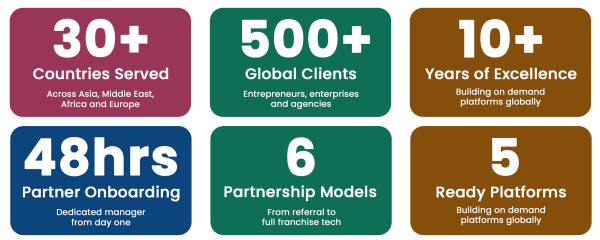
The global on-demand economy continues to grow at a remarkable pace. Ride hailing, food delivery, and logistics together represent a combined market opportunity exceeding USD 600 billion. Yet, thousands of entrepreneurs and regional businesses lack the technology resources to enter and compete effectively. Grepix is changing that with ready-to-deploy, fully customizable solutions backed by a decade of development experience.
“We have spent years perfecting our platforms so our partners do not have to. Our goal is to give ambitious entrepreneurs the technology backbone they need to launch fast, compete confidently, and grow profitably,” said a spokesperson from Grepix Infotech.
Six Partnership Models for Every Type of Partner
1. White Label Reseller Partner Partners receive full rights to rebrand and resell Grepix solutions entirely under their own brand. With complete customization options, dedicated technical support, and faster time to market, this model is ideal for digital agencies, IT consultants, and entrepreneurs who want to deliver premium app products to clients without heavy development investment.
2. Revenue Share Partner Partners who refer new clients to Grepix earn a competitive commission on every successful deal with no upfront investment required. Marketing collateral, sales support, and transparent tracking are all provided. This model suits business development professionals, startup mentors, and consultants with strong industry networks.
3. Co-Branding Partner Co-branding partners collaborate with Grepix to deliver joint solutions to regional markets, combining Grepix’s technology credibility with the partner’s local presence and trust. Ideal for established regional tech companies and local businesses, this model offers shared brand visibility, joint go-to-market strategies, and dedicated account management.
4. Franchise Tech Model The most comprehensive model in the program allows partners to launch their own fully branded taxi, food delivery, logistics, or on-demand service business in their city or region using Grepix’s proven technology—operational within weeks. Territory exclusivity, ongoing product upgrades, and business launch guidance make this the fastest path for entrepreneurs ready to enter the on-demand economy with confidence.
5. API Integration Partner Technology: Companies, payment providers, EV charging networks, telematics firms, and insurance platforms can integrate their services directly with Grepix’s app ecosystem. This model opens co-marketing opportunities, expands reach across active app deployments, and creates bundled revenue opportunities for both parties.
6. Referral Partner: The simplest entry point into the Grepix ecosystem. Referral partners recommend Grepix solutions to their network and earn a bonus for every successful engagement with zero technical knowledge or upfront commitment required. Ideal for business coaches, digital marketers, incubators, and accelerators.
The Grepix Product Suite
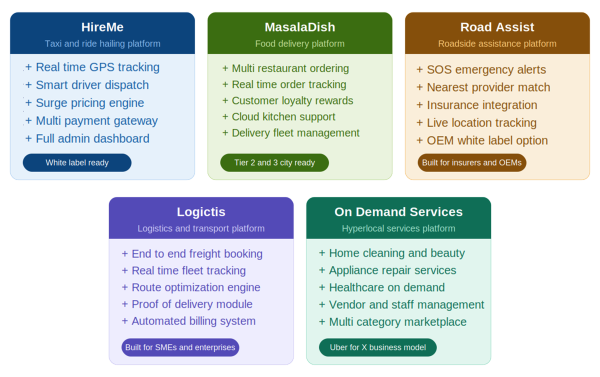
The partner program is powered by five industry-ready platforms:
HireMe — Taxi and Ride Hailing App A white-label-ready taxi booking platform with real-time GPS tracking, intelligent driver dispatch, surge pricing, multiple payment gateways, and a powerful admin dashboard. Trusted by ride-hailing operators across multiple countries.
MasalaDish — Food Delivery App A scalable multi-restaurant food delivery platform built for local restaurants, cloud kitchens, and large food networks. Features real-time order tracking, loyalty programs, and seamless delivery partner management.
InstaResQ — Roadside Assistance App: An on-demand vehicle emergency response platform connecting stranded drivers to the nearest service provider in minutes. Designed for insurance companies, automobile brands, and fleet operators.
GTA (GetTransportApps) — Logistics and Transport App: An end-to-end freight management platform covering booking, real-time tracking, route optimization, proof of delivery, and automated billing for SMEs and large logistics operators.
On-Demand Services Platform: A hyperlocal services marketplace supporting categories including home cleaning, beauty, appliance repair, and healthcare, ideal for entrepreneurs building the next generation of local service businesses.
Why Partner with Grepix?
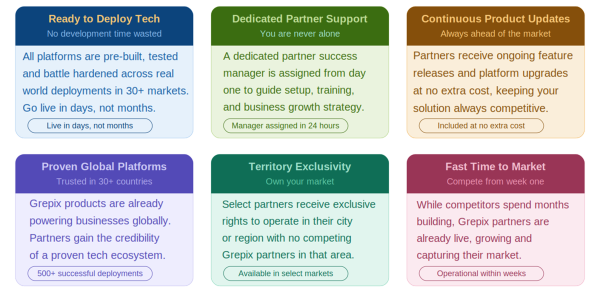
- 10+ Years of on-demand app development experience
- 500+ Clients served across 30+ countries
- Recognized among the top global mobile app development companies
- Dedicated Partner Success Team from onboarding through growth
- Continuous Product Updates so partners always stay ahead of the market
- 48-hour onboarding with a dedicated relationship manager assigned from day one
Join the Grepix Global Partner Program.

Businesses and individuals ready to build their on-demand future can apply by visiting www.grepixit.com or contacting the Grepix partnership team directly.
Email: reachus@grepixit.com Website: www.grepixit.com
About Grepix Infotech Pvt. Ltd.
Grepix Infotech Pvt. Ltd. is a India-based technology company specializing in mobile app development, web development, IoT, augmented reality, UI/UX design, and cross-platform solutions. With a deep focus on the on-demand economy, Grepix has built and deployed solutions across transportation, food delivery, logistics, healthcare, and eLearning for clients worldwide.
Media Contact
Organization: Grepix Infotech Pvt. Ltd.
Contact Person: Vinay Jain
Website: https://www.grepixit.com
Email: Send Email
Contact Number: +918860213347
Address:Logix Technova A 328, Noida-Greater Noida Expy, Block B, Sector 132, Noida, India – 201304
City: Noida
State: Uttar Pradesh
Country:India
Release id:44479
The post Grepix Infotech Launches Global Partner Program for On-Demand Business Entrepreneurs appeared first on King Newswire. This content is provided by a third-party source.. King Newswire makes no warranties or representations in connection with it. King Newswire is a press release distribution agency and does not endorse or verify the claims made in this release. If you have any complaints or copyright concerns related to this article, please contact the company listed in the ‘Media Contact’ section
About Author
Disclaimer: The views, suggestions, and opinions expressed here are the sole responsibility of the experts. No Digi Observer journalist was involved in the writing and production of this article.
HODL.DANCE is a new decentralized memecoin launchpad on BNB Chain offering bonding curve launches, permanent liquidity locking on PancakeSwap V3, and on-chain creator rewards via the $HODL4 program. HODL.DANCE Launches First Memecoin Launchpad on BNB Chain with Permanent Liquidity Lock and Built-In Creator Rewards The platform lets anyone launch a memecoin in seconds — with liquidity locked forever and trading fees flowing back to creators and traders.
United States, 4th May 2026 – HODL.DANCE, a new decentralized memecoin launchpad built on BNB Chain (BSC), has officially launched, offering a transparent and creator-friendly alternative to existing token launch platforms. The platform combines a bonding curve pricing mechanism with permanent liquidity locking and an on-chain rewards program — a combination rarely seen in the memecoin space.

What is HODL.DANCE?
HODL.DANCE allows any user to launch a memecoin directly from their browser in just a few clicks — no coding knowledge required. Once a token is created, it trades along a bonding curve until it reaches the graduation threshold. At that point, the token graduates to PancakeSwap V3, and the liquidity is locked permanently — ensuring traders can always buy and sell without rug pull risk.
Unlike other launchpads where creators profit only from the initial launch, HODL.DANCE distributes a portion of every trading fee to token creators and active ecosystem participants through its native $HODL4 rewards program. Leftover tokens from the bonding curve are burned at graduation, making each token deflationary by design.
Built for Transparency
Every core action on HODL.DANCE happens on-chain. Token verification, fee distribution, and liquidity locking are all managed by smart contracts deployed on BSC. The platform charges a flat 1% trading fee — no hidden costs, no off-chain surprises.
Key Features:
- Launch a memecoin in seconds — no coding required
- Liquidity locked permanently on PancakeSwap V3 at graduation
- Creators earn from trading fees, not just the launch
- Unsold tokens burned at graduation — built-in deflation
- $HODL4 Rewards Program — earn by trading and participating
- On-chain verification and transparent 1% fee structure
- Smart contracts deployed on BNB Chain (BSC)
About HODL.DANCE
HODL.DANCE is a decentralized memecoin launchpad on BNB Chain. The platform was built to give memecoin creators and traders a safe, transparent, and rewarding environment to launch and trade tokens. The team believes that locked liquidity and shared revenue are the foundation of a healthier memecoin ecosystem.
Contact:
Website: https://hodl.dance
X (Twitter): https://x.com/hodl4meme
Telegram: https://t.me/hodldance
Media Contact
Organization: HODL.DANCE
Contact Person: HODL.DANCE Team
Website: https://hodl.dance/
Email: Send Email
Country:United States
Release id:44636
Disclaimer: This content is for informational purposes only and does not constitute financial, investment, legal, or trading advice. Digital assets and blockchain-based technologies involve risk. Readers are responsible for conducting their own due diligence and complying with applicable laws and regulations.
The post HODL.DANCE Launches Memecoin Launchpad on BNB Chain With Permanent Liquidity Lock appeared first on King Newswire. This content is provided by a third-party source.. King Newswire makes no warranties or representations in connection with it. King Newswire is a press release distribution agency and does not endorse or verify the claims made in this release. If you have any complaints or copyright concerns related to this article, please contact the company listed in the ‘Media Contact’ section
About Author
Disclaimer: The views, suggestions, and opinions expressed here are the sole responsibility of the experts. No Digi Observer journalist was involved in the writing and production of this article.
Three-level model describes how systematically and effectively an organization uses AI for content creation and management
United States, 4th May 2026 — The AI Content Forum, an online venue for sharing knowledge and discussing the impact of AI on content marketing, today announced the release of the AI Content Maturity Scale. The AI Content Maturity Scale is a three-level model that describes how systematically and effectively an organization uses AI for content creation and management. The model is relevant for today’s content marketers because the predominant current practice of treating AI simply as a content production tool, rather than a strategic system, will lead to disappointing business outcomes.

“As AI transforms content marketing, marketing teams are under pressure to adapt and make the most of the new technology,” explained Hugh Taylor, founder of the AI Content Forum. “The potential is immense, but so are the challenges. Success will come to marketing organizations that can embrace the most holistic and strategic uses of AI. The AI Content Maturity Scale provides a way for marketing managers to assess how their departments are meeting this challenge.”
Presented in a paper written by Taylor, President of Taylor Communications, and Derek Little, CEO of Trailblazer Mastery, the model comprises a structured framework for understanding how well an organization is utilizing AI for marketing advantage. Its three levels describe how systematically and effectively an organization uses AI for content creation and management:
- Level 0: Production-driven AI—AI increases output, but not impact or trust.
- Level 1: Integrated AI operations—AI improves efficiency and consistency, but benefits are limited to operational considerations.
- Level 2: Decision-level AI—AI reshapes how content drives buyer evaluation and decision-making.
Each level represents a distinct stage of maturity across four key dimensions:
- Depth and breadth of AI use in content creation
- Degree of process automation and integration with marketing systems
- Extent of measurement and continuous improvement
- Consideration of AI’s impact on the customer’s business
The paper is licensed under a Creative Commons Attribution-ShareAlike 4.0 International License (CC BY-SA 4.0).
To download the paper, visit https://drive.google.com/file/d/1K4t53vIT1-tkPommAV59Ig9hXcwDQkBX/view?usp=sharing
About the AI Content Forum
The AI Content Forum is a LinkedIn-based venue for sharing knowledge and discussing the impact of AI on content marketing. Members of this group are invited to share insights, experiences, and best practices with their industry peers. The purpose of the AI Content Forum is to enable members to grow in their professional AI content marketing capabilities through the sharing of knowledge amongst industry peers.
Media Contact
Organization: AI Content Forum
Contact Person: Hugh Taylor
Website: https://www.linkedin.com/newsletters/ai-content-forum-7442838662309949441/
Email: Send Email
Contact Number: +13103837041
Country:United States
Release id:44656
The post AI Content Forum Releases AI Content Maturity Scale appeared first on King Newswire. This content is provided by a third-party source.. King Newswire makes no warranties or representations in connection with it. King Newswire is a press release distribution agency and does not endorse or verify the claims made in this release. If you have any complaints or copyright concerns related to this article, please contact the company listed in the ‘Media Contact’ section
About Author
Disclaimer: The views, suggestions, and opinions expressed here are the sole responsibility of the experts. No Digi Observer journalist was involved in the writing and production of this article.
HODL.DANCE Launches Memecoin Launchpad on BNB Chain With Permanent Liquidity Lock
Grepix Infotech Launches Global Partner Program for On-Demand Business Entrepreneurs
AI Content Forum Releases AI Content Maturity Scale
Benzinga Money Article Discusses How to Become Part of the 12% of Retirees Who Have Achieved the Recommended $550,000 Minimum Retirement Savings Threshold
Apu Apustaja Conquers New York with Lively Street Ads, Including Times Square Billboard
Bay Smokes Maintains Quality Amid Legislative Changes in the Hemp Industry


-
Press Release4 days ago
Representatives from More Than 40 Countries Discuss New Models of Global Growth in Moscow
-
Press Release7 days ago
Singapore’s Lucky Gemstones Launches Personalized Custom Gemstone Ring Service, Letting Every Love Story Bloom in an Enchanted Forest
-
Press Release7 days ago
TianYi High-Tech Launches TA Series Carbide Roller Rings for High-Speed Rolling Mills
-
Press Release5 days ago
Anyang Wire Mesh Launches New Epoxy and Oil-Water Separation Mesh for Global Filtration
-
Press Release3 days ago
Breescape Cooling Products Earn Prestigious Good Housekeeping Seal
-
Press Release5 days ago
Excimerlight Breakthrough UV Technology: 172nm EUV 222nm and 254nm Pet Disinfection Lamp
-
Press Release3 days ago
Crypto Office Makes Working with Cryptocurrencies Simple and Secure
-
Press Release2 days ago
Milestone Launches Project : Tsavkisi, The First Design-Code Community Near Tbilisi