
Press Release
Dual Diagnosis and EMDR Emerge as Critical Components in Trauma-Based Addiction Recovery

Awkward Recovery’s Innovative IOP Approach Addresses Root Causes of Addiction, Leading to More Sustainable Recovery Outcomes
Austin, Texas, United States, 12th Nov 2025 – As understanding of addiction’s underlying causes continues to evolve, mental health professionals are increasingly recognizing the critical role of trauma in substance use disorders. The integration of dual diagnosis treatment with Eye Movement Desensitization and Reprocessing (EMDR) therapy is emerging as a game-changing approach that addresses both trauma and addiction simultaneously, leading to more sustainable recovery outcomes.
Recent studies indicate that up to 75% of individuals seeking addiction treatment have experienced significant trauma, yet traditional treatment models often fail to address these underlying issues. This gap in care has contributed to relapse rates that hover around 40-60% within the first year of recovery. However, programs incorporating dual diagnosis treatment with trauma-focused interventions like EMDR are reporting significantly improved long-term recovery rates.
“For too long, we’ve treated addiction as if it exists in a vacuum,” says Rachel Stein, Co-Founder of Atomic Souls Counseling and Awkward Recovery. “But when someone is using substances to cope with unresolved trauma, treating only the addiction is like putting a bandaid on a broken bone. Dual diagnosis treatment combined with EMDR allows us to address the root cause while managing the symptoms.”
The Trauma-Addiction Connection
The relationship between trauma and addiction is well-documented but often overlooked in traditional treatment settings. Individuals with post-traumatic stress disorder (PTSD) are 2-4 times more likely to develop substance use disorders. Common trauma responses that contribute to addiction include:
- Hypervigilance and anxiety that individuals attempt to medicate with substances
- Emotional numbing that substances temporarily alleviate
- Sleep disturbances that lead to self-medication
- Intrusive memories that substances help suppress
Without addressing these underlying trauma symptoms, individuals in recovery often find themselves struggling with the same triggers that led to substance use initially, making sustainable recovery extremely difficult.
How EMDR Changes the Recovery Landscape
EMDR, originally developed for PTSD treatment, has shown remarkable effectiveness in addiction recovery settings. The therapy uses bilateral stimulation—typically through guided eye movements—to help the brain reprocess traumatic memories, reducing their emotional intensity and associated triggers.
When integrated into dual diagnosis treatment at intensive outpatient programs like Awkward Recovery, EMDR offers several advantages:
Rapid symptom relief: Many clients report significant reduction in trauma symptoms within 6-12 sessions, compared to months or years with traditional talk therapy alone.
Reduced cravings: As trauma triggers lose their intensity, many individuals experience decreased cravings for substances they previously used to cope.
Improved emotional regulation: EMDR helps develop healthier coping mechanisms, reducing reliance on substances for emotional management.
Breaking the cycle: By addressing root trauma, EMDR helps prevent the revolving door of treatment and relapse.
The Awkward Recovery Difference
Awkward Recovery’s intensive outpatient program in Austin takes a uniquely integrated approach to dual diagnosis treatment. The Joint Commission-accredited IOP combines evidence-based therapies like EMDR with flexible scheduling that accommodates real-world responsibilities.
“We built our IOP around the understanding that people can’t put their lives on hold for treatment,” explains Stein. “Our evening sessions and comprehensive dual diagnosis approach mean clients can address trauma and addiction while maintaining work and family commitments. It’s about creating sustainable recovery that fits into real life.”
The program’s approach recognizes that mental health conditions and substance use disorders are interconnected and must be treated simultaneously. This is particularly crucial for trauma survivors, who often experience:
- Depression and anxiety alongside addiction
- Complex PTSD that complicates traditional recovery approaches
- Multiple trauma exposures requiring comprehensive treatment
- Co-occurring disorders that worsen without integrated care
Real-World Impact
Treatment centers implementing integrated dual diagnosis and EMDR protocols are reporting encouraging outcomes:
- Higher treatment completion rates
- Reduced relapse rates at 6-month and 1-year markers
- Improved mental health outcomes beyond just sobriety
- Better family relationships and social functioning
- Increased ability to maintain employment during recovery
“What we’re seeing is not just people getting sober, but people actually healing,” notes Stein. “When you address the trauma driving the addiction, recovery becomes about building a life worth living, not just avoiding substances. Our IOP participants often tell us they’re discovering who they really are for the first time.”
Accessibility and Austin’s Unique Needs
Austin’s rapidly growing population and unique cultural landscape create specific challenges for addiction treatment. The city’s high-stress tech industry, vibrant nightlife scene, and rising cost of living all contribute to increased substance use and mental health challenges.
Awkward Recovery’s IOP addresses these local factors by:
- Offering evening sessions that work with professional schedules
- Providing culturally competent care that understands Austin’s diverse population
- Creating community connections that support recovery in a city where socializing often centers around alcohol
- Accepting insurance to improve accessibility
Looking Forward
The integration of dual diagnosis treatment with EMDR represents a paradigm shift in addiction recovery. Rather than treating symptoms in isolation, this approach acknowledges the complex relationship between trauma, mental health, and substance use.
“We’re finally treating people as whole human beings with interconnected experiences, not just a collection of diagnoses,” Stein emphasizes. “This integrated approach isn’t just changing how we do treatment—it’s changing what recovery is possible.”
For individuals struggling with both trauma and addiction, these advances offer new hope. By addressing root causes rather than just symptoms, integrated treatment approaches are helping people not just achieve sobriety but build foundations for lasting wellness.
About Awkward Recovery
Awkward Recovery is a Joint Commission-accredited intensive outpatient program (IOP) in Austin, Texas, providing evidence-based dual diagnosis treatment for addiction and mental health disorders. Co-founded by Rachel Stein, the program combines traditional therapies with innovative approaches like EMDR to address the root causes of addiction. With flexible evening scheduling and a focus on real-world recovery, Awkward Recovery helps individuals build sustainable sobriety while maintaining their daily responsibilities. For more information, visit awkwardrecovery.com.
Media Contact
Organization: Awkward Recovery
Contact Person: Rachel Stein
Website: https://www.awkwardrecovery.com
Email: Send Email
City: Austin
State: Texas
Country:United States
Release id:36897
The post Dual Diagnosis and EMDR Emerge as Critical Components in Trauma-Based Addiction Recovery appeared first on King Newswire. This content is provided by a third-party source.. King Newswire makes no warranties or representations in connection with it. King Newswire is a press release distribution agency and does not endorse or verify the claims made in this release. If you have any complaints or copyright concerns related to this article, please contact the company listed in the ‘Media Contact’ section
About Author

Disclaimer: The views, suggestions, and opinions expressed here are the sole responsibility of the experts. No Digi Observer journalist was involved in the writing and production of this article.

Press Release
Actress Tao Tsuchiya Named TOKYO LIGHTS 2026 Ambassador, 12 Light Artworks Announced, Signup Open
“Deeply Moved by an Otherworldly Journey” Actor Tao Tsuchiya says; Artistically Directed by Kenji Kohashi. Program Includes a New Work by Yoichi Ochiai and the Japan Debut of GAIA; Viewing Area Advance Registration Opens.
Tokyo, Japan, 4th May 2026 – The Tokyo International Projection Mapping Award Executive Committee is pleased to announce that TOKYO LIGHTS 2026, a creative festival of light illuminating Tokyo’s nights, will be held from Saturday, May 23 to Sunday, May 31, 2026, at the Tokyo Metropolitan Government No. 1 Building, Citizens’ Plaza and the Nishi-Shinjuku area (including Shinjuku Chuo Park)
The Committee is also pleased to announce that actor Tao Tsuchiya has been appointed official ambassador for TOKYO LIGHTS 2026. In addition, the Committee is unveiling the full lineup of 12 planned works for Light Art Park, the event’s light art program under the artistic direction of Kenji Kohashi. The program will bring together notable works from Japan and abroad, including a new installation by Yoichi Ochiai, the Japan debut of GAIA, and legacy works from Expo 2025 Osaka, Kansai. Viewing Area Advance Registration Now Open via official website!
Official Ambassador
The Committee is pleased to announce the appointment of actor Tao Tsuchiya as the official ambassador for TOKYO LIGHTS 2026. Widely supported across generations and known for continually taking on new creative challenges, Ms. Tsuchiya will help promote the event and will also appear at the Grand Finale on Sunday, May 31, 2026.
Comment from Tao Tsuchiya: “My first encounter with TOKYO LIGHTS was in 2022. I was deeply moved by the experience, which felt as though I had traveled into another world, and since then my family and I have visited every year. It is a great honor to now take on the role of ambassador. Projection mapping and light art connect people and connect generations and perhaps may even connect us to the universe. I believe they hold limitless possibilities. I hope to share this experience with many people at the venue.”
Born in Tokyo on February 3, 1995, Tao Tsuchiya made her film debut in Tokyo Sonata (2008) and rose to national prominence after being cast as the heroine of NHK’s morning drama series Mare (2015). Since then, she has built a wide-ranging career across film, television, stage, and animation, with more than 37 starring works as of 2026. Recognized for her solid acting ability, she has received the Newcomer of the Year Award at the 39th Japan Academy Awards, the Award for Excellent Actress in a Leading Role at the 41st Japan Academy Awards, and the Award for Excellent Actress in a Supporting Role at the 48th Japan Academy Awards. She is also widely praised for her dance and action performances, which draw on her strong physical abilities. In recent years, she has actively taken on new creative challenges in scriptwriting, planning, directing, and music, and incorporated projection mapping into a staged reading of her original script. Her upcoming releases include Matching TRUE LOVE (autumn) and SUKIYAKI Ue o Muite Aruko (December 25). She is currently appearing in TV Asahi’s Borderless: Wide Area Mobile Investigation Unit.
Five Themes of VISIBLE TOKYO
Under the concept of VISIBLE TOKYO, TOKYO LIGHTS 2026 presents five themes through which visitors can experience the city in light: Visible CITY, Visible NATURE, Visible HEART, Visible CONNECTION, and Visible IMAGINATION. Through these themes, the event seeks to visualize the many elements that shape Tokyo—its urban landscape, nature, emotions, human connections, and creativity—through the shared language of light.
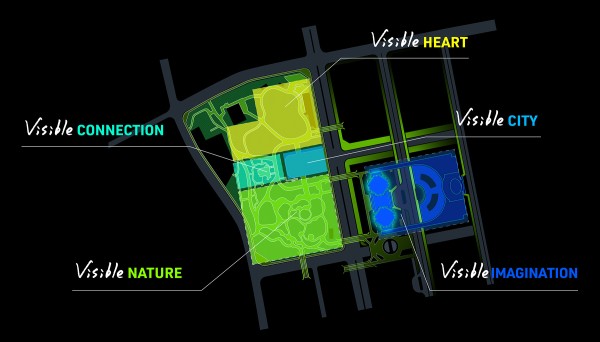
Visible CITY expresses Tokyo itself through light, including the flow of the city, traffic, signs of human presence, and data.
Visible NATURE presents installations that evoke the breath of nature and the subtle movements of life.
Visible HEART features artworks that project emotions, memories, and lingering traces of feeling as light.
Visible CONNECTION explores interfaces of light linking the city and nature, and people and the city.
Visible IMAGINATION offers participatory and immersive expressions designed to stimulate creativity and inspiration.
Light Art Park
For a limited period, Light Art Park will transform Shinjuku Chuo Park into an immersive environment of light art. Under the artistic direction of Kenji Kohashi, who has led numerous international events and large-scale festivals including Expo 2025 Osaka, Kansai, artists from Japan and overseas will depict the “invisible Tokyo” through light.
Light Art Park is organized around four themes—Visible CITY, Visible NATURE, Visible HEART, and Visible CONNECTION. Throughout the venue, visitors will encounter works that give physical form to these themes, allowing them to experience the world of VISIBLE TOKYO as they walk through the park.
Featured 5 Works
GAIA / Visible HEART / Lawn Area (East) / Luke Jerram / United Kingdom
Courtesy of Light Art Collection
Making its highly anticipated Japan debut—an immersive experience of viewing Earth from space
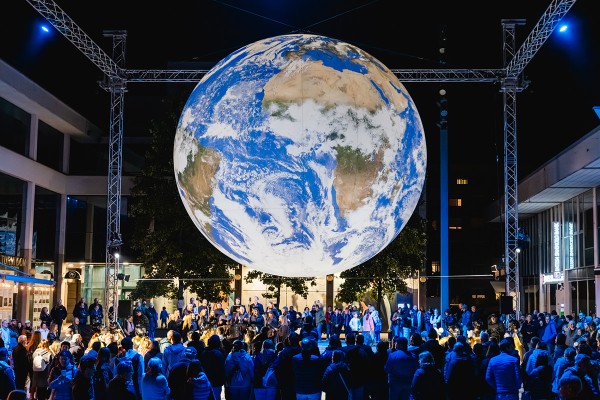
Created by Luke Jerram, known for works that cross artistic disciplines, GAIA is a monumental Earth installation at seven meters in diameter. Produced using high-resolution NASA imagery of the Earth’s surface, the work offers an immersive experience akin to viewing the planet from space. The installation will make its Japan debut at TOKYO LIGHTS 2026.
Embrace / Visible CITY / Fun More Time Hiroba / Beamhacker / Australia
Human connection expands outward as ripples of light
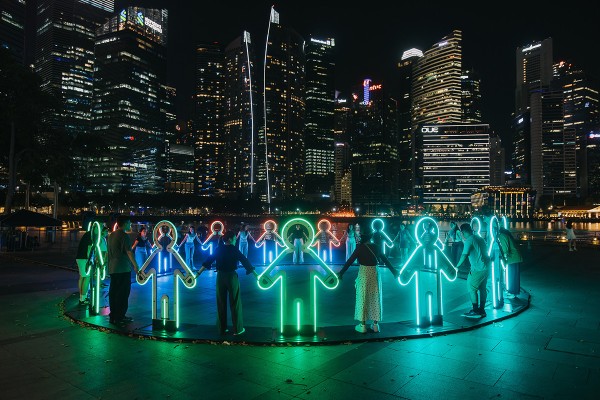
This participatory installation by Beamhacker, known for interactive works combining light and mirrors, invites visitors to join hands with the human-shaped silhouettes arranged around the piece. As they do so, ripples of light spread outward in a chain reaction, and the installation becomes increasingly dynamic through communication and cooperation among participants.
Liquid Universe: Sōbō Chūfu — An Unclassifiable Entomologia of the Luminous Swarm / Visible CONNECTION / Chobo-no-Mori / Yoichi Ochiai / Japan
A new installation by Yoichi Ochiai, where the lights of nature and the city intersect.
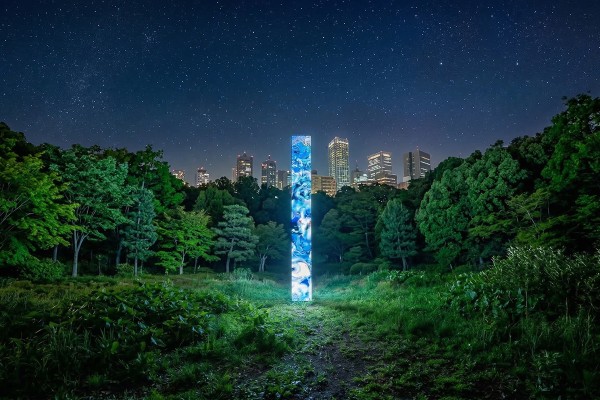
Created for TOKYO LIGHTS 2026 by Yoichi Ochiai, this new installation brings together different forms of light found in nature and in the city—such as fireflies, bioluminescent organisms, and LEDs—within a four-meter pillar of light. Amid imagery continuously generated by computational nature, the work invites visitors to reconsider the boundary between the natural and the artificial.
Visible TOWER / Visible CITY / Fun More Time Hiroba / V_T / Japan
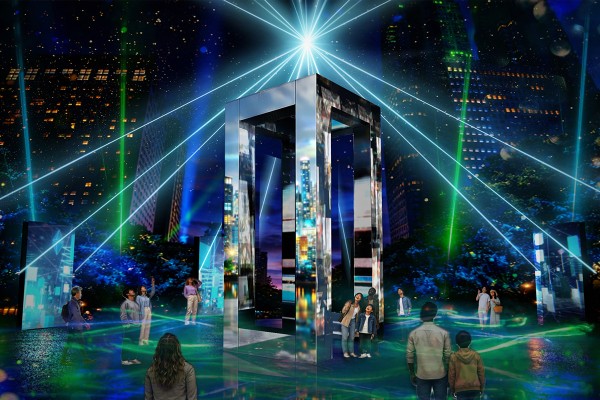
This tower-shaped installation visualizes the memories and everyday activities of people passing through the city as “memories of light.” During the day, it reflects the surrounding urban landscape and its visitors like a mirror; at night, AI-generated collages of the city’s memories appear on an LED display. Visitors may also walk through the sculpture itself and experience these “memories of light” at close range.
V_T:YAMACHANG / Kenji Kohashi / Naoya Murayama
INTER-WORLD/Cocooner: Apparent motion of celestial bodies
/ Visible NATURE / Hana-no-Mori / Akihito Okunaka / Japan
A legacy work from Expo 2025 Osaka, Kansai that evokes the cycles of nature
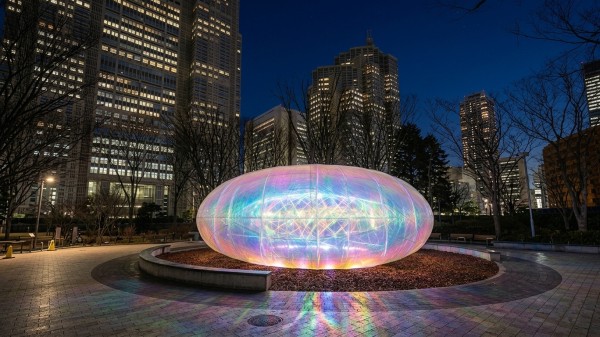
This experiential work was exhibited as an official program of Study: Osaka Kansai International Art Festival 2025 at Expo 2025 Osaka, Kansai. Through a soft sculptural form that amplifies natural phenomena created by the interaction of air, water, and sunlight, the work encourages visitors to reflect on how human beings are connected to the world. Visitors are invited to step inside and experience being enveloped by cocoons of changing light.
Additional Works and Open Call Program
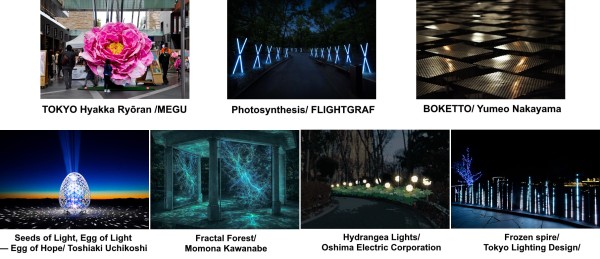
In addition to the featured works above, Light Art Park will include a range of other installations, including Seeds of Light— Egg of Hope, first exhibited at Burning Man in the Nevada desert in the United States; Photosynthesis, in which FLIGHTGRAF, a headliner at one of Europe’s leading light festivals, depicts the breathing cycle of plants; and TOKYO Hyakka Ryōran, which likens Tokyo’s individuality to a giant blooming flower. Throughout the venue, visitors will encounter light-based expressions that resonate with both the city and nature.
As opportunities to present light art in public spaces in Japan remain limited, the event has also held an open call and will exhibit works by emerging artists and students selected through the screening process. Through these efforts, TOKYO LIGHTS 2026 aims to help foster a new generation of artists and creators working in light-based expression.
1minute Projection Mapping Competition
The 1minute Projection Mapping Competition is one of the world’s most established and prestigious international projection mapping competitions, originating in Japan since 2012. Each year, creators compete for top honors with works running from one minute to one minute fifty-nine seconds. Bringing together leading creators from around the world as well as rising young talent, the competition offers a unique opportunity in Japan to experience a wide range of highly accomplished and distinctive works in one place.
The competition invited entries under the theme “Dialogue”. A total of 412 entries were received from 65 countries and regions around the world. Finalists selected from among these entries will compete for the Grand Prix.
Jury Member and Invited Artist
Ouchhh / Digital Media Artist / Turkey
Kentaro Tanaka / Video Creator / Graphic Designer (Winner of the previous competition) / Japan
MCs for the International Competition Awards Ceremony
Tetsuya Bessho / Actor; Representative of Short Shorts Film Festival & Asia
Aki Shibuya / Bilingual MC; Journalist
Official Website of the 1minute Projection Mapping Competition:
https://1minute-pm.com/
Event Overview: TOKYO LIGHTS 2026
TOKYO LIGHTS is a festival of light born in 2021 that illuminates Tokyo’s nights. Centered on an international projection mapping competition featuring creators from around the world and experiential entertainment that fuses light, art, and technology, the event sends a message of creativity and hope toward the future.
Event Title: TOKYO LIGHTS 2026
Venues:
Tokyo Metropolitan Government Building No.1, Tokyo Citizen’s Plaza
(2-8-1 Nishi-Shinjuku, Shinjuku-ku, Tokyo 160-0023)
Shinjuku Chuo Park
(2-11 Nishi-Shinjuku, Shinjuku-ku, Tokyo)
Dates (scheduled):
Saturday, May 23 to Sunday, May 31, 2026
1minute Projection Mapping Competition
- Screenings: Saturday, May 23; Sunday, May 24; and Sunday, May 31, 2026
- Screenings / Awards Ceremony: Saturday, May 30, 2026
Light Art Park
Saturday, May 23 to Sunday, May 31, 2026
Grand Finale
Sunday, May 31, 2026
Organizer:
Projection Mapping International Award TOKYO Executive Committee
Co-host:
Tokyo Metropolitan Government
Official Website: https://tokyolights.jp
Social Media:
X: https://x.com/tokyolights_jp
Instagram: https://www.instagram.com/tokyolights_jp/
Facebook: https://www.facebook.com/tokyolights.jp
YouTube: https://www.youtube.com/@tokyolightsjp
Inquiries Regarding Event Details and Tickets
TOKYO LIGHTS 2026 Call Center
TEL: +81-3-6706-7972
Hours: 10:00 a.m. to 5:00 p.m. on weekdays only
(excluding weekends and public holidays)
Media Contact
Organization: TOKYO LIGHTS 2026 PR Office (Antil Inc.)
Contact Person: Ishida
Website: https://tokyolights.jp
Email: Send Email
Contact Number: +81368217863
City: Tokyo
Country:Japan
Release id:44582
The post Actress Tao Tsuchiya Named TOKYO LIGHTS 2026 Ambassador, 12 Light Artworks Announced, Signup Open appeared first on King Newswire. This content is provided by a third-party source.. King Newswire makes no warranties or representations in connection with it. King Newswire is a press release distribution agency and does not endorse or verify the claims made in this release. If you have any complaints or copyright concerns related to this article, please contact the company listed in the ‘Media Contact’ section
About Author
Disclaimer: The views, suggestions, and opinions expressed here are the sole responsibility of the experts. No Digi Observer journalist was involved in the writing and production of this article.
Palm Beach Meme Coin Project Combines Meme Culture, Luxury Lifestyle Branding, Real-World Events, Staking, and Community Rewards Through the “Pepe in Paradise” Ecosystem.
The meme coin sector continues evolving beyond internet-driven speculation, with a growing number of projects attempting to build broader ecosystems centered around lifestyle, entertainment, staking opportunities, and community participation.
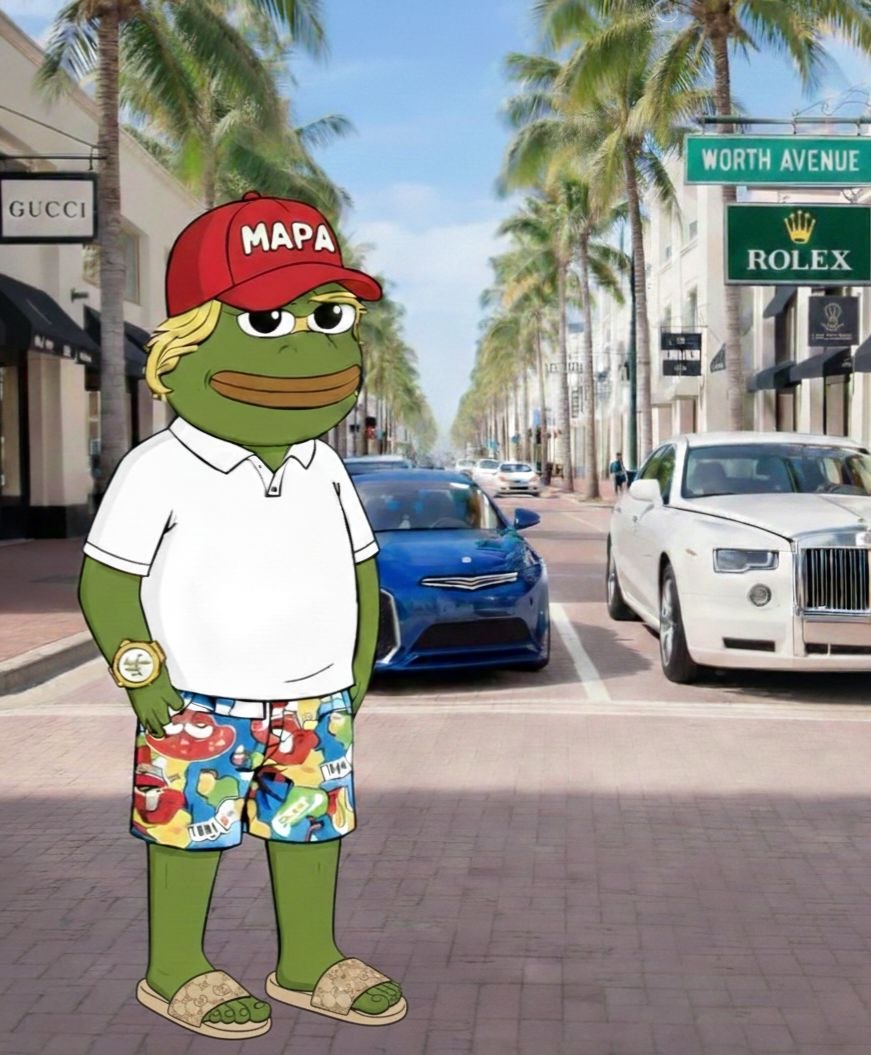
Pepe Palm Beach, a Palm Beach meme coin project inspired by the globally recognized Pepe meme and the luxury lifestyle associated with Palm Beach culture, has announced the upcoming launch of its $PPB crypto presale. The project states that staking functionality is expected to be introduced within the first two weeks following launch as part of its broader ecosystem development plans.
Pepe Palm Beach describes itself as a lifestyle-focused meme coin project designed to combine online culture, luxury branding, social experiences, and blockchain-based community engagement within a growing Web3 community.
The project positions itself as more than a traditional DeFi token or meme asset, describing the concept as the intersection of one of the internet’s most recognizable memes with the leisure-oriented Palm Beach lifestyle. Operating under the “Pepe in Paradise” theme, the project aims to establish a community-driven ecosystem centered around entertainment, luxury-inspired experiences, and real-world activations.
According to the project team, the upcoming Initial Coin Offering (ICO) and crypto presale for $PPB is expected to begin approximately one week from now. The team states that the early bird entry phase is intended to provide supporters with the lowest available entry price before the token’s planned launch on decentralized exchanges (DEXs).
Investors are expected to be able to participate in the crypto presale using ETH, BNB, or USDT directly through the Pepepalmbeach.com platform.
“Pepe Palm Beach isn’t just about the memes; it’s about a community that values the finer things in life while riding the wave of the next great crypto movement,” a spokesperson for the project stated. “We’re bringing the party to the blockchain.”
Unlike many meme coin launches focused exclusively on online engagement, Pepe Palm Beach has already begun building a real-world presence through event sponsorships and planned international activations.
On April 26, 2026, Pepe Palm Beach served as a sponsor at a VIP tent event at the National Polo Center in Wellington, Florida, aligning the project with luxury sporting and social environments commonly associated with the Palm Beach lifestyle. The event was held during the final of the U.S. Open Polo Championship and included several notable guests and presenters from the polo and luxury brand communities. Attendees and participants included Tim Kelly, USPA President, who presented the championship trophy to the winning team; J. Michael Prince, USPA Global President and CEO, who participated in award presentations; Marjan Malek, representing Jaeger-LeCoultre Palm Beach, who presented the Seymour H. Knox Most Valuable Player award to Lorenzo Chavanne; Dr. Scott Swerdlin of Palm Beach Equine, who presented the Best Playing Pony award; Stephen Orthwein Jr., USPA Secretary, who presented the Summerville “Skeeter” Johnston Sponsor of the Year Award; and Rachel Wong, Exclusive Sales Executive at Cassia in Coral Gables, Florida. Past notable guests at the event have included Prince Harry, Duke of Sussex, and Meghan, Duchess of Sussex.
The roadmap released by the team also outlines additional planned real-world events and activations connected to Miami Formula 1 activities scheduled for May 1-3, and Art Basel Miami.
According to the project roadmap, Pepe Palm Beach also plans to introduce exclusive Palm Beach-themed community events, staking integration, referral participation incentives, and future centralized exchange (CEX) expansion initiatives.
In addition, Pepe Palm Beach plans to implement an instant referral commission system using individualized referral URL codes intended to reward community participation and network growth opportunities.
The roadmap also references additional community engagement campaigns tied to future promotional activities.
As transparency and security continue to remain major priorities within the Web3 community and DeFi token sectors, the team states that audits from Sold Proof and Cyberscope are part of the project’s security framework.
The broader crypto presale and meme coin launch landscape has continued attracting attention throughout 2025 and 2026, with projects increasingly combining blockchain participation, real-world branding opportunities, and lifestyle-focused experiences.
Pepe Palm Beach states that its objective is to create a community-oriented platform where entertainment, meme culture, luxury-inspired branding, staking participation, and blockchain engagement intersect under the $PPB ecosystem.
Additional information regarding the Pepe Palm Beach crypto presale, roadmap milestones, and upcoming project developments is available at pepepalmbeach.com.
About Pepe Palm Beach
Pepe Palm Beach is a lifestyle-focused Palm Beach meme coin project built around the $PPB token and the “Pepe in Paradise” concept. The project combines meme culture, blockchain-based engagement, referral incentives, staking functionality, and real-world community experiences within a growing Web3 community ecosystem.
For the latest updates, follow Pepe Palm Beach on Social Media.
X: https://x.com/Pepe_Palm_Beach
Telegram: https://t.me/Pepe_Palm_Beach
Instagram: https://www.instagram.com/thepepepalmbeach
Media Contact
Company Name: Pepe Palm Beach
Contact Person:John Kent
Email: info@pepepalmbeach.com
Website: pepepalmbeach.com
City: Toronto
Country:Canada
About Author
Disclaimer: The views, suggestions, and opinions expressed here are the sole responsibility of the experts. No Digi Observer journalist was involved in the writing and production of this article.
Press Release
Hyper Local Marketing Launches Hyper Local Search Agency Built Exclusively for Home Service Contractors
New agency founded on a simple principle: contractors own their website, their data, and their results
United States, 4th May 2026 — Hyper Local Marketing (hyperlocalmarketing.co) today announced the launch of its hyper local search agency serving HVAC, plumbing, roofing, and electrical contractors across the United States.
The agency runs local SEO, Google Ads, and Local Services Ads exclusively for home service contractors, a vertical that has historically been underserved by generalist digital marketing agencies that apply broad strategies to businesses that require hyper local execution.
Hyper Local Marketing was founded after witnessing a home service contractor trapped in a predatory agency relationship. Their website was locked, their data inaccessible, unable to leave without losing everything they had built. That experience became the founding principle: every client owns their assets, their data, and their results. No contracts designed to hold contractors hostage.
“Home service contractors don’t need a marketing agency that also works with e-commerce brands and SaaS companies,” said Josh Blackburn, founder of Hyper Local Marketing. “They need someone who understands seasonal demand, high-intent local search, and what it actually takes to generate booked jobs, not traffic. That’s all we do.”
The agency specializes in three channels that drive qualified leads for contractors: local SEO, Google Ads search campaigns, and Google Local Services Ads. Services include Google Business Profile optimization, service area page development, search campaign management, conversion tracking, and LSA setup and optimization.
Hyper Local Marketing serves contractors nationwide. More information is available at hyperlocalmarketing.co.
About Hyper Local Marketing
Hyper Local Marketing is a hyper local search agency running local SEO, Google Ads, and Local Services Ads for home service contractors. The agency helps HVAC, plumbing, roofing, and electrical businesses across the U.S. dominate local search and generate qualified leads.
Media Contact
Organization: Hyper Local Marketing
Contact Person: Josh Blackburn
Website: https://hyperlocalmarketing.co/
Email: Send Email
Country:United States
Release id:44655
The post Hyper Local Marketing Launches Hyper Local Search Agency Built Exclusively for Home Service Contractors appeared first on King Newswire. This content is provided by a third-party source.. King Newswire makes no warranties or representations in connection with it. King Newswire is a press release distribution agency and does not endorse or verify the claims made in this release. If you have any complaints or copyright concerns related to this article, please contact the company listed in the ‘Media Contact’ section
About Author
Disclaimer: The views, suggestions, and opinions expressed here are the sole responsibility of the experts. No Digi Observer journalist was involved in the writing and production of this article.
Actress Tao Tsuchiya Named TOKYO LIGHTS 2026 Ambassador, 12 Light Artworks Announced, Signup Open
Pepe Palm Beach Reveals $PPB ICO and Lifestyle Meme Coin Launch
Hyper Local Marketing Launches Hyper Local Search Agency Built Exclusively for Home Service Contractors
Benzinga Money Article Discusses How to Become Part of the 12% of Retirees Who Have Achieved the Recommended $550,000 Minimum Retirement Savings Threshold
Apu Apustaja Conquers New York with Lively Street Ads, Including Times Square Billboard
Bay Smokes Maintains Quality Amid Legislative Changes in the Hemp Industry


-
Press Release3 days ago
Representatives from More Than 40 Countries Discuss New Models of Global Growth in Moscow
-
Press Release6 days ago
Singapore’s Lucky Gemstones Launches Personalized Custom Gemstone Ring Service, Letting Every Love Story Bloom in an Enchanted Forest
-
Press Release6 days ago
TianYi High-Tech Launches TA Series Carbide Roller Rings for High-Speed Rolling Mills
-
Press Release4 days ago
Anyang Wire Mesh Launches New Epoxy and Oil-Water Separation Mesh for Global Filtration
-
Press Release4 days ago
Excimerlight Breakthrough UV Technology: 172nm EUV 222nm and 254nm Pet Disinfection Lamp
-
Press Release3 days ago
Breescape Cooling Products Earn Prestigious Good Housekeeping Seal
-
Press Release3 days ago
Crypto Office Makes Working with Cryptocurrencies Simple and Secure
-
Press Release2 days ago
Milestone Launches Project : Tsavkisi, The First Design-Code Community Near Tbilisi