
Press Release
NFIRS Data Shows Nearly Half of All US Home Fires Begin in the Kitchen

Tempe, AZ, 31st October 2025, ZEX PR WIRE, A new 10-year analysis of publicly available U.S. Fire Administration (USFA) data from 2014–2023 indicates that nearly 50% of all reported residential fires in the United States originate in the kitchen, with 167,800 cooking-related incidents recorded in 2023 alone. Despite ongoing public awareness efforts, the data suggest that many households could improve their kitchen fire preparedness.
The data, compiled from the National Fire Incident Reporting System (NFIRS), sindicates that cooking has consistently led all home fire causes for over a decade, remaining higher than incidents caused by heating equipment (27,900 annually) and electrical malfunctions (23,700).
“Many households prioritise smoke detectors and fire extinguishers in garages or hallways,” says fire safety researcher Michael Chen, “yet the kitchen, where most home fires start, often has no readily accessible fire suppression tool.”
Why Kitchen Fires Require Immediate Attention
Cooking fires, especially grease-related incidents, behave differently from other household fires. They ignite quickly, spread rapidly, and should never be extinguished with water, as this can cause flames to intensify and spread burning oil.
Traditional fire extinguishers, while effective in many situations, may not always be practical during kitchen incidents because they:
- Are sometimes stored away from cooking areas
- Require multiple operational steps under stress
- Leave chemical residue that can contaminate surfaces
- Need regular maintenance or replacement
“In the first moments of a kitchen fire, accessibility and simplicity are key,” explains Michael Chen. “When a fire suppression tool isn’t immediately within reach, even a small ignition can escalate before help is applied.”
The Case for Fire Blankets: An Accessible Kitchen Safety Option
Fire safety experts often recognise fire blankets as the first line of defence in kitchens.
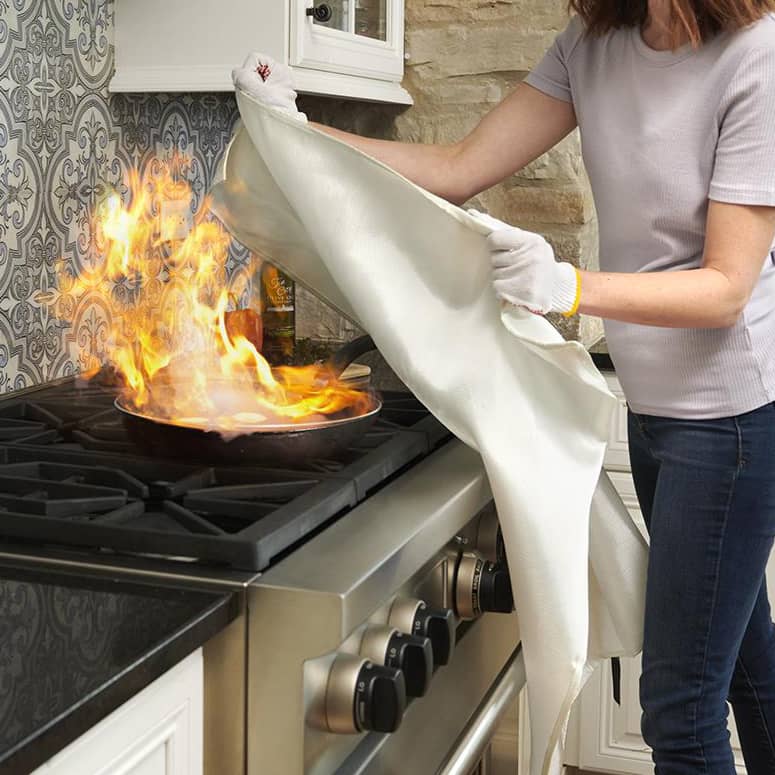
How they work: Fire blankets extinguish flames by cutting off oxygen, smothering the fire quickly without chemicals, noise, or residue.
Key advantages:
- Instantly deployable – just pull and cover
- Mountable near the stove for immediate access
- Safe for all types of kitchen fires (including grease)
- Leave no residue or contamination
- No maintenance or expiry issues
- Safe for anyone to use, even children or seniors
“The strength of a fire blanket lies in its simplicity,” says Chen. “It’s easy to use and requires no special training.”
Who’s Most at Risk
According to USFA data, cooking fires affect all demographics, but certain situations heighten the risk:
- Unattended cooking (the leading cause)
- Holiday or late-night cooking
- Deep frying and multitasking
Every year, 2,620 civilians die in home fires, with seven deaths daily and 92% occurring in residential settings. Many of these stem from preventable cooking incidents.
The Fiberglass Issue: A Hidden Safety Hazard
While fire blankets are lifesaving tools, many contain fiberglass may present potential health concerns. When deployed, fiberglass blankets can shed tiny airborne particles that irritate skin and lungs and contaminate kitchen surfaces.
“It’s ironic,” says occupational health specialist Dr. Sarah Martinez, “that a device meant to release fine particles that may affect indoor air quality, especially in homes with children, elderly, or asthmatic individuals.”
The Safer Alternative: Fiberglass-Free Fire Blankets
Newer, fiberglass-free fire blankets eliminate these health concerns while maintaining full fire suppression performance.
Fire Blanket Safety, a U.S.-based company pioneering this innovation, offers the market’s only certified fiberglass-free fire blanket using advanced non-shedding, fire-resistant materials.
Benefits of fiberglass-free blankets:
- No airborne fibers or respiratory irritation
- Safe for food-prep areas
- Reusable and durable
- No maintenance or expiration concerns
- Effective on grease, electrical, and general fires
“The technology finally matches the need,” says Fire Blanket Safety’s development team. “Families can now protect themselves instantly without compromising air quality or health.”
Beyond the Kitchen: All-Purpose Protection
Fire blankets are also effective for:
- Heating equipment fires: Quickly smother space heater ignitions
- Electrical fires: Safe alternative where water is dangerous
- Accidental fires: Candles, smoking materials, or small ignition sources
What Fire Safety Experts Recommend
To improve home fire preparedness, experts suggest a layered approach:
In the Kitchen:
- Install a fire blanket within arm’s reach of cooking areas
- Keep a fire extinguisher nearby as backup
- Never leave cooking unattended
For Whole-Home Safety:
- Smoke detectors on every floor
- Fire blankets in kitchen, garage, and workshop
- A clear family evacuation plan
“Each layer serves a purpose,” says Chen. “Blankets handle small fires instantly, extinguishers back them up, and detectors provide early warning.”
Taking Action: Key Questions for Homeowners
How quickly can you access fire suppression tools from your stove?
- Are your safety devices appropriate for grease fires?
- Do your tools pose any health risks?
- Can every family member operate them confidently?
Experts emphasise proximity, simplicity, and safety as the three essentials of kitchen fire readiness.
The Bottom Line
Public NFIRS data indicates that nearly half of all U.S. home fires start in the kitchen, highlighting the importance of accessible fire-safety tools. Fire blankets, especially fiberglass-free versions—offer a safe, immediate, and cost-effective solution for the most likely fire kitchen emergency.
“We can’t prevent all fires, but we can be prepared,” concludes Dr. Martinez. “Having a fire blanket in your kitchen isn’t optional, it’s essential.”
About the Data:
All data referenced are from publicly available NFIRS reports issued by the U.S. Fire Administration.
Media Contact:
Fire Blanket Safety
Website: fireblanketssafety.com
About Author

Disclaimer: The views, suggestions, and opinions expressed here are the sole responsibility of the experts. No Digi Observer journalist was involved in the writing and production of this article.

Press Release
Tennessee Roots Shape John Gordon Nutley’s Push to Redefine Marketing to Older Consumers
Chicago, IL, 9th April 2026, ZEX PR WIRE — As brands compete for relevance in a fragmented marketplace, marketing strategist John Gordon Nutley is highlighting a major missed opportunity. Older consumers remain one of the most overlooked segments in modern advertising. Nutley argues that outdated assumptions about aging are costing companies both revenue and relevance.

Raised in Tennessee and now based in Jersey City, Nutley has built a reputation for helping organizations rethink their positioning. His work focuses on clarity, purpose, and long-term value. Today, he is urging brands to confront a persistent issue within the industry. Ageism still shapes many marketing strategies. “Too many campaigns portray older adults as fragile or disconnected,” Nutley said. “That image is inaccurate. It is also bad for business. The reality is far more dynamic. Brands that ignore this are missing real opportunities.”
Recent data supports his view. Older consumers control a large share of disposable income. Many are active online and use social media regularly. At the same time, this group is not uniform. Nutley explains that strict age-based segmentation no longer works. People in their 60s and 70s often feel younger than their age. They connect more with lifestyle and values than with labels.
This shift creates both challenges and opportunities. A large portion of older adults are comfortable with technology. However, many still face barriers. Nutley points to the digital divide as a key issue. Some individuals struggle with complex interfaces or unclear designs. He believes the solution is simple. Brands should focus on accessibility. Clear fonts, intuitive navigation, and strong contrast can improve user experience. These changes help older users, but they also benefit everyone. “Accessibility is a strength,” Nutley said. “It improves performance across all audiences. It is not something brands should treat as a limitation.”
Nutley also highlights the importance of language. Many older consumers dislike terms such as “senior” or “elderly.” They prefer language that reflects how they live, not just their age. This requires brands to rethink how they describe their audiences.
He also points to the positivity effect. Research shows that older adults respond better to positive messages. They prefer content that focuses on benefits, meaning, and emotional rewards. Negative or fear-based messaging is less effective. “People want to feel understood,” Nutley said. “They want to see value and purpose. Messaging should reflect that.”
One segment stands out in particular. The group often called “Active Agers” is changing perceptions. These consumers are highly engaged and financially strong. Many own smartphones and manage their lives online. They challenge the stereotype of older individuals as passive or disconnected.
Despite this, many companies struggle to adjust. Internal resistance is a major barrier. Some teams still focus heavily on younger audiences. They believe this builds future loyalty. Nutley sees this as short-term thinking. “In Tennessee, I learned that trust takes time,” he said. “You build loyalty through consistency. You do not wait for the future. You earn it every day.” From his base in New Jersey, Nutley helps companies rethink these assumptions. He uses data, research, and human insight to guide decisions. His approach is practical and grounded. It focuses on real behavior, not outdated beliefs.
He also emphasizes cultural differences. Attitudes toward aging vary across regions. Social norms and economic conditions shape how people view later life. Brands must adapt their strategies to fit each market. “A global strategy needs local understanding,” Nutley said. “You cannot assume one message will work everywhere.”
Nutley’s work reflects a broader philosophy. He believes authenticity creates long-term value. He avoids shallow tactics and quick wins. Instead, he focuses on strategies that align with real human experiences.
As the industry evolves, Nutley sees a clear path forward. Brands must move beyond stereotypes. They must recognize the diversity within older audiences. Most importantly, they must act with intention. “The opportunity is clear,” Nutley said. “Brands just need to see it and respond with honesty.” To learn more about John Gordon Nutley, visit: https://johngordonnj.com/
About Author
Disclaimer: The views, suggestions, and opinions expressed here are the sole responsibility of the experts. No Digi Observer journalist was involved in the writing and production of this article.
United States, 8th Apr 2026, – As more parents rethink how to support early childhood development beyond screens and structured routines, Kidpop is introducing a new perspective on toddler mobility: the idea of a child’s “first independence experience.”
With the launch of the PULA Mini, a compact 2-in-1 push walker and toddler wagon, the brand aims to shift the focus from simply helping children walk to supporting how they explore, make choices, and build confidence from the very beginning. 
Moving Beyond the “First Toy” Mindset
For decades, early childhood products have centered around milestones—first steps, first rides, first toys. But increasingly, parents are prioritizing how those experiences shape independence, rather than just when they happen.
Kidpop’s approach reframes early mobility not as a task to accelerate, but as a process to support.
“Parents don’t just want their children to walk sooner—they want them to feel confident moving through the world,” said Fay, Founder of Kidpop. “That first moment of independence, whether it’s pushing forward, choosing a direction, or carrying their own toys, is more meaningful than the milestone itself.”
Introducing PULA Mini: A Tool for Early Exploration
Designed for children aged 6-36 months, the PULA Mini combines the functionality of a push walker and a toddler wagon in a compact, easy-to-use format. The product supports multiple stages of early movement while encouraging self-directed exploration. 
Key features include:
- 2-in-1 walker and wagon design, supporting both assisted walking and independent play
- Enhanced stability, with a low center of gravity and widened enclosed wheels
- Smooth, controlled movement, enabled by shock-absorbing EVA wheels for indoor and outdoor use
- Multi-purpose functionality, allowing children to push, pull, and carry objects as they explore
Rather than acting as a passive ride-on, the PULA Mini is designed to actively engage toddlers in movement—encouraging them to initiate action, navigate space, and interact with their surroundings.
A Shift Toward Everyday Independence
The concept of a “first independence experience” reflects a broader shift in parenting priorities: less emphasis on structured achievement, and more focus on everyday autonomy.
From pushing a walker across the living room to pulling a wagon at the park, these small moments allow toddlers to test boundaries, build coordination, and gain confidence through repetition and choice.
Kidpop positions the PULA Mini not just as a product, but as a tool that supports these early experiences—bridging the gap between assisted movement and independent exploration.
Availability
The PULA Mini is now available through Kidpop’s official website and Amazon across the United States.
About Kidpop
Kidpop is a children’s ride-on brand dedicated to supporting early independence through movement-based, sensory-rich outdoor play. Inspired by Montessori principles and crafted with a focus on thoughtful design, safety, and sustainability, Kidpop creates products that encourage balance, coordination, and confident exploration.
The brand’s design-forward approach has earned multiple international recognitions, including the Red Dot Award, iF Design Award, IDEA Award, and Good Design Award, reflecting Kidpop’s commitment to bringing aesthetics and functionality into everyday family life.
Media Contact
Organization: Kidpop
Contact
Person: Jolin
Website:
https://kidpop.com/
Email:
jolin@kidpop.com
Country:United States
The post
Kidpop Introduces PULA Mini, Reframing Toddlers’ First Independence Experience appeared first on
Brand News 24.
It is provided by a third-party content
provider. Brand News 24 makes no
warranties or representations in connection with it.
About Author
Disclaimer: The views, suggestions, and opinions expressed here are the sole responsibility of the experts. No Digi Observer journalist was involved in the writing and production of this article.
United States, 8th Apr 2026, – As more parents rethink how to support early childhood development beyond screens and structured routines, Kidpop is introducing a new perspective on toddler mobility: the idea of a child’s “first independence experience.”
With the launch of the PULA Mini, a compact 2-in-1 push walker and toddler wagon, the brand aims to shift the focus from simply helping children walk to supporting how they explore, make choices, and build confidence from the very beginning.
Moving Beyond the “First Toy” Mindset
For decades, early childhood products have centered around milestones—first steps, first rides, first toys. But increasingly, parents are prioritizing how those experiences shape independence, rather than just when they happen.
Kidpop’s approach reframes early mobility not as a task to accelerate, but as a process to support.
“Parents don’t just want their children to walk sooner—they want them to feel confident moving through the world,” said Fay, Founder of Kidpop. “That first moment of independence, whether it’s pushing forward, choosing a direction, or carrying their own toys, is more meaningful than the milestone itself.”
Introducing PULA Mini: A Tool for Early Exploration
Designed for children aged 6-36 months, the PULA Mini combines the functionality of a push walker and a toddler wagon in a compact, easy-to-use format. The product supports multiple stages of early movement while encouraging self-directed exploration.
Key features include:
- 2-in-1 walker and wagon design, supporting both assisted walking and independent play
- Enhanced stability, with a low center of gravity and widened enclosed wheels
- Smooth, controlled movement, enabled by shock-absorbing EVA wheels for indoor and outdoor use
- Multi-purpose functionality, allowing children to push, pull, and carry objects as they explore
Rather than acting as a passive ride-on, the PULA Mini is designed to actively engage toddlers in movement—encouraging them to initiate action, navigate space, and interact with their surroundings.
A Shift Toward Everyday Independence
The concept of a “first independence experience” reflects a broader shift in parenting priorities: less emphasis on structured achievement, and more focus on everyday autonomy.
From pushing a walker across the living room to pulling a wagon at the park, these small moments allow toddlers to test boundaries, build coordination, and gain confidence through repetition and choice.
Kidpop positions the PULA Mini not just as a product, but as a tool that supports these early experiences—bridging the gap between assisted movement and independent exploration.
Availability
The PULA Mini is now available through Kidpop’s official website and Amazon across the United States.
About Kidpop
Kidpop is a children’s ride-on brand dedicated to supporting early independence through movement-based, sensory-rich outdoor play. Inspired by Montessori principles and crafted with a focus on thoughtful design, safety, and sustainability, Kidpop creates products that encourage balance, coordination, and confident exploration.
The brand’s design-forward approach has earned multiple international recognitions, including the Red Dot Award, iF Design Award, IDEA Award, and Good Design Award, reflecting Kidpop’s commitment to bringing aesthetics and functionality into everyday family life.
Media Contact
Organization: Kidpop
Contact
Person: Jolin
Website:
https://kidpop.com/
Email:
jolin@kidpop.com
Country:United States
The post
Kidpop Introduces PULA Mini, Reframing Toddlers’ First Independence Experience appeared first on
Brand News 24.
It is provided by a third-party content
provider. Brand News 24 makes no
warranties or representations in connection with it.
About Author
Disclaimer: The views, suggestions, and opinions expressed here are the sole responsibility of the experts. No Digi Observer journalist was involved in the writing and production of this article.
Tennessee Roots Shape John Gordon Nutley’s Push to Redefine Marketing to Older Consumers
Kidpop Introduces PULA Mini, Reframing Toddlers’ First Independence Experience
Kidpop Introduces PULA Mini, Reframing Toddlers’ First Independence Experience
Benzinga Money Article Discusses How to Become Part of the 12% of Retirees Who Have Achieved the Recommended $550,000 Minimum Retirement Savings Threshold
Apu Apustaja Conquers New York with Lively Street Ads, Including Times Square Billboard
Bay Smokes Maintains Quality Amid Legislative Changes in the Hemp Industry


-
Press Release4 days ago
Finance Complaint List Alerts Public to AI-Powered Deepfake Scams Using Celebrity Likenesses to Lure Crypto Investors
-
Press Release6 days ago
ClearVoro Enhances Exchange Liquidity Protocols to Address Institutional Liquidity Fragmentation Amidst Q1 2026 Digital Asset Retracement
-
Press Release7 days ago
Navigating South Africa’s 2026 iGaming Shakeup
-
Press Release6 days ago
Digital Smart AI Unveils AI and GPU Rental Solutions for Global Businesses
-
Press Release6 days ago
After The Fall Show Podcast Launches, Expanding Street Therapy to help a Global Audience
-
Press Release6 days ago
Ardennis Global Finance Group Integrates Traditional and Digital Assets
-
Press Release7 days ago
CaoCao Inc. Enters Unmanned Road Testing Phase – Marking a Milestone in Robotaxi Capabilities
-
Press Release6 days ago
Your Genetic Wellness Partners with Senior Care Expert Lance A. Slatton to Expand Reach of Actionable Biology